9 Oldest Founded Small Towns to Visit on the Pacific Coast
The oldest towns on the Pacific Coast trace back to Spanish missions, Russian fur forts, and American trading posts that predate most of the country's push west. Spanish soldiers raised a presidio at Monterey in 1770, decades before the United States reached the coast. Russian traders ran the capital of their American fur empire out of Sitka until the 1867 handover. A fur company's stockade near the mouth of the Columbia became Astoria in 1811. Down the Mendocino coast, an Army garrison gave Fort Bragg both its name and its 1857 start. These nine towns still wear their early histories in working harbors, restored cathedrals, and museums set inside their original schoolhouses and jails.
Monterey, California

Monterey is the oldest town on this stretch of coast. Spanish forces under Gaspar de Portola founded it in 1770, after Junipero Serra raised a mission and presidio above the bay. It went on to serve as the capital of Alta California under both Spain and Mexico. In 1849, delegates gathered at Colton Hall to write California's first constitution. The hall survives as a museum near the Custom House, which happens to be the oldest government building in the state and California's very first registered historic landmark.
Preserved adobes line the surrounding blocks, most of them marked on the Path of History walking route. The Presidio of Monterey Museum sits on a garrison that was Spanish before it was American. The Monterey Bay Aquarium fills the old Cannery Row sardine plants John Steinbeck made famous, which is a tidy retirement for a strip of fish factories. Old Fisherman's Wharf started as Thomas Larkin's freight landing in the 1840s, before the sardine fleet took it over.
Sitka, Alaska

Russian fur traders built a fort at Sitka in 1799, making it the second oldest town on this coast and the only one Russia founded. Tlingit warriors destroyed that first post in 1802. Alexander Baranov returned in 1804, won the Battle of Sitka, and rebuilt the settlement as New Archangel, the capital of Russian America. On October 18, 1867, the United States took formal possession on Castle Hill. Sitka stayed the territorial capital until 1906.
St. Michael's Cathedral, first raised in 1848, still displays Orthodox icons carried across the Pacific. The original burned in 1966, and the town rebuilt it to match, onion dome and all. The Russian Bishop's House, finished in 1842, ranks among the oldest intact Russian buildings in North America. Sitka Lutheran Church traces its congregation to 1840, the first Protestant church on the Pacific Coast. Castle Hill is now a state historic site above the harbor where Alaska changed hands.
Astoria, Oregon

Oregon's oldest town dates to 1811, when John Jacob Astor's Pacific Fur Company threw up a stockade near the mouth of the Columbia River, the first permanent American settlement west of the Rocky Mountains. British traders seized it during the War of 1812 and renamed it Fort George, but the American name came back for good. The Columbia River Maritime Museum records two centuries of shipwrecks, bar pilots, and salmon canneries at the river's notoriously deadly mouth.
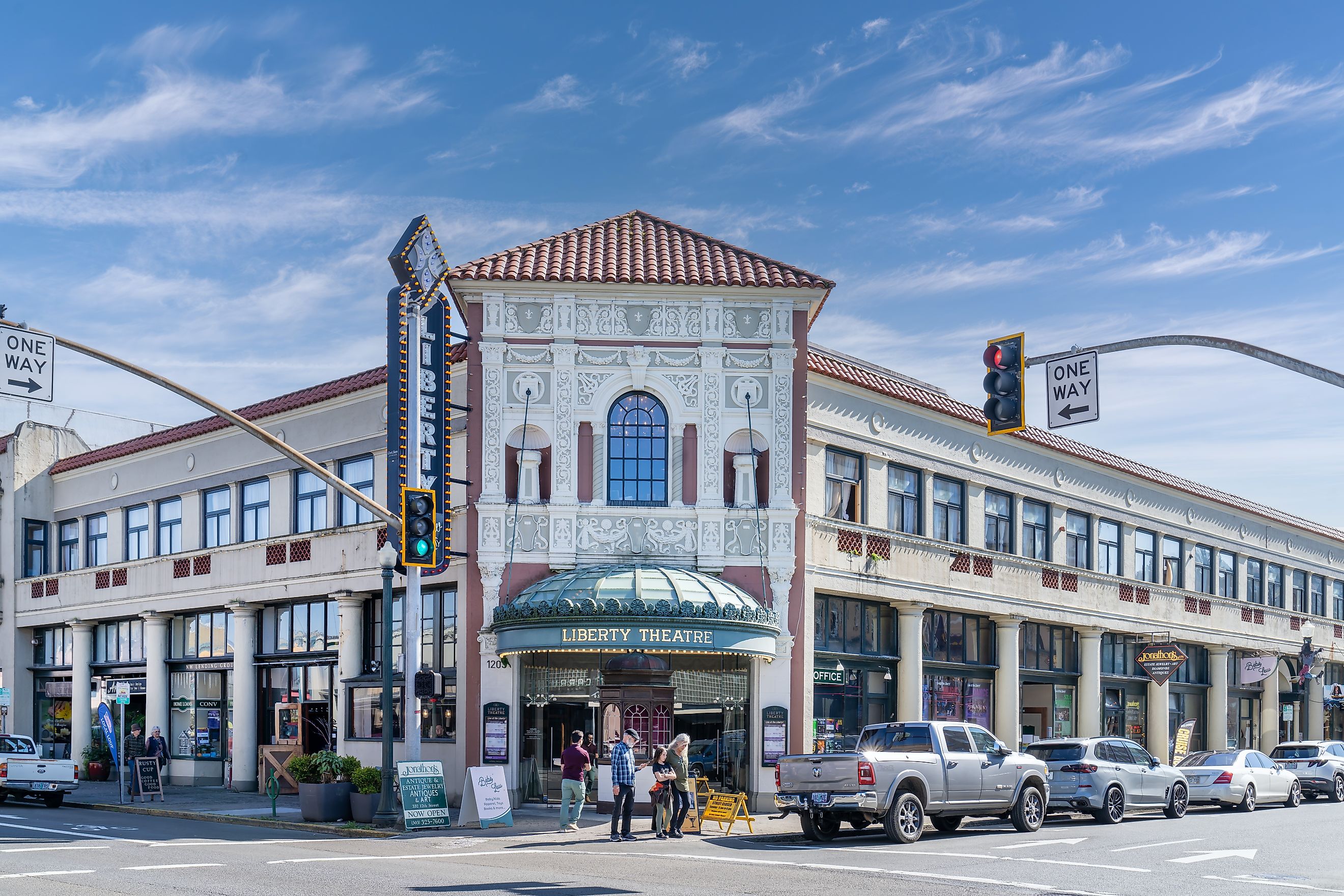
The Heritage Museum keeps the town's early records inside the former city hall. The Oregon Film Museum operates out of the old county jail that opens The Goonies, which may be the only jail in the country whose main draw is a 1985 movie. The Astoria Riverfront Trolley rolls the waterfront on restored tracks. The Flavel House, an 1885 Queen Anne mansion, was built on the fortune Captain George Flavel made piloting ships over the deadly Columbia bar.
Port Townsend, Washington

Port Townsend took its name in 1851, out on the northeastern corner of the Olympic Peninsula at the entrance to Puget Sound. Settlers were certain it would become the largest port on the West Coast, the "New York of the West," and they built to suit that conviction, raising ornate Victorian mansions and stone commercial blocks fit for a future metropolis. Then the railroads chose Seattle and Tacoma instead, the boom collapsed, and the great port never arrived.
The bust turned out to be the best thing that ever happened to the buildings. With no money left to tear anything down or put anything new up, the town simply froze, which is why its downtown survives today as one of only three Victorian-era seaport districts left in the country, now a National Historic Landmark. The Jefferson County Courthouse and its clock tower, finished in 1892, still help guide ships in. Point Wilson Lighthouse has marked the harbor entrance since 1879, and Fort Worden, the old coastal-defense post on the bluff, is now a state park.
Fort Bragg, California

Fort Bragg owes its name to an 1857 Army post built to police the Mendocino Indian Reservation. The soldiers left in 1864, a redwood mill town grew up on the site through the 1880s, and it incorporated in 1889. The Guest House Museum, a redwood Victorian from 1892, recalls the lumber years from a block off the old mill site.
The California Western Railroad, better known as the Skunk Train, has hauled passengers through the redwoods since the logging days and still leaves from the downtown depot. North of town, Glass Beach draws crowds to admire what is, in plain terms, an old garbage dump. For decades residents pitched their trash off the bluff, and the surf spent the years since grinding the broken bottles into smooth colored glass.
Westport, Washington

Thomas Speake moved his family onto Point Chehalis at the mouth of Grays Harbor in 1857, making them Westport's first settlers, though he lasted only a few months before turning over the land claim and leaving. Glenn and Jane Peterson took it over in 1858 and stayed the rest of their lives. The settlement went by Peterson for years before adopting the name Westport in 1890, and it was in no hurry to incorporate, waiting until 1914.
The Westport Maritime Museum occupies a 1939 Coast Guard station, with a giant Fresnel lens from the Destruction Island Lighthouse filling a gallery of its own. Nearby, the Grays Harbor Lighthouse has stood since 1898. At 107 feet it is the tallest in Washington and the third tallest on the entire West Coast, with a spiral stair winding up to the lantern room.
Newport, Oregon

In 1866, a former soldier named Sam Case built the Ocean House hotel above Yaquina Bay and named the town after Newport, Rhode Island. It incorporated in 1882 on the strength of its oyster beds and shipping trade. The Yaquina Bay Lighthouse, first lit in 1871, is the oldest building in town, and the only lighthouse in Oregon where the keeper lived under the same roof as the light he tended.
The Pacific Maritime Heritage Center documents the bayfront's fishing and shipping past above a still-working harbor. Burrows House, an 1895 Queen Anne home a few blocks inland, holds the local history collection. A wooden boardwalk reached the Nye Beach district in 1891, and by the early 1900s its cottages and bathhouses had made it the most popular resort on the Oregon coast.
Seaside, Oregon

Railroad magnate Ben Holladay built the Seaside House in the 1870s, and the resort town incorporated in 1899. Its history runs deeper than the hotels, though. In the winter of 1805 and 1806, the Lewis and Clark Expedition boiled seawater here to make salt for the journey home. A reconstructed salt cairn marks the spot on the Promenade, its location remembered and later pointed out by the daughter of a Clatsop woman.
The Seaside Museum keeps the 1890s Butterfield Cottage next door, and downtown, the bronze End of the Trail statue marks where the expedition's coastal travels stopped. The Seaside Aquarium, open since 1924, is one of the oldest on the West Coast, with a gray whale skeleton hanging above the tanks. The mile-and-a-half Prom carries on the resort tradition Holladay started.
Florence, Oregon

Florence incorporated in 1893, the youngest town on this list, though settlers had worked its riverbanks since the 1870s and the Siuslaw people had lived along the river for generations before them. Nobody is entirely sure how it got its name. One story credits state senator A. B. Florence; the other credits a French ship that wrecked at the river's mouth in 1875. The town has never settled the matter.
The Siuslaw Pioneer Museum took over a 1905 schoolhouse. Old Town Florence lines the river with early-1900s storefronts, now given over to shops and galleries. The Art Deco Siuslaw River Bridge, finished in 1936, still raises its center span for passing boats. Twelve miles north, the Heceta Head Lighthouse has thrown its beam from the headland since 1894.
The Coast Wears Its Age Well
These nine towns began as forts, missions, resorts, and trading posts, and most of them are honest about it. Monterey still runs a wharf that started life as a freight landing. Sitka rebuilt its Russian cathedral rather than replace it. Port Townsend got rich, went broke, and preserved an entire Victorian downtown almost by accident. The founding dates here are never buried. They are the reason the towns are worth the stop.