9 of the Friendliest Towns To Retire In Italy
Italy has been drawing retirees from around the world for decades, and the reasons are not hard to understand. The food, climate, architecture, and pace of life all make a compelling case. Meanwhile, Italy offers universal healthcare to citizens and eligible legal residents. Access rules and service availability vary, and non-EU retirees using the elective-residence route generally need independent income, accommodation, and private medical insurance. Italy's smaller towns are genuinely welcoming to newcomers, where the piazza functions as a daily gathering place, festivals bring the whole community together several times a year, and a foreigner who makes the effort to learn a few words of Italian is quickly absorbed into the fabric of local life. These towns, spread from Tuscany to Calabria to Sicily, are the friendliest places in Italy to spend your retirement years.
Cortona, Tuscany

Cortona climbed onto the international radar when Frances Mayes immortalized it in Under the Tuscan Sun, but the town was already one of the oldest continuously inhabited settlements in Italy, with Etruscan origins stretching back over 2,500 years. It sits on a steep hillside above the Val di Chiana, with views across to Lake Trasimeno and the Umbrian hills beyond. The municipality counts roughly 20,900 residents, though only about 2,100 of them live inside the walled hilltop center. The MAEC Museum of the Etruscan Academy, housed in Palazzo Casali, presents important Etruscan finds alongside Roman and Egyptian collections. The Girifalco Fortress, a Medici stronghold at the highest point of the old town, hosts Cortona on the Move every summer. The international photography festival fills the historic center with exhibitions and draws photographers from around the world. The Piazza della Repubblica, the main square anchored by a 13th-century town hall, is where daily life happens. The market fills it in the morning, and the evening passeggiata brings everyone back.
Spoleto, Umbria

Spoleto sits on a hillside in the green heart of Umbria, and it announces its character immediately with the Ponte delle Torri, a medieval aqueduct bridge of uncertain date whose present form is generally associated with the 13th and 14th centuries. The town is best known internationally for the Festival dei Due Mondi, held every June and July. Since 1958, it has brought together theater, opera, dance, and visual arts from around the world, and it remains one of the most important performing arts festivals in Europe. The Teatro Romano, a theater built in the 1st century BC and still used for summer performances, gives the town an everyday connection to antiquity that never loses its power. Retirees seeking language instruction can use the Spoleto campus of CPIA 1 Perugia or private providers such as Artelingua, while local cultural associations offer separate opportunities to meet residents. Housing asking prices in Spoleto remain well below the Tuscan regional average, and direct trains to Rome typically take roughly 90 minutes to two hours, depending on the service.
Sulmona, Abruzzo

Sulmona sits in a high valley below the peaks of the Majella National Park in the Abruzzo region. The town has been producing confetti, sugar-coated almonds arranged into elaborate decorative bouquets, since the 15th century. The tradition is not just a tourist attraction but a living part of local culture, documented at the Museo dell'Arte e della Tecnologia Confettiera Pelino and visible in the workshops lining the streets of the historic center. The Piazza Garibaldi, one of the largest medieval squares in the Abruzzo, hosts a weekly market and the annual Giostra Cavalleresca. The jousting tournament runs in late July and draws the entire town into weeks of costumed preparation and street celebrations. The Acquedotto Medievale, a 13th-century aqueduct running through the main square, frames the piazza in a way that makes it one of the most photogenic in central Italy. Sulmona is the birthplace of the Roman poet Ovid, whose bronze statue stands in Piazza XX Settembre.
Ostuni, Puglia

Ostuni is known as the White City, its cubic whitewashed houses and narrow lanes spreading across a hilltop above the Adriatic plain in a way that is visible from miles around. The compact Centro Storico is best explored on foot in the early morning before the heat arrives, although it is a limited-traffic zone rather than an entirely pedestrian district. The Cattedrale di Ostuni, a late Gothic church completed in 1495 with an unusual rose window and an elaborately carved portal, sits at the highest point of the old town with views across olive groves stretching to the sea. Each August, the Cavalcata di Sant'Oronzo accompanies Ostuni's patronal feast. Devotion to the saint dates to the 17th century, while the mounted procession in its recognizable form is documented from at least 1794. The Adriatic beaches of the Marina di Ostuni are about 8 kilometers (5 miles) away, and Puglia's affordability makes Ostuni one of the most practical retirement destinations in southern Italy. One tax detail matters here as well. Italy applies a 7% flat tax on foreign-source income for pensioners who move their tax residence to qualifying municipalities in the south, and a law effective in April 2026 raised the population ceiling for eligible towns to 30,000 residents. That change brought Ostuni, with just under 30,000 people, inside the threshold.
Monopoli, Puglia

Monopoli is one of Puglia's most livable small cities, a working harbor town of just under 48,000 people. The old fishing quarter, the borgo antico, sits directly on the Adriatic. Daily life here has a rhythm and self-sufficiency that resort towns cannot replicate. The Porto Vecchio is the heart of town. Its waterfront is lined with seafood restaurants, fish markets, and the boats of local fishermen who still bring in daily catches. The Castello Carlo V, a 16th-century coastal fortress, sits on a promontory above the harbor and now hosts exhibitions and cultural events. Opening hours and admission vary by event. Monopoli's municipal social-services office provides information and support for older residents. The Ospedale San Giacomo, Monopoli's main hospital, covers emergency medicine, cardiology, neurology, and orthopedics within the town itself.
Castiglione del Lago, Umbria

Castiglione del Lago sits on a limestone promontory jutting into Lake Trasimeno, the largest lake in central Italy. On a clear morning, the view from the town's medieval ramparts takes in the whole width of the water and its three islands. The Palazzo della Corgna, a 16th-century ducal palace connected by a covered walkway to the Rocca del Leone, houses a remarkable cycle of Renaissance frescoes and is the town's most impressive monument. Each spring, the Festa del Tulipano fills the streets with floats covered in thousands of tulip petals, built by local volunteers and accompanied by brass bands and historical reenactments. The tradition dates to the 1950s, when Dutch growers settled around the lake and began decorating the town with the short-stemmed tulips they could not sell. The lake itself offers kayaking and cycling along the Trasimeno Cycle Path. Ferries from Castiglione del Lago cross to Isola Maggiore, the only permanently inhabited island, while Isola Polvese is reached from San Feliciano on the far shore. Both are free of cars. Castiglione del Lago has a small but established community of foreign retirees drawn by its affordability, its central position between Tuscany and Umbria, and a pace of life that requires no adjustment.
Tropea, Calabria

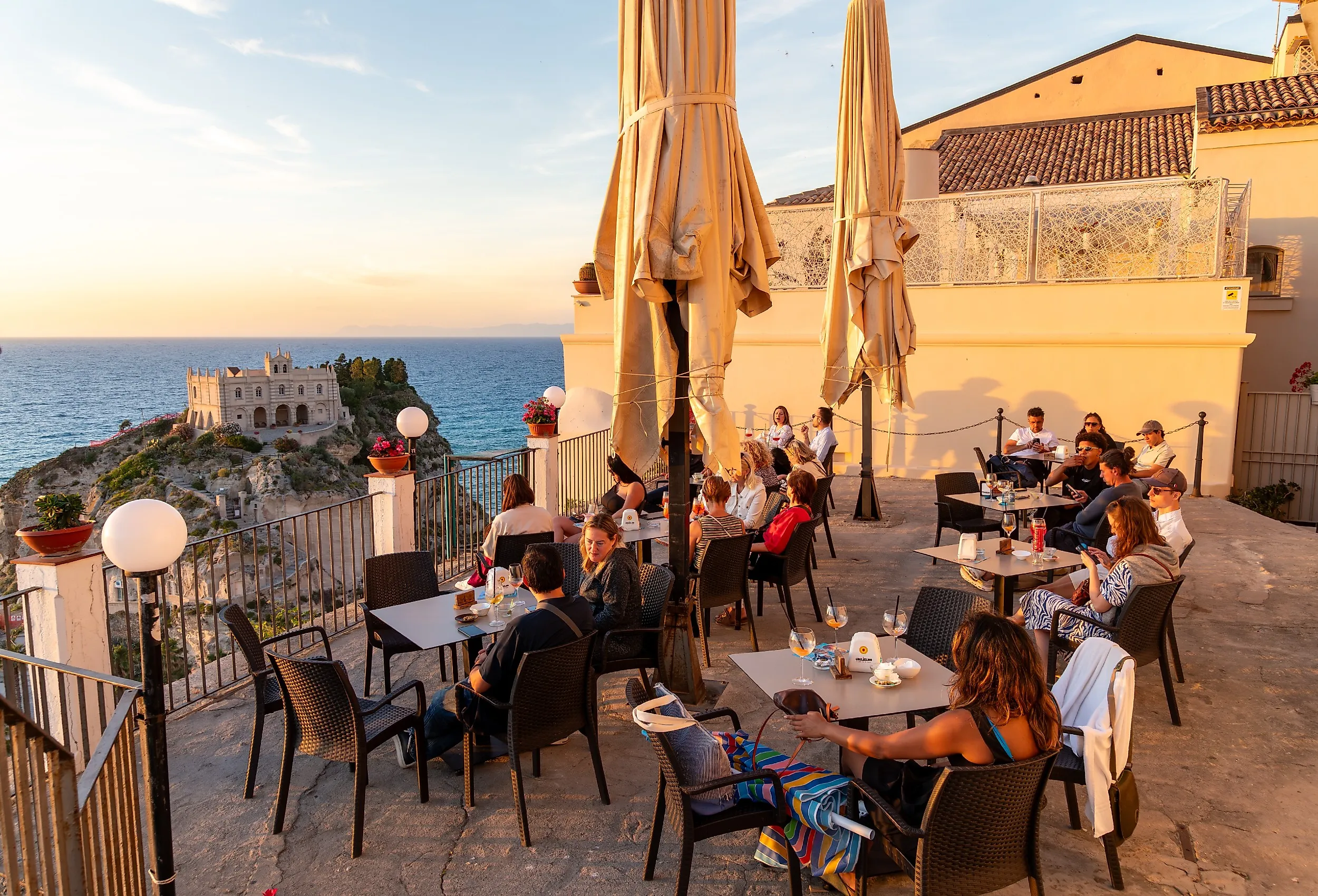
Tropea was named Italy's most beautiful borgo in 2021, and the distinction is easy to understand from the clifftop above its famous beach. The town is built on a sandstone promontory above the Tyrrhenian Sea, its pastel palaces and baroque doorways looking out over turquoise water toward the volcanic silhouette of Stromboli on clear days. The Santuario di Santa Maria dell'Isola stands on a rocky promontory once separated from the mainland. The municipality traces its origins to an early Eastern monastic settlement, with later Benedictine ownership, and the Assumption is marked each August 15 with a procession at sea. The IGP-protected cipolla rossa di Tropea has its own celebration at Ricadi nearby, where the Sagra della Cipolla runs each August. Boat tours from the harbor reach sea caves along the Costa degli Dei and connect to the Aeolian Islands, giving retirees access to one of the most dramatic stretches of coastline in southern Italy.
Noto, Sicily

Noto was rebuilt entirely in the Baroque style after a catastrophic earthquake destroyed the original city in 1693, and the result is one of the most unified Baroque townscapes in Italy, recognized as a UNESCO World Heritage Site as part of the late Baroque towns of the Val di Noto. The Corso Vittorio Emanuele, the main street running through the historic center, is lined with honey-colored limestone palaces and churches that glow golden in the afternoon light. The Cattedrale di Noto, rebuilt after its dome collapsed in 1996 and reconsecrated in 2007, stands fully restored at the top of a wide ceremonial staircase as the town's centerpiece. Every May, the Infiorata di Noto transforms the Via Nicolaci into a carpet of flower petals arranged in elaborate pictorial designs by local volunteers, one of the most visually extraordinary community events in Sicily. The weekly market in Piazza Risorgimento, held on Monday mornings, is where local life is most visible. Stalls sell Sicilian almonds, blood oranges, olive oil, and the marzipan sweets for which the region is famous. Noto sits in southeastern Sicily, about 50 kilometers (30 miles) by road from the baroque city of Ragusa and an hour from Catania's airport, which gives it practical connections without sacrificing its small-town character.
Pienza, Tuscany

Pienza was built to be perfect. In 1459, Pope Pius II commissioned the Florentine architect Bernardo Rossellino to transform his birthplace into an ideal Renaissance city. The work was finished in about three years, and Pienza became the place where Renaissance town-planning concepts were first put into practice, recognized as a UNESCO World Heritage Site in 1996. The Piazza Pio II, the central square, is framed by the cathedral, the papal palace, the town hall, and a bishop's palace in a composition that has barely changed in more than 550 years. The surrounding Val d'Orcia is one of the most painted and photographed landscapes in Italy, with its rolling wheat fields, cypress avenues, and fortified farmhouses. It is a UNESCO landscape in its own right and visible from almost every point on the town's ramparts. The Fiera del Cacio, the cheese fair celebrating the town's Pecorino di Pienza, runs for a week around the first Sunday of September. Its centerpiece is the Cacio al Fuso, a contest in which the town's six contrade roll a wheel of cheese at a wooden spindle set in the main square. Pienza has a permanent population of roughly 2,000, which means newcomers are noticed, welcomed, and quickly integrated into a community where everyone knows everyone else.
Italy Welcomes Those Who Stay
Italy rewards the retiree willing to look beyond the famous cities and well-worn tourist routes. These towns are friendly not because they have decided to market themselves that way, but because friendliness has always been built into the way Italian small-town life works, in the piazza every evening, in the weekly market, in the festival that the whole community prepares for months in advance.