9 Most Walkable Town Centers on the Pacific Coast
The ferry into Friday Harbor lands at the foot of Spring Street, and the shops begin at the top of the ramp. Coupeville's self-guided historic walking tour starts at the foot of a wharf that reaches 500 feet into Penn Cove, then follows Front Street past the 19th-century storefronts above the water. Cannon Beach put its commercial core within a few minutes of Haystack Rock, Astoria strung its downtown along a riverfront path, and Mendocino ends at a bluff trail rather than a parking lot. There are certain towns on the Pacific Coast that can be explored almost completely on foot. These are nine of those town centers.
Port Townsend, Washington

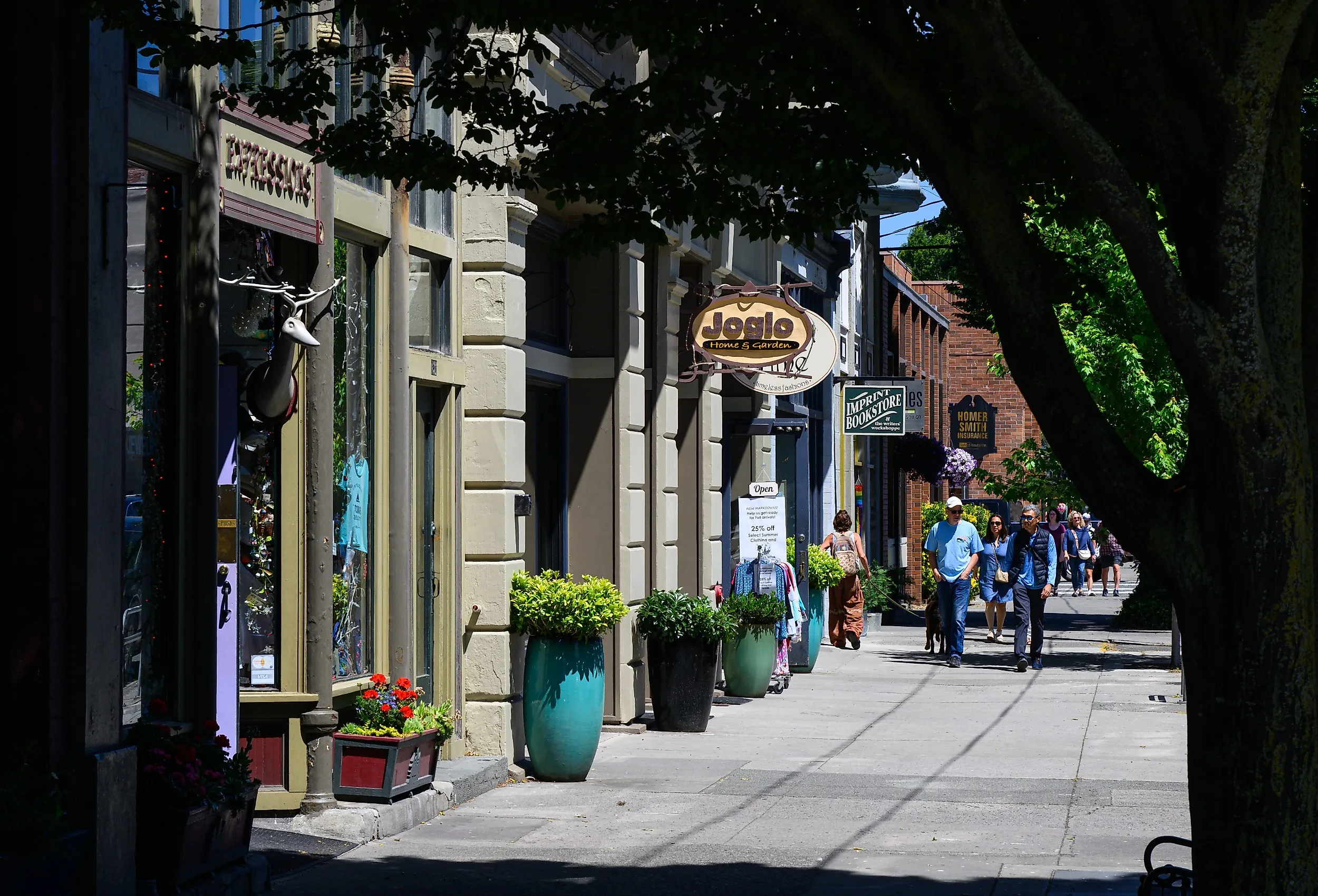
Port Townsend's downtown fills the narrow shelf between the bay and the bluff behind it, and nearly every building on it dates to a boom that stopped short. Merchants in the 1880s built for a city they expected to become the rail terminus and principal port of Puget Sound. The railroad went to Seattle instead, investment dried up, and the ornate commercial blocks stayed as they were. The result is one of the most intact Victorian seaports in the country, now a National Historic Landmark district.
Most of what a visitor wants to see sits within a few blocks of Water Street. The Rothschild House, built in 1868 by merchant David Charles Henry Rothschild and open seasonally, stands up the hill in Uptown with its original furnishings in place. Down at the waterfront, Northwest Maritime occupies the ground between downtown and Point Hudson, running sail training, boat-building workshops, and the Wooden Boat Festival each September. Pope Marine Park breaks up the walk with a little over an acre of lawn and picnic tables, the City Dock beside it and City Hall directly across the street.
The concentration is what makes the town work on foot. A single loop covers a working boatyard, a preserved 19th-century house museum, and a waterfront park without a car entering the picture.
Ferndale, California

Ferndale's Main Street carries one of the densest collections of ornate 19th-century commercial architecture in California, listed on the National Register of Historic Places in 1994. Dairy money built most of it. Danish, Swiss-Italian, and Portuguese families who settled the Eel River Valley in the 1850s put their profits into the Italianate, Stick-Eastlake, and Queen Anne buildings that locals still call the Butterfat Palaces. The district runs about 46 acres, and the town's architectural walking tour goes straight through it.
The Ferndale Museum anchors the history, with exhibits covering the valley's dairy industry, local geology, and Victorian-era domestic life. A short way down the block at 421 Main Street, Golden Gait Mercantile has operated as a general store for more than 50 years and keeps a small collection of old-time goods upstairs above the candy counter and dry goods. The Ferndale Repertory Theatre stages productions year-round on the same walkable stretch.
What separates Ferndale from a list of individual stops is that the architecture is the attraction and it is continuous. There is no gap between one landmark and the next, so the walk itself supplies the experience. In December, the town lights a living spruce on Main Street, a tradition kept since 1934.
Cannon Beach, Oregon

Haystack Rock rises 235 feet out of the surf at the edge of town, close enough that a walk down any of several beach accesses puts you at its base in minutes. The sea stack is basalt, left by lava flows that reached the coast millions of years ago. At low tide the surrounding tide pools expose sea stars and anemones, and tufted puffins nest on the rock in spring and summer. Cannon Beach built its commercial core within reach of it rather than around a historic square.
The Cannon Beach History Center and Museum, a few blocks south of the main shopping blocks on South Spruce Street, explains the name. The USS Shark, a Navy schooner surveying the mouth of the Columbia, broke apart on Clatsop Spit in September 1846. Part of the wreck drifted south, and a cannon from it surfaced on the sand near Arch Cape in 1898. Admission runs on donations. On North Hemlock Street, the Coaster Theatre Playhouse has staged plays and musicals for decades.
The layout removes the usual trade-off between town and coastline. The shoreline starts inside the same compact grid that holds the restaurants and galleries.
Mendocino, California

Mendocino sits on a headland with state park land wrapping three sides of it, which means the village ends at a bluff trail rather than a parking lot. Mendocino Headlands State Park surrounds the town, and its paths follow the cliff edge above sea caves and coves within a few minutes of the main street.
The wooden buildings inland of those bluffs came from logging. Redwood cut in the surrounding forests moved through the port in the second half of the 1800s, and the water towers, false-front stores, and New England-influenced houses built with that money still stand across the Mendocino Historic District.
Two stops sit close together in the village. The Ford House Visitor Center and Museum, run by the state park, covers the town's logging history and coastal ecology and hands out trail information. The Mendocino Art Center occupies the former Preston estate, where the mansion burned in the 1950s. Bill and Jennie Zacha bought the one-acre property and founded the center there in 1959, and it has run classes, studios, and exhibitions since.
The distances are the point. A visitor can move between a house museum, an art school, and an open bluff over the Pacific in roughly fifteen minutes on foot.
Astoria, Oregon

The Astoria Riverwalk runs several miles along the south bank of the Columbia and serves as the town's pedestrian spine. The path passes working piers, cannery pilings, and moorings tied to the city's fishing fleet, with the Astoria-Megler Bridge in view for much of its length. A restored 1913 trolley car runs the same corridor seasonally.
Astoria grew where it did because of the river mouth. Fur trading came first, in 1811, and salmon canning followed later in the century, drawing Finnish, Norwegian, and Chinese labor to the waterfront.
The Columbia River Maritime Museum sits directly on the Riverwalk and covers bar pilots, the Coast Guard, and the wrecks that gave the river entrance its reputation. Up the hill, the Flavel House was built in 1885 for Captain George Flavel, the bar pilot who made a fortune guiding ships across that entrance. Its Queen Anne detailing and its position above the working waterfront show how unevenly the money landed. Downtown's grid climbs from the river toward those older streets, and the Liberty Theatre on Commercial Street, opened in 1925, still runs performances a few blocks up from the water.
One route covers the river, a maritime museum, a house museum, and the commercial core with no driving between any of them.
Friday Harbor, Washington

The ferry lands at the foot of Spring Street, and the business district starts at the top of the ramp. That arrangement has held since the late 1800s, when Friday Harbor became the commercial center of San Juan Island with a bank, hotels, and stores clustered around the landing. Everything a visitor arriving on foot needs is inside a few blocks of that dock.
National chains are largely absent, and independent bookshops, galleries, and cafes fill the storefronts instead. The San Juan Islands Museum of Art shows regional artists in rotating exhibitions on Spring Street. The San Juan Historical Museum, a short walk inland on a 19th-century family homestead, holds photographs, oral histories, and original farm buildings. The Whale Museum, opened in 1979, interprets the southern resident killer whales and runs the region's marine mammal stranding network.
Because ferry service makes a car optional here, the town has developed around people who arrive without one. Sidewalks connect the marina, the museums, and the shopping streets, and the terminal sits about ten minutes on foot from the far end of downtown.
Coupeville, Washington

The Coupeville Wharf reaches 500 feet into Penn Cove, and the town's self-guided walking tour begins at its foot. Local farmers and merchants built it in 1905, the fourth wharf on this shoreline and the first long enough for boats to unload at low tide. Grain towers went up on it between 1909 and 1914 and came down in 1985. The Port of Coupeville now operates it, and the Washington Trust for Historic Preservation named it an endangered place in 2024, with king tides and rising water reaching the pilings.
Front Street runs along the water from the wharf, lined with 19th-century storefronts, and the tour route continues to the Island County Historical Museum at 908 Alexander Street. Its collection covers island farming, settlement, and the original survey used to plat the town.
Coupeville sits inside the Central Whidbey Island Historic District, listed on the National Register in 1973, and within Ebey's Landing National Historical Reserve, where more than 400 buildings carry historic-register status. Settled in the early 1850s, it is among the oldest towns in Washington. The mussels rafted offshore in Penn Cove are served in restaurants a block from the water.
Silverton, Oregon

More than 30 murals cover the walls of downtown Silverton, and the Silverton Mural Society has commissioned and maintained them since 1992. They work through local subjects: the political cartoonist Homer Davenport, the astronaut Donald Pettit, and Bobbie the Wonder Dog, the collie who found his way home to Silverton from Indiana in 1924. A reproduction of Norman Rockwell's Four Freedoms went up in 1994.
The town was founded in 1854 along Silver Creek, and the creek still organizes the center. Town Square Park, a quarter-acre at West Main and Fiske, holds a lawn, the Silverton Freedom Memorial Plaza, and a covered pedestrian bridge across the creek to Water Street. The bridge is a modern structure rather than a historic one, but it does the work of keeping both sides of the core connected on foot.
The Oregon Garden is the outlier in a walking itinerary here. It's 80 acres and more than 20 specialty gardens sit about a mile west along Main Street, far enough to be a deliberate walk rather than a casual one. Terraced wetlands inside the property filter the city's reclaimed wastewater and supply all of the garden's irrigation. The Gordon House, the only Frank Lloyd Wright design in Oregon, stands on the same grounds.
Cambria, California

Cambria's downtown arrives in two parts, the East and West villages, separated by a stretch of pine-shaded road along Main Street.
The East Village came first. Mercury mining, dairy ranching, and lumber drove the local economy in the 1860s, and the 19th-century buildings left over from that period now hold antique shops, cafes, and bakeries. The Guthrie-Bianchini House, a 1870s saltbox, holds the Cambria Historical Museum. On the hillside above, Nitt Witt Ridge is the work of Arthur Harold Beal, a Cambria garbage collector who spent roughly 50 years building a terraced house out of abalone shells, beer cans, car parts, and salvaged timber. It became California Historical Landmark No. 939 in 1981. The property changed hands in 2022 and no longer offers tours, though the structure is visible from Hillcrest Drive.
The West Village developed later, alongside the tourism that followed the opening of Hearst Castle to the public up the coast at San Simeon. Galleries, studios, and specialty shops occupy it now.
At the edge of town on Main Street, the Old Santa Rosa Chapel was built in 1870 as the first Catholic church in San Luis Obispo County after the mission era. Its final Mass was said in May 1963. Volunteers restored the building and rededicated it for community use in 1984, and the cemetery behind it holds many of the area's earliest settlers.
Final Thoughts
Walkability can look different from town to town along the Pacific Coast, but all the strongest examples share a common characteristic: their attractions were made to be integrated into the town rather than being built separately from it. From waterfronts and public spaces to commercial hubs and museums, everything is oriented such that visitors can experience multiple aspects of the neighborhood in one walk. Instead of driving from one isolated attraction to another, visitors can follow the same streets that residents have used for generations.