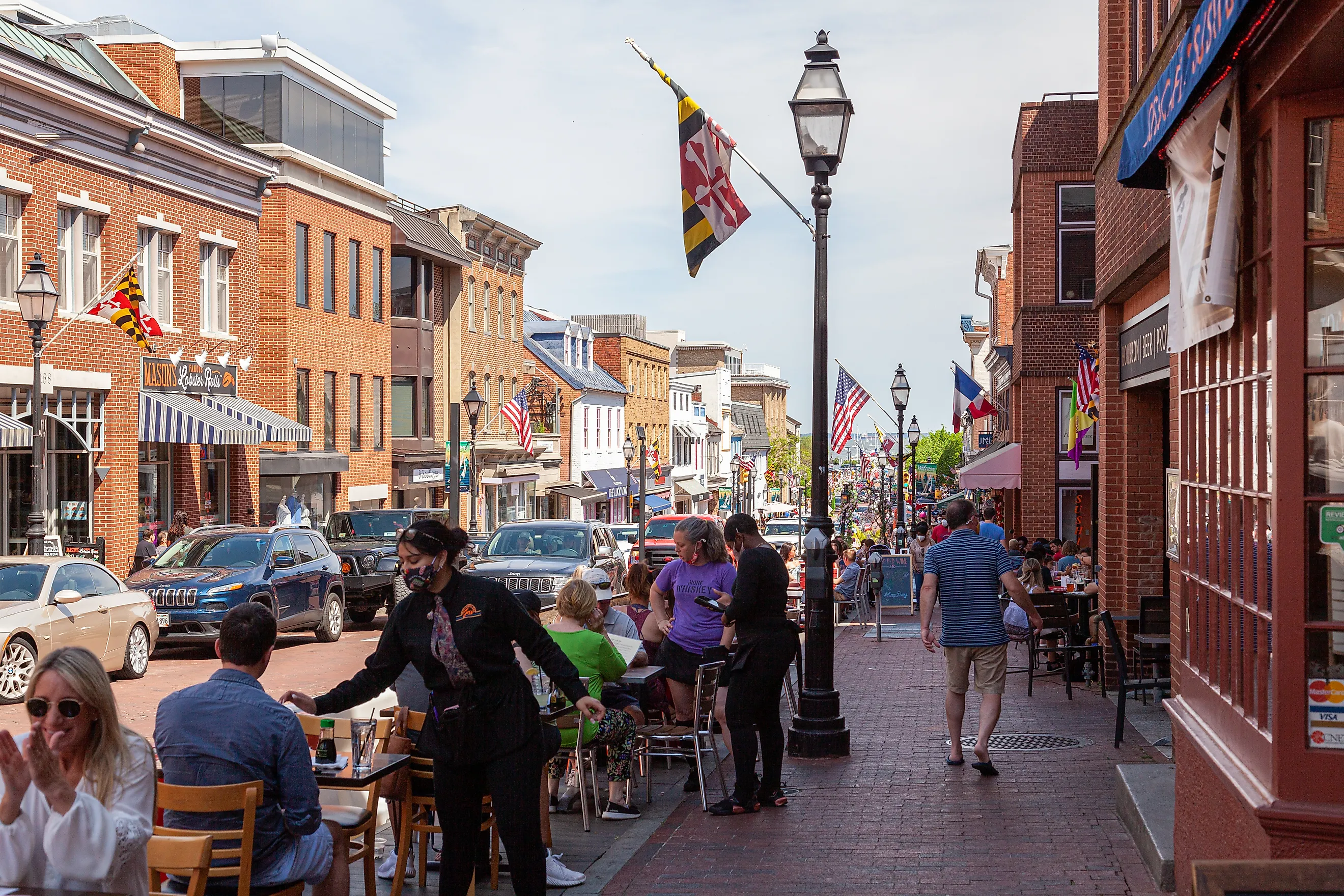
9 Most Walkable Town Centers In Maryland
A single stretch of paved sidewalk in Maryland can take you from a colonial statehouse into a harbor dock lined with sailboats in under five minutes. Berlin has a restored mansion, an eclectic mermaid-themed museum, and a Victorian-era hotel sharing the same main drag. In Annapolis, the state capital, a parish, a museum, and a harbor are within 15 minutes of each other. Talbot Street in St. Michaels and Main Street in Sykesville run through town centers that pack a lot within a compact grid that does not require a car to explore. The best way to see each of these towns is on foot, where history, tradition, and culture unfold one step at a time.
Annapolis

Annapolis may be Maryland's capital, but its downtown core is small enough to explore on foot. It has a radial street network laid out well before cars existed, putting centuries of local culture and maritime history within a few blocks. Start at the top of the hill on State Circle at the Maryland State House, the oldest state capitol still in legislative use in the United States. Admire the beauty of this red-brick Georgian landmark topped with a wooden dome built without nails, or step inside its historic legislative spaces.
Walk a short block down School Street to Church Circle to see Tiffany stained-glass windows at St. Anne's Parish. Then stroll the brick sidewalks of Main Street to the Museum of Historic Annapolis. Here, three floors of interactive exhibits and local artifacts detail the city's 400-year history. From the museum, it's less than five minutes to cross to the Annapolis City Docks. Sailboats line the narrow waterway of Ego Alley, giving you a front-row view of the harbor, next to local shops and restaurants.
Easton

Less than an hour from Annapolis, across the Chesapeake Bay Bridge, Easton trades the capital's slopes for a flatter and highly walkable grid. Wide brick sidewalks connect theaters, art galleries, local eateries, and historic sites. The lawn of the Talbot County Courthouse on Washington Street is the perfect starting point. A bronze statue depicting abolitionist Frederick Douglass on a podium while delivering a speech sits on its lawn. At the Academy Art Museum, appreciate the works displayed in its galleries, which range across vintage prints and contemporary paintings.
Following Harrison Street two blocks north brings you face-to-face with the neon marquee of the Avalon Theatre. Built in 1921 and refitted with the Art Deco interior it still carries during a 1934 remodel, the restored venue hosts live music and theatrical productions. Once it's time to wind down, directly across the intersection is the Tidewater Inn, a historic downtown hotel. Hunters Tavern, the hotel's in-house restaurant, serves the signature snapping turtle soup and crab cakes.
St. Michaels

St. Michaels sits just west of Easton on Route 33, which becomes Talbot Street, the main thoroughfare running north to south through the compact historic district. On the northern end, Chesapeake Bay Maritime Museum occupies an 18-acre waterfront property. Visitors can climb the 1879 Hooper Strait Lighthouse, watch wooden boats being restored in a working shipyard, and learn about the region's oyster industry. Your walk continues along the main drag, then to Mulberry Street and the leafy public green of St. Mary's Square, featuring a museum with war memorials and artifacts. Further south on Talbot Street, a former mill is now a commercial complex where St. Michaels Winery and Eastern Shore Brewing are next-door neighbors. Choose whether to enjoy Maryland-grown wines or local craft beers.
Chestertown

Heading north of St. Michaels into Kent County, less than an hour away, Chestertown has one of the largest collections of pre-Revolutionary War buildings in its walkable downtown historic district. Wake up at White Swan Tavern, an 18th-century bed and breakfast that used to be a tannery and drinking house. One block up, High Street opens into the greenery at Fountain Park. A Victorian iron fountain topped with the Greek goddess Hebe acts as the centerpiece in this green space. Walking back along High Street, Garfield Center for the Arts supports local entertainment with a packed calendar of live theater and musical performances inside an Art Deco theater built in 1928. The foot of High Street leads right to Water Street, where the public docks, Chestertown Marina, and the river promenade come together along the Chester River.
Berlin

The main commercial district in Berlin stretches three blocks, making it easy to walk without getting tired. Sidewalks are flat and lined with trees, while parking along Main Street is free. A shaded lawn at the northern end of Main Street sets the stage for the Calvin B. Taylor House Museum. The Federal-style home is decorated with ornate fireplaces, antique furniture, and vintage wallpaper. Continuing south toward Jefferson Street leads to the Mermaid Museum, an eccentric gallery devoted to maritime folklore and quirky ocean artifacts. It then takes just a minute to cross the street and post up at the Atlantic Hotel. The 1895 Victorian-era-style hotel serves as a comfortable and convenient home for the night.
Havre de Grace

Where the Susquehanna River meets the Chesapeake, Havre de Grace packs nearly everything worth seeing into a handful of downtown blocks that slope straight down to the water. Explore the storefronts lining Washington Street. Independent shops like Found Vintage Co. curate antique and handmade decor, including ceramics and table lamps. From the shop, head a few doors down to the corner of Pennington Avenue, then walk to Union Avenue and the Cultural Center at the Opera House for live theater, concerts, and screenings. At the end of Giles Street, you'll find the Havre de Grace Decoy Museum. Its galleries are packed with waterfowl decoys that celebrate the region's folk art and carving traditions.
Cumberland

Cumberland links a historic train depot, a regional history museum, and a performing arts venue in a downtown core small enough to cross in about 15 minutes. Start at Canal Place, where a plaza surrounds the Western Maryland Railway Station. Built in 1913, the depot is the starting and ending point for excursion train rides that send vintage locomotives on scenic runs through the Allegheny Mountains to Frostburg. Less than five minutes on foot after crossing Canal and South Mechanic Streets is the Allegany Museum. Here, a former federal courthouse and post office now houses tens of thousands of artifacts that showcase 12,000 years of regional history. On Baltimore Street, the Embassy Theatre has entertained audiences since 1931. Cap your day with a comedy show, cabaret, or live music, depending on what the show season offers.
Sykesville

Sykesville, located less than 30 miles west of Baltimore, has a Main Street that stretches only a few blocks. It climbs from the Patapsco River and branches out into side streets lined with Victorian homes and storefronts. At the top of the hill, Millard Cooper Park is the perfect place to start the morning along shaded walking paths. There's a playground and a splash pad that come in handy for those traveling with kids. Within its grounds is the Gate House Museum. This free attraction provides a glimpse of the town's beginnings as an agricultural hub and its development as a railroad community.
Main Street opens to Sykesville's main commercial area. Near the intersection at Sandosky Road, Gypsy Systers stocks its shelves with crystals, hand-poured candles, and essential oil blends to take home. Across the street is Patapsco Distilling Company. Enjoy craft-distilled spirits made in Maryland, including single malt whiskey and vodka.
Bel Air

Bel Air's original town limits in the late 18th century covered nothing more than the two sides of Main Street. The town has grown, of course, but its historic core has remained compact with well-maintained sidewalks that make exploring a breeze. Bel Air Armory stands at the foot of North Main Street, a 1915 granite fortress hosting mostly private events. Even from the outside, it's impossible not to admire its twin hexagonal towers that make it look like a medieval castle. Behind it is the Armory Marketplace with the Harford Artists Gallery, a must-stop for art enthusiasts with its rotating exhibits and lectures.
On West Gordon Street, the Liriodendron Mansion is the restored summer home of Dr. Howard Kelly, one of Johns Hopkins Hospital's founding physicians. It has a free art gallery and an expansive public parkland. Doubling back north to the intersection of North Main and Ellendale Streets wraps up your day at Independent Brewing Company for craft beers, including gluten-free options.
Your Next Maryland Trip, Entirely On Foot
There's no need for a car to explore the most walkable town centers in Maryland. Many of their downtowns are built compact enough to head from one attraction to another on foot. Museums sit next door to local shops. Restaurants are steps from the park. Historic courthouses stand just blocks from art galleries and cafes. With everything this close together, all you need is a good pair of walking shoes, and you're good to go.