9 Most Charming Small Towns In The Netherlands
The Netherlands runs on a layered cultural identity of tulips, windmills, cheese, and centuries of Dutch art. The smaller towns hold that history in working form. Giethoorn navigates by canal rather than road. Edam still runs its weekly summer dairy market. Doesburg and Naarden survive as star-shaped bastion fortresses. The nine towns ahead each capture a different piece of the country's story.
Giethoorn

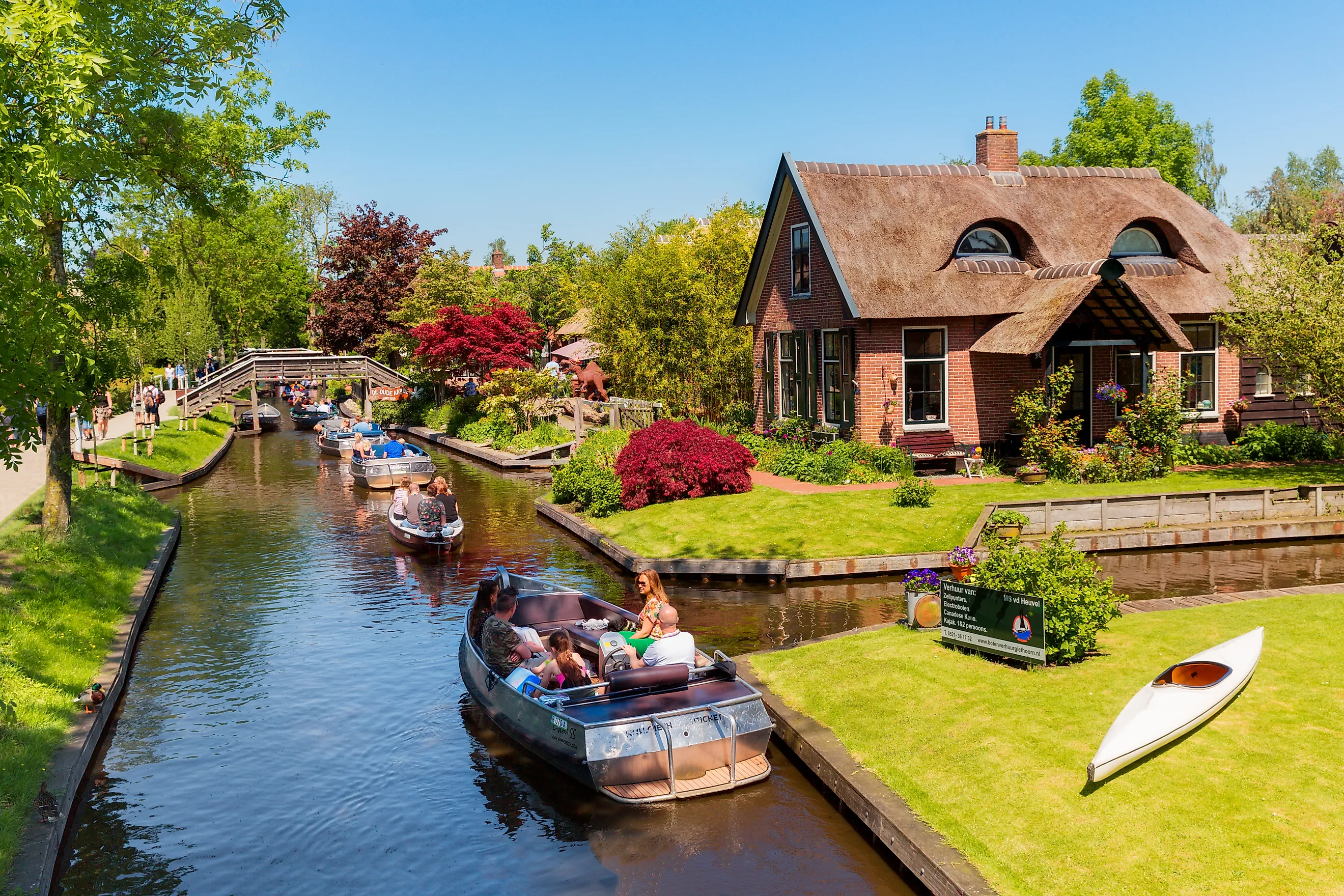
Giethoorn is a mostly car-free dorp (village) with no roads through the historic centre, widely known as the "Venice of the North" because of its boat-thronged waterways, walking paths, bicycle trails, and centuries-old thatched-roof houses. About 33 minutes from Zwolle, Giethoorn borders the wetlands of Weerribben-Wieden National Park, a former peat-harvesting area now protected as a nature reserve. Adjacent to the park is the Museum De Oude Aarde (The Old Earth), a museum displaying minerals, gemstones, and fossils. The Museum Giethoorn 't Olde Maat Uus covers the town's traditional peat excavations dating back to the 1200s. The main way to get around Giethoorn is by canal or on foot, and lodging options include Hotel Harmonie, Hotel Giethoorn, and Hotel De Eese-Giethoorn.
Edam

What would the Netherlands be without its cheese? In the small dorp of Edam, cheese has driven the local economy since the 16th century. The village sits on the IJsselmeer (Lake IJssel) about 22 miles north of Amsterdam. Surrounding the town is the Beemster Polder, a UNESCO World Heritage site of historic fields, waterways, and farms. The Kaasmarkt (cheese market), restored to its traditional form, runs weekly during the summer months and lets visitors watch the cheese-weighing process and purchase fresh local wheels.
Beyond cheese, Edam functioned as a major shipbuilding port from the 12th to 17th centuries. The town's 33 shipyards built many notable ships including the Halve Maen, the vessel used by Henry Hudson in 1609 when he sailed for the Dutch East India Company in an unsuccessful search for a northeast passage to Asia and instead reached what is now Manhattan. For overnight stays, options include De Harmonie or De Krasse Man.
Oudewater

Oudewater sits in the 'green heart' of the Netherlands at the confluence of the Hollandse IJssel and the Linschoten rivers. The town carries one of the more unusual chapters in Dutch history through the Heksenwaag (Witches' Weighhouse), where during the European witch hunts of the 1500s and 1600s women accused of witchcraft could be officially weighed to demonstrate that their bodies were of normal weight rather than impossibly light enough to ride a broom. The Heksenwaag now operates as a museum covering the era. Oudewater also contains the Touwmuseum (Rope Museum) "De Baanschuur," a former barn where rope-makers stored hemp, yarn, and spindles during the town's centuries-long rope-making industry that ran from roughly 1675 to the 20th century. Local lodging options include the Broeck Oudewater and Ruyge Weyde Logies.
Veere

On the banks of the Veerse Meer, Veere holds a tight cluster of 15th- and 16th-century architecture from the town's commercial peak. The Campveerse Toren, a medieval defensive tower on the waterfront, now operates as a hotel and restaurant with views across the lake. The Schotse Huizen (Scottish Houses), named for the once-flourishing wool trade between Veere and Scotland, now house the Veere Museum, which covers the town's mercantile and maritime past. The Grote Kerk (Great Church), a late Gothic cross-basilica built between 1405 and 1521, was never fully completed and now hosts theatrical and artistic performances inside its cavernous interior. Local accommodations include Bed and Bread, Hotel de Heeren, and Hotel Veere.
Zutphen

Zutphen, about 19 miles from the city of Arnhem, sits at the confluence of the IJssel and Berkel rivers. The Hanseatic town pulls visitors with its medieval streetscape, including the Wijnhuis (Wine House), a 14th-century building that grew into the seat of the local wine trade. The Sint-Walburgiskerk, a Gothic church with a distinctive tower, anchors the historic centre. Inside the church, the Librije is one of only five surviving chained libraries in Europe, with books still chained to their reading desks as they were when scholars consulted them in the 16th century. The medieval Jufferenstraat runs nearby, watched over by the historic Drogenapstoren clock tower. Other places to visit include the Stedelijk Museum Zutphen, Museum Henriette Polak, and De Hoven Museum Boer Kip, the last being the working farm of national painter Herman Kip. Local lodging options include the Broederenklooster and Hampshire Hotel's Gravenhof Zutphen.
Thorn

Once part of the Imperial Abbey of Thorn within the Holy Roman Empire, the town of Thorn is known as Het Witte Stadje (The White Town) because of its whitewashed brick houses. The tradition dates to French occupation in the late 18th century, when residents bricked up windows to avoid a window tax and whitewashed the patched facades to hide the scars. The town sits in southern Limburg near one of the major Dutch rivers, the Meuse, and the Belgian border. The Sint-Michaëlskerk is a notable example of Maasland Gothic architecture, originally founded in the 10th century as the church of an aristocratic women's abbey under Count Ansfried and his wife Hilsondis. The abbey itself operated as an independent imperial principality for more than eight centuries, governed by a succession of abbesses with princely rank. For walks along the river, the Thorn-Wessem ferry route gives access to the Maas. For overnight stays, the Hotel Abdijhof Thorn is the local option.
Doesburg

About 22 minutes from Zutphen, Doesburg is a Hanseatic town on the IJssel at its confluence with the Oude IJssel. The town's defensive earthworks were originally engineered around 1700 by Menno van Coehoorn under William III, the Dutch stadtholder who also reigned as King William III of England. Half of Doesburg still resembles the geometric star-shaped fortresses with High and Low Defensive Lines that withstood many sieges. These lines can be walked from the Turfhaven or Kraakselaan road (Low Defence Line) up to the ramparts, dry ditches, and trenches of the High Defence Line. History buffs might also visit the Doesburgse Mosterdfabriek, a working mustard factory dating to 1457 and one of the oldest still operating in the Netherlands, and the Martinitoren church tower. Doesburg also makes a gateway to Veluwezoom National Park. Local lodging options include the Stadshotel Doesburg, Guesthouse Het Voorhuys, and B & B Red Deer.
Zierikzee

On the island of Schouwen-Duiveland about 43 miles from Rotterdam, Zierikzee is a Hanseatic harbour town with a rich maritime history. The Sint-Lievensmonstertoren is the unfinished Gothic tower of what was meant to be the largest church in Europe, with construction halted in 1454 at 62 metres. The town also holds its three ancient gates: the Nobelpoort, Noordhavenpoort, and Zuidhavenpoort. Other notable sites include the Burgerweeshuis (former orphanage), the Dikke Toren (a church tower), the Gravensteen (a 16th-century stone-built house and former prison), and the Lutheran Church. The historic harbour, including the Oude Haven (Old Harbour), runs leisure boat tours. Nearby Oosterschelde National Park supports a wide range of Dutch flora and fauna including harbour porpoises. Local lodging options include Hotel van Oppen, De Theetap, and B&B De Schuur.
Naarden

Search for Naarden on a map and the most notable feature is a star-shaped fortress encircled by moats and bastions. About 20 minutes from Amsterdam on the banks of the Gooimeer, Naarden's bastion fort, called Naarden Vesting, has stood intact since its 17th-century reconstruction following the Spanish massacre of 1572. Naarden commemorates its military history every third Sunday from May to September through a 17th-century reenactment called Garnizoensdagen.
Within the town walls, the Comenius Museum and the Nederlands Vestingmuseum provide history of the town's religious, military, and cultural heritage. The Het Spaanse Huis (The Spanish House) marks the 1572 event in which Spanish troops murdered most of the town's inhabitants. For a view of the town's full star shape, the Grote Kerk tower can be climbed. Local lodging options include the Fortress Hotel, ROOM One-Twenty-One, and B&B Naarden Vesting.
The Painted Country
Looking at the still-life paintings of the Dutch Golden Age, the country recorded in those scenes survives in pockets across the nine towns above. A visitor might stand as a calm subject sampling cheese in Edam, a small figure inside Veere's Grote Kerk, or a quiet observer on the ramparts of Naarden. Whether the trip lands during tulip season or beside the windmills of Holland's polder country, the Netherlands' small towns each give a different read of the country's layered past.