8 Netherlands Small Towns With Unmatched Friendliness
Many Dutch small towns still sit within bastion walls and along canals cut centuries ago, and the people who live there go about their days inside those original perimeters. Bronkhorst received its city rights from Gijsbert VII in 1482. Sloten holds its place among the eleven traditional cities of Friesland, despite being small enough to walk across in under an hour. Several of the towns on this list host community events and local fairs that predate organized tourism by decades, and their historic cores still function as everyday centers for residents.
Giethoorn, Overijssel

Often called the Venice of the North, Giethoorn earns the nickname through a network of canals running through the historic core, the Binnenpad walking and cycling path, and thatched-roof farmhouses connected by 176 small wooden bridges. The village runs roughly 2,800 residents across a strip of land barely wider than a lane in places, and motorized traffic stays out of the old village by both custom and design.
Most visits begin with a punt boat rental from one of several harbors at the village edges, with the standard route running the length of the Dorpsgracht canal past historic farms set on individual islands. A short walk from the main canal, Museum Giethoorn 't Olde Maat Uus reconstructs a 19th-century peat-cutter's farmhouse from the era when the village's original income came from harvesting peat across the surrounding wetlands. In late summer, the Gondelvaart festival fills the canals with elaborately illuminated boats parading slowly down the Dorpsgracht after sunset, drawing crowds to the village's bridges and footpaths. Beyond the village, Weerribben-Wieden National Park protects over 12,000 hectares of marshland, reed beds, and shallow lakes formed by centuries of peat extraction.
Thorn, Limburg

Known across the Netherlands as Het Witte Stadje (The White Town), Thorn earns the nickname from the whitewashed walls that cover nearly every building in the historic core. The tradition dates to the late 18th century, when French occupiers introduced a tax based on window size and residents bricked up many of their windows to lower their bills, then whitewashed the patched facades to hide the scars. The town has roughly 2,500 residents across a compact medieval core in southern Limburg province near the Belgian border.
The Sint-Michaëlskerk, originally built in the 10th century as the church of an aristocratic women's abbey founded by Count Ansfried (later Bishop of Utrecht) and his wife Hilsondis, anchors the town center with a mix of Romanesque westwork and Gothic and Baroque elements. The neo-Gothic bell tower was added by Pierre Cuypers in the 19th century. A short walk from the church, Museum Het Land van Thorn covers the unusual history of the abbey as a sovereign mini-state ruled by a long line of princess-abbesses until the French invasion of 1794. After dark, lantern-lit walking tours through the white-walled lanes show the town in a quieter light. The surrounding Maasplassen lake district, formed from gravel-pit excavations along the Maas River, provides swimming, boating, and beach access just outside town.
Sloten, Friesland

One of the eleven traditional cities of Friesland and the smallest of them at roughly 700 residents, Sloten sits in the southwestern corner of the province on a star-shaped fortification surrounded by water. The town received city rights in 1426 and has retained its compact, mostly walkable street plan ever since. The whole place is small enough to cover end to end in under an hour.
The Heerenwal canal cuts directly through the center, and the lift bridges along its course operate the same way they have for centuries. A few steps inland, the former town hall on Heerenwal, built between 1759 and 1761, now houses Museum Stedhûs Sleat, which preserves local history including a magic-lantern collection assembled over decades by former resident Peter Bonnet. Each summer the town holds Sipelsneon (Onion Saturday), a local fair tied to Sloten's nickname as the "onion city," earned for the rounded shape of its fortifications. Sloten also hosts a leg of the IFKS skûtsjesilen, when traditional flat-bottomed Frisian sailing boats race across the Slotermeer just south of town.
Bourtange, Groningen

Built in 1593 on the orders of William Louis of Nassau, stadtholder of Friesland and Groningen, Bourtange still occupies a reconstructed star fort in eastern Groningen near the German border. About 430 people live inside and around the original fortification walls, with the moat system and earthworks rebuilt between 1967 and 1992 to reflect the fort's 1742 configuration.
The fortress itself is what most visitors come for, with five reconstructed bastions, working drawbridges, and a perimeter walking path that follows the original ramparts. Just inside the main gate, the Bourtange Museum complex includes a barracks building, a Dutch Reformed church, and a synagogue consecrated in 1842. The synagogue is a reminder of the town's history as one of the few inland Dutch towns with a significant Jewish community before the Second World War. In summer, the Slag om Bourtange (Battle of Bourtange) reenactment draws hundreds of costumed participants for cannon fire, period military camps, and two days of staged engagements. The surrounding peat-bog landscape, part of the Westerwolde region, offers cycling and walking routes through one of the least-developed corners of the country.
Bronkhorst, Gelderland

One of the smallest cities in the Netherlands with roughly 100 residents, Bronkhorst received its city rights in 1482, when Gijsbert VII granted limited self-government to the inhabitants of the village clustered next to the Bronkhorst family castle. The town occupies a single street in the IJssel river valley, with a cluster of preserved 17th- and 18th-century farmhouses leading down toward the river.
The main street runs roughly 300 meters end to end, lined with brick-paved lanes and small shops housed in centuries-old buildings. At the western edge, the Bronkhorst burchtheuvel marks the site of the ancestral castle of the lords of Bronkhorst, built in the 12th century and largely demolished in 1828. By 1902 the last above-ground remains were gone, but the castle mound is still visible. Each December, the Dickens in Bronkhorst festival turns the entire village into a 19th-century Victorian setting, with costumed residents performing as characters from Dickens' work and a puppet-theater rendition of A Christmas Carol staged in the village chapel.
Naarden, Noord-Holland

About 25 kilometers southeast of Amsterdam, Naarden sits inside one of the best-preserved star fortifications in Europe, with roughly 17,500 residents split between the original Vesting and surrounding neighborhoods. The current double-moat configuration with six bastions and six ravelins was built between 1675 and 1685, and the fortifications remain intact enough that aerial photographs of the town are widely circulated as examples of classical European military engineering.
The Nederlands Vestingmuseum, located in the Turfpoort bastion, runs guided tours through the underground casemates where the fort's original gunpowder magazines and barracks have been preserved. A few minutes' walk away on Marktstraat, the 15th-century Grote Kerk hosts the annual St. Matthew Passion performance every Good Friday, a tradition the Netherlands Bach Society began on 14 April 1922 and has continued without interruption since. A weekly Saturday market is held on A. Dortmansplein. On Kloosterstraat, the Comenius Mausoleum preserves the burial site of Czech educational reformer Jan Amos Comenius and draws steady year-round traffic from Czech visitors, and the adjacent Comenius Museum covers his work and influence in detail.
Zierikzee, Zeeland

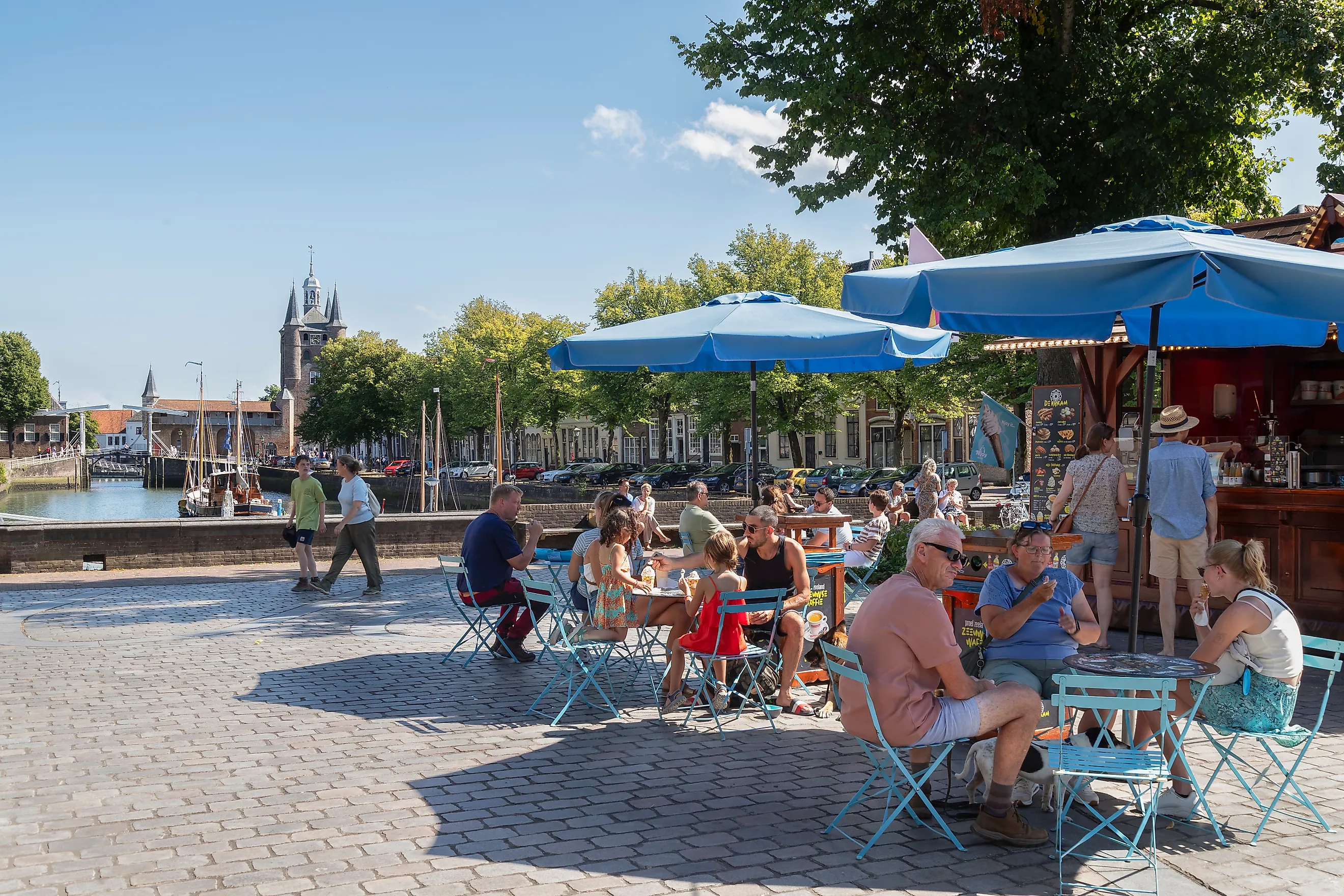
On the island of Schouwen-Duiveland in the province of Zeeland, Zierikzee has roughly 11,500 residents and a medieval old town that survived World War II. The low-lying parts of the town were heavily damaged in the 1953 flood. Three medieval city gates remain (the Noordhavenpoort, the Zuidhavenpoort, and the Nobelpoort), still marking the original perimeter of the fortified town.
The Sint-Lievensmonstertoren, a massive unfinished church tower started in 1454 and intended in some accounts to reach around 130 meters before financial collapse halted construction, stands at 62 meters and remains the town's tallest landmark. Visitors can climb it for views across Schouwen-Duiveland and the Oosterschelde. A few minutes' walk from the tower, the Stadhuismuseum occupies the 16th-century town hall and houses the merged collections of the former Maritime Museum, including a 17th- or 18th-century Greenland kayak considered one of the oldest surviving examples in the world. Each August, the Havendagen (Harbor Days) festival fills the historic harbor with mussel cooking demonstrations, the crowning of a Mossel Princess, and live music along the quay. The harbor itself is still in active use by both commercial fishing boats and historic sailing vessels, and the surrounding Oosterschelde National Park offers birding and tidal-flat walking.
Willemstad, Noord-Brabant

In the western corner of Noord-Brabant near the Hollands Diep estuary, Willemstad occupies another of the country's preserved star fortifications, this one a seven-bastion heptagon fortified under William of Orange in 1583 and expanded by his son, Prince Maurice, by 1587. About 2,500 people live inside and around the historic ramparts, which remain walkable in a continuous loop and shape the entire layout of the historic core.
The Mauritshuis, originally built between 1623 and 1625 as a hunting lodge and country residence (then called the Princehof) for Prince Maurice, stands at the center of town and now operates as a small museum and event space with exhibits on local history and the Dutch defense lines. A few steps away on Voorstraat, the Koepelkerk, built between 1597 and 1607 and considered one of the first purpose-built Protestant churches in the Netherlands, has a distinctive octagonal floor plan and a domed roof that gives the church its name. The harbor along the Hollands Diep still works for both pleasure craft and traditional sailing vessels, with several restaurants along the waterfront serving local fish. The surrounding Biesbosch National Park, one of the largest freshwater tidal areas in Europe, is a short drive south and offers boat tours through a maze of small creeks and willow forests.
Why These Dutch Towns Feel Welcoming
On a weekday morning, the welcome feels quiet, with shopkeepers chatting with the same customers they served yesterday, cyclists nodding to the people they pass, and residents running errands across centers small enough that everyone recognizes everyone. Visit during a festival weekend, and the welcome opens outward, with the same residents folding outsiders into traditions that have run for decades. Either visit works. None of these eight towns depends on tourism for its identity, so there is no version of them that exists only for visitors. The reward for the longer drive from Amsterdam, Rotterdam, or wherever the international flight first lands is time in a place that is simply being itself.