9 Best Small Towns In Illinois For A Crowd-Free Summer
Route 66 turns 100 this year. The centennial summer will pull crowds onto the Mother Road in numbers Illinois hasn't seen in decades. These nine towns sit far enough off the centennial map to stay quiet. Real rivers and bison and swinging bridges still fill their calendars, and they still have parking in July. This is where to spend a real summer.
Ottawa

Start with the bison. Buffalo Rock State Park keeps a small resident herd on 298 acres of bluff-top woodland, and the animals graze within sight of the hiking trails. The same park holds the Effigy Tumuli, five enormous animal-shaped earth mounds sculpted into a reclaimed strip mine above the Illinois River. It is the strangest public art in the state, and most people have never heard of it.
The river itself does the rest of the work. Ottawa sits where the Fox meets the Illinois, and Quest Watersports rents kayaks and paddleboards right in town. Starved Rock River Adventures goes bigger, with a 60-foot houseboat for rent that sleeps a full family across four staterooms. The Sainte Genevieve, a 149-passenger sternwheeler, runs sightseeing and sunset cruises from downtown with light narration and a stocked bar. A paddlewheel boat with no crowd on the dock is a rare thing in a Route 66 centennial summer.
Pontiac

Pontiac is the one gamble on this list. The town is a Route 66 museum stop, and in the centennial year its murals and shield signs will draw road-trippers. Go anyway, and aim for the water instead of the highway. Vermilion River Adventures runs a seven-mile canoe and kayak float through quiet farm country, and the crowds chasing neon never find it. Mill Street Dam splits the fishing neatly. The murky water east of the dam holds catfish, and the clearer water west of it holds smallmouth bass.
The bridges are the real signature. Pontiac has three pedestrian swinging bridges over the Vermilion River, and they actually swing. The oldest went up in 1898 so shoe-factory workers could cross to their shifts. The second came in 1926, and the newest was built in 1978 at Humiston Riverside Park, a five-acre green space with a playground, a splash pad, and a bandshell that hosts summer concerts. Cross all three in an afternoon and you will have done something most lifelong Illinoisans have not.
Woodstock

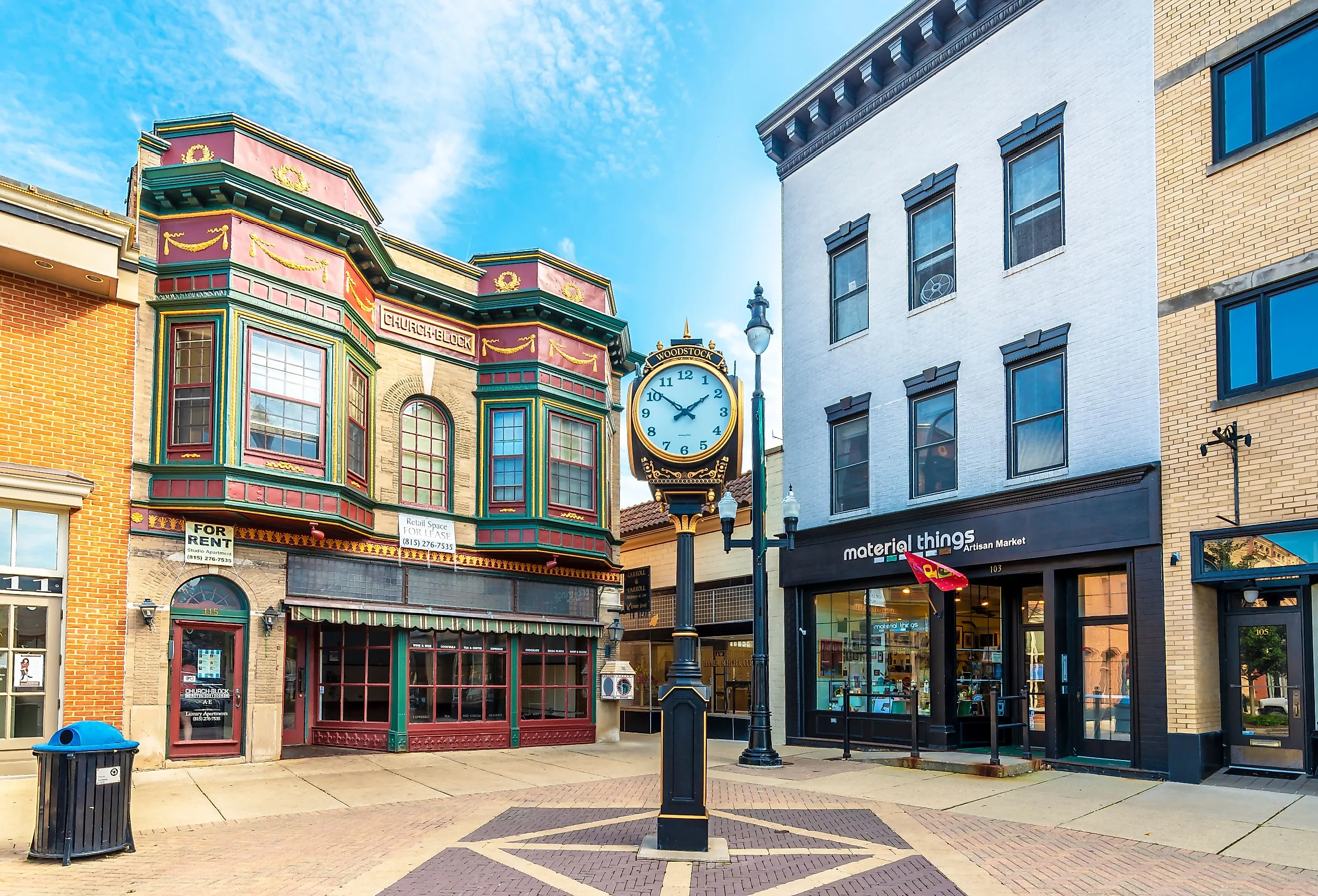
Woodstock already survived one round of fame. The town square played Punxsutawney in the movie Groundhog Day, and the Woodstock Square Historic District still looks exactly like it did on screen, which is why the National Register of Historic Places lists it. The square earns its keep twice a week in summer, when the award-winning Woodstock Farmers Market sets up on Tuesdays and Saturdays. Every vendor grows, raises, or makes what they sell. The honey is local, the cheese is local, and the prices beat any city green market.
The town backs the square with more than 500 acres of parkland. Emricson Park packs in a disc golf course, sand volleyball, ball diamonds, and a paved walking loop. Inside the same park, Woodstock Water Works runs an eight-lane lap pool, diving boards, and a kiddie pool. It is a public aquatic center with small-town admission prices, and that math gets better every summer.
Clinton

The C.H. Moore Homestead DeWitt County Museum is an 18-room Victorian mansion on 10 acres, and it comes with a period flower garden, a replica covered bridge, vintage barns, and a working blacksmith shop. That is a full museum campus in a farm town of 7,000, and on most summer days you will share it with almost no one. Clinton is what an agricultural hub looks like when it keeps its history instead of selling it.
The outdoor anchor is Weldon Springs State Park, 550 acres around a spring-fed lake with two miles of shoreline. Anglers pull sunfish, bluegill, and catfish from the fishing platform, and 75 designated campsites plus a primitive backpack site handle anyone who wants to stay over. For families, the Vespasian Warner Public Library runs a summer reading program that spills onto the lawn with inflatables and games. It is the kind of small-town institution that big suburbs spend millions trying to imitate.
Fulton

Heritage Canyon rebuilt the 1800s inside a 12-acre limestone quarry. The walk-through village has a church, a blacksmith shop, and a schoolhouse, and costumed reenactors sometimes work the grounds. Admission is free, and the quarry walls keep it shaded even in August. It is one of the best history stops on the Upper Mississippi, and it sits in a town most of the state drives past.
Fulton's Dutch settlers left a bigger landmark on the levee. The De Immigrant Windmill was built in the Netherlands, shipped across the Atlantic, and reassembled piece by piece above the Mississippi. Free tours run from May through October, and the millstones still grind. Next door, the Andresen Nature Center adds hands-on wildlife exhibits and short trails, which makes Fulton an easy full day with grandchildren in tow.
Alton

The Christian Hill Historic District stacks more than 250 heritage buildings up Alton's river bluff, most of them Victorian, threaded with steep staircase streets and the 1838 Greek Revival home of a former mayor. Inside the district, Riverview Park delivers the payoff: a sunken garden, a concert gazebo, and the widest Mississippi panorama in the region. The view alone justifies the drive, and summer concerts make it a habit.
Alton spreads the rest of its appeal across serious acreage. Gordon Moore Community Park covers 704 acres and hides an oriental garden with a koi pond, a pagoda, and a waterfall on its south side. A few miles northeast, the 18-hole Cloverleaf Golf Course has been run by the same family since 1931 and bills itself as the oldest family-owned and operated course in the United States. Green fees stay modest, and tee times stay available, which is more than the suburbs can say in July.
Zion

Zion Nostalgia Days has filled the streets with classic cars, custom trucks, and vintage motorcycles since 1987, and it remains a genuine local show rather than a tourist product. That is Zion in one event. The town sits under 50 miles from Chicago, yet it guards the rarest thing on Lake Michigan: undeveloped shoreline.
Adeline Jay Geo-Karis Illinois Beach State Park runs 6.5 miles of sand along the lake, backed by marsh and oak forest instead of condominiums. The park takes campers, including RVs, and its shaded trails and swimmable water absorb summer visitors without ever feeling like a resort. In the center of town, the 132-acre Shiloh Park stacks tennis courts, ball diamonds, and picnic cottages around Port Shiloh Pool, where a tube slide and splash pad handle the kids. The lakefront does the rest.
Kewanee

Kewanee Hog Days arrives every Labor Day weekend with a parade, people in pig costumes, and what organizers bill as one of the largest outdoor barbecues anywhere. The town has thrown this party since the 1950s, and it closes the summer the way a farm county should. Show up hungry and skeptical, and leave convinced.
The rest of the season belongs to Johnson-Sauk Trail State Recreation Area north of town. The 58-acre lake runs 21 feet deep and holds heavy populations of crappie, bullhead, and channel catfish, with nearly four miles of trails crossing rolling prairie and pine plantings around it. The landmark is Ryan's Round Barn, finished in 1910 for a Chicago surgeon's Black Angus herd. It stands more than 80 feet tall and 85 feet across, one of the largest round barns in the country, and volunteer guides still open it for tours on select summer Saturdays. Closer to town, Windmont Park wraps a walking path around a fountain-fed fishing pond for the quiet evenings in between.
Lisle

The Morton Arboretum is a 1,700-acre living museum with a hedge maze, giant outdoor art installations, 16 miles of trails, and one of the oldest preserved prairies in the country. It would be the headline attraction in any town in Illinois. In Lisle, it is simply the backyard. Despite sitting next to Naperville, one of the largest suburbs in the state, Lisle stays calm in summer because the trees absorb the traffic.
The town backs the arboretum with real recreation. Sea Lion Aquatic Park runs zero-depth, vortex, lap, and leisure pools plus drop and flume slides, a full water park at park-district prices. The 110-acre Community Park sits next door with lakeside paths and courts for tennis and basketball. Big-city amenities with small-town crowd levels is the whole pitch, and Lisle delivers it better than almost anywhere in the Chicago orbit.
The Quiet Side of a Loud Year
The centennial crowds will pack the museums of Route 66 and the new campus on the South Side, and they are welcome to both. The better summer is the one where bison graze beside the trail at Buffalo Rock, a swinging bridge bounces underfoot in Pontiac, and a windmill grinds grain above the Mississippi at Fulton. These nine towns prove the point every July. The state's best season does not require a ticket, a reservation, or a parking garage. It requires a tank of gas and a willingness to stop where the buses do not.