9 Best Downtowns In Missouri
Missouri’s nine best downtowns reflect the state’s deep roots in frontier settlement and Civil War history, all set against a landscape of broad waterways and Ozark scenery. Hermann stands out along the Missouri River with its dense historic district of more than 150 preserved buildings and the hillside stone cellars of Hermannhof Winery. Ste. Genevieve offers a similarly historic experience along the Mississippi River, where rare French colonial landmarks like the Green Tree Tavern and Louis Bolduc House sit within a few walkable blocks.
Hermann

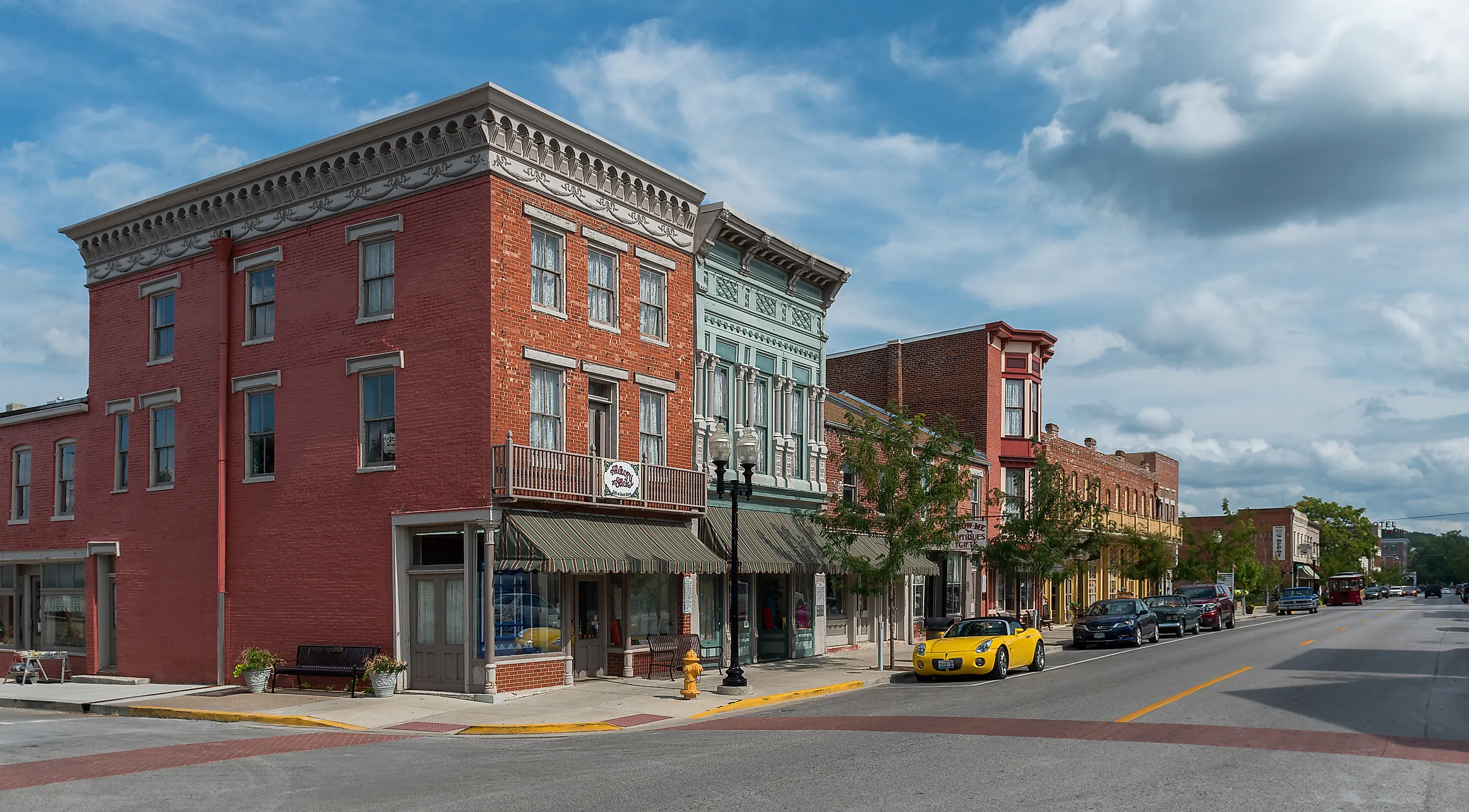
German immigrants founded Hermann in 1837 along the southern bank of the Missouri River. Downtown’s Wharf Street runs parallel to the water, with brick and stone warehouse buildings that once handled river and rail freight after the Pacific Railroad reached town in 1855. One block uphill, Market and Schiller streets compress into a dense historic district containing more than 150 preserved 19th- and early 20th-century buildings. Thick masonry walls, arched openings, and multi-story façades reflect a town built on wine production and agricultural trade. The Hermannhof Winery, founded in 1852 and listed on the National Register of Historic Places, sits on Frene Creek and includes ten stone cellars cut into the hillside within downtown. A ten-minute walk away, the Deutschheim State Historic Site preserves original 1840s residences and outbuildings that document the town’s German settlement. Among the historic buildings are a number of inns and bed & breakfasts, including The Schiller House, which was built atop an 1880s bowling alley.
Ste. Genevieve

Long before Missouri achieved statehood, French Canadian settlers established Ste. Genevieve along the western bank of the Mississippi River. On the edge of the downtown area is the Ste. Genevieve National Historical Park, a National Historic Landmark District recognized as the state’s oldest permanent European settlement. Within a few walkable blocks, stand rare examples of 18th-century French colonial “poteaux-en-terre” construction, featuring vertical log posts set directly into the ground. The 1790 Green Tree Tavern remains the oldest verified building in Missouri, preserved within the park alongside the 1792 Amoureux House and the 1793 Louis Bolduc House. Ste. Genevieve’s history extends beyond the park to Main Street and 3rd Street. Among the businesses found here is The Anvil Saloon & Restaurant, which has been serving since 1855.
Weston

Many of the structures in downtown Weston were standing during, and even before, the California Gold Rush, giving the town a nostalgic, gritty historic texture. The historic buildings include the Weston Brewing Company, which traces the town’s beer heritage back to 1842; its 24-barrel system dates to 1997-1999. O’Malley’s 1842 Pub, located in the same space 50-55 feet below street level, serves its ales in a room carved into the bedrock. Near the end of Main Street, Western Tobacco sits in an old warehouse and hosts a couple of the more popular annual downtown events, including Tobacco Fest and Whiskey Fest. Neighboring the warehouse are rows of 19th-century brick buildings, stacked side by side, home to boutiques like The Celtic Ranch and cafes like the Weston Coffee Roastery. Also along Main Street is The Weston Historical Museum, which showcases Civil War and Native American artifacts, vintage clothing, a working gramophone, and a WWI quilt signed by Edith Wilson.
Marceline

Highway 5 funnels straight into downtown Marceline, where Kansas Avenue runs past late-19th- and early-20th-century storefronts tied to Walt Disney's childhood. The commercial core centers on Ripley Square, with Main Street U.S.A. running beside it. The latter is widely seen as a nod to the design Disney later re-created at Disneyland. Many of the buildings standing today were already in place when the Disney family lived here from 1906 to 1911, and the Zurcher Building is widely cited as inspiration for Disneyland’s Coke Corner. A few steps from the square, the Walt Disney Hometown Museum finds its home in the restored Santa Fe Railroad Depot. Inside are roughly 4,000 artifacts connected to Disney and his family. A few blocks from Ripley Square, Walt Disney Municipal Park adds open green space to downtown, with a swimming pool, playground, volleyball court, and Marceline Country Club Lake directly adjoining the park grounds.
Branson

Branson is one of the Ozarks' best-known destination towns, in part thanks to attractions located outside of downtown, such as the Titanic Museum and Dolly Parton’s Stampede. But Branson’s historic downtown core is filled with the same kind of energy, brought together by a free trolley system that loops through several times a day. Along Main Street, Dick’s 5 & 10 has been a landmark since 1961, drawing visitors with its more than 50,000 items, from vintage toys to souvenirs. Just steps away, The Flagstore stocks hundreds of flags, and Fashion House on Veterans Boulevard showcases designer women’s apparel from Joseph Ribkoff, Cartise, and others. A short walk connects to Branson Landing, a 1.5-mile boardwalk along Lake Taneycomo, where the water and fire fountains and hourly music-and-light shows bring riverfront energy directly to downtown.
Carthage

The Jasper County Courthouse’s Romanesque Revival architecture is a standout in downtown Carthage. The 1894-95 building, constructed of local Carthage marble, is listed on the National Register of Historic Places. Its towers and arches rise above the square, where historical markers and plaques explain Carthage’s Civil War history, including the 1861 Battle of Carthage fought west of the Mississippi. Inside the courthouse, a wrought‑iron cage elevator still moves between floors and exhibits such as the “Forged in Fire” mural portray county history and Route 66 artifacts. One block off Main Street, the Civil War Museum displays artifacts, dioramas, and murals about the battle and the region’s wartime role, anchoring downtown’s historical narrative within a few walkable blocks of the courthouse. Central Park is nearby, along with numerous restaurants and cafes, such as Maple Leaf Coffee House & Creperie, which attract visitors traveling on Route 66, which cuts right through town.
Boonville

Historic downtown Boonville lies along the northern bank of the Missouri River, where Main Street’s brick façades frame a mix of 19th‑ and 20th‑century architecture. Thespian Hall on Main, built in 1855-57 and listed on the National Register of Historic Places, is one of the oldest theaters still in use west of the Alleghenies and hosts concerts, plays, and the Missouri River Festival of the Arts. A few blocks away, the River, Rails & Trails Museum in the historic Depot District traces Boonville’s role in steamboat, railroad, and early trail transportation. While Boonville's downtown has plenty of shops and historic places to explore, its green spaces, such as Bell's View Park and Johnstons Park, provide immediate access to nature. Cobblestone Street Park and Water Street Dog Park give visitors and locals alike sweeping views of the Missouri River just a couple of blocks from the downtown core.
Hannibal

Walking through downtown Hannibal offers a first-hand look at the origin of one of America’s greatest authors and the work he created. The Mark Twain Boyhood Home & Museum preserves the actual house where the author (born Samuel Clemens) lived from 1844 to 1853, along with the Huckleberry Finn House and the Becky Thatcher House, all of which sit within steps of the compact downtown core, which rests directly beside the Mississippi River. The town became one of Missouri’s busiest river ports in the 19th century after its founding in 1819. That history still carries through in the commercial buildings along North Main Street in the Historic District. The area contains many original, replicated, or refurbished Italianate and Beaux Arts façades, which feature arched upper windows and detailed brickwork. Along North 3rd Street, Jim's Journey: The Huck Finn Freedom Center expands the Mark Twain literary experience with exhibits centered on Jim’s story. Down the street, amongst the trees, stands the Mark Twain Memorial Lighthouse, which can also be seen from the Mark Twain Riverboat, which boards passengers for cruises along the same stretch of river that fueled the district’s economic rise.
Excelsior Springs

Broadway Avenue runs through Excelsior Springs’ historic downtown, lined with red brick buildings from the early 1900s. Murals along the façades depict scenes from the town’s mineral-water past, while cafés like The Mug sit in restored storefronts. The Art Deco Hall of Waters dominates the block, its 1937 façade marking the former site of “the world’s longest water bar.” Inside, museum exhibits trace the town’s spa-town legacy and the role mineral waters played in 19th- and 20th-century wellness culture. Fishing River Linear Park runs behind the Hall, connecting downtown businesses to ball fields, playgrounds, and basketball hoops, and is adjacent to nearby trails in Isley Park Woods and Siloam Mountain. The Elms Hotel & Spa, originally established in 1888, with the current hotel opened in 1912, continues the town’s mineral-water tradition with the Grotto hydrotherapy area, massages, facials, and halo therapy. High-profile historical guests include Harry S. Truman, Al Capone, Pretty Boy Floyd, and Bugsy Moran.
Missouri’s downtowns host 19th-century theaters, railroads, and riverfront streets that shaped commerce and culture. Hannibal’s Mississippi-adjacent core preserves Samuel Clemens’ boyhood home, the Huckleberry Finn House, and the Jim’s Journey museum, all within steps of arched Italianate façades along North Main Street. Carthage’s Romanesque Jasper County Courthouse rises above the square, while one block away, the Civil War Museum preserves battle artifacts. These are just a few starting points for exploring the state’s layered downtowns and the stories woven into their streets.