8 Wyoming Towns Where Time Stands Still
In Wyoming, where many towns grew up along the Union Pacific Railroad in the late 19th century, and it is still common to find an active railroad depot near downtown and century-old buildings that reflect the spirit of the Wild West. Take Evanston, where traces of its railroad heritage remain visible in the restored Union Pacific Train Depot and in the town’s mix of frame and brick buildings, giving it an enduring sense of continuity. The eight Wyoming communities on this list invite visitors to step into places where history is on full display.
Pinedale

Sublette County’s administrative center, Pinedale, set against the western slope of the Wind River Mountain Range, is a leading hunting outfitting town with ties to the region's deep mountain-man history. Since its establishment in the late 19th century, thanks to the local ranchers John F. Patterson, Charles A. Petersen, and Robert O. Graham, this small ranching and supply town has been serving settlers, fur trappers, and traders who travelled through the Green River Valley. Every year on the second full weekend in July, the town hosts Green River Rendezvous, a reenactment of the historic gatherings of mountain men, fur traders, suppliers, and buyers at the Upper Green River Rendezvous Site.
The Museum of the Mountain Man, open in the warmer months, focuses on the region’s fur-trading past through exhibits about the mountain men who surveyed the region from the early to the mid-19th century. The nearby Sommers Ranch Homestead welcomes travellers for a glimpse into the ranching heritage of the families living in the Upper Green River Valley. For outdoor activities, Fremont Lake is Wyoming’s second-largest natural lake and a popular spot for fishing, water skiing, and kayaking in its clean waters, while hikers and climbers are especially drawn to the Wind River Range. After a hectic day outside, the Wrangler Cafe is a reliable stop for a casual meal, especially for its spicy burgers and blueberry pancakes.
Kemmerer

Kemmerer, named by founder Patrick J. Quealy in honor of his financial backer, Mahlon S. Kemmerer, developed as a coal-mining town built around the needs of a railroad and proximate coal mines. Located at the center of this Lincoln County seat is the Herschler Triangle Park, a site featuring more than 100-year-old buildings from the town’s boom period. Near the Triangle Park in the J.C. Penney Historic District is the J.C. Penney House, where Mr. James Cash Penney resided with his family from 1904 to 1909. Also close by is the original J.C. Penney store, called the ‘Mother’ store/Golden Rule Store, which has been in operation since 1929.
Not far from the town is the Fossil Butte National Monument, encompassing just 13 sq. mi. of an ancient fossil lake that once spanned 900 sq. mi. It preserves the finest fossil record of aquatic life from the Cenozoic Era. At the Visitor Center, tourists can inspect hundreds of fossils and fossil casts on display, try making fossil rubbings to take home, and learn about the monument’s geology and natural history via a computer program.
Lander

Christened for the transcontinental explorer General Frederick William Lander, who surveyed the Lander Cutoff of the Oregon Trail, this government seat of Fremont County developed as a supply town in the vicinity of the Oregon Trail route. The town celebrates its cultural and historical roots through interesting landmarks in downtown, such as the Fremont County Pioneer Museum and the Museum of the American West. The Fremont County Pioneer Museum tells the story of early settlers from prehistory to the 1920s through well-preserved artifacts, while the 1998 Museum of the American West uses historic structures and interactive exhibits to enlighten visitors about the diverse people who shaped the American frontier.
Lander’s location at the base of the Wind River Mountains has been instrumental in attracting outdoor recreation enthusiasts from near and far. Sinks Canyon State Park hypnotizes visitors with hiking trails and picnic spots, as well as the uncommon phenomenon of the Middle Fork of the Popo Agie River disappearing into an underground limestone cave and reappearing farther down the canyon in a pool. A short distance away, the Wind River Wild Horse Sanctuary offers visitors a 45-minute tour to observe wild horses in a free-roaming environment on the functional cattle ranch of the Oldham Family.
Evanston

Founded in the late 1860s as a quaint railroad town along Union Pacific’s transcontinental railroad, built to service stretches of an expanding railway line, Evanston is the current center of administration of southwest Wyoming’s Uinta County. The town’s fascinating historical attraction is the Union Pacific Railroad Complex, which features a mix of frame and brick buildings. The frame buildings include a woodworking shop, a company store, and an office, whereas the still-standing five brick structures are a roundhouse, a mineral building, a machine shop, a storehouse, and a gas building.
Within walking distance of the railroad complex is the Uinta County Museum, where visitors get an insight into the old days of Uinta County and the surrounding region. The Depot Square is the site of the Chinese Joss House Museum, a reconstruction of an original Chinese temple. Through its collection of artifacts from the 19th and 20th centuries, historical photographs, archaeological discoveries, and a replica of Evanston’s Chinatown, the museum chronicles the story of the county’s Chinese immigrants. On the eastern outskirts of the town, Bear River State Park offers a tranquil experience, with hiking trails, a visitor center, picnic grounds, and wildlife-viewing opportunities.
Cody

Situated in the state’s northwestern portion by the Shoshone River, around 50 miles from the eastern entrance of Yellowstone National Park, Cody was established by Colonel William F. ‘Buffalo Bill’ Cody, who traversed the region in the 1870s. Deeply impressed by the enormous development prospects of the settlement, Colonel Cody returned to lay out the town in 1896. The Buffalo Bill Center of the West is the principal place to learn about the town’s history, with five outstanding museums and a world-class research library under one roof. The museums: Buffalo Bill Museum, Plains Indian Museum, Cody Firearms Museum, Whitney Western Art Museum, and Draper Natural History Museum, in addition to the McCracken Research Library, cover everything from American West histories, Plains Indian cultures, early firearms, Yellowstone ecosystems, and frontier art, without feeling overly curated.
Right down the street, Old Trail Town spotlights original frontier buildings, including cabins, saloons, blacksmith shops, and other structures that illuminate how the town looked and how people lived there in the early years. As the ‘Rodeo Capital of the World,’ the town hosts the action-packed Cody Nite Rodeo nightly during the summer, showcasing the skill, fearlessness, and sportsmanship of both amateur and professional riders. Similarly, the Cody Stampede Rodeo, one of the long-running professional rodeos, is hosted every year over the Fourth of July at Stampede Park.
Buffalo

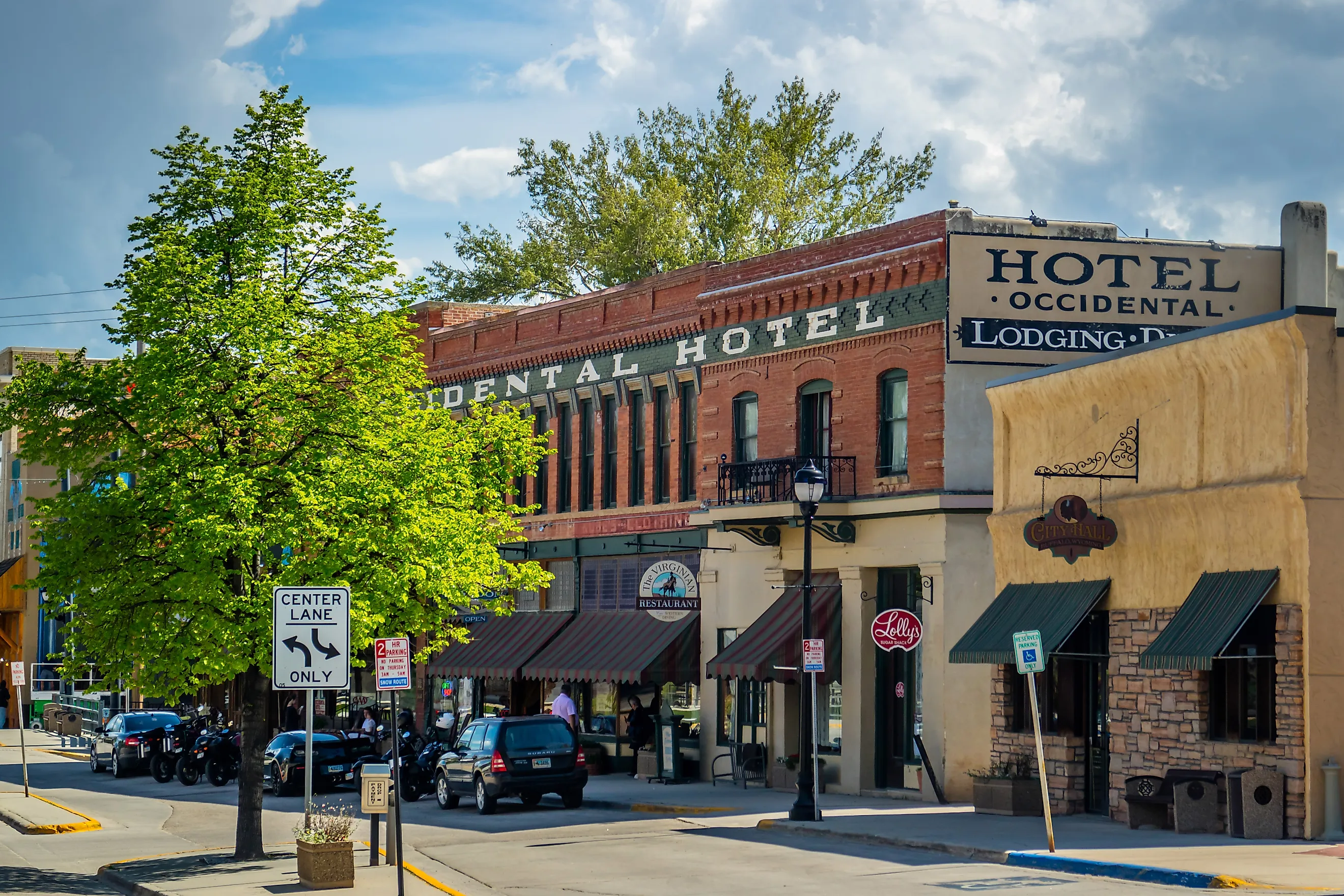
Precisely set at the base of the Bighorn Mountains in north-central Wyoming’s Johnson County, Buffalo took shape in the late 19th century with the establishment of Fort McKinney for the protection of miners and white travelers along the Bozeman Trail. Over time, the town became linked to one of the region’s most well-known frontier conflicts, the 1892 Johnson County Cattle War, with the final battle site located about 13 miles south. Today, the first stop for all tourists in this town is the Occidental Hotel on Main Street. Also called ‘The OX,’ the 1880 Occidental Hotel is Buffalo’s most renowned landmark hotel and still carries its original interiors, a 1908 historic saloon, the Virginian Restaurant, and the Busy Bee Breakfast Café.
Ever since it was founded, the Occidental has attracted the likes of President Teddy Roosevelt, outlaws Buffalo Bill Cody, Calamity Jane, Butch Cassidy, and Sundance Kid, cattle detective Tom Horn, and frontier sheriffs Frank Canton and ‘Red’ Angus. Additionally, the 1909 Jim Gatchell Memorial Museum showcases a wide variety of Native American artifacts, household items, frontier weapons, ranching gear, and wagons, in addition to dioramas focusing on historic events along the Bozeman Trail.
Green River

The Green River townsite, primarily a part of the Dakota Territory, was platted in 1867 by the Union Pacific Railroad for workers and travelers moving to the west. Over the years, the town developed into a steady community supported by the Green River Basin, trona mining, and wide-open landscapes. Tourists looking to uncover the past should head to downtown Green River, home to Expedition Island. This public park is a designated National Historic Landmark that memorializes the river expeditions started from the island in the late 1860s by Major John Wesley Powell.
At the Sweetwater County Historical Museum, find out more about the county’s rich heritage through both temporary and permanent exhibitions on Native Americans, early settlers, outlaws, and the mining period in the museum galleries. Just a 15-minute drive from the town, the Flaming Gorge National Recreation Area allows fishing, paddling, and boating activities on the Flaming Gorge Reservoir and rafting on a part of the Green River downstream from the Flaming Gorge Dam.
Laramie

Placed on a high plain at an elevation of 7,200 feet, between the Snowy and Laramie Mountain Ranges, Laramie was founded as a tent city in the mid-1860s, in the vicinity of the Overland Stage Line route. In due course, the settlement became the cultural and economic nucleus of the Wyoming Territory, as well as home to the University of Wyoming’s main campus. The National Register-listed Laramie Downtown Historic District includes several railroad-related structures and contributing buildings dating to Laramie’s earliest days, such as the Original Courthouse, the Ivinson Mansion (now the Laramie Plains Museum), and the 19th-century St. Matthew’s Cathedral.
Also in Downtown is the Wyoming House for Historic Women, which recognizes the achievements of 13 women belonging to the State of Wyoming. Among them is Louisa Swain, the first woman in the United States to vote in a general election in 1870, and Esther Hobart Morris, one of the country’s first female justices of the peace. Right outside town is the Wyoming Territorial Prison State Historic Site, centered on the 1872-built Wyoming Territorial Prison, offering first-hand views of frontier justice and the lives of notorious inmates in the late 19th century.
These Wyoming Towns Are Full Of History
From Pinedale, where everyday life revolves around the Museum of Mountain Man and plentiful outdoor recreation, to Buffalo, where the Old West theme is evident in well-kept Main Street attractions and deep-rooted ranching culture, these Wyoming towns remain anchors of continuity in this rapidly urbanizing world. For wanderers seeking to chase frontier legends, uncover preserved histories at dusty museums, experience authentic cultures, and behold untamed scenery, Wyoming’s small towns leave lasting impressions on every visitor, proving that the prime escapades are those that take one back in time.