9 Best Small Towns To Retire In Portugal
Retirees have discovered there's a lot "Moor" to Portugal than just coastal sunshine and Moorish architecture. Situtated on the Atlantic elbow of mainland Europe, Portugal's relatively low cost of living offers many the chance to retire in comfort if not outright leisure, in regal surroundings. Whatever your priorities are in a future hometown, odds are that Portugal could exceed your expectations. Let these nine towns spark the imagination as you consider the setting for life's next chapter.
Lagos

Lagos is a celebrated coastal town known for its rich history and its beautiful beaches. The coastlines here are some of the finest in the world with majestic rock formations, and sea arches known as the Ponta da Piedade. By going out on a kayak or taking a boat tour, you can find caves and grottos you can't see from the beaches. The easiest of these highly acclaimed beaches to reach is Meia Praia, which stretches out for kilometers along the eastern side of town. You can see how this place became an epicenter of activity during the Age of Exploration in the 15th century.
The history of Lagos supposedly goes as far back as 2,000 years before the birth of Christ. A stroll through Old Town takes you along cobbled streets beside walls dating back hundreds of years through ancient town squares (now filled with lively shops and eateries), past a waterfront fortress, baroque churches, museums and a sea of culture. Walking is an easy and practical means to get around because the town itself is relatively flat, although driving and ride sharing is also an option that's relatively inexpensive. A mild Mediterranean climate means hot, dry summers and warm, wet winters. And the cost of living is relatively low for American expats, with a couple generally spending about €2,300 to €3,200 monthly for all their expenses.
Tavira

Perhaps the most popular region for retirees for its beautiful sunshine more than 300 days a year, its high rate of English speakers, and its already established expat community. This is a city of many churches, ancient convents, hermitages, and chapels, exceptional for their many different eras and styles. Here is a living testimony to the evolution of Portuguese religion and art. In a sense, this entire city is an open air museum. The Ribeira Market, built in 1887 along the bank of the River Gilão, is still alive with shops, restaurants, and even hosts concerts and shows on occasion inside its historic courtyard.
The landscape here, like much of the surrounding area, includes both beautiful coastlines (more than 18 kilometers of coastline) and mountains, which are marked by white houses spread across the hills. Traditional fruit trees are abundant here, such as carob, almond, fig trees, and olive groves. These are all essential elements of local confectionery. There are streams flowing around the town, and the peaceful waterfalls of Vale da Assêca. And, at the foot of the mountains, the Conceição de Tavira Forest Perimeter Leisure Park stands as a place where nature and culture meet and can be enjoyed. The cost of living here averages about €2,000 to €2,500 monthly for a couple to live comfortably.
Nazaré

The name Nazaré is the Portuguese version of Nazareth, the biblical city. According to legend, the town takes its name in honor of a small wooden statue of the Virgin Mary brought there from Nazareth by a monk in the 4th century. After arriving, the monk decided to live on as a hermit beside the high crashing waves. (As of 2025, the record for the tallest wave ever surfed stands at a wave measured at 26.2 m at Nazaré.) And to this day, a 10 day religious and secular celebration is held, the Our Lady Of Nazaré Festival, complete with processions, bullfights, fireworks, folk dancing, and a fair.
The sea is a predominant feature, and the light that reflects off the water makes the town seem to gleam. Countless artists have come to capture some of this rare beauty, and it remains a hotbed of artistic activity. The predominant trade here remains focused on the sea, whether that be shipbuilding, navigation, fishing, or even folklore. The Sítio da Nazaré is the high point of town, literally speaking. Up there, at the Suberco viewpoint, your gaze is lost in one of the most beautiful maritime panoramas in Portugal. Then the Praia, the lower part of town along the coast, is the original nucleus of this village, and it has a lively seaside promenade, narrow neighborhood streets, and salt air with the delicious smell of seaside savory dishes.
The cost of housing is the largest variable here with some places costing rather more than others. A couple can live here for about €2,000 to €2,500 monthly, but it is also easy to spend more than €3,000+ monthly for a luxury lifestyle.
Guarda

This is Portugal's highest city, perched atop the Serra Estrela Mountains and founded in 1199 by King Dom Sancho I. Guarda remains a stronghold of medieval history, Jewish culture, and enduring loveliness. Perhaps the best view can be gained from The Keep, also known as Guarda Castle, which dates back to the 13th century, and sits at an altitude of 1056 m. There you can see the entire city and the wooded surrounding region like a scene from a tapestry. Down below, within the city's granite walls, the Old Jewish Quarter still exists. There is evidence to suggest it also dates to the 13th century. The Jewish community in Guarda was for a long period one of the country’s most important Jewish communities and remains one of the oldest.
The area is surrounded by the UNESCO Estrela Geopark filled with granite outcroppings, lush green mountain vegetation, and accessible by ancient trails and shepherd routes. In November of 2022, Guarda proudly opened the Mondego Walkways, wooden walkways for miles along the Mondego River and its tributaries, including three suspension bridges, for the best views of the most breathtaking natural landscapes and welcoming mountain villages beyond.
Summers are still warm, but at such an altitude, the winters are among the coldest and snowiest in Portugal. And the cost of living is likewise among the lowest in Portugal. A couple can live in comfort here for just €1,200 to €1,800 monthly. Owning a car is helpful for getting down the mountain and visiting other regions, but buses and trains are also available and are quite economical. Shopping is also very affordable , and whether you're cooking at home or dining out, you can expect the food and wine to be excellent.
Tomar

Tomar was once the seat of the Order of the Knights Templar and remains the seat of the Templar Castle and Convent of Christ, one of the greatest achievements of the Portuguese Renaissance. Its Convent was built in the 12th century, like the castle, which was at the time the Kingdom’s most up-to-date and advanced military set-up, inspired by the fortifications of the Holy Land. It was converted into a Chancel during the restoration works ordered by King Manuel I in the 16th century, when the complex gained the architectural splendor, kept intact to this day, which earned it World Heritage Site status.
From the castle you walk down through the Sete Montes Woods to the historical heart of Tomar, the Praça da República, a medieval town laid out like a cross upon a compass. To the west is the Templar Castle, and to the east is the Main Church dedicated to St. John the Baptist. The streets are lined with traditional shops, including the oldest café. Local pastries delight the senses (like almond and squash cheese cakes and the traditional "Tomar slices").
Like most of Portugal's towns, Tomar enjoys a temperate climate with hot summers and wet winters but generally remaining a beautiful place to be outdoors most of the year round. And being further inland, a couple can live in this historical city quite comfortably for about €1,600 to €2,300 monthly even with frequently dining out and enjoying all that the town has to offer.
Ericeira

Ericeira is the town in Portugal for surfing expats. This former fishing village has become one of Portugal’s main beach and surfing towns, and Europe’s first and only World Surfing Reserve. Surfers from all over the world head here to the golden Ribeira d’Ilhas Beach year round. This is even one of the World Qualifying Series (WQS) sites for surfing and often hosts additional national championships. But amateur surfers are welcomed here too. Come as you are and you’ll find surf camps for lessons, and board and wetsuit rentals.
While the beaches (in particular the Praia dos Pescadores or "Fisherman's Beach") are the main attraction of Ericeira, the main town is charming, having maintained its traditional fishing village vibe and also evolved a cosmopolitan side. It's warm and sunny here; perfect for beach bums well through September each year. The cost of living for this kind of lifestyle is slightly higher than some other towns in Portugal, but a couple can still live well on about €2,300 to €3,300 monthly here in Ericeira.
Águeda

Águeda is the "Umbrella Town," where bright colored umbrellas hang overhead, all over town, and especially on Luis de Camões Street, "one of the most beautiful streets in the world." Every year, hundreds of national and international artists come here to take part in the AgitÁgueda Art Festival, an event that makes the entire city into a stage teeming with color, excitement, music, living statues, art installations, and many other iconic activities like the "Carnival After Hours" and Color Day.
This explosively artistic town sits beside the Pateira de Fermentelos Lagoon, has 5 cheerful rivers passing though that can be enjoyed in leisure parks and along hiking trails. Delights are to be found everywhere, including sweet confections whose traditions have been handed down from monasteries. The custards and flaky pastries have so wonderful a reputation that the town slogan here is, "Sweets that only Águeda has for you!"
The weather here is mild and pleasant most months of the year, and the cost of living is quite low. A couple can live here in leisure for about €1,500 to €2,200 each month. In fact, this is one of the more affordable places to live in western Europe.
Óbidos

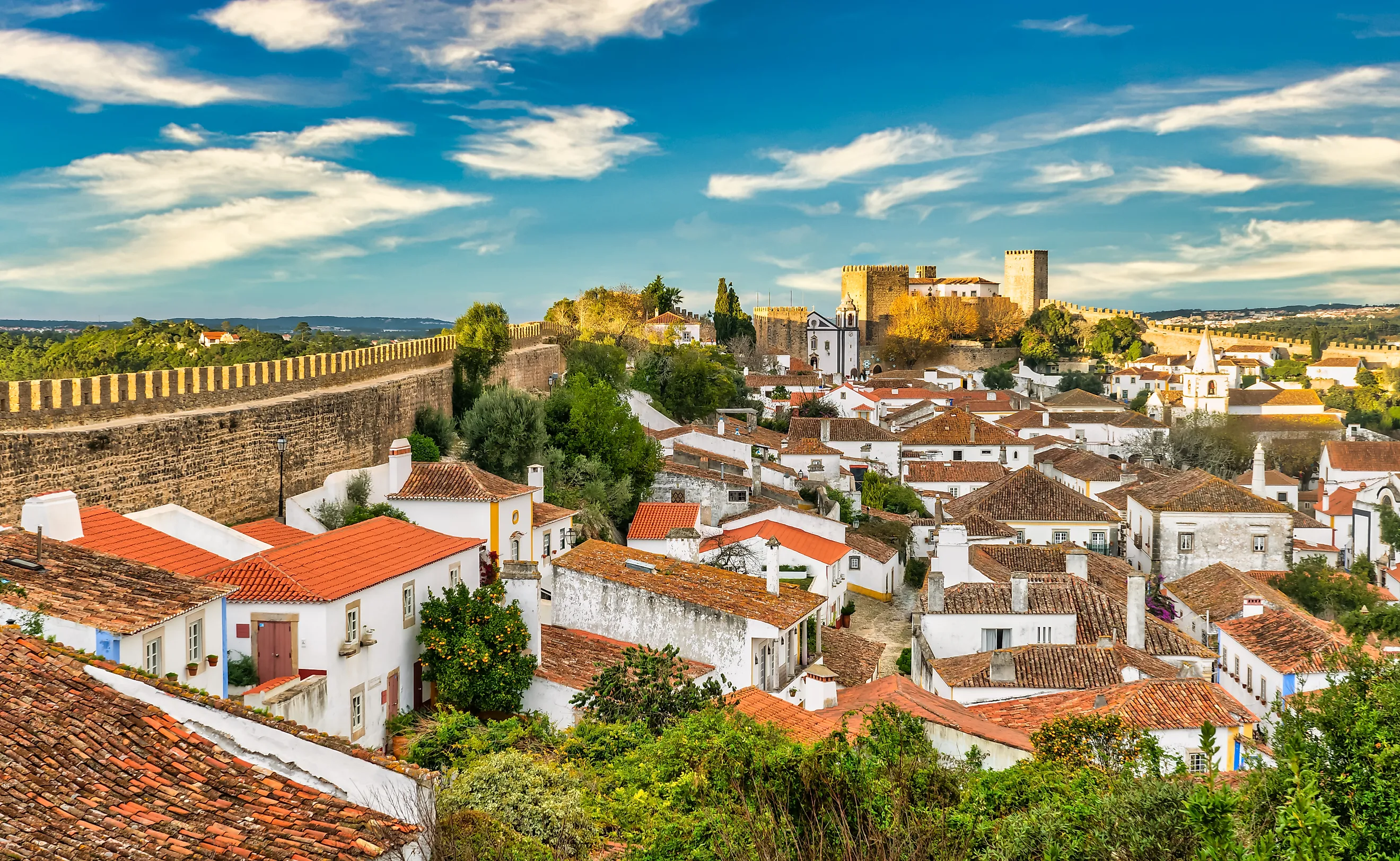
Óbidos is one of the best preserved villages in Portugal. Its location by the sea is so pleasantly situated, archeologists have confirmed that this area has always been inhabited from the Lower Paleolithic, through the recent Prehistory, to the Roman period, to today. Within the walls of the city is a well-preserved castle and a maze of streets filled with white houses, enclosed gardens, nooks and crannies. This village is itself a work of art that spans centuries.
Of course you can't miss The Castle, of Roman origins, dating perhaps as far back as the 12th century. This magnificent fortress sits at the heart of the city. Nor can you miss the Porta da Vila, the town gates and primary entrance to the town, built with staggering size and strength to repel a full cavalry charge. The gathering place in this fortified town is still the Praça de Santa Maria, a place of whitewashed beauty, narrow streets, extraordinary shops and eateries that receive praise far and wide.
The weather here is rarely too cold or too hot. And the cost of living for such storybook surroundings is remarkably reasonable. A couple can live here for about €1,700 to €2,500 monthly. The cost, you can imagine, varies largely on whether or not you're living within the historic center of town, or in one of the more modern villas that have grown up along the outskirts since the mid twentieth century.
Beja

Once a place of battles and conquests, Beja is now a place of quiet beauty and calm. This is the place for retirees and expats who favor well-defended peace and affordability above all else. Like something out of a gothic novel, the Tower of the Castelo de Menagem is the chief monument of Beja, standing 40 meters high and built entirely of marble. The view from this place is expansive because the area is known for its sprawling plains. You can easily see how this Tower helped to defend the borders of Portugal.
You can explore the history of this place more closely in the Museu Rainha D. Leonor, which is housed in the 15th century Convent of Nossa Senhora da Conceição. This museum offers rare glimpses of impressive religious exhibits including the famous Letters of a Portuguese Nun. And within and without the town of Beja, beautiful religious structures and even old ruins can be found.
Beja is considered a destination for hearty gastronomy, and the food is inspired by traditional peasant recipes and relies heavily on olive oil, pork, fresh breads, and aromatic herbs. The weather in the plains is warmer than along the coast. Summers have been known to pass with barely a drop of rain, and winters tend to be more crisp than damp. The cost of living is among the lowest in Portugal, and a couple can live on a budget of about €1,600 to €2,000 monthly. For this reason, you can also enjoy the camaraderie of a growing expat community in Beja.
Storybook Settings in Portugal for Life's Next Chapter
From the surf to the sweets, from the highest mountain peak to the most magnificent architectural feats, these nine towns can each, in very different ways, give a storybook setting to your next chapter. Which would you choose?