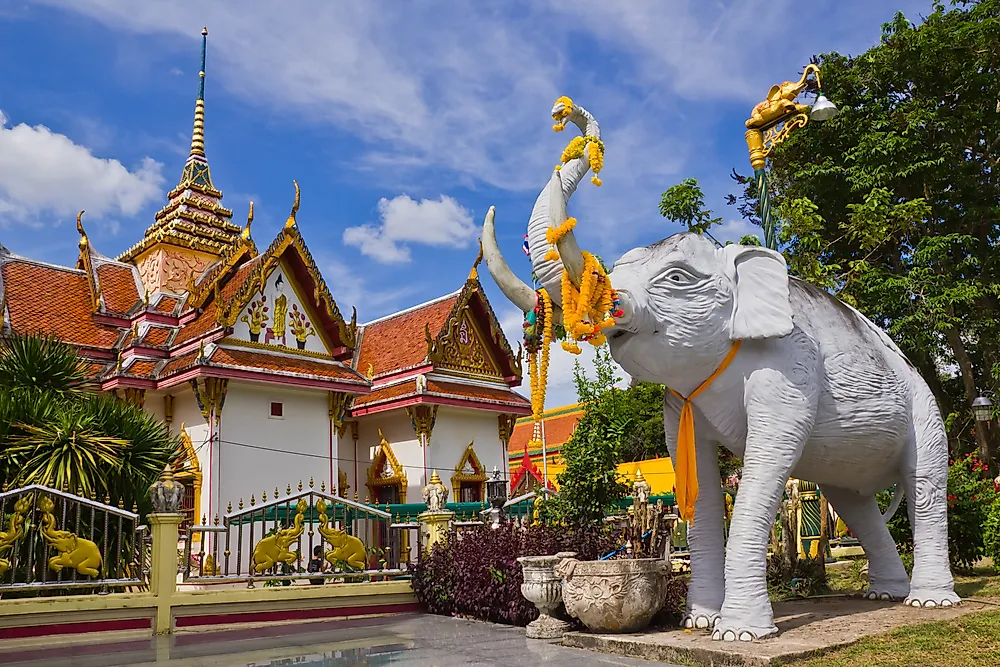
Which Country Is Known As The Land Of White Elephants?
- Thailand is known as the land of the white elephant.
- White elephants are not a distinct species, but rather elephants with unusually light skin.
- In Thai culture, white elephants in the king's possession represent the power and prosperity of his reign.
Thailand, officially the Kingdom of Thailand, is widely known as the Land of White Elephants because of a centuries-old royal tradition in which rare pale-skinned elephants are presented to the king as sacred symbols of legitimate rule. The country sits at the center of mainland Southeast Asia, bordered by Myanmar to the west and northwest, Laos to the northeast, Cambodia to the southeast, Malaysia to the south, the Gulf of Thailand to the southeast, and the Andaman Sea to the southwest. It covers about 513,120 square kilometers (198,117 square miles) and is home to approximately 71.9 million people, ranking around 20th globally by population. Thailand is the only mainland Southeast Asian country never colonized by a European power, and its monarchy is one of the world's longest continuously reigning institutions; the current Chakri dynasty has held the throne since 1782.
Identifying a White Elephant
White elephants are not a separate species and are not generally true albinos. The Thai term is chang phueak, literally "pale elephant," which is sometimes also rendered as chang samkhan ("auspicious elephant"). The animals in question are Indian elephants (a subspecies of the Asian elephant, Elephas maximus indicus) with unusually light skin that is typically a reddish-brown that turns pink when wet. The "whiteness" referred to in the Thai tradition has more to do with auspiciousness and ritual purity than with actual color.
Under the Wild Elephant Protection Act of 1921 (Buddhist Era 2464), the Thai state recognizes seven physical characteristics that distinguish an auspicious elephant: pale eyes, pale palate, pale toenails, pale hair, pale skin, pale tail hair, and pale genitals. Once a pale-skinned elephant is identified in the wild or in private ownership, royal palace experts evaluate the animal against these criteria. Behavior is also assessed: the elephant must be even-tempered and bear itself with what Thai tradition considers regal composure. If the elephant is certified as auspicious, it is presented to the king, who is its legal owner under Thai law regardless of where it was found.
Religious and Mythological Origins
The veneration of white elephants is far older than the Thai monarchy itself. The tradition has two ancient roots, one Hindu and one Buddhist, both stretching back more than 2,000 years. In Hindu mythology, the white elephant Airavata (known in Thailand as Erawan) is the mount of Indra, the king of the Vedic gods; references to Indra's elephant appear in the Rigveda, compiled roughly between 1500 and 1200 BCE. The Erawan Shrine in central Bangkok, dedicated to the four-faced Brahma figure Phra Phrom, takes its name from this same elephant, and the three-headed Erawan appears across Thai art, architecture, and royal iconography.
The Buddhist root is equally old. According to the traditional life of the Buddha, his mother Queen Maya dreamed of a six-tusked white elephant entering her right side during a midday nap; ten lunar months later she gave birth to Siddhartha Gautama, the future Buddha. The canonical account appears in the Lalitavistara Sutra, which reached its current form in the 2nd or 3rd century CE, and in earlier texts of the Mahavastu and Asvaghosa's Buddhacarita. Because of this dream, the white elephant is interpreted in Theravada Buddhism, the dominant form of Buddhism in Thailand, as a sign of moral authority and a marker of a chakravartin, or universal monarch. The mid-14th-century Thai Buddhist cosmological text Traiphum Phra Ruang, composed in the Sukhothai Kingdom, lists possession of a "gem elephant" as one of the attributes of the ideal universal ruler. The chronicles of the Ayutthaya Kingdom record the first official capture of a white elephant in Thailand in 1471 or 1472.
Symbolism in Thai Royal Tradition

In Thai royal tradition, the white elephant is simultaneously a religious symbol, a political symbol, and a piece of legal property. Possession of white elephants is taken as evidence that the king reigns righteously and that his kingdom is blessed with peace and prosperity. The more white elephants a monarch holds, the stronger this claim is. Historically, Burmese and Thai kings sometimes added "Lord of the White Elephants" or similar titles to their formal names; the third king of Burma's Konbaung dynasty took the regnal name Hsinbyushin, which translates literally as "Lord of the White Elephant."
The numbers of officially certified white elephants per reign vary widely. Under the current Chakri dynasty, ten white elephants were declared during the reign of King Rama I, six under Rama II, eighteen under Rama III, twelve under Rama IV, sixteen under Rama V, one each under Rama VI and Rama VII, and ten under King Bhumibol Adulyadej (Rama IX), who reigned for seventy years from 1946 to 2016. The first white elephant officially certified during the reign of the current king, Maha Vajiralongkorn (Rama X, crowned May 2019), was a male named Plai Ekachai, identified in 2018 at a conservation center in Maha Sarakham Province and formally presented to the king after the coronation. White elephants from previous reigns remain in royal care but are not counted toward the current monarch's collection.
The War of the White Elephant

The most famous historical episode involving white elephants is the Burmese-Siamese War of 1563 to 1564, often called the War of the White Elephants. King Bayinnaung of Burma's Toungoo dynasty, an aggressive expansionist whose armies had already overrun much of mainland Southeast Asia, demanded that King Maha Chakkraphat of Ayutthaya, then the ruler of Siam, hand over four of his white elephants as tribute. Chakkraphat refused, on the grounds that the elephants were sacred and could not be given as ordinary diplomatic gifts. Bayinnaung used the refusal as casus belli and invaded with what contemporary chroniclers describe as one of the largest armies ever assembled in Southeast Asia at that point.
The war ended with the siege and fall of Ayutthaya in February 1564. Chakkraphat was forced to surrender, ceded four white elephants and other royal items, and accepted vassal status under Burma. The Siamese kingdom regained full independence only after Naresuan the Great defeated and killed the Burmese crown prince Mingyi Swa in single combat on elephant-back at the Battle of Nong Sarai in 1593, an event still commemorated annually in Thailand as Royal Thai Armed Forces Day on January 18. The white elephant continued to anchor Thai national identity through the 19th century: between 1843 and 1917, the Siamese national flag depicted a white elephant on a scarlet field. The modern flag of the Royal Thai Navy still bears a white elephant.
The Origin of the English Idiom
Past Thai and Burmese kings were also known to give white elephants to courtiers or rivals with whom they were dissatisfied. Because the animals were sacred, the recipient could not put them to work, sell them, give them away, or have them killed; he could only feed and house them at his own expense, which was ruinous. Declining a gift from the king was unthinkable. This particular form of royal trolling is the origin of the English expression "white elephant," meaning an expensive possession that produces no benefit and that the owner cannot easily dispose of. The phrase passed into English in the 19th century, largely through colonial-era accounts of Siam published in Britain and the United States.
Modern Criticism and Conservation Concerns
The white elephant tradition has attracted significant criticism in recent decades. Animal-welfare advocates argue that capturing pale-skinned elephants from the wild and transferring them to royal conservation centers traumatizes the animals and disrupts the social structure of wild herds. The cost of maintaining white elephants in royal style, including staff, veterinary care, and ceremonial functions, has been criticized as wasteful in a country where significant portions of the population still live below the poverty line. The broader population of Asian elephants in Thailand has collapsed from an estimated 100,000 at the start of the 20th century to roughly 3,000 to 4,000 today, split between domesticated working animals and a small wild population in national parks. The Asian elephant (Elephas maximus) is listed as Endangered on the International Union for Conservation of Nature Red List, and Thailand's wild elephant population is one of the smallest in the species' range. The white elephant tradition remains culturally and religiously central to the Thai monarchy, but its modern practice exists in increasing tension with conservation and animal-welfare standards that have shifted significantly since the days when the chronicles of Ayutthaya were first recording royal elephant captures.