6 Of The Quietest Queensland Towns
Queensland holds tropical coastline at one end and arid Outback deserts at the other. The state is one of Australia's most varied. Six towns stand out for travellers looking for room to breathe. Ravenswood and Eulo carry their gold and opal histories in surviving heritage streetscapes. Ilfracombe and Aramac trade on pastoral and tramway legacies. Airlie Beach is the mainland gateway to the Whitsundays without the festival-week crowds.
Ravenswood

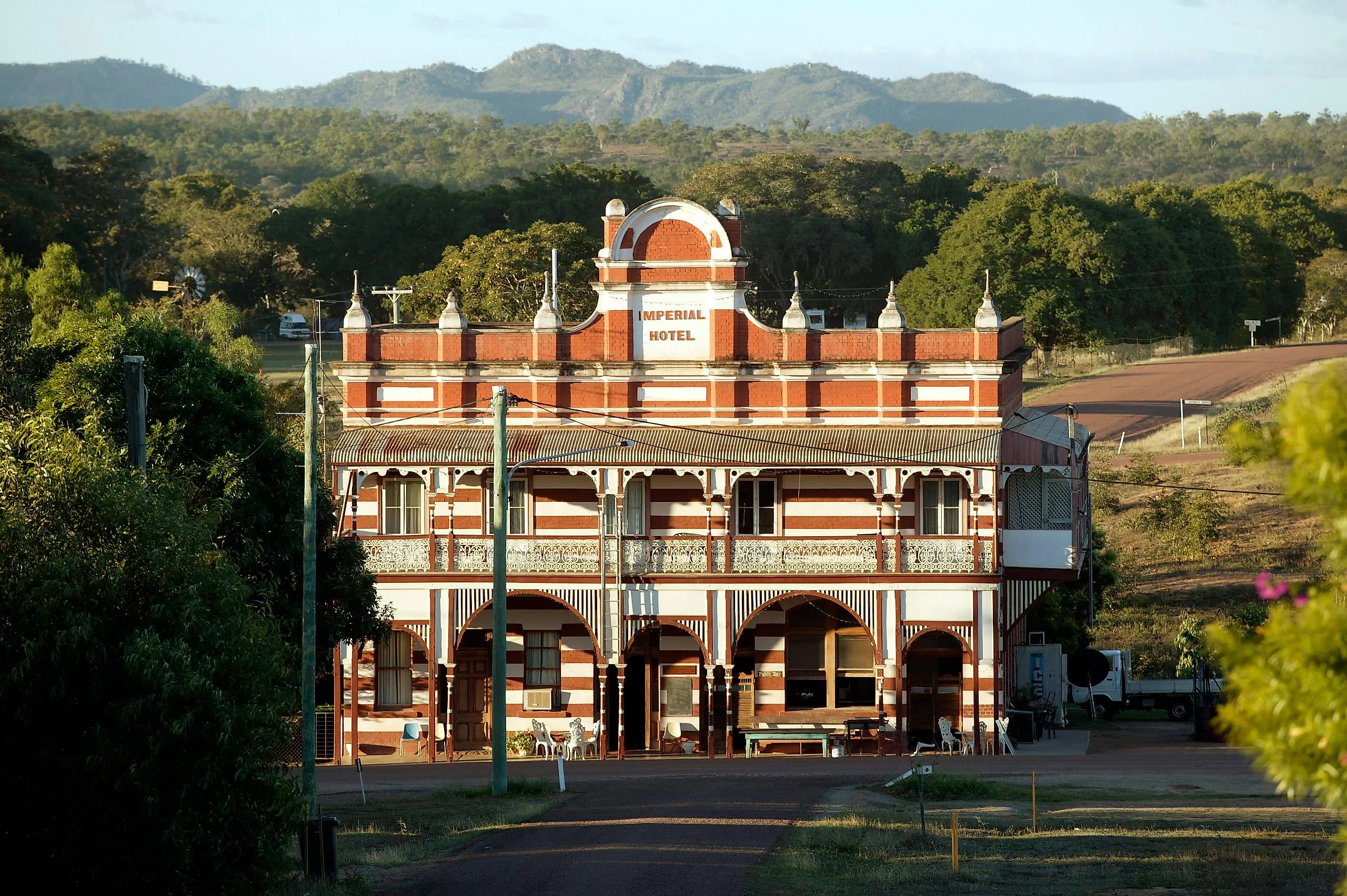
Set in Queensland's Charters Towers Region around 130 km south of Townsville, Ravenswood is a former gold mining town that has eased into a quiet retreat. The 2021 census counted 297 residents, down from a peak of 4,700 in 1903 when the goldfields were running flat out. Most of the timber buildings were dismantled and removed in the 1920s as the population collapsed, but the brick ones could not be moved, which is why the surviving heritage core still reads like a frozen Edwardian streetscape.
The Imperial Hotel on Macrossan Street, built in 1901 with red and cream brick banding, still operates as a pub and accommodation. The Railway Hotel from the same year sits across the way. The School of Arts Hall, the 1882 former courthouse (now a museum), and the 1871 Community Church round out the heritage block. The Ravenswood Restoration and Preservation Association maintains walking trails past the ruins of old mines and stamping batteries, and open country roads make for a pleasant drive into the surrounding Burdekin River country.
Eulo

Eulo is a remote outback township around 856 km west of Brisbane on the Adventure Way, set among mulga lands and dry riverbeds in Paroo Shire. The population sits at around 40 to 100 depending on the season, with beekeepers arriving each winter to work the eucalypts. The town served as a supply stop for opal miners and cattle stations through the 19th century and still trades on that history at the Eulo Queen Opal Centre, named for Isabel Gray, the "Queen of Eulo" who ran the local hotel in the late 1800s.
The Paroo River, which runs nearby, is one of the last free-flowing rivers in the Murray-Darling Basin, and when water is running the banks become a magnet for birdwatchers tracking brolgas, pelicans, and black swans. The Eulo Artesian Mud Baths use mineral-rich mud from the Great Artesian Basin estimated to be 20,000 years old, drawn from springs nine kilometres west of town. Kenny the Diprotodon, a life-size statue of the extinct giant marsupial, marks the entry to town and points to one of the densest megafauna fossil fields in Australia.
Airlie Beach

Airlie Beach is the mainland gateway to the Whitsunday Islands and one of Queensland's most scenic access points to the Great Barrier Reef. The waterfront is built around the Airlie Beach Lagoon, a free public swimming area beside Coral Sea Marina, safe to swim year-round with low risk of jellyfish or strong tides. Outside peak holiday periods, the pace slows down considerably, and the cafés and bars along Shute Harbour Road carry a much more local feel.
Many visitors come here to book day trips or overnight charters from the marina to Whitehaven Beach, Hamilton Island, and Heart Reef. The Whitsunday Great Walk starts just outside town, leading through Conway National Park's rainforest with multiple lookout points. The Bicentennial Walkway hugs the shoreline for several kilometres connecting Airlie Beach to Cannonvale. Shute Harbour, a short drive east, serves as a popular launch site for sea kayaking and island ferry transfers. Coral Sea Resort at the northern tip of downtown puts you within walking distance of the marina and most of the town's restaurants and bars.
Ilfracombe

Ilfracombe sits west of the Capricorn Highway (A4), set between the Mitchell grass plains and the open Outback country roughly 27 km east of Longreach. What looks like a one-street town reveals a community with deep ties to Queensland's pastoral heritage, especially the wool industry that built central Queensland through the late 19th and early 20th centuries.
The Machinery Mile is the town's signature attraction, a long open-air display of historic wool industry equipment running beside the highway. Steam engines, rusted tractors, sheep shearers' tools, and shearing presses trace the evolution of the technology rural Queensland still depends on. The Wellshot Hotel, established in 1890 and one of the longest continuously operating pubs in central Queensland, stands near the centre of town in its yellow timber siding with sloping verandas. The Ilfracombe Memorial Park Swimming Pool and Spa fills with artesian water drawn from over a kilometre underground, warm year-round.
Aramac

Aramac sits north of Barcaldine in another historic Queensland town flanked by open cattle country and dry creek beds on the borderland between the Outback and the coast. The town carries the legacy of a small bush tramway that linked it to Barcaldine from 1913 to 1975, which is documented at the Aramac Tramway Museum and traces the route through what remains of the original infrastructure.
The Lake Dunn Sculpture Trail is the regional draw for outdoor and art enthusiasts: a self-guided drive past dozens of outdoor artworks placed across the surrounding landscape, many built from scrap metal and salvaged farm equipment. The trail loops through some of Queensland's quietest country, where emus and kangaroos outnumber cars by a wide margin. Back in town, a pub, a few general stores, and other essentials cover the basics, while the rest of Aramac maintains a quiet pace that draws those eschewing big city life.
Windorah

Windorah, population 104 (2021 census), sits at the edge of the Channel Country 35 km downstream from where the Thomson and Barcoo Rivers meet to form Cooper Creek. The Cooper Creek Causeway is the local landmark: a wide crossing where seasonal floodwaters turn the dry landscape into a network of temporary lakes, attracting pelicans, herons, and corellas. Visitors stop here to photograph the bird populations or to launch small boats when the water is high.
A short drive from town leads to the Windorah Sandhills, low red dunes that shift with each season and reward the trip at sunset when the view covers the floodplain for kilometres. The local information centre runs displays on the region's Indigenous and settler histories. The original Windorah Solar Farm, which opened in 2008 with five large sun-tracking dishes, was decommissioned in October 2023, and Ergon Energy is building a replacement solar farm and battery system on the same site to supply most of the town's electricity.
Find Your Quiet Spot in Queensland
Whether you are looking for a new corner of Queensland or somewhere quiet to clear your head, these six towns deliver. Ravenswood and Eulo trade on their gold-and-opal heritage with surviving buildings still in working use. Ilfracombe and Aramac carry the pastoral history forward in tramways, machinery displays, and outdoor sculpture trails. Airlie Beach is the gateway to the Whitsundays without the festival-week crowds. Windorah anchors the Channel Country at the edge of Cooper Creek. Visit before they pick up more of the millions of visitors heading to Australia each year.