8 Unforgettable Small Towns To Visit In New Mexico
Few states pack as much historical depth into as little population density as New Mexico, and its small towns are where that concentration becomes most visible. Few miles from Taos sits Taos Pueblo, a 1,000-year-old adobe community still inhabited without electricity or running water. Here, visitors step into one of the oldest continuously occupied settlements in North America. In Santa Rosa, scuba divers descend into the Blue Hole, a crystal-blue artesian spring plunging 80 feet into the desert floor with visibility exceeding 100 feet. Near Socorro, 27 massive radio telescope dishes stretch across an ancient lakebed in the Plains of San Agustin, scanning the cosmos from one of the most productive observatories on Earth. From the sacred pilgrimage chapel at Chimayó to the 900-year-old reconstructed Great Kiva in Aztec, these are eight unforgettable small towns to visit in New Mexico.
Taos

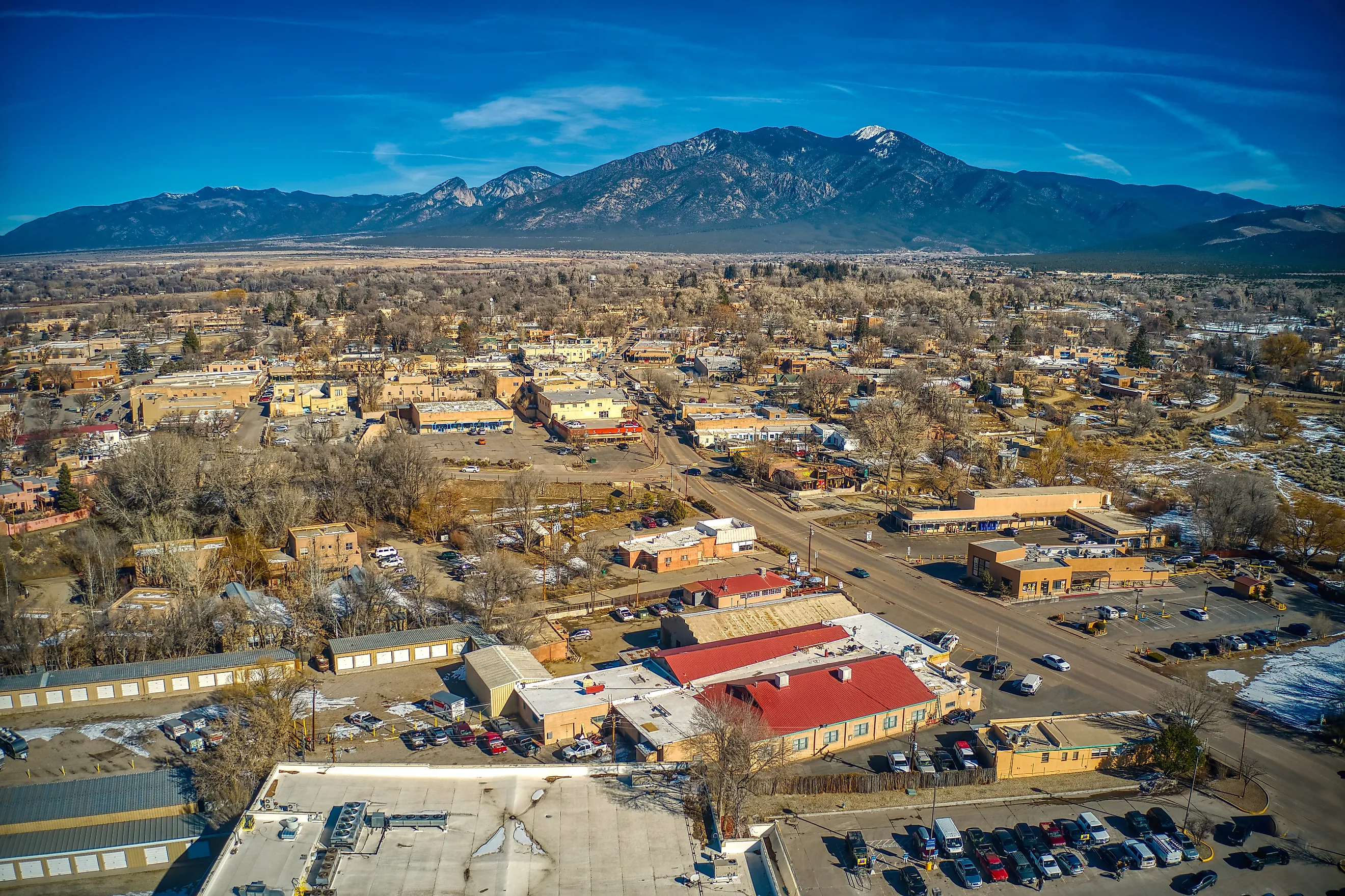
The Sangre de Cristo Mountains rise sharply to the east, the Rio Grande Gorge drops away to the west, and between them sits Taos, a town of roughly 6,400 people that has attracted artists, writers, and seekers for more than a century. Georgia O'Keeffe painted here. D.H. Lawrence wrote here. And long before any of them arrived, the Tiwa-speaking people of Taos Pueblo were building multi-story adobe dwellings that still stand today.
Taos Pueblo, about a mile north of town, has been continuously inhabited for over 1,000 years and holds the rare distinction of being the only living Native American community designated as both a UNESCO World Heritage Site and a National Historic Landmark. The multi-story adobe structures of Hlauuma (North House) and Hlaukwima (South House) operate without electricity or running water, and roughly 150 residents continue to live within the main buildings year-round under those same conditions. Guided tours run daily, and visitors can purchase handmade pottery, drums, and jewelry directly from Pueblo artisans. The pueblo closes periodically for private ceremonies, so checking the calendar before visiting is recommended.
About 14 miles northwest of town, past the Rio Grande Gorge Bridge, the Greater World Earthship Community spans 630 acres and contains over 100 off-the-grid homes built from recycled tires, glass bottles, and adobe. Architect Michael Reynolds pioneered the concept in the early 1970s, designing structures that generate their own electricity, harvest rainwater, treat their own sewage, and grow food in built-in greenhouses. The Earthship Visitor Center offers self-guided and guided tours, and visitors can book an overnight stay in one of several rental Earthships on-site. Back in town, the historic Taos Plaza anchors the community with galleries, cafes, and small shops, and more than 80 art galleries operate in the greater Taos area.
Silver City

A former mining boomtown of around 9,400 people, Silver City sits at 5,900 feet in the foothills of the Gila National Forest in southwestern New Mexico. Billy the Kid spent part of his youth here, and the surrounding landscape still carries the untamed feel of the frontier West.
The crown jewel nearby is the Gila Cliff Dwellings National Monument, about 44 miles north of town. The Mogollon people built these remarkably well-preserved rooms in natural caves high above a canyon floor during the late 1200s and early 1300s. A one-mile loop trail leads visitors through the alcoves where families once lived, cooked, and raised children. The surrounding Gila Wilderness, which Aldo Leopold championed into existence in 1924 as the first designated wilderness area in the world, covers over 558,000 acres of roadless terrain with hot springs, deep canyons, and old-growth ponderosa forest.
The revitalized downtown along Bullard Street and Broadway features galleries, studios, and the Silver City Museum, housed in the 1881 H.B. Ailman House, a Mansard/Italianate Victorian home that the prospector and businessman built at the height of the silver mining boom. Cultural events run throughout the year, including the Southwest Festival of the Written Word, which draws visitors from across the region.
Truth or Consequences

In 1950, the residents of a small spa town, then called Hot Springs, voted to rename their community after a popular radio game show hosted by Ralph Edwards, who had dared any American town to take on the name. The lighthearted spirit of that decision still characterizes Truth or Consequences today.
The real draw, however, predates the name change by several centuries. Truth or Consequences sits atop a geothermal zone along the Rio Grande Rift, and its natural hot springs have attracted visitors for hundreds of years. A cluster of small, independently operated bathhouses lines the downtown area, each with its own character. La Paloma Hot Springs and Spa features 13 gravel-bottom soaking pools fed by continuously flowing artesian springs, with water temperatures ranging from 98 to 116 degrees Fahrenheit and mineral content that includes naturally occurring lithium. Riverbend Hot Springs, on the banks of the Rio Grande, offers outdoor tubs with views of the river and Turtleback Mountain.
Beyond the springs, this town of roughly 6,000 people has cultivated a quiet arts scene with galleries, vintage shops, and murals in the walkable downtown. Elephant Butte Lake State Park lies just minutes to the north, offering boating, fishing, and wide-open desert views along New Mexico's largest body of water. About 30 miles to the southeast, Spaceport America, the world's first purpose-built commercial spaceport, offers guided tours of its facilities.
Chimayó

The village of Chimayó occupies a narrow valley along the scenic High Road to Taos, a tiny community of fewer than 3,000 people that carries a spiritual and cultural weight far exceeding its size. The Tewa Native Americans originally named this place "Tsi-Mayoh" after a sacred hill above the valley, and for centuries before the Spanish arrived, the site held significance as a place of healing.
At the heart of the village stands El Santuario de Chimayó, a small adobe chapel built in 1816 that has become one of the most important Catholic pilgrimage sites in the United States. According to local tradition, builders constructed the chapel on soil believed to possess miraculous healing properties, and a small room within the sanctuary allows visitors to collect a handful of the sacred earth. During Holy Week each spring, over 300,000 pilgrims walk to the Santuario from cities across northern New Mexico, many traveling on foot for days.
Chimayó also celebrates a weaving heritage passed down through generations of families like the Ortegas and Trujillos. At Centinela Traditional Arts, visitors can watch master weavers at looms producing vibrant rugs, shawls, and jackets using techniques that date back to the Spanish colonial period. For a meal that captures the spirit of the village, Rancho de Chimayó serves traditional New Mexican cuisine in a restored adobe home, with red chile enchiladas made from Chimayó's own heirloom chile variety cultivated locally for over 300 years.
Santa Rosa

Route 66 runs through the center of Santa Rosa, a small highway town of roughly 2,800 people about 114 miles east of the Rio Grande Valley. The Blue Hole, a circular artesian spring measuring about 80 feet in diameter at the surface and plunging over 80 feet deep, appears like a gemstone dropped into the arid red mesa landscape.
What makes the Blue Hole remarkable is its clarity and consistency. An underground spring pumps approximately 3,000 gallons of fresh water per minute into the pool, maintaining a constant temperature of 62 degrees Fahrenheit and visibility that regularly exceeds 100 feet. At the bottom sits a metal grate sealing off an explored but publicly inaccessible cave system that descends to at least 194 feet. This combination of factors has made the Blue Hole one of the most popular inland scuba diving destinations in the United States, earning Santa Rosa the unofficial title of "Scuba Diving Capital of the Southwest." Non-divers can swim or simply marvel at the surreal blue water from the stone rim. The town itself retains a nostalgic Route 66 atmosphere, with vintage signage and the Route 66 Auto Museum drawing road-trip enthusiasts.
Socorro

Socorro, a town of about 8,700 people in central New Mexico, sits along the Rio Grande at the crossroads of history and cutting-edge science. The name itself, meaning "help" in Spanish, traces back to 1598, when the Piro Pueblo people provided food and shelter to the exhausted Juan de Oñate expedition.
The Karl G. Jansky Very Large Array (VLA) commands the most attention, located 50 miles west of town on the Plains of San Agustin. Twenty-seven radio telescope dishes, each 82 feet in diameter and weighing 230 tons, stand in a massive Y-shaped formation across an ancient lakebed surrounded by mountains that act as a natural shield against radio interference. Scientists consider the VLA the most productive ground-based telescope in the world. A visitor center with exhibits on radio astronomy and a self-guided walking tour that leads to the base of one of the enormous dishes make the experience accessible regardless of scientific background.
Closer to town, the Bosque del Apache National Wildlife Refuge provides a completely different kind of spectacle. Each winter, tens of thousands of sandhill cranes, snow geese, and other migratory birds descend upon the refuge's managed wetlands, creating one of the premier birdwatching experiences in North America. The Old San Miguel Mission, established in 1598, and the Mineral Museum at New Mexico Tech round out a visit with historical and educational depth.
Aztec

Early settlers in the 1800s mistakenly attributed the ancient ruins within the Aztec city limits to the Aztec Empire of central Mexico, and the name stuck. In reality, ancestral Puebloan people built the structures over 900 years ago, and today this small city of about 6,400 along the Animas River in the Four Corners region preserves one of the most impressive examples of their architectural achievements.
Aztec Ruins National Monument, right within the city limits, contains a massive great house of over 400 masonry rooms constructed between approximately 1100 and 1300 CE. The Great Kiva, a 40-foot-diameter ceremonial chamber that archaeologist Earl Morris fully reconstructed in the 1930s, sets this site apart. The largest and oldest reconstructed kiva in North America, it offers a rare, immersive sense of the communal and spiritual life that once animated these walls. Original wooden roof timbers, ancient mortar bearing the fingerprints of its builders, and intact plaster walls give the site an uncanny feeling of proximity to the people who lived here. UNESCO designated the monument a World Heritage Site in 1987 as part of the broader Chaco Culture network. Admission is free.
Beyond the ruins, dozens of structures in the downtown area appear on the National Register of Historic Places, and the Aztec Museum and Pioneer Village allows visitors to walk through reconstructed buildings from the town's frontier era. The Animas River, which runs through town, provides opportunities for fishing and floating during the warmer months.
Cloudcroft

At over 8,600 feet in the Sacramento Mountains of southern New Mexico, Cloudcroft is a mountain village of fewer than 800 permanent residents that feels like a geographic anomaly. While the Tularosa Basin below bakes under desert sun, Cloudcroft enjoys cool alpine breezes, towering ponderosa pines, and golden aspen groves in autumn.
The Mexican Canyon Trestle, a dramatic railroad trestle spanning a mountain canyon, stands as a remnant of the Alamogordo and Sacramento Mountain Railway that once carried timber and passengers to the summit. An overlook with interpretive signage provides sweeping views of the trestle and the Tularosa Basin far below. Hikers can explore the Osha Trail, which loops through fir and spruce forest with viewpoints overlooking the basin, or follow the Bluff Springs Waterfall trail to one of the few year-round waterfalls in this part of New Mexico.
A short drive south leads to the Sunspot Solar Observatory, operated by New Mexico State University at an elevation of nearly 9,200 feet. Back in the village, Burro Avenue serves as Cloudcroft's walkable main street, lined with small cafes, pie shops, and gift stores. The Lodge Resort, a historic hotel originally built by the railroad in 1899, anchors the town with a nine-hole golf course that claims to be one of the highest in the country.
New Mexico's Most Singular Small Towns
These eight towns prove that the most memorable destinations in the Southwest are often the ones with the smallest populations and the most outsized character. A layering of time and culture runs through each of them, from the ancient masonry of Aztec to the pilgrimage traditions of Chimayó, from the healing waters of Truth or Consequences to the high-altitude cool of Cloudcroft. Travelers willing to venture beyond the interstate will find a state where 1,000-year-old adobe walls stand within driving distance of radio telescopes scanning the cosmos, and where a crystal-blue swimming hole rises from the desert floor along a stretch of Route 66 that time has not entirely forgotten.