8 Best Small Towns In France For A Weekend Retreat
France received about 102 million international visitors in 2025, the most of any country in the world and a record for France itself, but the great majority of those trips concentrate in Paris and a handful of larger cities. The eight small towns below sit in very different parts of the country and each holds onto a specific local identity that is harder to find in the bigger destinations. The selection covers an Alpine resort, two Provençal villages, a Corsican clifftop, a Bordeaux wine town, a Jura wine village, an Alsatian merchant town, and Monet's village in Normandy. Each is worth a weekend on its own terms, not as a half-day stop on the way to somewhere else.
Chamonix-Mont-Blanc

Chamonix-Mont-Blanc, usually shortened to Chamonix, is the historic Alpine resort at the foot of Mont Blanc, the highest peak in Western Europe at 4,808 meters. The town hosted the first Winter Olympics in 1924, when the event was still called the International Winter Sports Week, and has remained one of the most serious mountain towns in Europe since. Hôtel Mont-Blanc, which sits on the rue du Docteur Paccard in the village center, is the long-standing five-star option with a heated outdoor pool that stays open through the winter.
The Aiguille du Midi cable car, in two stages from Chamonix center, climbs to 3,842 meters in roughly 20 minutes for views of the French, Swiss, and Italian Alps. The "Step into the Void" glass skywalk on the upper platform, opened in 2013, projects guests over a 1,000-meter drop on a glass-floored cube. The Mer de Glace, the largest glacier in France at about seven kilometers long, is reached by the Montenvers Railway from Chamonix; the glacier has retreated dramatically over the last several decades, and the gondola from the railway station down to the ice has been repeatedly extended to keep up with the retreat. The Glaciorium at Montenvers explains the geology and the climate-change story together. In summer, Chamonix is a base for the long-distance Tour du Mont Blanc circuit (about 170 km, typically walked over 7 to 11 days) and dozens of shorter day hikes.
Gordes

Gordes is a hilltop village in the Vaucluse department of Provence, with cobblestone streets, traditional dry-stone walls, and tiered limestone facades that catch evening light. Most of the visible architecture dates from the medieval and Renaissance periods, with later 17th- and 18th-century additions. It is one of the inaugural members of "Les Plus Beaux Villages de France," the official association of France's most architecturally intact small villages. Les Bories & Spa, a former bergerie converted into a hotel, sits on an eight-hectare estate of olive trees, cypresses, holm oaks, and lavender on the road below the village.
The 12th-century church of Saint-Fermin sits in the heart of the village. The Sentier des Ocres in nearby Roussillon, an old ochre-mining valley converted into a marked walking trail, is a 35-minute drive away and runs about a kilometer through red and yellow cliffs eroded over millennia. The Cistercian Abbaye de Sénanque, founded in 1148 and still home to a small community of monks, sits in a valley about four kilometers north of Gordes; the lavender fields in front of the abbey bloom from mid-June to mid-July and are one of the most-photographed views in Provence.
Bonifacio

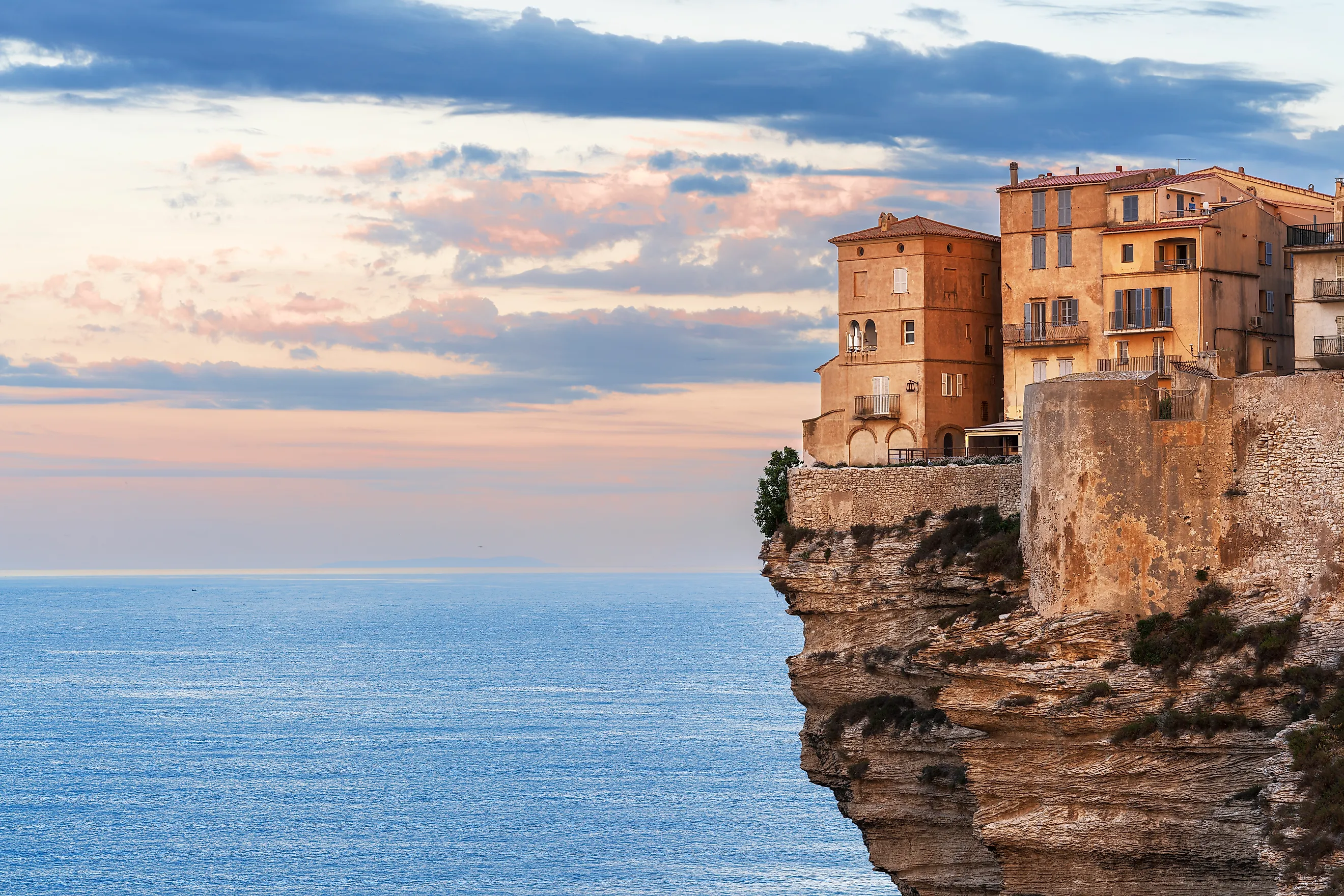
Bonifacio sits on the southern tip of Corsica, perched on white limestone cliffs that drop straight into the Mediterranean. The town was reportedly founded in 828 AD by Boniface II of Tuscany, and the citadel and old town reflect Genoese rule that lasted from the 13th century until 1768. The architecture mixes Genoese fortifications and later French additions, and the surrounding maquis shrubland produces the aromatic herbs that give Corsican cuisine its character. The Cala di Greco hotel, on the bluff above the marina, has suites looking out over the citadel and the Strait of Bonifacio toward Sardinia.
The Porte de Gênes is the original main gate into the old town and was the only land entrance for centuries. The Bastion de l'Étendard, the bastion above the gate, now houses a museum on the town's military history with access to the ramparts. The Bouches de Bonifacio Natural Reserve, established in 1999 and one of the largest marine protected areas in mainland France, covers about 800 square kilometers of sea between Corsica and Sardinia and includes cliff-top walks, secluded coves, and snorkeling sites in some of the clearest water in the western Mediterranean.
Saint-Émilion

Saint-Émilion sits in the Gironde department of Nouvelle-Aquitaine and was the first wine-growing region in the world to be inscribed on the UNESCO World Heritage list, in 1999. The town runs across a limestone plateau above the Dordogne River, and the same limestone is what made the region's underground spaces, originally quarried for the building stone of the village, available for use as wine cellars. Hôtel de Pavie, on the village's main square, has a raised terrace with views over the rooftops and the surrounding vineyards.
The Saint-Émilion Monolithic Church, carved entirely out of the limestone bedrock between the 11th and 12th centuries, is the largest underground church in Europe. It can be visited only on guided tours operated by the tourist office. Château Ausone, named after the 4th-century Roman poet Ausonius, who is believed to have owned a villa nearby, is one of the two estates in the top tier (Premier Grand Cru Classé A) of the Saint-Émilion classification system, alongside Château Cheval Blanc; production volumes are very small and visits require advance booking. La Grotte de Ferrand, on the Saint-Hippolyte road outside the village, is a network of former limestone quarries now used as wine cellars and open for tours that include a tasting.
Moustiers-Sainte-Marie

Moustiers-Sainte-Marie is built into a cleft in the limestone cliffs at the western entrance of the Gorges du Verdon. A mountain stream runs through the center of the village, and a 16-pointed star suspended on a 135-meter chain hangs across the gap between the two cliffs above the town; the star has at least a dozen competing legends about its origins, the most-told version involving a Crusader knight named Bozon de Blacas who returned from captivity. La Bastide de Moustiers, formerly the home of a master faïencier and now a hotel-restaurant operated under chef Alain Ducasse, sits in a four-hectare park at the foot of the village.
The Chapel of Notre-Dame-de-Beauvoir, partly Romanesque and partly Gothic, sits high above the village and is reached by a stone staircase of 262 steps (formerly 365). The Musée de la Faïence in the village center documents the local tin-glazed pottery tradition that began in 1679, when a Crusader-returned monk taught the technique to a local potter named Pierre Clérissy. The Gorges du Verdon, often called the Grand Canyon of Europe, runs east of the village; the Verdon River below is open to kayaking, paddleboarding, and electric-boating in summer, and a series of marked trails follow the rim above.
Château-Chalon

Château-Chalon sits on a rocky promontory in the Jura department of eastern France, looking out over its appellation's vineyards. The village is one of the four production zones for Vin Jaune, the long-aged oxidative white wine made from the Savagnin Blanc grape that is the signature wine of the Jura. Vin Jaune is matured for six years and three months under a layer of yeast called voile, similar to the flor on Sherry, and bottled in the distinctive 62-centiliter clavelin bottle. The Jura wine tradition itself goes back to the Middle Ages, when monastic communities first cultivated vines on these slopes. Maison d'Eusebia, in a 17th-century building in the village, is the local boutique hotel; rooms come with a complimentary glass of the house's Vin Jaune.
The Maison de la Haute Seille is the village's wine-interpretation center and covers the geology, climate, and human elements that go into the local terroir. Tastings are part of a visit. L'École d'Autrefois preserves an early-20th-century village schoolhouse with original furnishings and the teacher's living quarters. The Église Saint-Pierre, founded in the 12th century with later additions, sits at the highest point of the village. Château-Chalon is a Plus Beaux Villages member and the views from the village edge across the Bresse plain to the west are some of the broadest in the Jura.
Riquewihr

Riquewihr is the textbook Alsatian wine village, set into the eastern slopes of the Vosges foothills along the Alsace Wine Route. The walled village survived World War II almost entirely intact, and its 15th- to 17th-century half-timbered houses, painted in pinks, yellows, and pale blues, still line the cobblestone Rue du Général de Gaulle that runs the length of the old town. J. L. Brendel, on the rue de Cerf, runs a small collection of suites and a guest cottage in restored 16th-century buildings.
Hugel et Fils, founded in 1639 and now operated by the 13th and 14th generations of the family, is the most internationally recognizable producer in Riquewihr, with cellars that can be toured and a tasting room on the main street. The Dolder Tower, built in 1291 as part of the village's defensive walls and now standing at 25 meters, holds the village historical museum and offers the best vantage over the surrounding vineyards. It is a reminder of the strategic importance and the wealth Riquewihr enjoyed in medieval times. The Marché de Noël, Riquewihr's Christmas market, runs weekends from late November through Christmas and is one of the most heavily attended Christmas markets in Alsace, with the medieval setting doing most of the work.
Giverny

Giverny is a small village in the Eure department of Normandy, on the right bank of the Seine, best known for the 43 years that Claude Monet lived and worked there. He arrived in 1883, bought the property in 1890, and stayed until his death in 1926. La Réserve, a guesthouse on the heights above Giverny in an old Norman farmhouse surrounded by orchards, has five garden-view rooms and is a quieter alternative to staying in nearby Vernon.
The Fondation Claude Monet manages Monet's pink-stuccoed house and the two gardens that he built and that he painted from for the last decades of his life: the Clos Normand in front of the house, and the Japanese-inspired Water Garden, with its famous green-painted bridge and lily pond, across the road. The site is open from late March through early November and is one of the most heavily visited day-trip destinations from Paris. The Musée des Impressionnismes Giverny, a five-minute walk from Monet's house, hosts rotating exhibitions on the broader Impressionist movement and its legacy. The 11th-century Église Sainte-Radegonde, named after the 6th-century Frankish queen and saint Radegund, sits just up the hill from the museum and contains the family tomb where Monet, his wife Alice, and several of their children are buried.
Picking Between Them
The choice is mostly about geography and what you want a weekend to feel like. Chamonix offers serious mountains. Gordes and Moustiers-Sainte-Marie offer the limestone-and-lavender Provence look from two different angles. Bonifacio is the option for anyone who wants Corsica without committing to a longer trip. Saint-Émilion and Château-Chalon are wine country at very different price points, the first famous and expensive, the second relatively unknown outside France. Riquewihr is Alsatian half-timbered postcard country and especially worth a December visit for the Christmas market. Giverny is a half-day bolted onto a longer Paris trip for some visitors and a destination in its own right for others. None of them require a car-hostile rental, none of them need a week to see, and all of them survive close inspection in a way that Paris and the Riviera resorts increasingly do not.