8 Towns Perfect For Retirement In the Great Lakes
The Great Lakes region has shoreline, freshwater, and four real seasons. These eight towns put that to work. One is a gateway to the most visited wilderness in the country. Another has a folk school that teaches boatbuilding on Lake Superior's harbor. A third sits on a lake so full of walleye it built its identity around it. You can take free university courses in one, walk to a public boardwalk in another, and watch freighters pass through the world's heaviest lift bridge in a third. Retirement here means having something to do that isn't shopping or waiting.
Grand Marais, Minnesota

Grand Marais sits on Lake Superior's North Shore with a population of about 1,340. That's small. Winters are long and cold. Services are limited. If that doesn't scare you off, what's left is one of the most distinctive small towns in the upper Midwest.
The name is French for "Great Marsh," from the fur trading days in the 1700s. Today the town runs on tourism and a real arts community. North House Folk School, a nonprofit right on the harbor, offers over 200 courses in boatbuilding, blacksmithing, woodworking, fiber arts, leatherwork, and more. For retirees looking to fill their time with something hands-on, it's hard to beat. The Grand Marais Art Colony adds another layer.
The outdoor access is the other half of the equation. Grand Marais is a primary gateway to the Boundary Waters Canoe Area Wilderness: 1.09 million acres, over 1,100 lakes, the most visited wilderness in the country, and one of only 20 designated Dark Sky Sanctuaries in the world. Lake Superior's shoreline is right outside the door.
Healthcare options are limited in a town this size, so retirees with serious medical needs should factor in the distance to larger facilities. Housing runs higher than many Great Lakes towns. But for someone who wants a small, creative community with world-class wilderness access, Grand Marais earns its reputation.
Traverse City, Michigan

Traverse City sits at the head of Grand Traverse Bay on Lake Michigan. The city proper has about 15,700 residents, but the metro area runs past 153,000, which means retirees get small-town waterfront living with access to real infrastructure.Healthcare is a major strength. Munson Medical Center is a 442-bed regional referral hospital, the largest employer north of US-10, and the only facility in northern Michigan with a NICU and inpatient behavioral health services. For retirees who need reliable medical access, that matters more than the scenery.
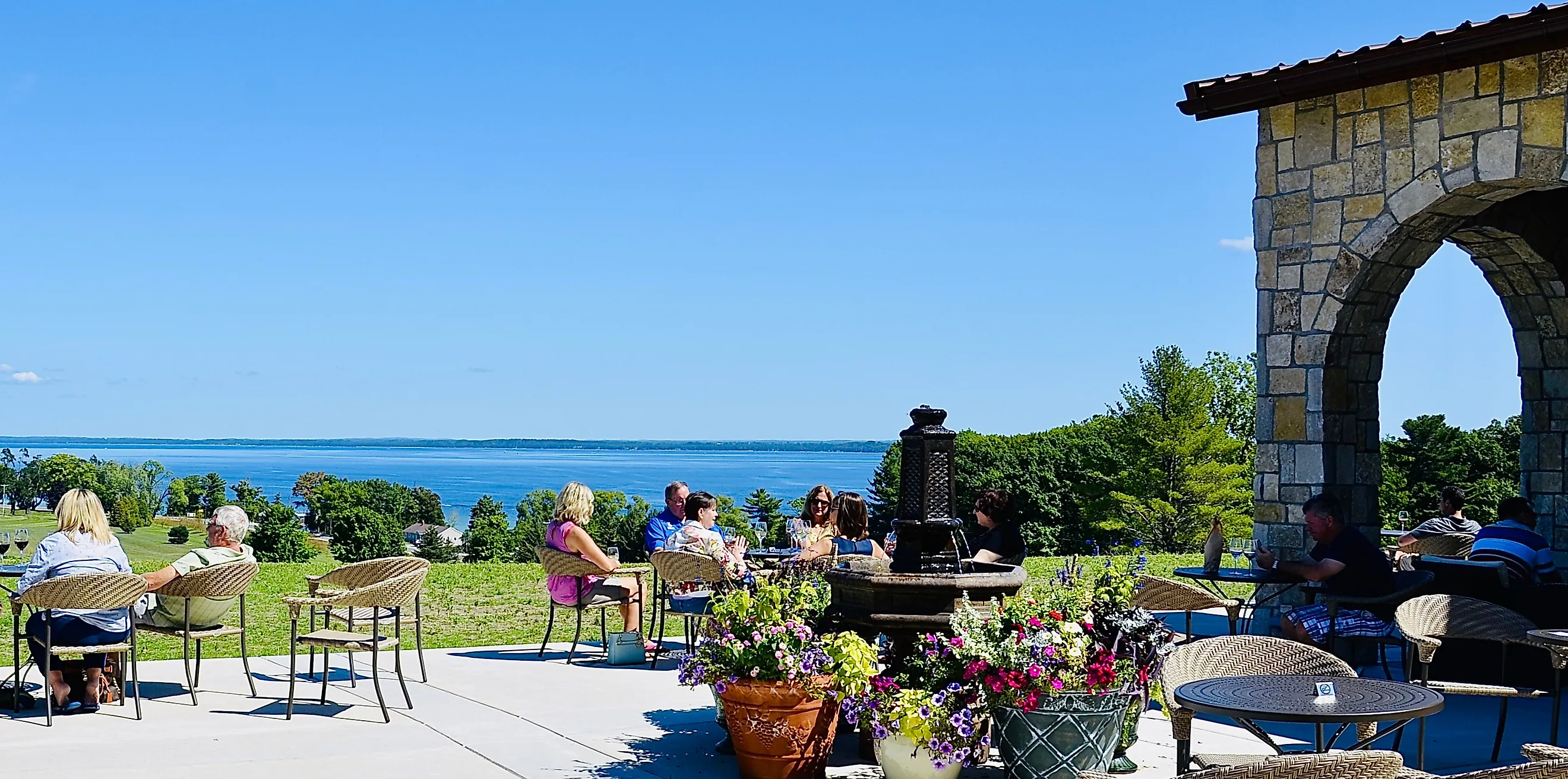
The scenery is still worth mentioning. Clinch Park puts a public beach within walking distance of downtown. Boardman Lake and the TART trail system add more waterfront and biking. Sleeping Bear Dunes National Lakeshore, about 30 miles west, was voted the Most Beautiful Place in America by Good Morning America. The Old Mission and Leelanau peninsulas have a growing wine region that gives retirees something to do on a Tuesday afternoon.
Traverse City earns its "Cherry Capital of the World" nickname every July when the National Cherry Festival draws roughly 500,000 visitors. The median age is about 40, so it skews younger than many retirement towns, but that keeps the restaurants, shops, and cultural scene active year-round.
Housing costs are higher than most Great Lakes towns. But the combination of a serious hospital, a real downtown, and Lake Michigan out the window makes Traverse City one of the most complete retirement options in the region.
Baileys Harbor, Wisconsin

Baileys Harbor is a town of about 1,350 on the Lake Michigan side of Door County, Wisconsin. It got its name from a ship captain who ducked into the harbor to escape a storm in 1848. The pace hasn't picked up much since.
Door County draws summer crowds, but Baileys Harbor stays quieter than the peninsula's busier towns. The standout natural attraction is the Ridges Sanctuary: 1,600 acres, Wisconsin's first land trust, a National Natural Landmark, and home to 25 native orchid species with an active restoration program. A LEED-certified nature center opened in 2015. For a town this small, that's an unusual resource.
Kangaroo Lake, Door County's largest inland lake at 1,123 acres, sits partly in Baileys Harbor. It's shallow (12 feet max) but good for paddling, fishing, and birdwatching. Toft Point State Natural Area adds more trail access along the shore.
Healthcare means driving about 25 miles south to Door County Medical Center in Sturgeon Bay. That's the main trade-off. Services are limited in a community this size, and winters on the peninsula are real. But retirees who want a quiet lakeside life surrounded by preserved natural areas, with the Baileys Harbor Range Lights on the National Register and Björklunden's chapel nearby, will find a town that hasn't been overdeveloped and doesn't plan to be.
Housing runs above $600,000 for most listings. You're paying for Door County, and Baileys Harbor is one of the better reasons to.
Port Clinton, Ohio

Port Clinton sits at the mouth of the Portage River on Lake Erie, about 6,000 residents, county seat of Ottawa County. It calls itself the Walleye Capital of the World, and the fishing in Lake Erie's Western Basin earns that.
The location does more than fishing. The Jet Express ferry runs from Port Clinton to Put-in-Bay and Kelleys Island, two of Lake Erie's most popular island destinations. Cedar Point is nearby. The whole area markets itself as "Vacationland," and the tourism economy that comes with it means restaurants, shops, and seasonal energy that many small towns lack.
The Liberty Aviation Museum, near the local airport, holds a Ford Trimotor, a PBY Catalina seaplane, a B-25 Mitchell bomber, and WWII torpedo boats under restoration. A 1950s diner operates inside the museum. It's a better attraction than the original text lets on.
The median age is about 42. The economy is seasonal and tourism-driven, so retirees should expect a quieter off-season. Healthcare and housing details should be verified locally, but the baseline appeal is straightforward: Lake Erie waterfront, island access by ferry, solid fishing, and a small-town scale that doesn't feel isolated.
Houghton, Michigan

Houghton sits on the Keweenaw Peninsula in Michigan's Upper Peninsula, population about 8,400. It averages 218 inches of snow per year. That number filters out a lot of people. The ones who stay tend to like it here.
The town exists because of copper. Native Americans mined it for thousands of years before Europeans arrived. Cornish and Finnish immigrants built the area during the copper boom. The last mines closed in the late 1960s, and Michigan Technological University, founded in 1885 as the Michigan College of Mines, became the economic anchor. It's now a public research university and the city's largest employer.
The Portage Lake Lift Bridge connects Houghton to Hancock across the water. It's the world's heaviest and widest double-decked vertical lift bridge. Hancock has its own downtown, and the two cities function as a pair.
For retirees, the appeal is affordability, outdoor access, and a college-town feel in a place most people overlook. MTU may offer tuition-free courses for seniors, which is worth verifying directly with the university. Healthcare is available through UP Health System - Portage. Winter Carnival, put on by MTU students every February, is one of the biggest events in the Upper Peninsula.
Allegan, Michigan

Allegan is the county seat of Allegan County, Michigan, about 40 miles from Grand Rapids and 30 from Kalamazoo. The population is around 5,200. It's small, but it's not isolated. Two mid-size cities are within easy driving distance, which gives retirees access to hospitals, airports, and shopping without living in the middle of it.
The local economy has more going on than most towns this size. Perrigo, the world's largest maker of private-label over-the-counter pharmaceuticals, was founded in Allegan in 1887 and is still the biggest employer. That kind of corporate anchor keeps a town more stable than one running purely on tourism or government.
The Kalamazoo River runs through town. The one-lane iron bridge over it, built in 1886, nearly got demolished before local activists raised the money to restore it in 1983. It's now on the city logo. Allegan General Hospital provides local healthcare. The median age runs around 35, so it skews younger, but the proximity to Grand Rapids and Kalamazoo means retirees can tap into the services and social networks of larger communities without the cost.
Housing remains more attainable than most waterfront-oriented retirement towns. For retirees who want a small Michigan town that's connected rather than remote, Allegan is a practical pick.
Angola, Indiana

Angola is the county seat of Steuben County in northeastern Indiana, population about 9,300. It's a college town (Trine University) in one of the most lake-dense counties in the state. If water access matters to your retirement, Steuben County delivers. Lake James is the largest and most visible, but the county is dotted with smaller lakes that keep things from feeling crowded.
Pokagon State Park, five miles north of town, is the anchor outdoor attraction. It covers 1,260 acres, draws nearly 640,000 visitors a year, and has over 10 miles of trails, glacial landforms, and CCC-era structures on the National Register of Historic Places. The refrigerated toboggan run in winter hits 35-40 mph and is one of the most distinctive things to do in Indiana.
The median age runs low (around 30-32), reflecting the university population, but retirees benefit from that: a college town keeps restaurants open and services running. Healthcare and housing details should be verified locally, but the baseline pitch is simple. Angola gives you a small Indiana city with a university, a state park that draws over half a million visitors a year, and lakes in every direction. For the price, that's a lot of retirement.
Oconomowoc, Wisconsin

Oconomowoc is a city of about 18,200 in Waukesha County, Wisconsin, roughly 34 miles west of Milwaukee on I-94. The name is Potawatomi for "waterfall," and pronouncing it correctly is considered a tell that you're actually from Wisconsin.
The city has been a lake destination since the railroad arrived in 1854 and turned the surrounding area into a resort community. That legacy holds. Fowler Lake sits in the center of town with a public boardwalk. Lac La Belle, Oconomowoc Lake, and several other lakes are all close by. For retirees who want daily access to water without living in a remote lakeside cabin, the setup works.
One piece of trivia worth knowing: The Wizard of Oz had its world premiere at the Strand Theatre in Oconomowoc on August 12, 1939.The proximity to Milwaukee is the practical selling point. Thirty-four miles on I-94 puts a major metro's hospitals, airport, cultural institutions, and professional sports within easy reach. Healthcare, dining, and shopping options in Oconomowoc itself reflect a city of this size, but Milwaukee backstops anything the local market can't cover.
Housing costs run higher than most towns on this list. The median age is in the high 30s to low 40s, giving it a mixed-age community feel. For retirees who want lake access, a real downtown, and a major city close enough to use but far enough to ignore, Oconomowoc checks the boxes.
The Takehome
For retirees who want a peaceful setting, water access, and a high quality of life, the Great Lakes region deserves a close look. These towns offer scenic views, outdoor recreation, and generally calmer surroundings than many coastal destinations. In many cases, they are also more affordable and less crowded than retirement spots on the East or West Coast. Places like Traverse City, Baileys Harbor, Port Clinton, and Houghton show just how appealing retirement in the Great Lakes can be.