8 Prettiest Downtown Strips In Maine
Maine's small-town downtowns are shaped by the water that runs through or past them. Shipbuilding, cod, oysters, and lobster built these places, and most of the main streets in this part of the coast still sit within a block of a working waterfront. Bath looks over the Kennebec where Bath Iron Works still launches Navy destroyers. Damariscotta lines its oyster boats up within sight of Main Street. Bar Harbor opens onto Frenchman Bay at the foot of the Acadia ridgelines. These eight Maine towns wear their maritime roots plainly, and the result is some of the most walkable downtowns in the state.
Bath

Bath sits on the Kennebec River and carries the nickname "City of Ships" from a shipbuilding run that began in the colonial era and continues today at Bath Iron Works, the Navy destroyer yard that still drives much of the local economy.
Front Street holds most of the downtown's shops and restaurants. OystHERS serves local oysters and a short seafood menu, and Bath Brewing Company pours its own ales a few doors down. Linwood E. Temple Waterfront Park adds a paved riverside walk, a boat dock, and a pavilion that hosts the Bath Farmers' Market on Saturday mornings.
A short walk south, the Maine Maritime Museum preserves the site of the former Percy & Small Shipyard, the last American yard to build large wooden sailing ships. Exhibits cover the state's shipbuilding and maritime history, and the museum operates narrated cruises on the Kennebec in season.
Belfast

Belfast sits at the head of Penobscot Bay, where the Passagassawakeag River meets the sea. Settled in the 1770s, the town was named for Belfast in Northern Ireland. Its shipbuilding past left behind the tight grid of brick and clapboard buildings that still defines the downtown.
The 1912 Colonial Theatre has run continuously for more than a century, screening first-run films in a Vaudeville-era house. Its roofline carries a life-sized sculpture of Hawthorne the Elephant, a longtime local landmark. Arts in the Park fills Heritage Park on the waterfront each July with fine-craft vendors, music, and food.
Two of the downtown's best-known restaurants sit on opposite sides of the harbor. Marshall Wharf Brewing Company pours its ales in a waterfront beer garden, and Laan-Xang Café serves Lao and Thai dishes on Main Street.
Damariscotta

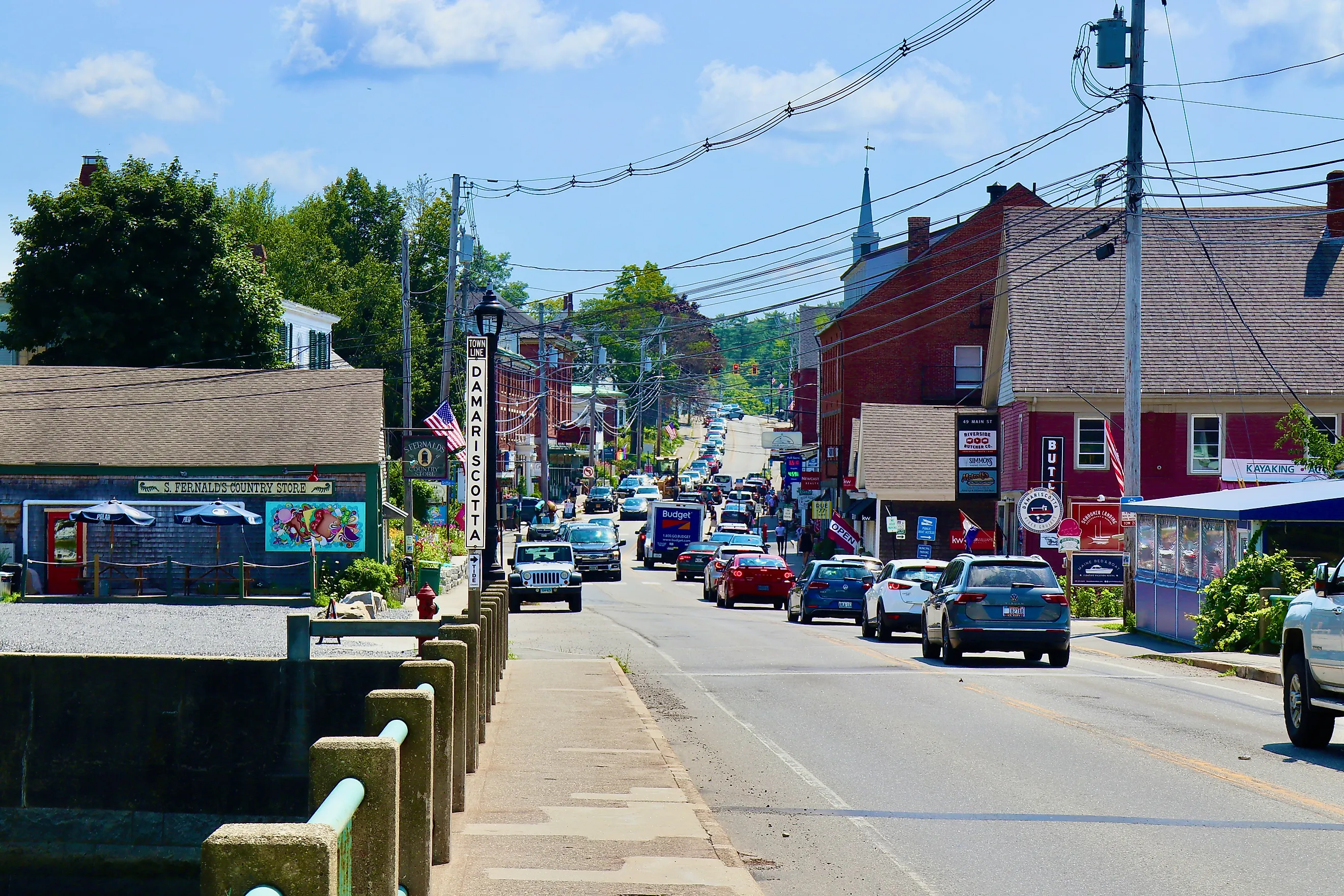
Damariscotta sits on the tidal Damariscotta River, which has been farmed for oysters since prehistoric times. The shell middens on the north side of town, built up over more than two thousand years of indigenous harvest, are among the largest in North America.
The downtown has leaned into the town's shellfish identity. Newcastle Publick House and Oysterhead Pizza both work local oysters into their menus, and the Damariscotta Farmers' Market runs on Fridays through the warmer months. Main Street itself is compact, with independent bookstores, cafes, and a handful of galleries within a short walk.
The 1875 Lincoln Theater still operates as a performing-arts venue. Its programming covers live theater, concerts, and film, and the building's exterior anchors one corner of the downtown.
Bar Harbor

Bar Harbor occupies the northeastern shore of Mount Desert Island, with Frenchman Bay on one side and the mountains of Acadia directly behind it. The town was originally called Eden and took its current name in 1918.
Most visitors come for the proximity to Acadia National Park, but the downtown holds its own. The Barnacle runs a compact menu of lobster rolls, oysters, and draft beer. McKay's Public House serves a longer surf-and-turf menu in a converted Victorian with a garden out back. Main Street and Cottage Street carry most of the gift shops and galleries, with the Shore Path running from the Bar Harbor Inn along the waterfront.
From the downtown, the Park Loop Road into Acadia is a ten-minute drive, and the carriage roads, Cadillac Mountain summit road, and Thunder Hole are all within easy reach.
Camden

Camden bills itself as the Jewel of the Maine Coast, and its setting at the foot of the Camden Hills on Penobscot Bay earns the claim. The town took its name from Charles Pratt, the first Earl of Camden, whose support for the colonies during the American Revolutionary War was acknowledged by several New England communities.
The harbor is the downtown's visual anchor, with windjammer schooners still tied up at the public landing during the summer season. Along Bay View and Main, local restaurants include The Waterfront Restaurant for traditional seafood and Sea Dog Brewing Co. for Maine classics paired with in-house ales. The 1894 Camden Opera House, built above the town office, continues to host concerts, films, and community performances.
Rockland

Rockland lies on the west side of Penobscot Bay and has shifted over time from a fishing and lime-trading port into a working harbor with a strong arts scene. The downtown's seafood restaurants include Archer's on the Pier, which builds its menu around the day's catch, and Hill's Seafood Co., a family-run spot with waterfront views.
Rockland's public art includes the Water Town mural, a multi-building installation completed in 2012 by Alexis Iammarino with help from more than forty volunteers. The Center for Maine Contemporary Art, designed by Toshiko Mori and opened on Winter Street in 2016, shows rotating exhibitions of contemporary work with a focus on Maine artists. The Farnsworth Art Museum, just up Main Street, holds one of the most significant collections of Maine art anywhere, including extensive holdings of work by the Wyeths.
Wiscasset

Wiscasset sits on the Sheepscot River an hour's drive northeast of Portland. In the 1920s, the travel writer Wallace Nutting called it the "Prettiest Village in Maine," and the name has stuck. The town's Federal-era architecture survives largely intact in the blocks along Main and Water Streets.
Wiscasset's reputation for lobster rolls draws most of the summer traffic. Red's Eats, on the corner of Main and Water, has built decades of lines outside its small takeout window. Sprague's Lobster and Water Street Kitchen and Bar offer alternatives a short walk away. The downtown also carries a heavy concentration of antique dealers for a town of 4,000, with Bradbury Art and Antiques on Main Street among the most established.
Gardiner

Gardiner sits on the Kennebec River about a dozen miles south of Augusta. The downtown runs along Water Street and holds a largely intact stretch of 19th-century commercial buildings. The 1881 Gardiner Public Library, designed in a Richardsonian Romanesque style, is one of the downtown's most distinctive structures.
Johnson Hall, built in 1864, is one of the oldest surviving performing-arts venues in New England. The building reopened in 2022 after an extensive renovation restored its upstairs opera house, which now hosts concerts, comedy, and theater. For a meal, the A1 Diner, housed in a 1946 Worcester Lunch Car No. 790 perched over Bridge Street, has been a Gardiner fixture for more than seventy years. Bateau Brewing pours its ales a few blocks away on the riverfront.
The Working Waterfronts Of Small Maine
What these eight downtowns share is a direct line between their streets and their water. Shipyards, oyster flats, fishing piers, and packet ports built each of them, and most of the buildings still standing go back to that working era. The Colonial Theatre in Belfast has been open since 1912. Johnson Hall in Gardiner is older still. Red's Eats has been feeding people at the corner of Main and Water since 1938. Next time you're on Route 1 or the Kennebec corridor, these are the main streets worth pulling off for.