8 Offbeat Spain Towns To Visit In 2026
In Spain’s offbeat towns, travelers have the opportunity to encounter Cantabrian mythological creatures in a Castro Urdiales park, and watch a coin-operated puppet theater tell the story of Frigiliana. Meanwhile, the unusual limestone formations of the Torcal de Antequera showcase caves and corridors, creating a weaving maze. Whether you’re seeing sights that make your mind boggle or tasting cuisine that may be out of your comfort zone, España proves that the unexpected can be the best reason to make a detour.
Almagro

Almagro, a town in Castile, is known for berenjenas de Almagro, a whole small eggplant pickled with cumin, paprika, and vinegar that is a local delicacy. It can be found at the gourmet store Berenjenas Morris in jars, along with other distinct foodie delights, such as raspberry vinegar and truffled goose mousse pâté. Open the doors into the world of Museo del Encaje y la Blonda, The Municipal Lace and Blonde Museum, and prepare to be amazed! The handicraft museum documents the local tradition of bobbin lace and blonde lace techniques, which are still present in Almagro's cultural identity.
Your legs are going to be in great shape from climbing El Silo de Almagro, a tall silo building that gives you awesome city views from the terrace. The eye-catching paintings of Antonio Laguna covering parts of the tower and its lighting area make for beautiful scenery throughout the entire journey.
Antequera

Antequera is revered for its unique natural landscape found in Torcal de Antequera, its strange formations declared a World Heritage Site by UNESCO. "El Torcal" translates to "the place of the sinkholes", with sinkholes formed by the dissolution of limestone. The natural terrain has structures of corridors, caves, and chasms within it. Wind your way around it via the public trails, and be sure to wear sturdy footwear.
To take a breather after the excursion, rest your feet at Nacimiento del Río de la Villa, a nature preserve that boasts crystal-clear waters, as you watch ducks floating along. When evening rolls in, an authentic tapas bar with great food is what Bar Carrera offers, serving up chorizo ibérico and flamenquín, a roll of wrapped slices of ham in a roulade of pork loin, breaded and deep-fried.
Arévalo

Arévalo is located in the northern part of the province of Ávila and is home to the magnificent Castillo de Arévalo. The 14th-century medieval fortress is perched on a hilltop plateau at the confluence of the Adaja and Arevalillo rivers and has a commanding view of the surrounding landscape. Entering its doors, you’ll feel its sinister royal presence, once the prison of Queen Blanca de Borbón, wife of King Pedro I of Castile, also known as Pedro the Cruel, who confined her within its walls.
For a lighter activity, take a walk along the banks of the Adaja River and look out for the information panels that explain the local ecology. Since roast suckling pig is the town’s known specialty, you have got to dig in at Asador Museo Siboney, which is the local favorite, although they do still have other choices on the menu if it’s not your thing!
Castro Urdiales

Castro Urdiales is a coastal town nestled in the historic region of Cantabria and has a mystical energy to it, which is brought to life at Arrieras Park. Dotted with statues of Cantabrian mythological creatures and quirky informational signs detailing more about them, the river flowing through the area, and ducks moseying around, it feels like an otherworldly portal.
Spend some time at Santa Ana Castle-Lighthouse, and you’ll be rewarded with stunning views of the bay. A sunset at Playa de Brazomar, a sandy beach that seems endless with turquoise waters, sure is a nice way to end the day on a high note.
Haro

Internationally renowned for its wines, the gorgeous town of Haro is equally a fine food and culture mecca. Bodegas Roda takes the reins as an outstanding winery. You can have various seasonal experiences, including a horse-drawn carriage through the vineyard, and a tour of their winemaking process is like no other. You can also venture through an underground wine barrel-aging tunnel overlooking the Ebro River. And they don’t just do charcuterie and wine pairings; they also do it with chocolate.
Prepare to be dazzled by Basílica de Nuestra Sra. de la Vega, a Catholic church of Baroque 18th-century architecture. Its distinctive feature, the semicircular arched doorway adorned with images of the Immaculate Conception, is a sight to behold. Food, glorious food, is at El Jarrero, a rustic, cave-like restaurant dishing up paella and rich cheesecake with ice cream.
Trujillo

Trujillo is based in western Spain and has interesting landmarks steeped in history. La Alberca is one of them, a water tank once used for horses and cattle, and also used through underground conduits to supply the fields of San Lázaro. It is fed by water from two springs at the bottom that can be reached by descending a wide, stone-carved staircase.
Take a snap of the nearby Palacio de la Conquista, or Palace of the Conquest, built between 1562 and 1580, and a lavish example of Spanish Renaissance architecture. It belonged to the noble family of the Marquises of the Conquest, one of the most influential families in the region. El Rincon De La Reina, located in the Plaza Mayor, is the perfect dinner spot. Sit out on the square with a glass of wine, an empanada, and people-watch.
Albarracín

The quaint town of Albarracín is coveted for its irregular buildings and streets, Plaza de La Comunidad among them. It creates an indulgence with volumes produced by the overlapping of the houses, whose windows vie for the light as if they were the leaves of a plant or a half-open fan, known as "Rincón del Abanico", which translates to “fan corner.” Catedral del Salvador de Albarracín, a cathedral church dating back to the 16th century, is a beautiful, emblematic building worth visiting, complete with gloriously high ceilings and ornate statues. The mirador (viewpoint) right by the cathedral provides panoramic views of the town below.
While in town, be sure to check out the Cat Mill, a whimsical cafe tucked underneath an old mill, with grape vines hanging overhead in the patio area and a glass-covered walkway to the bar. The menu of cheeses, embutidos (sausages), and wine is simple yet delicious.
Frigiliana

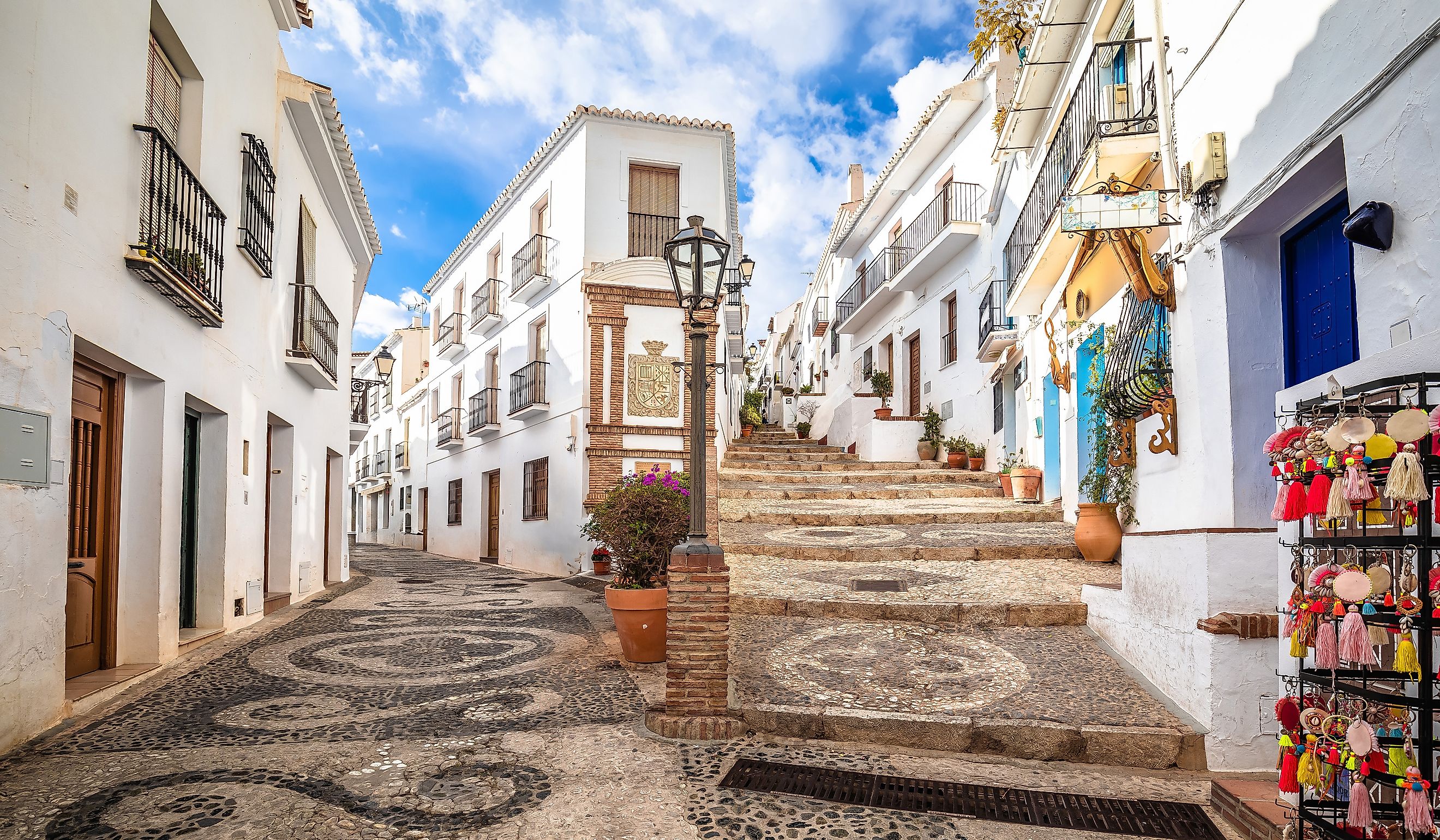
Frigiliana is home to traces of prehistoric settlements and is positioned like a balcony on the slopes of the Sierra Almijara. As a result, it has some of the most spectacular scenery of Costa del Sol. The Castle of Lizar, a ruins site, brings those vistas to light, just a short walk from the center of town. Although there’s little left of the castle, the view is more than worth it.
A little fun can be ignited through Casita de la Información y la Fantasía, a curious mechanical theater where, by inserting a 1-euro coin, a puppet theater tells the story of Frigiliana! And if you love an ice-cold cerveza (beer), La Domadora y el León, a craft beer store and bar, is your ideal stop. You may be regaled with stories from the passionate owners about the history and celebrations of Frigiliana as you relish a beer tasting with cheese, a truly personalized experience.
Spain’s offbeat side comes into focus in towns where the unexpected is part of the experience. Travelers can wander through El Torcal’s unusual limestone formations, sample Almagro’s pickled eggplants, or pair Rioja wine with chocolate in Haro. Add Cantabrian mythology in Castro Urdiales and Albarracín’s unusual architecture, and these eight towns offer plenty of reasons to venture beyond Spain’s major cities in 2026.