8 Most Walkable Town Centers In Oklahoma
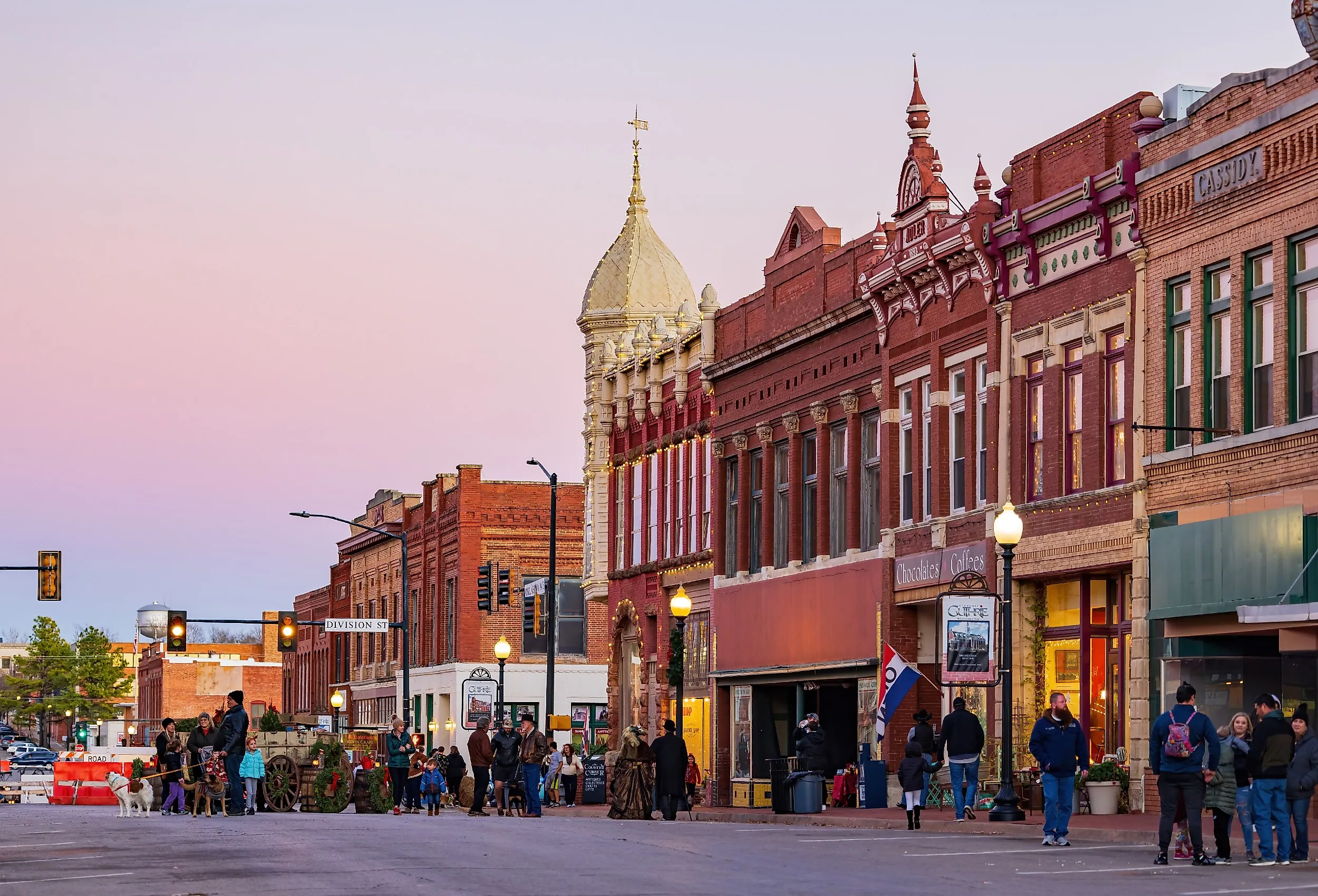
Guthrie became a city of 10,000 people in a single day in April 1889. Guthrie’s broader historic-preservation area now encompasses more than 2,000 buildings across roughly 1,400 acres and 400 blocks. Sapulpa lines its brick storefronts along the original Route 66 alignment. Medicine Park built many of its original cottages and commercial structures from locally formed round granite cobblestones. Bethany carries the highest Walk Score among the 30 largest Oklahoma cities included in the ranking. These town centers across the state hold a full afternoon within a few blocks.
Sapulpa

Sapulpa joined the state Main Street program in 1990, and the brick-clad blocks that earned it the designation are still the reason to park the car. Route 66 runs straight through the middle of them. The Route 66 Vintage Market and Little Bit of Country sit within a few hundred feet of each other, the latter a western-themed shop that also houses Western Anvil Artisan Metals. The Sapulpa Historical Museum occupies a downtown building, while the Heart of Route 66 Auto Museum fills a former 45th Armory on the west side of town.
The Route 66 Blowout has filled downtown each year since 1989, and the 2026 festival is scheduled for September 12 with a car show, arts-and-crafts vendors, food, and downtown shopping. Sapulpa now counts about 23,000 residents. One landmark does require driving: the Tee Pee Drive-In, built in 1949 and opened in May 1950 with room for 400 cars, sits west of town on an older Route 66 alignment. New owners reopened it in 2023 and added restored Spartan trailers for overnight stays.
Bethany

Walk Score ranks Bethany first among the 30 largest Oklahoma cities it evaluates, although its score of 47 remains in the site’s car-dependent category. The score comes from one dense stretch: NW 39th Expressway, which carries the Route 66 alignment through town and faces Southern Nazarene University, founded in 1899. Most of the shopping clusters in the 6700 block, where Apple Tree Antique Gallery hosts a row of storefronts. Apple Tree Antique Gallery remains active in the 6700 block, while Eden Antique Emporium offers another antique stop farther west on NW 39th Expressway.
Two of the better-known stops need a short drive rather than a walk. Rink Gallery, an old ice rink now holding more than 90 vendor booths, is south of the strip on Rockwell Avenue. The 1924 steel truss bridge at Lake Overholser marks the west edge of town and turns up in Steinbeck's The Grapes of Wrath. Back on the main stretch, Boomarang Diner serves all-day breakfast, and a pair of painted murals on College Avenue track Route 66 businesses across the highway's first three decades.
Guthrie

Guthrie’s broader historic-preservation area contains more than 2,000 buildings across roughly 1,400 acres and 400 blocks, while its 31-acre commercial core became a National Historic Landmark district in 1999. The town served as territorial capital from 1890 and as the first state capital from 1907 until Oklahoma City took the seat of government in 1910, and the decades of decline that followed left the Victorian commercial core standing.
Guthrie has since built the infrastructure to match. It was the second Oklahoma city to adopt a complete streets ordinance. First Capital Trolley provides on-demand transportation within Guthrie, although its dedicated historic route is closed until further notice. That is unusual equipment for a town of roughly 11,000. The 1901 Carnegie Library on East Oklahoma Avenue was the second Carnegie building in the state and is the oldest one left standing; the Oklahoma Territorial Museum sits alongside it. Recollections Antique Mall fills about 7,000 square feet on North First Street, and the Pollard Theatre stages productions a few doors away.
Claremore

Lynn Riggs was born on a farm outside Claremore in 1899 and set his 1931 play Green Grow the Lilacs in the country around it. Rodgers and Hammerstein turned that play into Oklahoma! The Lynn Riggs Memorial occupies part of the Claremore Museum of History on North Weenonah Avenue, where the surrey with the fringe on top from the film version is on display. One block east stands the Belvidere Mansion, a three-story brick house with a tower at each corner and a tea room on the ground floor.
Will Rogers gets top billing here, though he was born in a log cabin on the Oologah side of the county rather than in Claremore itself. His tomb and the Will Rogers Memorial Museum sit on a hill about a mile northwest of downtown, on land he had bought for a retirement home before his 1935 plane crash. The museum opened in November 1938 and is running an exhibit on the highway's renaming as the Will Rogers Highway through February 2027. Downtown itself carries the J.M. Davis Arms and Historical Museum, whose collection runs past 12,000 firearms plus World War I posters and roughly 1,200 German beer steins.
Tahlequah

The Cherokee National Capitol has stood on the town square since 1869, when the Cherokee Nation replaced council buildings destroyed during the Civil War. It housed all three branches of the government until statehood in 1907, then spent decades as the Cherokee County courthouse before returning to the Nation in 1970. Since 2019, it has held the Cherokee National History Museum across more than 7,000 square feet. A short walk away at Keetoowah Street and Water Avenue, the 1844 Cherokee National Supreme Court building is the oldest government building in the state and once printed the Cherokee Advocate, the first newspaper published in what is now Oklahoma. More on the town's history sits in this look at an Oklahoma town older than the state.
Street signs through the Tahlequah Original Historic District carry both English and the Cherokee syllabary that Sequoyah completed in 1821, including the stop signs and the parking restrictions. Northeastern State University sits just north of the square, close enough that student traffic keeps the downtown storefronts busy through the school year. Sam and Ella's Chicken Palace on North Muskogee Avenue serves thick-crust pizza despite its name and its chicken-themed decor, and Carrie Underwood worked there during college. Labor Day weekend brings the Cherokee National Holiday and thousands of people to these same blocks.
Stillwater

Downtown Stillwater runs about 11 blocks, with Main Street as its spine, and operates as a formal business improvement district with its own association and event calendar. Two of the original commercial buildings still stand a block over on West Seventh Avenue: the 1913 Selph Building and the 1914 Walker Building, both on the National Register. The Stillwater History Museum at the Sheerar covers the 1889 land run and the community’s development after Stillwater Township was established that year. The city counted 48,394 residents at the 2020 census, and more of them are within walking distance of this core than the raw number suggests.
However, many of the popular restaurants are not actually downtown, which matters if the plan is to leave the car parked. Eskimo Joe's has been at 501 West Elm since July 1975, and the original Hideaway Pizza opened in 1957 at Third and Knoblock in the Campus Corner district. Both sit near the Oklahoma State University campus, as does the National Wrestling Hall of Fame and Museum, a serious institution built around the Hall of Honors rather than a roadside stop.
Arcadia

William Harrison Odor built the Round Barn in 1898 by soaking green bur oak boards until they bent, then setting them into molds to hold the curve. The result measures 60 feet across and 43 feet tall on a foundation of local red Permian rock, and Odor laid a floor upstairs so the community could hold dances in it. His son later explained the shape simply: his father figured a tornado would go around a round building instead of through it. The barn made the National Register in 1977, then its rotted roof gave way in June 1988. A crew of mostly retired volunteers who called themselves the Over-the-Hill Gang rebuilt it using Odor's original method and rededicated it in April 1992.
Arcadia recorded 169 residents at the 2020 census, and it developed after the 1889 land run as a cotton settlement worked by both white and African American farmers who named it for the Greek Arcadia. Its second landmark sits about half a mile west along the old highway, close enough to walk on a decent day. POPS pours more than 600 varieties of soda under a 66-foot bottle sculpture ringed with color-changing LEDs, which is the reason most people slow down here after dark.
Medicine Park

Elmer Thomas founded Medicine Park on the Fourth of July in 1908, years before he went to Washington as a representative and then a senator. He and his partner Hal Lloyd bought 900 acres in the Wichita Mountains and opened it as the Medicine Park Summer Resort and Health Spa, trading on the reputation Medicine Creek already carried among the Plains tribes. It was the first resort town in the state. The round granite cobbles that give the place its look came out of the ground nearby, and roughly 85 percent of the original cobblestone structures are still standing, which is why the legislature named Medicine Park the Cobblestone Capital of Oklahoma in 2019.
Most downtown shops and restaurants cluster around Cobblestone Row and East Lake Drive, while the Healthy Hippie Cafe and Medicine Park Aquarium sit along Highway 49. A dam built in the 1920s created Bath Lake for swimming, and a second one made Lake Gondola for boats. The Old Plantation Restaurant occupies a cobblestone building on East Lake Drive and has been feeding people here for generations. Joe Mountain Breakfast Bar covers the earlier part of the day.
What Keeps These Centers Walkable
These downtowns arrived at the same result through four different routes. Guthrie retained much of its commercial core through decades of limited redevelopment, while Claremore has supported its historic downtown through Main Street preservation and revitalization programs. Sapulpa and Stillwater rebuilt theirs deliberately, through Main Street designation and a business improvement district. Tahlequah never needed to, since its blocks were laid out around a government square in the 1840s, and the square still sets the geometry. Medicine Park was designed for walking from the start, being a resort where guests arrived and then stayed put. The scale varies enormously, from Arcadia's two landmarks half a mile apart to Stillwater's eleven blocks, and the smaller places ask for an hour rather than an afternoon. Bethany makes the most interesting case: it ranks as the most walkable among Oklahoma’s 30 largest cities, according to Walk Score.