8 Most Breathtaking Towns In Washington
In some Washington towns a spectacular view sits at the end of every street. The Cascade peaks rise straight above the downtown rooftops in Leavenworth. Deep blue water stretches 50 miles between the mountains at Chelan. Rows of purple lavender cover the valley below the Olympic range at Sequim. A working harbor fills the foreground in Friday Harbor with islands and open sea beyond. Residents of these places wake up to that scenery every morning. Here are eight towns across Washington where the view is worth the drive.
Leavenworth

Leavenworth was a dying logging town before it became one of the best-looking places in the state. When the railroad pulled its yards out in the 1920s, the sawmill jobs went with them. In the early 1960s, residents made a gamble that sounds ridiculous on paper. They rebuilt the whole downtown to look like an alpine village in Bavaria, financed it with their own mortgaged property, and took no federal money to do it. The bet paid off, and the Cascade peaks behind Front Street make the illusion convincing.
Walk Front Street first for the timber-framed buildings and flower boxes, then stop at Andreas Keller for sauerkraut and house-made sausage. Waterfront Park sits a few minutes away along the Wenatchee River, with benches and overlooks facing the current and the forested slopes above it. For a longer stretch of the same scenery, the Icicle Gorge Trail runs an easy 4.2-mile loop past granite cliffs and footbridges over the blue-green creek. The Leavenworth Reindeer Farm rounds out the day with pasture tours and a chance to feed the animals under the mountains.
Winthrop

Residents here ran the same play a decade later with a different theme. In 1972, the North Cascades Highway was about to open and send drivers straight through town. Local sawmill owner Otto Wagner and his wife Kathryn organized the merchants, hired the architect who had styled Leavenworth, and rebuilt two blocks of downtown as an 1890s frontier main street. The false fronts and wooden boardwalks you see today are the result, held in place by a design code that still governs new construction.
The centerpiece is Three Fingered Jack's Saloon, the oldest legal saloon in Washington, named for a butcher named Jack Lemma who lost two fingers by most accounts cutting meat. Beyond the storefronts, the Methow River runs past town below the jagged North Cascades. The Susie Stephens Trail runs 2.3 miles through meadows and across a river bridge with valley views. Pearrygin Lake State Park sits three miles out, with a swimming beach, boat launch, and hiking trails around the water.
Walla Walla

Walla Walla is a more recent reinvention, built largely on the strength of wine. The downtown had fallen into decline before a local preservation push restored it, work that won the Great American Main Street Award in 2001. The tree-lined blocks now hold tasting rooms, restaurants, and brick buildings kept in period trim. Seven Hills Winery pours Bordeaux-style reds inside the 1904 Whitehouse-Crawford building, one of dozens of tasting rooms within walking distance of each other. The 1880 Kirkman House Museum anchors the historic side, an Italianate mansion built by an English cattle money family.
The landscape outside town is worth as much time as the glass in your hand. Pioneer Park sits just south with gardens, ponds, and shaded paths laid out over more than a century ago. Bennington Lake has the bigger views, ringed by more than 20 miles of trail that climb into the hills above the water. The Whitetail Trail is the one to pick, running close to five miles with a good chance of spotting deer and other wildlife along the way.
Chelan

Chelan sits at the foot of a lake that glaciers spent thousands of years carving into the mountains. Lake Chelan runs about 50 miles back into the Cascades, narrow and deep enough to pass for a fjord. It is the third-deepest lake in the country, deeper than any of the Great Lakes, and its blue water is why travelers come. Lady of the Lake runs boat tours out onto it, from short sunset cruises to all-day trips up to the roadless village of Stehekin at the far end.
Along the shoreline you will find plenty of ways to take the water in. Slidewaters sits on a hillside above the lake with slides and a lazy river facing the mountains. Lake Chelan State Park sits a short drive from downtown, with a swimming beach, boat ramp, and the two-mile Little Bear Trail winding through quiet forest along the shore. Tsillan Cellars pours nearby, the valley's largest winery, with Tuscan-style buildings and terraces looking straight down at the lake.
Sequim

Growers built Sequim's reputation on a single crop, and in July the whole valley turns purple with it. The town sits in a rain shadow between the Olympic Mountains and the Strait of Juan de Fuca, dry enough that lavender grows here like nowhere else in the region. Growers keep the rows open through summer, and Purple Haze Lavender Farm is a fine place to picnic among the plants, pick your own bundle, and buy lavender ice cream. The Olympic Mountains rise behind the fields, with the strait a short distance beyond.
The coast is worth as much time as the fields. John Wayne Marina has boat ramps, picnic tables, a waterfront restaurant, and a public beach for an easy afternoon. The Dungeness National Wildlife Refuge runs a forest trail out to a view of the Dungeness Spit, the longest natural sand spit in the country, reaching roughly five miles into the strait. A lighthouse stands near the far end, and the refuge draws birders, anglers, and anyone hoping to spot seals offshore.
Poulsbo

Poulsbo sits on Liberty Bay, settled by Norwegians in the late 1800s who left their mark on the place. Locals call it Little Norway, and the downtown treatment reads as heritage rather than gimmick. The Scandinavian-style storefronts line Front Street, where Sluys Poulsbo Bakery has turned out Nordic pastries for decades. The calm water of the bay stays a block away the whole length of the walk.
The waterfront is where the town has the most to do. Muriel Iverson Williams Waterfront Park runs right along the bay with a fishing pier, a kayak launch, and a boardwalk facing the moored boats. Poulsbo Fish Park sits just north, its boardwalk threading through estuaries and wetlands where herons work the shallows. Both put you on the water within minutes of the pastry counter.
Friday Harbor

Friday Harbor is the kind of place you reach by ferry and remember by the water. The main town on San Juan Island, it looks out over a busy harbor backed by evergreen islands and the far Olympic Mountains. Front Street runs along the waterfront, where Downriggers serves seafood and cocktails with the harbor spread out below. The island setting is the draw, and the town stays small enough that the water is never far from view.
The real show is nine miles out at Lime Kiln Point State Park, one of the best spots in the country to watch whales from dry land. A short trail leads to the 1919 Lime Kiln Light, and orcas, humpbacks, and seals pass close to shore from spring through fall. Back in town, the Whale Museum fills in the science with skeletons and life-size models. Small farms dot the island too, and Amaro Farm lets visitors feed and pet the sheep.
Port Townsend

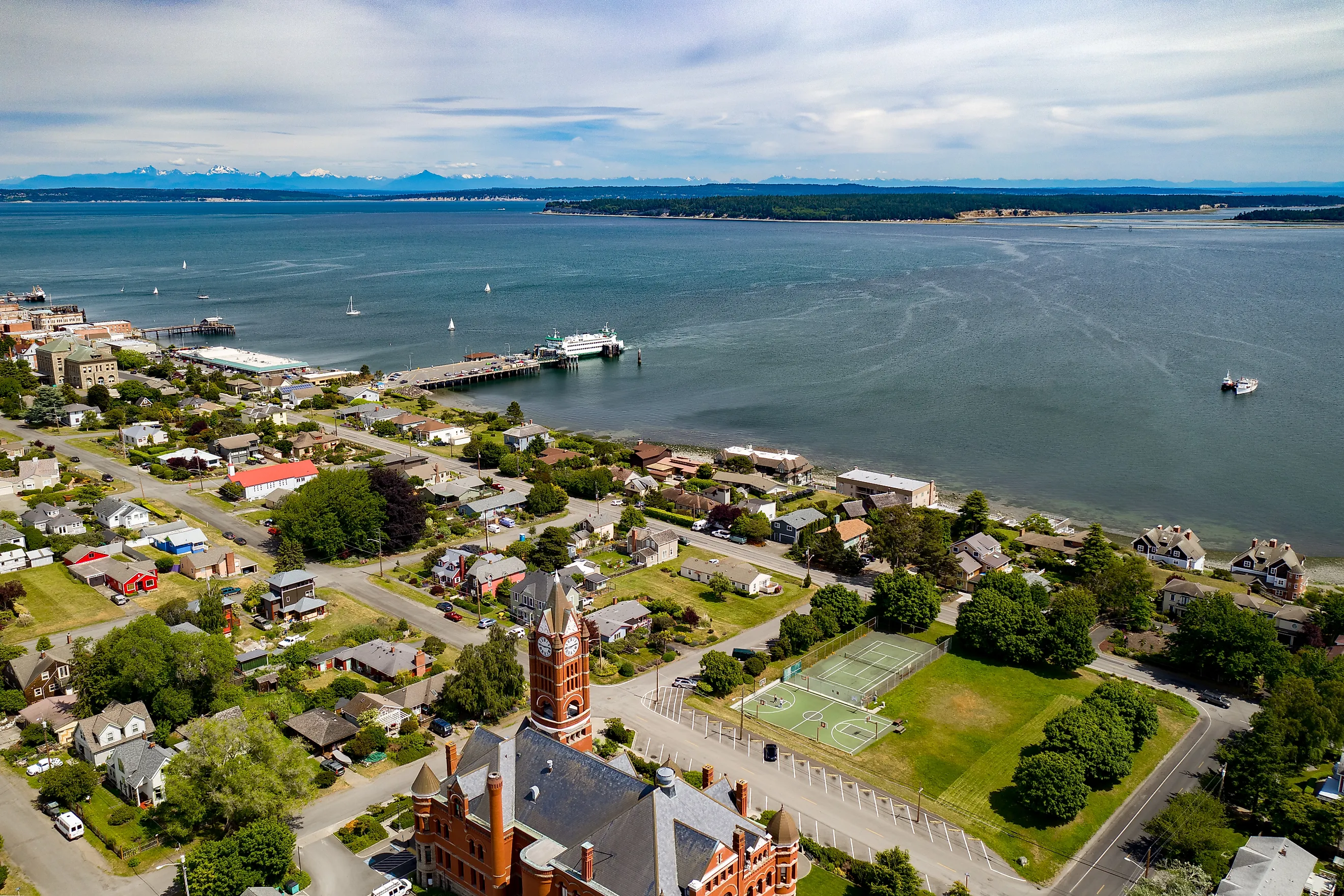
Port Townsend looks the way it does because of a boom that never fully arrived. In the late 1800s the town was one of the busiest ports on the West Coast, and everyone expected the railroad to make it a major city. Investors put up block after block of ornate Victorian buildings on the strength of that bet. The railroad went elsewhere, the boom stalled, and the town was left with one of the largest collections of preserved Victorian architecture in the country. It sits on the northeastern tip of the Olympic Peninsula, facing the Salish Sea with the Cascade Range beyond.
Water Street is the place to walk it, past the 1890 Hastings Building and down toward the boats in the harbor. Stop at the Bayview for seafood with a view of the inlet. Pope Marine Park stretches along the shoreline with piers and open space facing Admiralty Inlet. Just outside town, Fort Worden Historical State Park holds a fort built in the 1890s, along with old gun batteries, 12 miles of trail, and two miles of beach below views of Puget Sound and Whidbey Island.
The Views Are Only Half The Story
What ties these eight together is that the beauty was rarely just an accident of geography. In Leavenworth and Winthrop, residents chose the look outright and hired the work done. In Poulsbo and Port Townsend, the character traces back to who settled there and where the money went. In Sequim, Chelan, and Walla Walla, the draw is a crop, a lake, and a wine industry. Visit any of them for the scenery, and you come away knowing the reason behind it.