8 Main Streets Where The Poconos Come Alive
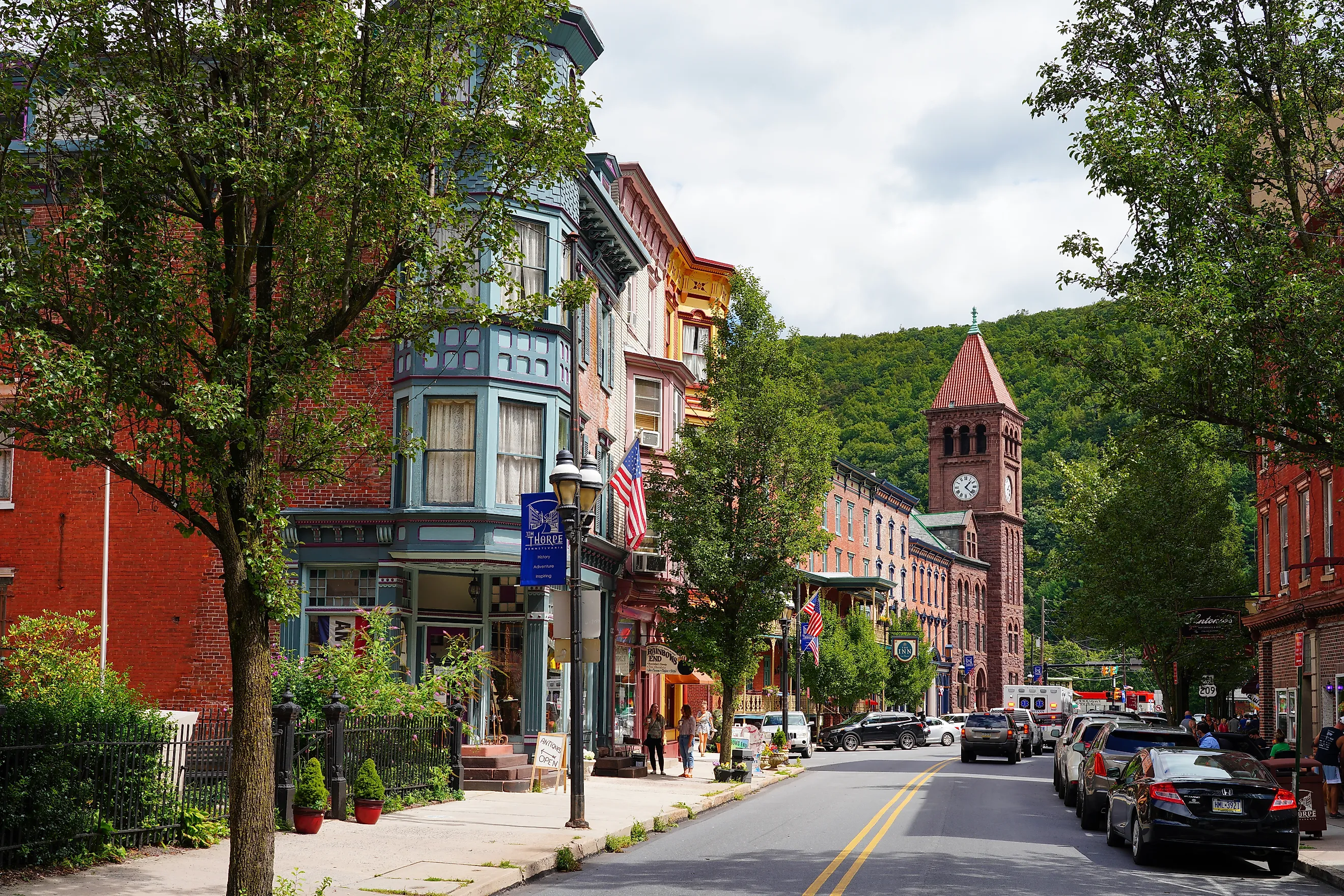
The Pocono Mountains still carry the marks of coal, rail, and resort history in their downtown corridors. On Broadway in Jim Thorpe, a Richardsonian Romanesque courthouse with a clock tower reminiscent of London's Big Ben rises above the Victorian facades of Millionaire's Row. In Honesdale, a replica of the Stourbridge Lion, widely regarded as the first commercial steam locomotive to run in the United States, anchors a Main Street of brick storefronts and independent boutiques. Hawley's Main Avenue threads past the massive bluestone Silk Mill, and in Delaware Water Gap, the Deer Head Inn has kept live jazz flowing on Main Street for generations. These are eight main streets where the Poconos come alive.
Jim Thorpe

Broadway curves through the steep-walled Lehigh River valley in Jim Thorpe, a former coal-shipping hub of about 4,500 people originally known as Mauch Chunk. The prosperity generated by the Lehigh Coal and Navigation Company in the mid-1800s produced a concentration of Victorian, Italianate, and Romanesque architecture that earned the street the nickname "Millionaire's Row," and much of it remains intact today.

The Carbon County Courthouse, completed in 1894 and designed by Lewis S. Jacoby in the Richardsonian Romanesque style, dominates the lower end of Broadway with its rough-cut sandstone facade and clock tower that recalls London's Big Ben. Nearby, the Inn at Jim Thorpe occupies a building dating to 1849, with its ornate cast-iron balcony overlooking the sidewalk below. The Mauch Chunk Opera House, built in 1881 and still hosting live performances, anchors the upper block. Lehigh Gorge Scenic Railway departs from a station at the edge of downtown for excursions typically lasting 45 to 80 minutes along the river.
Honesdale

Main Street in Honesdale traces the former terminus of the Delaware and Hudson Canal, the 108-mile waterway that once carried coal from the mountains to the Hudson River. In 1829, the Stourbridge Lion ran here, an event widely regarded as the first operation of a commercial steam locomotive in the United States. That history remains visible today in the full-size replica housed inside the Wayne County Historical Society Museum on Main Street.

The brick-fronted storefronts that line the surrounding blocks have found a second life as independent shops, with Wallflower alone covering 4,000 square feet of clothing, jewelry, and decor, and the commercial stretch invites the kind of unhurried browsing that can turn a morning bagel at Camp Umpy's into a full afternoon of wandering. When the storefronts eventually give way to restlessness, the Stourbridge Line offers a natural next move, departing from the downtown station on scenic excursions that follow the Lackawaxen River through the surrounding countryside.
Stroudsburg

Colonel Jacob Stroud settled along the confluence of Brodhead, McMichaels, and Pocono Creeks in 1760, and his son, Daniel, founded Stroudsburg in 1799. Main Street developed as the commercial spine of what became the Monroe County seat, and the Stroud Mansion, built in 1795 at the corner of Main and Ninth Streets, still anchors the corridor as the headquarters of the Monroe County Historical Association.
That founding-era architecture now shares the streetscape with a visible creative layer. Murals appear across several downtown facades, lending color to the brick buildings between Courthouse Square and the blocks to the north. The Sherman Theater, built in 1928 as a movie palace, remains the cultural anchor, drawing national touring acts and community productions to a stage that has been active for nearly a century. On Saturday mornings, the Monroe Farmers Market fills the square with local produce and artisan goods, and by evening, the energy shifts to the tasting rooms and live music venues just off Main that keep the sidewalks active well past dark.
Milford

Judge John Biddis founded Milford in 1796 and laid out its streets in a grid inspired by the design of the nation's then-capital, naming the north-south streets after his children and the alleys after fruits and berries. Broad Street, aligned as the town's primary axis, has served as the commercial center of this Pike County seat ever since, and the Milford Historic District joined the National Register of Historic Places in 1998.
Hotel Fauchere, dating to the early 1850s and having hosted guests from Theodore Roosevelt to Charlie Chaplin, anchors one end of Broad Street, offering lodging and a dining room sourced from regional farms. The Milford Theater provides a regular schedule of live performances and film screenings beneath its distinctive marquee. Grey Towers National Historic Site, the former estate of Gifford Pinchot, the first chief of the US Forest Service, sits close enough to pair with a downtown visit and offers guided tours of its French chateau-style mansion and terraced gardens.
Hawley

Main Avenue in Hawley reflects the town's origins as a canal and lumber hub along the Lackawaxen River. A defining presence on the street is the Hawley Silk Mill, an 1880s factory often cited as one of the largest bluestone industrial buildings in the Northeast. After decades of disuse following the decline of the silk industry, the mill now houses an arts center, specialty shops, and the Cocoon Coffeehouse, which occupies a ground-floor space within the restored building.
A 25-minute walk down Spring Street leads to the Ritz Company Playhouse, a community theater staging productions year-round in a volunteer-run venue that draws performers and audiences from across the region. The Settlers Inn, a craftsman-style lodge along Main Avenue, serves farm-to-table meals and provides overnight lodging steps from the commercial center. Lake Wallenpaupack, one of Pennsylvania's largest lakes at roughly 5,700 acres, lies just a few miles from downtown and draws visitors for boating, fishing, and shoreline walks.
Delaware Water Gap

Main Street in Delaware Water Gap traces its origins to the 1790s, when Antoine Dutot settled the village and later began building the area's first inn overlooking the Delaware River. By the late 1800s, railroad access had transformed the tiny borough into the second-largest inland resort destination in the United States, behind only Saratoga Springs, with around 16 hotels lining the streets at the village's peak. Fires claimed the two grandest properties, the Kittatinny House and the Water Gap House, in 1915 and 1931, and the automobile age drew vacationers further afield. Today, Main Street measures only a few blocks, but its setting at the base of Mount Minsi, where the Delaware River cuts through Kittatinny Ridge, gives it an outsized presence.
The Deer Head Inn, dating to the 19th century, has hosted live jazz performances for decades and is often cited as one of the oldest continuously operating jazz venues in the country. Musicians and audiences gather in its intimate performance space on weekend evenings, keeping alive a tradition that helped define the town's identity as an artists' retreat. The Antoine Dutot Museum and Gallery, housed in a former schoolhouse, features exhibits on local history and rotating art shows. The historic Delaware Water Gap Station marks the entrance to town and the gateway to more than 70,000 acres of protected land within the Delaware Water Gap National Recreation Area.
Lehighton

First Street in Lehighton grew up along the Lehigh River during the canal era of the early 1800s, when the Lehigh Navigation system transformed the valley into a corridor for shipping anthracite coal downstream. That transportation heritage survives today in the D&L Trail, a multi-use path following the historic canal route that connects Lehighton directly to Jim Thorpe, allowing walkers and bikers to travel between the two downtowns along a scenic riverside corridor.
The street itself maintains a practical, everyday character that sets it apart from the more tourist-oriented downtowns nearby, its blocks lined with local restaurants and early-20th-century commercial buildings. Country Junction, billed by its owners as the "world's largest general store," anchors the edge of town with a sprawling mix of home goods, seasonal items, and a family-friendly petting zoo. A short drive south, Beltzville State Park opens up around a 949-acre lake ringed by wooded hiking trails and swimming areas, extending the appeal of a Lehighton visit beyond the storefronts.
Tannersville

The stretch of Route 611 that serves as Tannersville's main corridor follows the path of the old Lackawanna Trail. The settlement, originally called Pocono Point, was established around 1750 and took the name Tannersville in 1840 because of the area’s leather tanneries. The Kistler family operated the largest of these, employing over 160 workers at the industry's peak and shipping finished leather to markets as far as Europe. By the 1880s, the surrounding hemlock forests had been stripped of the bark needed for tanning, and the industry collapsed. What replaced it was tourism, first through mountain boarding houses and eventually through the ski resort that now dominates the town's identity.
Camelback Mountain Resort, built on the site of one of Pennsylvania's earliest ski runs, now brings year-round traffic to Route 611 with skiing, snowboarding, and a large indoor waterpark. That activity spills into nearby businesses, including Barley Creek Brewing Company, a Pocono institution since 1995 with a wood-paneled taproom that fills on weekend evenings. The Tannersville Inn, which has provided lodging and dining along Route 611 since the resort era took hold, offers a quieter stop nearby. Together, they reflect the town’s shift from tannery center to mountain resort gateway.
Where the Mountains Meet the Sidewalk
Each of these eight main streets draws from a different chapter of the Poconos' layered history, whether coal shipping, canal building, resort hospitality, or mountain recreation. What connects them is the way the surrounding landscape remains visible from the sidewalk, reminding visitors that the forested ridgelines, river gorges, and mountain peaks framing each downtown are never more than a short walk or drive away. The best Poconos main streets are not just places to shop and eat but entry points into a region where natural beauty and small-town life have shaped each other for more than two centuries.