11 Standout Main Streets In The Poconos
Long before highways reshaped travel, many Poconos towns built their main streets around rail stations, resort hotels, and trail access, a layout that still defines how these downtowns function today. Towns like Stroudsburg, Jim Thorpe, and Milford make it easy to park once and stay put, with downtown blocks laid out for walking instead of cutting through traffic.
Along these corridors, places such as the Sherman Theater, Mauch Chunk Opera House, Grey Towers National Historic Site, and the Deer Head Inn, one of the oldest continuously operating jazz clubs in the United States, sit close enough to matter. A short walk can connect lunch, live music, a historic landmark, or even access to the Appalachian Trail without turning the day into a plan-heavy exercise. These 11 standout main streets work exceptionally well because they concentrate culture, dining, and public space into compact corridors designed for lingering, not rushing.
Stroudsburg

Stroudsburg’s Main Street works because it compresses one of the region’s busiest downtowns into a tight grid centered on Courthouse Square. As the county seat, this area has long served as an administrative and civic center, which helps explain why so much activity remains concentrated here. The Sherman Theater sits directly on the corridor and serves as a dependable evening anchor, keeping performances and scheduled events tied to the downtown blocks after typical daytime hours. On scheduled days, Monroe Farmers Market operates in the Courthouse Square area, reinforcing Main Street’s role as a recurring stop rather than a one-off visit.

Dining follows the same pattern, with The Apple Tree positioned right on the corridor as part of the street’s everyday mix. The Pocono Mountains Visitors Bureau is also located on West Main, which is a practical indicator of how central this stretch is to both local orientation and visitor movement through town. Courthouse Square itself anchors festivals and large-scale downtown events, including StroudFest, which regularly closes sections of Main Street and uses the square as its focal point. Taken together, the courthouse, theater, market schedule, and festival use create a downtown zone that supports extended periods of walking without needing to move the car.
Jim Thorpe

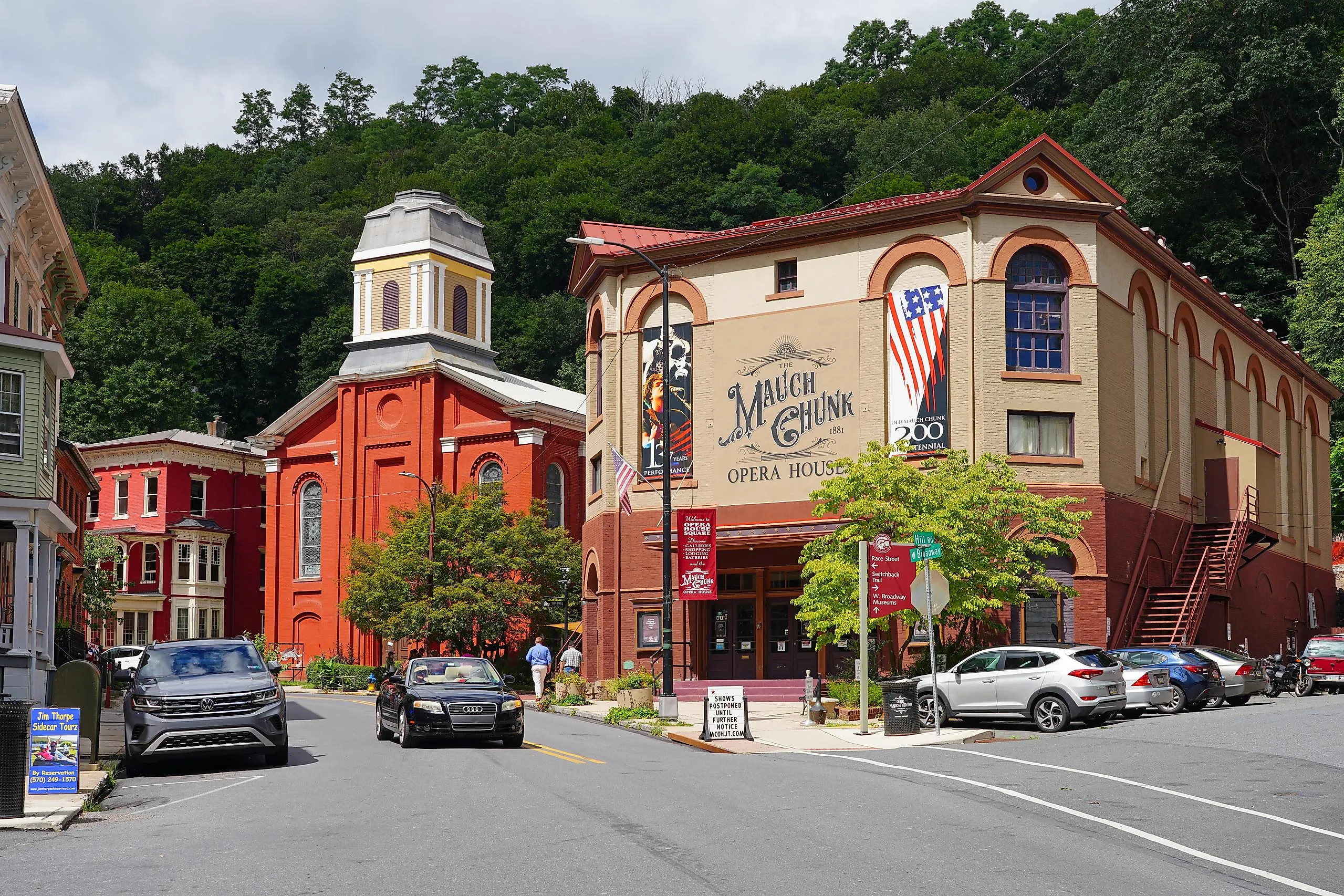
Broadway in Jim Thorpe is a single, continuous downtown corridor, with major landmarks and everyday institutions arranged within a short walking distance of each other. Mauch Chunk Opera House anchors the street with a historic performance venue that gives Broadway a clear role beyond daytime shopping. Nearby, Lehigh Gorge Scenic Railway operates directly out of the downtown station area, linking storefront activity with scheduled rail excursions that begin and end right in town. The Jim Thorpe Visitors Center is situated within the same core. It helps define where the main corridor begins and ends, making Broadway a convenient orientation point for first-time visitors.

Broadway’s importance extends beyond entertainment and tourism. Community institutions, such as Dimmick Memorial Library, remain part of the corridor, reinforcing that this stretch supports both daily town life and visitor traffic. Just uphill from Broadway, the Asa Packer Mansion adds a primary historic anchor within walking distance of downtown, tying the street directly to Jim Thorpe’s 19th-century industrial legacy. A few blocks away, the Old Jail Museum offers another town-specific landmark that remains closely connected to the downtown grid, rather than functioning as a separate destination. Taken together, the rail station, performance venue, civic institutions, and nearby historic sites give Broadway a density that allows it to function as Jim Thorpe’s primary organizing spine.
Milford

Milford’s downtown core, centered on Broad Street and East Catharine Street, stands out because several of the town’s key anchors sit within the same compact area. The Milford Theater offers a distinctive marquee presence and a consistent reason to be downtown in the evening with its diverse range of live performances. Nearby, Hotel Fauchere stays right in the walkable core, reinforcing Milford’s downtown-first layout with a historic lodging option that dates back to the early 20th century.

Grey Towers National Historic Site is a defining part of the town’s identity and sits close enough to function as a natural pairing with downtown stops. The estate’s gardens and architecture are part of what draws visitors interested in both outdoor spaces and historical interpretation to Milford. Within a few blocks of these anchors, visitors can also find galleries and small businesses that reflect the town’s arts-forward reputation.
Not far from the heart of downtown, The Columns Museum preserves local history and provides additional context for the community that grew up around this area. Because all of these critical stops are situated within the same walkable grid, movement between the theater, historic site, hotel, and museum can occur on foot. That connection between civic, cultural, and historical institutions is part of what makes Milford’s primary street function as a cohesive district.
Honesdale

Honesdale’s Main Street combines a traditional downtown layout with a calendar that keeps the corridor active throughout the year rather than only on weekends. Roots & Rhythm Music & Arts Festival is tied directly to Main Street and provides a predictable point in the year when the downtown blocks are at their busiest, bringing local musicians and visual artists into the heart of town. For a rail-town experience connected to the street itself, The Stourbridge Line operates excursion trains out of Honesdale, adding scheduled rides that link the downtown station area with a regional attraction.

The Cooperage Project adds a modern cultural venue to the downtown mix, supporting concerts, community events, and year-round programming that draws patrons into the corridor. Within a few blocks, you can also find the Wayne County Historical Society Museum, which offers exhibits on the region’s past and reinforces the downtown’s role as a community hub. Just outside the commercial blocks, Irving Cliff Park sits close enough to function as a short extension of a Main Street visit, with scenic overlooks that reference the area’s landscape and historic rail heritage. Together, these features create a downtown corridor with a blend of programming, cultural anchors, and historical context that go beyond weekend storefront browsing.
Hawley

Hawley’s Main Avenue stands out because it blends small storefronts with larger, repurposed anchors that stay active throughout the year. Hawley Silk Mill is a prime example, converting a former industrial complex into a concentrated destination for dining, shopping, and services that are within walking distance of the main corridor. Its scale gives downtown Hawley a second layer without pulling activity away from Main Avenue.

The performing arts remain an integral part of daily town life through The Ritz Company Playhouse, which operates a year-round schedule and ties scheduled performances directly to the downtown area. Dining plays a similar role. The Settlers Inn, situated along Main Avenue, serves as both a destination restaurant and a downtown anchor that complements the street’s slower, walkable pace. Seasonal programming adds to that rhythm through the Hawley Farmers Market, which operates within the borough and draws regular foot traffic into the downtown area during its run.
Outdoor access stays connected rather than separate. The Lackawaxen Riverwalk is situated close enough to downtown to serve as a convenient extension of a Main Avenue visit, providing a way to step away from storefronts without leaving town. Together, these elements allow Hawley’s main corridor to function as a compact, layered downtown that balances commerce, performance, dining, and outdoor access in one place.
East Stroudsburg

East Stroudsburg’s downtown is compact and walkable, with short blocks that support easy movement between dining, services, and historic landmarks. The street functions as a connector rather than a single destination, which is part of why it works so well as a central corridor. The Historic Dansbury Depot sits just off the main downtown blocks and serves as a recognizable historic landmark tied to the town’s rail and civic history. Its placement helps orient the surrounding blocks and reinforces where downtown activity naturally gathers.

Within the same grid, Renegade Winery sits comfortably among other street-level stops, fitting into short walking loops rather than pulling foot traffic in one direction. That matters here, since Crystal Street rewards small circuits rather than straight-line movement. You can seamlessly transition between landmarks, dining, and evening stops without needing to reset your plan or relocate your car. The corridor facilitates seamless transitions from daytime errands to evening plans without requiring a change in neighborhoods.
What holds the area together is scale. Crystal Street does not stretch endlessly or fragment into disconnected pockets. Instead, the depot, nearby businesses, and surrounding blocks form a downtown that stays readable and contained. For East Stroudsburg, that clarity comes from the corridor’s limited scale and defined boundaries. The corridor works because it feels complete without trying to do too much.
Delaware Water Gap

Main Street in Delaware Water Gap condenses much of the borough’s identity into a compact footprint, which is part of what makes it a true main corridor. The borough sits along the Delaware River, and that proximity shapes how Main Street connects directly to outdoor access without separating downtown from the surrounding landscape. Dining, live music, and outdoor access are all conveniently located along the same stretch, rather than being spread across different parts of town. Deer Head Inn is the most prominent anchor, operating as a long-running jazz venue directly on Main Street and giving the corridor a clear role in the borough’s cultural life. Its presence keeps evening activity tied to the downtown blocks rather than scattered elsewhere.

For daytime stops, Village Farmer & Bakery sits along the same corridor. It fits naturally into a walking route through town, reinforcing how Main Street supports everyday use alongside scheduled events. A short distance away, the Antoine Dutot Museum & Gallery adds a historical layer tied directly to the borough, offering context on the area’s early European settlement without pulling visitors away from the primary street grid. Outdoor access remains tightly connected. The nearby Appalachian Trail access point allows a walk on Main Street to transition easily into a hike without requiring a drive across town.
The borough’s municipal buildings and services are also situated along or near Main Street, reinforcing the community's compact and centralized nature. Everything necessary sits close enough to function together, which is precisely what gives Delaware Water Gap’s main corridor its strength.
Lehighton

Lehighton’s downtown corridor, centered on Broadway, is effective because it seamlessly links traditional storefronts with nearby outdoor infrastructure and public gathering spaces, maintaining a compact and readable layout. Broadway functions as the town’s central organizing spine, with local businesses, civic buildings, and services clustered close enough to support regular foot traffic. The proximity of the D&L Trail allows Broadway to serve as a practical before-or-after stop for walking and biking, tying downtown directly to one of the region’s most heavily used multi-use trails.
A short distance from the commercial corridor, downtown Lehighton is supported by nearby trail access and public spaces that keep activity connected to Broadway. Its location near the downtown grid helps keep community activity linked to Broadway rather than separated from it. Downtown Lehighton also benefits from ongoing revitalization efforts led by Lehighton Main Street, which focuses on maintaining the corridor as a functional business district rather than a single-purpose destination.

What makes Broadway effective is not one standout attraction, but how easily different uses fit together. Food, trail access, public spaces, and day-to-day errands are all within a short distance. That layout allows downtown Lehighton to support a complete stop without stretching the visit across multiple areas or requiring extra planning.
Palmerton

Palmerton’s downtown, centered on Delaware Avenue, stands out for how clearly civic life and community space organize the corridor. The street immediately reads as the town’s center because municipal, historical, and public gathering places are situated close together, rather than being spread out. Palmerton Borough Hall establishes a clear municipal anchor along Delaware Avenue, helping to define where the downtown core begins and ends. Its placement reinforces the avenue’s role as the town’s primary decision-making and service corridor.
Nearby, the Palmerton Area Historical Society offers a locally focused historical stop that remains grounded in Palmerton’s own story, rather than serving as a regional museum. Its presence keeps local history tied directly to the downtown blocks, rather than being separated from everyday town activity. A short distance from Delaware Avenue, Palmerton Park functions as the town’s largest public gathering space and plays a significant role in the downtown calendar. The park hosts the annual Palmerton Community Festival, which connects the downtown corridor to a larger shared space designed for public events.

What makes Palmerton’s main corridor work is how naturally those pieces fit together. Civic services, local history, and community events all sit within easy reach. That closeness gives Delaware Avenue a steady purpose beyond retail alone.
Mount Pocono

Mount Pocono’s core corridor centers on Pocono Boulevard and the nearby crossroads where several major routes meet, functioning as a borough hub rather than a single retail strip. This area operates more like a compact service and transit center, supporting both residents and visitors, rather than a traditional linear main street. The Mount Pocono Borough Building helps define where downtown activity begins, anchoring municipal services directly along the corridor and reinforcing the area’s role as the borough’s administrative center.
Transportation plays a visible role in shaping the corridor. Mount Pocono serves as a transportation hub, with major routes and regional transit services concentrating activity near the borough core. That accessibility helps explain why activity concentrates here rather than spreading across multiple commercial pockets. Nearby, Mount Airy Casino Resort stands as one of the borough’s most recognizable destinations and contributes to steady traffic in the area without displacing the corridor’s everyday functions.

Everyday services remain part of the same landscape. Perkins Restaurant & Bakery on Route 940 illustrates how routine dining options coexist alongside larger destinations and civic buildings. Taken together, Pocono Boulevard and the surrounding crossroads form a downtown that prioritizes access, services, and connectivity over a single attraction-driven model.
Lake Harmony

Lake Harmony’s main street activity concentrates along Lake Drive, where dining, resort properties, and the shoreline line up into a compact, walkable loop. Unlike towns with a single commercial strip, Lake Harmony’s corridor works because the road follows the edge of the lake and naturally organizes activity around it. Nick’s Lake House anchors South Lake Drive with a waterfront location that places dining directly along the shoreline, helping to define the southern end of the loop. Its position reinforces how closely food and lake access are tied together here.
On the opposite side of the drive, Piggy’s Restaurant provides another street-level stop that fits into the same walking pattern rather than pulling activity away from the lake. Split Rock Resort is situated close enough to function as part of the broader Lake Harmony footprint, particularly for visitors planning a day that combines dining, recreation, and time on the water. Its proximity helps keep activity centered rather than scattered across the surrounding area.

Evening options, such as Shenanigans, round out the corridor and extend the usable hours of Lake Drive without altering its scale. What makes this area work is not variety for its own sake, but alignment. Here, Lake Drive follows the shoreline, which keeps dining, resorts, and lake access aligned within a short walking loop.
What sets the strongest main streets in the Poconos apart is not scale or spectacle, but structure. These corridors grew up around rail depots, resort hotels, and trail access points, and they still operate on that same logic today. That pattern reflects the geography of the Pocono Mountains, where towns developed in valleys, river gaps, and rail corridors long before modern highway travel reshaped the region. In places like Jim Thorpe, Stroudsburg, and Milford, historic anchors, cultural venues, and everyday services remain clustered close together, making it easy to arrive, park once, and stay engaged on foot. Whether the draw is live music in Delaware Water Gap, theater nights in Honesdale, or lakeside dining in Lake Harmony, each main street functions as a complete district. That consistency explains why these downtowns remain active, practical, and relevant year after year.