7 Prettiest Main Streetscapes In The Ozarks
Small towns across the Ozarks have as much personality as one might expect from a region defined by its rich mountain culture. Van Buren flaunts Victorian storefronts against the backdrop of the Boston Mountains, Eureka Springs bends its downtown around steep limestone bluffs, and Hollister imports an unexpected touch of Tudor England to southern Missouri. Across the seven towns on this list, these streetscapes come to life through live music, folk festivals, and longtime gathering places that keep them at the heart of community life.
Van Buren, AR

Eight blocks of restored buildings from the late 1800s and early 1900s make up the Van Buren Historic District, with the Boston Mountains rising along the northern edge of Crawford County and the Arkansas River valley spreading south. Pressed metal cornices and hood molding over second-story windows give the Italianate storefronts their character. The 1889 Crawford County Bank shows off a corner turret, terra cotta and brick detailing, and patterned slate shingles.
The King Opera House of 1891 is now home to a community theatre a few doors down. At one end of Main stands the Frisco Depot of 1901 and 1902, Mediterranean in style with a red tile roof, wide overhanging eaves, and triangular knee braces, now the visitor center and the boarding platform for Arkansas and Missouri Railroad excursion trains. The Crawford County Courthouse closes the other end, rebuilt after an 1877 fire on its original four exterior walls and dressed with wings and a portico in 1905.
Eureka Springs, AR

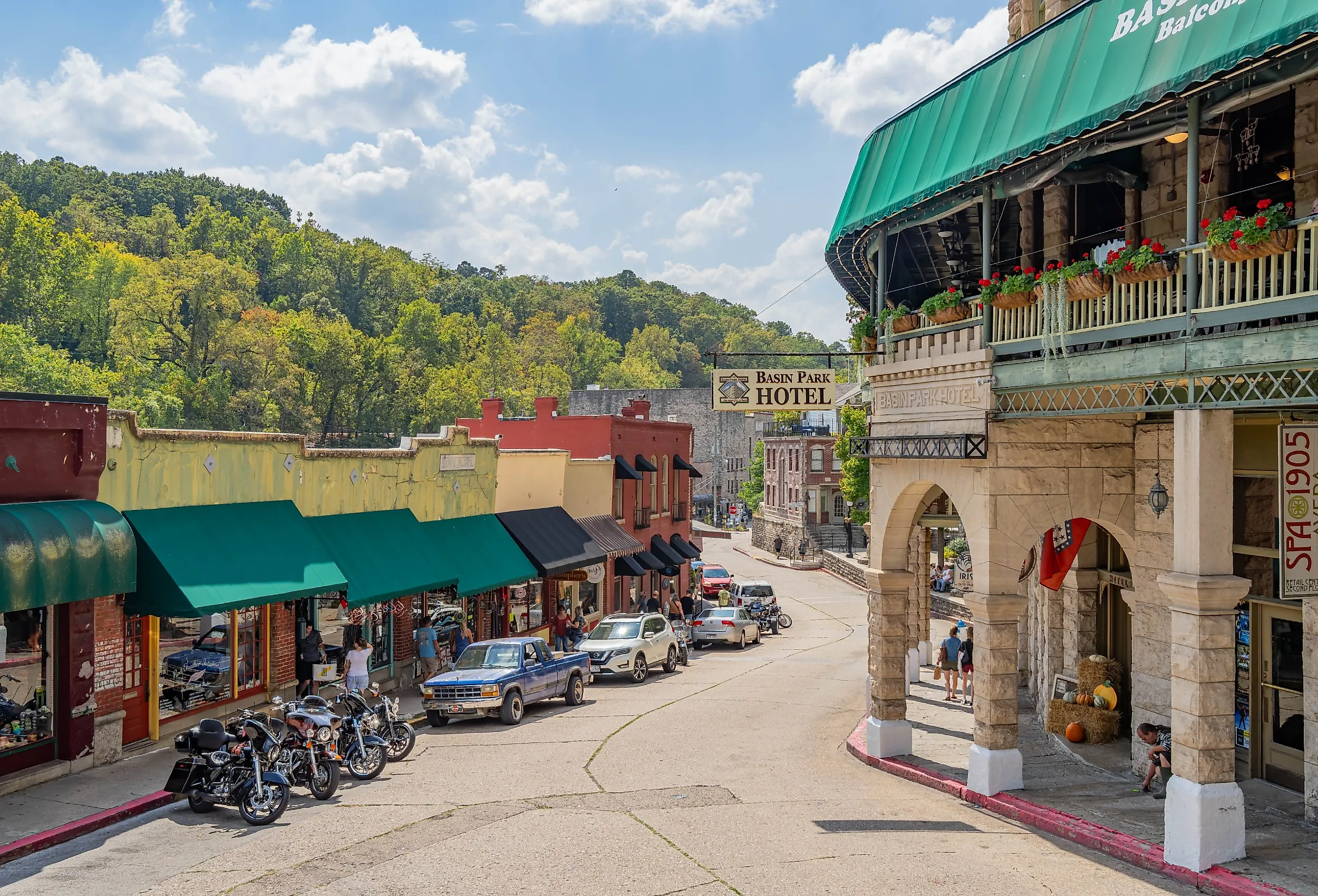
North of the Boston Mountains, in Carroll County, Eureka Springs main street runs along a bluff. Spring Street winds roughly a mile through terrain that allows no perpendicular intersections, so buildings on the west side sit into the mountainside while those on the east descend the bluff with street-level doors on upper floors. The Basin Park Hotel of 1905, seven stories tall and the tallest building in town, is built into the bluff so that all eight of its levels sit at ground level.
First Baptist Church touches three streets at three separate ground levels. Five natural springs break the street into pocket parks along the way, among them Crescent Spring and Basin Spring Park, where free outdoor concerts and street performers fill the lawn. The entire city and its Queen Anne, Romanesque, and Italianate work went on the National Register in 1970, and the National Trust for Historic Preservation has named the district one of America's Dozen Distinctive Destinations.
Jasper, AR

Southeast in Newton County, Jasper's town square sits at 876 feet above sea level, with the Little Buffalo River running below the town. The Works Progress Administration built the Newton County Courthouse between 1939 and 1942 from locally quarried limestone and granite, and its Art Deco detailing and original metal frame hopper windows still face the square. The Jasper Commercial Historic District has 26 buildings listed on the National Register, many of which are built of local stone.
Across from the courthouse, the Ozark Cafe has served patrons since 1909 and now runs three rooms of tables under walls papered with notes and photographs. The Turquoise Buffalo Mercantile sells jewelry on the square. Every June, the Buffalo River Elk Festival fills the square and Bradley Park with a craft fair and outdoor sporting event named for the roughly 600 elk along the Buffalo River corridor. Bradley Park runs along the Little Buffalo River within the city limits, with a walking trail, a pavilion, and a small swimming beach.
Mountain View, AR

South in Stone County, Mountain View's shops and restaurants center around a square of one and two-story storefronts. Here, storefronts are filled with antique shops and restaurants. Musicians still bring their instruments to the courthouse square for informal 'pickin' sessions, continuing the folk-music tradition that helped make Mountain View famous and is celebrated each spring during the Arkansas Folk Festival. At the north edge of town, the Ozark Folk Center State Park runs a craft village of about 20 working artisans Tuesday through Saturday from mid-April to mid-November, with daily performances on the Blacksmith Stage. Its 1,000-seat Ozark Highlands Theater books concerts and festivals through the same season.
Hollister, MO

North across the Missouri line in Taney County, Hollister's Downing Street looks more like an English village than a typical Missouri town. Storefronts sport half-timbered gables and arched casements dating back to the village William Johnson platted in 1906 and built out through the 1920s. Ye Olde English Inn, finished in 1913, now runs as a boutique hotel with a restaurant and bar. Hook and Ladder Pizza throws handmade pies a few doors down. Every October, the Hollister Grape and Fall Festival closes the street for a grape stomp, live music, and vendor booths.
Warsaw, MO

The Osage arm of Lake of the Ozarks reaches north to Benton County, where Warsaw sits. In 2001, the town relaid its Main Street in old-fashioned brick pavers and lit it with period lamps. Shops and restaurants fill the historic storefronts along the corridor. The Steamboat Landing boardwalk at Drake Harbor makes for a short walk to the water from those storefronts. Nearby, the Riverfront Trails connect downtown to the Joe Dice Swinging Bridge, built in 1904 and rebuilt in 1928, one of only a handful of Dice suspension bridges left in Missouri. The Benton County Museum of Missouri covers county history from 1835 onward and features photographs of local churches spanning more than a century, including several that were relocated for the construction of the Truman Dam.
West Plains, MO

In the southern Missouri Ozarks, West Plains gathers much of its historic character around the Courthouse Square Historic District. The National Register-listed district contains 46 contributing buildings, many dating from the late 19th and early 20th centuries, with Italianate, Queen Anne, Romanesque Revival, and Art Deco details lining the surrounding blocks. At the center stands the Howell County Courthouse, while four streets enter the square at the midpoint of each side rather than at the corners, an unusual "Lancaster" square layout.
The Catron Opera House, built in 1893, is one of downtown's most prominent landmarks and once hosted traveling theatrical productions and community events. Nearby, Washington Avenue continues the historic streetscape with brick commercial buildings, including the West Plains Bank Building, constructed in 1883. Together, the courthouse, old storefronts, and compact street grid give West Plains a downtown that still looks and feels like the commercial heart of the southern Missouri Ozarks.
A Walk On The Wild Side
The Ozarks' main streets are full of ways to have a great day out. Whether you're catching live music on a park lawn, riding a vintage train up into the mountains, or shopping from local businesses that can't be found anywhere else in the country, the prettiest main streetscapes in the Ozarks are top spots for a wander or a weekend getaway.