7 Oldest Founded Small Towns to Visit on the Atlantic Coast
In 1565, a Spanish admiral named Pedro Menendez de Aviles planted a flag at St. Augustine and started the oldest European town still standing in the continental US. The rest of the Atlantic Coast caught up over the next two centuries, one fishing harbor and trading post at a time. Gloucester sent its first cod boats out in 1623. Dutch whalers set up at Lewes in 1631, only to lose the whole settlement a year later. Newport grew on religious freedom, and Newburyport split off from its parent town in 1764 to chase the shipbuilding money. These seven towns came online across two centuries, and the colonial bones are still right there on Main Street.
St. Augustine, Florida

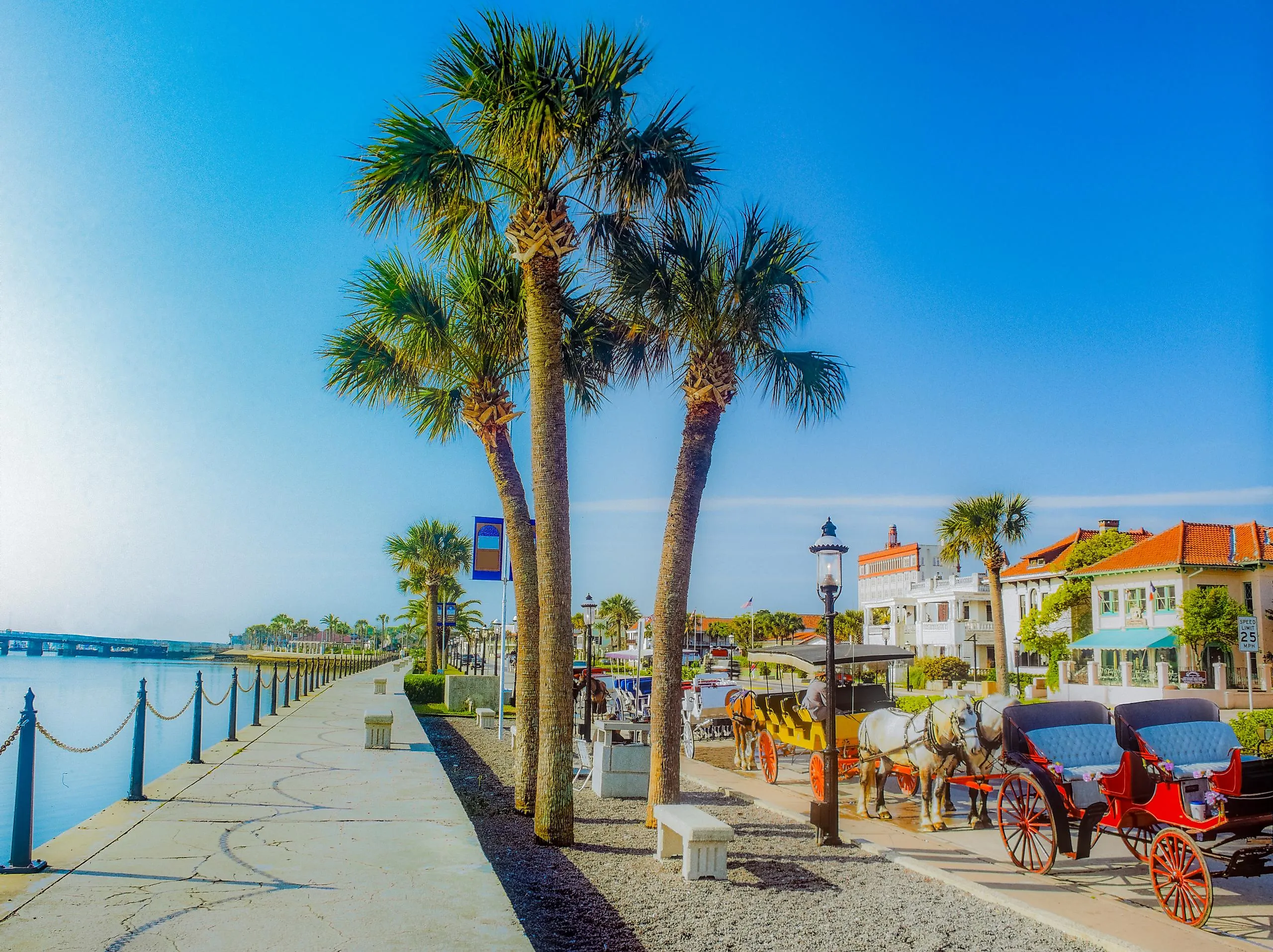
The coquina walls of the Castillo de San Marcos have guarded the inlet at St. Augustine since the 1600s, and no older masonry fort stands anywhere in the continental US. The town behind the fort is older still. Pedro Menendez de Aviles founded it in 1565, which makes it the oldest continuously inhabited European settlement in the continental US, a full 42 years ahead of Jamestown. The cannons on the wall still point out over Matanzas Bay.
Spanish colonial history is stacked all over the old town. The Gonzalez-Alvarez House, known simply as the Oldest House, has occupied its site since the 1600s and is the oldest surviving Spanish colonial home in Florida. A few streets over, the Oldest Wooden School House has stood near the old city gate since the early 1700s.
Gloucester, Massachusetts

Fisherman's Memorial Cenotaph, also known as the "Man at the Wheel" statue, on South Stacy Boulevard in Gloucester, Massachusetts
Gloucester bills itself as America's oldest seaport, and the claim has teeth. English fishermen set up here in 1623, almost a decade after John Smith mapped Cape Ann, and the town made cod its whole identity before incorporating in 1642. The Gloucester Fishermen's Memorial on the harbor, the bronze Man at the Wheel unveiled in 1925, honors the thousands of local fishermen lost at sea since those first boats went out.
The Cape Ann Museum holds the maritime art and gear that tell the rest of the story. And the Eastern Point Lighthouse, first lit in 1832, still marks the harbor mouth those early crews sailed out of.
Portsmouth, New Hampshire

Portsmouth got its start in 1623, when English colonists landed on the Piscataqua River and named their settlement Strawbery Banke for the wild berries on the bank. The name lasted until 1653, when the town reincorporated as Portsmouth. The Strawbery Banke Museum preserves that origin story on its original ground, a 10-acre neighborhood of more than 30 restored houses spanning four centuries of Seacoast life.
The 1720 Buckminster House shows off the Georgian style the early shipping money paid for. North Church traces back to the town's first meetinghouse in 1657, though the white spire you see across the rooftops today went up in 1854.
Salem, Massachusetts

Aerial view of Salem historic city center including Salem Witch Museum in Massachusetts.
Roger Conant and a band of English settlers put down roots at Salem in 1626, back when the Naumkeag people called the spot home. The witch trials of 1692 turned the town's name into shorthand for hysteria, and that history is everywhere downtown. The Witch House on Essex Street, the restored home of trial judge Jonathan Corwin, is the only building left in Salem with direct ties to 1692.
A few blocks over, the Salem Witch Museum walks through the whole grim chapter. Salem was also a global trading port, and the Peabody Essex Museum grew straight out of that. Founded in 1799, it ranks among the oldest continuously operating museums in the country.
Lewes, Delaware

Lewes calls itself the First Town in the First State, and 1631 backs it up. Dutch settlers built a whaling and trading post called Zwaanendael that year, making it the earliest European settlement in Delaware. It did not last. A dispute with the local Lenape wiped out the whole colony in 1632, and the spot stood empty for years before the Dutch returned.
The Zwaanendael Museum, built to look like a town hall in the old country, tells that short brutal story. The War of 1812 left its own mark too, and the Cannonball House downtown still wears a British round in its wall. Shipcarpenter Square gathers restored colonial and Victorian homes moved in from around the county.
Newport, Rhode Island

The historic seaside city of Newport, Rhode Island. Image credit George Wirt via Shutterstock
William Coddington and a band of religious dissenters broke off from Portsmouth up the bay and founded Newport in 1639. Religious freedom was the draw, and it shows in what survived. The Touro Synagogue, dedicated in 1763, is the oldest synagogue building still standing in the US. The Colony House, finished in 1741, is where Rhode Island read its independence aloud. And the White Horse Tavern, first licensed in 1673, still pours drinks and gets called the oldest tavern in the country.
Newport's colonial core goes deep. The Redwood Library, founded in 1747, is the oldest lending library in America still operating in its original building. Trinity Church, finished in 1726, still seats worshippers in the same boxed-in family pews. Around the harbor, whole blocks of the 1700s are still standing.
Newburyport, Massachusetts

Newburyport is the youngster here, carved out of Newbury in 1764 once the waterfront got too busy to share. Shipbuilding and the fishing trade made it rich fast, and the brick downtown and Federal-era mansions are the receipts. The Custom House Maritime Museum, inside the granite building where the port once collected its duties, lays out that seafaring boom, and the Museum of Old Newbury holds the deeper backstory of the parent town next door.
Those fortunes paid for the mansions still lining High Street, a row of Federal-era homes built by the families who ran the port. Newburyport also claims the Coast Guard as its own. The first revenue cutter to enter service, the Massachusetts, was built and launched here in 1791.
The Coast Wears Its Age Well
Four and a half centuries of American history line this one shoreline, and most of it is still standing. St. Augustine had a stone fort before the Pilgrims found Plymouth. Salem was trading with China while it was still spooked by its own ghosts. Newport still has the country's oldest synagogue, and Lewes lost an entire colony and rebuilt from nothing. The dates span 1565 to 1764, but the through line is simple. These towns started early, held on, and left the proof out in the open.