7 Most Walkable Town Centers In Croatia
Croatia's historic town centers were built centuries before automobiles, and many remain best experienced at walking speed. Stone lanes thread through medieval neighborhoods, pedestrian promenades connect café-filled squares, and waterfront paths lead directly to fortresses and harbors. In some towns, the route is almost entirely level. In others, stairs and steep lanes reward walkers with views across the Adriatic. Each of these seven Croatian towns puts three or four worthwhile stops close enough together to explore as a single walk.
Trogir

Trogir compresses centuries of architecture into a historic center small enough to cross in minutes. Begin in the heart of the UNESCO-listed Old Town at St. Lawrence's Cathedral, whose elaborate Romanesque portal opens onto the main square. After exploring the cathedral and surrounding civic buildings, leave the square through the maze of narrow stone lanes heading toward the southern edge of the Old Town.
Pass through the South Town Gate to emerge directly onto the Riva, Trogir's palm-lined waterfront promenade. Turn west and follow the Riva past café terraces, boats, and the Church of St. Dominic. The waterfront makes navigation easy because the next landmark remains straight ahead. At its western end stands Kamerlengo Fortress, constructed by the Venetians during the 15th century. Climb the fortress walls for views back across Trogir's rooftops and harbor. The entire route links medieval architecture, everyday waterfront activity, and a major defensive landmark without requiring transportation between stops.
Rovinj

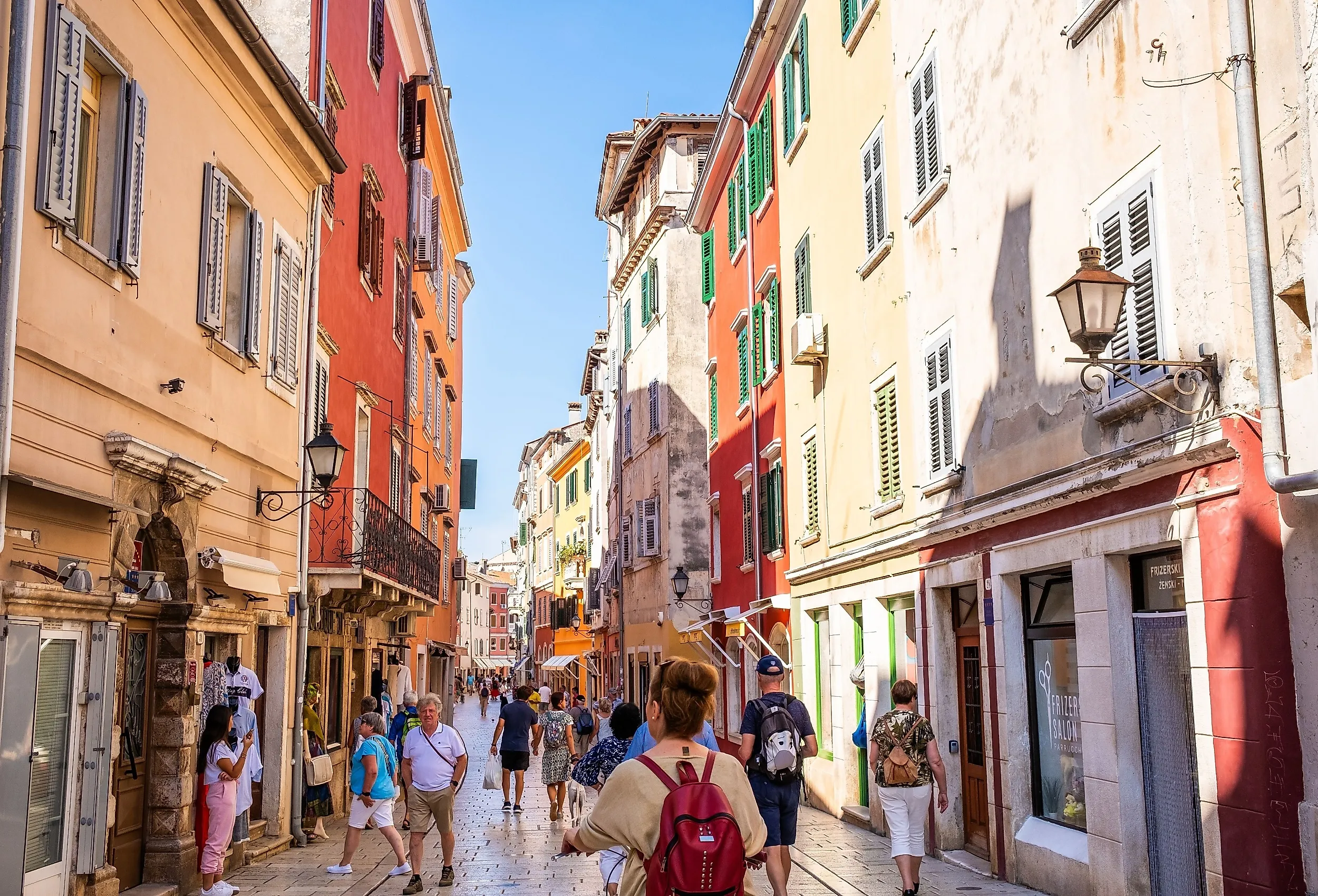
Rovinj's car-free Old Town occupies a compact peninsula, although its steep stone lanes make this walk more energetic than its short distances suggest. Start at Balbi Arch, the historic gateway leading from Marshal Tito Square into the oldest part of town. Pass beneath the arch and follow Grisia Street uphill, browsing galleries, small shops, and workshops tucked into Venetian-era buildings as the lane climbs toward the peninsula's summit.
Grisia eventually brings walkers toward St. Euphemia's Church, whose Baroque bell tower rises above virtually every view of Rovinj. Explore the church and the surrounding terrace, where the elevated position provides broad Adriatic views. Rather than retracing the same route, descend through the Old Town's western lanes toward the water and follow the shoreline around the peninsula toward Rovinj Harbor. Fishing boats, excursion vessels, restaurant terraces, and rows of colorful façades provide a lively finish after the quieter stone passages higher in the Old Town.
Varaždin

Varaždin's Baroque center consists of interconnected pedestrian squares, making it possible to see several of the town's defining landmarks without confronting hills or long distances. Begin on King Tomislav Square, better known as Korzo, where the Town Hall and pastel-colored historic buildings surround café terraces that remain central to local social life. From Korzo, walk west through the compact center toward Franciscan Square, passing ornate façades and the Franciscan church along the way.
Continue northwest through the pedestrian streets until you reach Miljenko Stančić Square. Its cafés provide one of Varaždin's most popular gathering places, with the medieval fortress visible just beyond the square. Walk across to the Old Town, the white-walled, red-roofed castle surrounded by remnants of defensive earthworks and green space. The progression between Korzo and the fortress takes visitors through several distinct phases of Varaždin's development, while the cafés and pedestrian squares ensure the historic center still functions as an everyday gathering place rather than simply a collection of monuments.
Korčula Town

Korčula's walled Old Town occupies a small peninsula, and its medieval street plan makes getting around on foot part of the attraction. Begin at the Land Gate, the historic southern entrance reached by a broad stone staircase. Pass through the gate and continue along the Old Town's central street, where narrow lanes branch toward the sea on either side. This distinctive layout was designed to channel summer breezes while providing protection from colder winter winds.
Follow the central route to St. Mark's Cathedral, whose Gothic-Renaissance façade overlooks the principal square. After visiting the cathedral, turn into one of the lateral stone lanes and walk downhill toward the waterfront. From there, follow the promenade around the eastern side of the peninsula, passing restaurant terraces shaded by trees and looking across the Pelješac Channel. Continue around the walls toward the Sea Gate, which provides another entrance into the historic center. Because the Old Town is so compact, walkers can move easily between monumental architecture, residential lanes, and waterfront scenery without losing sight of the sea for long.
Šibenik

Šibenik demands more climbing than the other towns on this list, but its stairways and stone lanes turn the ascent through the historic center into part of the experience. Begin beside the waterfront at the UNESCO-listed Cathedral of St. James, constructed entirely from stone and distinguished by the sculpted heads encircling its exterior. After exploring Cathedral Square, head inland and uphill through the narrow pedestrian streets of the Old Town.
Follow the lanes toward Four Wells, a 15th-century public cistern complex built to secure the town's water supply. From here, continue climbing through passages and stairways toward St. Michael's Fortress, whose position above the historic center explains the increasingly expansive views encountered along the route. Once inside the fortress, the ramparts overlook Šibenik's red-tiled roofs, harbor, and surrounding Adriatic islands. The return walk can follow a different set of lanes downhill toward the waterfront, turning a relatively short distance into a circuit through several levels of the medieval town.
Samobor

Samobor offers a gentler walking experience, with the Gradna Creek providing a natural guide through much of the center. Begin beside the water and follow the creek toward King Tomislav Square, the town's historic gathering place. The walk takes only a few minutes, and the square's surrounding cafés provide an opportunity to try a Samobor kremšnita, the custard-filled pastry closely associated with the town.
From the square, cross the creek and continue along its banks toward the Samobor Museum, housed in the former residence of composer Ferdo Livadić. After seeing exhibits on local history and culture, keep following the waterside route toward Vugrinščak, a green recreational area that was associated with Samobor's development as a spa destination during the 19th century. Paths and trees replace the busier streets around the central square, giving the route a natural finish. With most central destinations reachable within about 15 minutes, Samobor demonstrates walkability without relying on the dense medieval street patterns found along the Adriatic.
Požega

Požega's pedestrian center provides one of the easiest walks in the article and a chance to experience a very different side of Croatia from the coastal Old Towns. Begin on Cehovska Street, part of the town's central promenade and a commercial street whose name recalls the craftsmen's guilds once important to Požega's economy. Walk past shops selling regional foods and drinks before continuing into Holy Trinity Square, the unusually shaped Baroque square at the heart of town.
After circling the square and its 18th-century Holy Trinity monument, follow the pedestrian zone east toward St. Teresa of Ávila Cathedral. The Baroque church dominates its own open square and dates to the period when Požega was reestablishing itself as an important regional center following Ottoman rule. From the cathedral, loop back through the adjoining pedestrian promenade, where cafés, shops, and historic façades return the route to everyday town life. Požega's official sightseeing circuit covers the center in roughly 90 minutes, but these four stops can be combined into a shorter walk without sacrificing its principal sights.
Croatian Towns Best Seen at Walking Speed
Croatia's small-town centers demonstrate how much variety can fit into a relatively short walk. Trogir links a medieval square with the Adriatic waterfront, while Rovinj and Šibenik turn steep stone lanes into routes toward hilltop churches and fortresses. Korčula's unusual street plan makes navigating the walled town an attraction in itself. Inland, Varaždin links Baroque café squares with a medieval fortress, Samobor follows a creek between its principal sights, and Požega provides a largely level promenade through the commercial and architectural heart of Slavonia.
None requires a car to connect the attractions featured here. More importantly, walking reveals details that are easy to miss when concentrating only on major landmarks: galleries tucked into Rovinj's lanes, café terraces filling Varaždin's squares, boats lining Trogir's Riva, and regional shops along Požega's pedestrian streets. In these town centers, the route between destinations is an essential part of seeing the place.