11 Prettiest Small Towns In Croatia
The prettiest towns in Croatia are the ones that stayed small and stayed busy. Their good looks came straight out of the work that kept them alive. Motovun grew beautiful on the wealth of the truffle forest below its walls. Rastoke became a picture the day its millers built homes above the falls. Trogir dazzles because the stonemasons who carved its cathedral lived in its lanes. These eleven towns wear their livelihoods as their best feature. A slow weekend in any of them shows you exactly how that works.
Motovun, Istria

Truffles made Motovun, and the forest on the valley floor is still the reason people climb the hill. A local hunter pulled a record white truffle of 1.31 kilograms (2.9 pounds) out of that ground in 1999, and the galleries and tasting rooms around the main square have traded on the harvest ever since. They pour the Teran and Malvazija wines grown on the slopes right below the walls. Those walls are the second draw. Venice took the town in 1278 and ringed the summit at 277 meters (886 feet), and the ramparts still open onto the vineyards at every turn. At the top, the Church of St Stephen keeps a 13th-century bell tower whose design is credited to a follower of the Venetian architect Palladio. The old Parenzana railway below has become a walking and cycling trail through the hills. Come in summer and the town hosts a film festival under the stars.
Grožnjan, Istria

By the late 1950s Grožnjan had almost nobody left in it. The post-war exodus emptied the hill town down to a few dozen residents, and the stone houses simply stood open. Then in 1965 the Croatian Association of Fine Artists made an offer: restore an abandoned building and it was yours. Painters and sculptors took the deal, and the place came back as a working colony. Around forty galleries and studios fill the lanes today, and roughly 160 people live here year-round. The music arrives every summer, when an international youth academy running since 1969 turns the village into a residential conservatoire and the sound carries through open shutters. At the center, the Parish Church of Saints Vitus, Modestus and Crescentia was rebuilt in 1770 next to a bell tower from 1721. Italian is still widely spoken, and the loggia and carved doorways keep the Venetian centuries close.
Rovinj, Istria

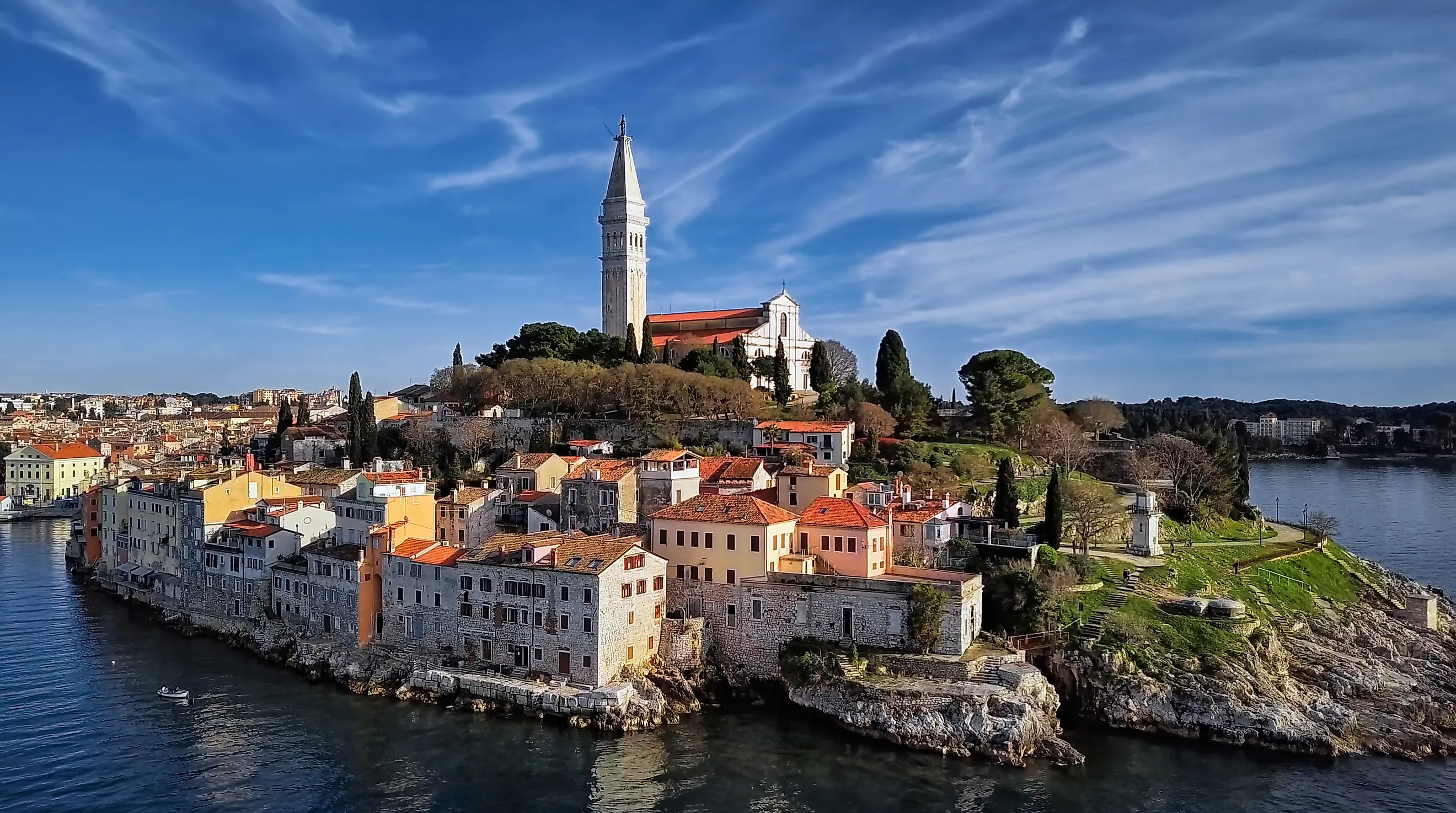
Fishing boats still work the Rovinj harbor and unload each morning below cafes that open onto the water. That daily catch is the oldest thing about a town of roughly 14,000 people, one that sat on an island until the channel to the mainland was filled in 1763. Painters have since made it their own too. Grisia Street climbs toward the church between galleries, and each summer the whole staircase becomes an open-air exhibition. The Baroque Church of St Euphemia crowns the high point, finished in 1736 as the largest church in Istria. Its 61-meter (200-foot) bell tower copies the campanile of St Mark's in Venice and carries a weathervane statue of the saint on top. Below it, the 1680 Balbi Arch opens into a knot of lanes where laundry hangs between the shutters. The forested Golden Cape park shades a coastline of coves just south of the old town, with 22 islands scattered offshore. Croatian and Italian share the street signs.
Krk, Kvarner

Croatia's largest island is where the country got one of its founding documents. The Baška Tablet, carved on Krk around 1100, holds one of the first written uses of the Croatian name in Croatian, cut in the Glagolitic script that is the oldest known Slavic alphabet. It surfaced beneath the floor of the Church of St Lucy at Jurandvor in 1851, and the Baška valley now marks the heritage with a trail of stone sculptures shaped like Glagolitic letters. Up in the old town, medieval walls and the Frankopan Castle recall the noble family that ran the island for centuries. The Cathedral of the Assumption keeps the stone inscriptions that tie the place to that literary past. Folk costumes and old wind instruments still turn up at celebrations along Krk Harbor, and the beaches around Baška draw the summer crowds down to the water.
Rastoke, Central Croatia

Falling water has run Rastoke for four hundred years. The village sits on a shelf of travertine rock where the Slunjčica River spills into the Korana, and its couple of dozen households built their homes directly over the cascades to use the power. Wooden mills still perch above the water, some of them working, their wheels turning as they have since the 17th century. The falls carry their own names and stories. Buk, the tallest at around 22 meters (72 feet), takes its name from the Croatian word for the noise it makes, while Vilina Kosa means Fairy's Hair. Footbridges cross the channels between the houses, and trout restaurants line the banks where the two rivers meet. The village has been protected heritage since the 1960s, and people call it Little Plitvice for good reason: the famous lakes lie just half an hour south. The ruined 15th-century Slunj fortress sits on the bluff above.
Samobor, Central Croatia

One dessert put Samobor on the map, and locals will send you straight to the square to eat it warm. The samoborska kremšnita is a plain-looking square of custard cream between two sheets of pastry, and it is worth the trip west of Zagreb on its own. The town has drawn day-trippers from the capital for generations. King Béla IV granted it the rights of a free royal town in 1242, and the main square took its Baroque shape after a fire in 1797. The Gradna stream threads through the center under a run of small bridges. Craftspeople here still cut crystal and paint gingerbread hearts, traditions kept up for well over a century. Above the rooftops stand the ruins of a 13th-century castle, a short walk through the woods to a viewpoint over the valley. Each winter the town throws one of Croatia's oldest carnivals, and the trails of the surrounding nature park climb into hills laced with vineyards.
Trogir, Dalmatia

Stonemasons gave Trogir its masterpiece, and it still sits above the cathedral door. The main portal of the Cathedral of St Lawrence was carved in 1240 by a master named Radovan into one of the great works of Romanesque sculpture. The cathedral rose between the 13th and 17th centuries, and its bell tower is climbable above a square that also holds a Venetian loggia and a clock tower. The town sits on a small island wedged between the mainland and larger Čiovo, linked to both by short bridges and built entirely of honey-colored limestone. Greek colonists founded it in the 3rd century BC, arriving from the island of Vis, and the street plan still follows the orthogonal grid they laid out. That preservation earned the whole old town a place on the UNESCO World Heritage list in 1997. At the waterfront, the 15th-century Kamerlengo Fortress marks the end of a palm-lined promenade. About 10,000 people live here, a short hop from Split, and the lanes behind the harbor go quiet once the day-trippers leave.
Skradin, Dalmatia

Most people pass through Skradin on their way to the water, and the town has quietly built a life around being the gateway. A boat leaves the marina and glides 25 minutes up the green Krka to Skradinski Buk, the longest travertine waterfall in Europe, where the river tumbles over seventeen steps among restored watermills. That traffic feeds a tidy V of stone houses climbing the hillside under a clock tower and a ruined fortress. Around 4,000 people live here. Swans drift along the embankment in town, and yachts fill the marina through the summer. The surrounding hills grow the grapes for the region's Babić wine, and a well-known winery in nearby Plastovo has pulled in visitors from around the world. Skradin keeps its own dish too, a risotto slow-cooked over an open fire until it turns dark and rich. Narrow lanes climb from the waterfront toward the fortress and its views across the valley. The Krka National Park begins just upstream.
Primošten, Dalmatia

Generations of farmers built Primošten's most striking sight by hand, out on the bare rock. The dry-stone Babić vineyards of Bucavac ring the town, kilometers of walls laced across the stone to shelter the vines and hold the soil. The old town itself spills across a small peninsula of pale houses and orange roofs almost surrounded by the sea. It started as an island refuge from Ottoman raids, joined to the mainland by a bridge that gave the town its name, from the Croatian word for bridging. A single main street climbs to the 15th-century Church of St George at the summit, built in 1485. Beside it a hilltop cemetery looks out over the Raduča beaches and the scattered islets of the Šibenik archipelago. The 16th-century Church of St Roch stands lower down near the town gate. Pebble beaches curve along the shore below a promenade of cafes, and a hilltop statue of Our Lady of Loreto watches the marina.
Korčula, Dalmatia

Shipbuilders and stonecutters laid out Korčula, and they built it to beat the wind. The old town fills a rounded headland reaching into the channel toward the Pelješac mainland, and its side streets branch off the main spine in a herringbone plan angled to soften the gusts. Those lanes lead up to the Gothic and Renaissance Cathedral of St Mark, raised over several centuries by local masons. A 15th-century land gate and the round Revelin tower guard the way in, and a Renaissance palace nearby holds the town museum. Around 3,000 people live in and around the walls. Korčula claims the explorer Marco Polo as a native son, and a house near the cathedral trades on the link, though historians place his birth in Venice. The town has performed its Moreška sword dance for some four centuries. A cocktail bar built into a turret serves drinks as the sun drops behind Pelješac, and local vineyards bottle the crisp white Grk and Pošip.
Cavtat, Dalmatia

Cavtat raised two of Croatia's great artists, and it keeps their work at either end of town. The painter Vlaho Bukovac was born here, and his childhood home is now a museum of his canvases. Up on a rise above the harbor stands the Račić family mausoleum, a domed tomb carved by the sculptor Ivan Meštrović, Croatia's most celebrated artist. The town curves around a bay on two small wooded peninsulas near the Montenegrin border, just down the coast from Dubrovnik. A long waterfront promenade lined with palms runs past pebble beaches and moored boats, and coastal paths loop each headland through pine and cypress. The flat old town is easily walked, and its lanes hold the Baroque Church of St Nicholas and a Renaissance Rector's Palace. Regular boats and buses reach Dubrovnik across the water, and the airport sits a short drive inland. The quieter pace and the two green peninsulas give Cavtat the beauty of the Dalmatian south with room to breathe.
The Beauty And The Work Are The Same Thing
What connects these eleven towns is that the prettiness and the livelihood turn out to be one story. Motovun looks the way it does because the truffle forest paid for the walls and the wine cellars. Rastoke draws people for the exact reason it exists, the water that turned its mills. Trogir dazzles because the masons who carved the cathedral lived and worked inside those same lanes. The setting and the stonework grew up together, one paying for the other over centuries. Croatia's big cities keep their Roman palaces and their crowds, and this is a different pleasure, measured in harbor mornings and the long southern light on old stone. Pick a corner of the map, keep the weekend unhurried, and let the towns show you the country the coastal highways speed right past.