9 Croatia Towns Where Time Stands Still
Croatia has no shortage of old towns. What sets these nine apart is that their old ways of doing things never really stopped. In Komiža, boatbuilders construct the falkuša, the wooden fishing boat once used for long sardine runs. In Ston and Nin, workers still harvest salt by hand using traditional solar evaporation.
Lacemakers in Pag continue without printed patterns, passing the craft through families. Other towns preserve vineyards, fortifications, and street plans that continue to guide daily routines. The journey begins in the hills of Istria and follows the Adriatic south to Ston, where medieval walls overlook the salt pans they were built to protect.
Grožnjan, Istria

Grožnjan nearly emptied out in the years after World War II, but its abandoned stone houses found a second life as artists' homes and studios. In 1965, Grožnjan was declared an art town, and some of its empty houses were assigned to artists from Croatia, Slovenia, and Vojvodina.
The artists restored abandoned buildings and turned Grožnjan into the art colony it is now. The Town Loggia dates to 1587 and once served as the courthouse. The floor above housed the fontico, or public granary, and is now Gradska galerija Fonticus. The gallery holds dozens of solo exhibitions during the art season and houses a collection of 889 works by 343 artists from 19 countries, according to the gallery's own records.
From the edge of the old center, you can see olive groves, vineyards, and the Mirna River valley. Grožnjan's medieval walls still surround much of the historic core, with a 15th-century gate marking its main entrance.
Motovun, Istria

Motovun's medieval walls and steep hilltop streets still determine how people move through the upper town. Walls built during the 13th and 14th centuries enclose the oldest part of the settlement, and a 14th century inner city gate leads into its historic core. Below the hill, Motovun Forest, protected as a special forest vegetation reserve since 1963, spreads along the Mirna River Valley. It preserves a rare type of lowland Mediterranean forest of common oak, narrow-leaf ash, and elm, known as a longozas.
White and black truffles, rare underground fungi prized by chefs around the world, grow beneath the oak trees of Motovun Forest. First documented here in 1929, they are still hunted with trained dogs when they are in season. Inside the town, the oldest surviving sections date to the 11th and 12th centuries, with major additions during Venetian rule.
The Church of St. Stephen, built between 1580 and 1614, took its current form at the end of the 18th century. Its Mannerist façade has led some scholars to suggest that the design followed plans by Venetian architect Andrea Palladio.
Vrbnik, Krk Island

Vrbnik lies on a limestone cliff 50 meters above the sea, first recorded in 1100 and later ruled by the Frankopan counts, who governed Krk from 1118 to 1480. It was also a historic center of Glagolitic script, the old Slavic alphabet once used across the region. The Church of the Assumption of the Blessed Virgin Mary stands at the highest point of Vrbnik and was first mentioned in 1325. Its bell tower has dominated the town's skyline since 1527.
Among Vrbnik's maze of narrow stone streets, Klančić measures just 17 inches at its tightest point, making it one of the narrowest streets in the world. Žlahtina, a white grape grown almost nowhere outside this part of Krk, is still made by local family wineries. The Vitezić Family Library preserves rare Glagolitic manuscripts and early printed books, linking the town's literary heritage with the present.
Lubenice, Cres Island

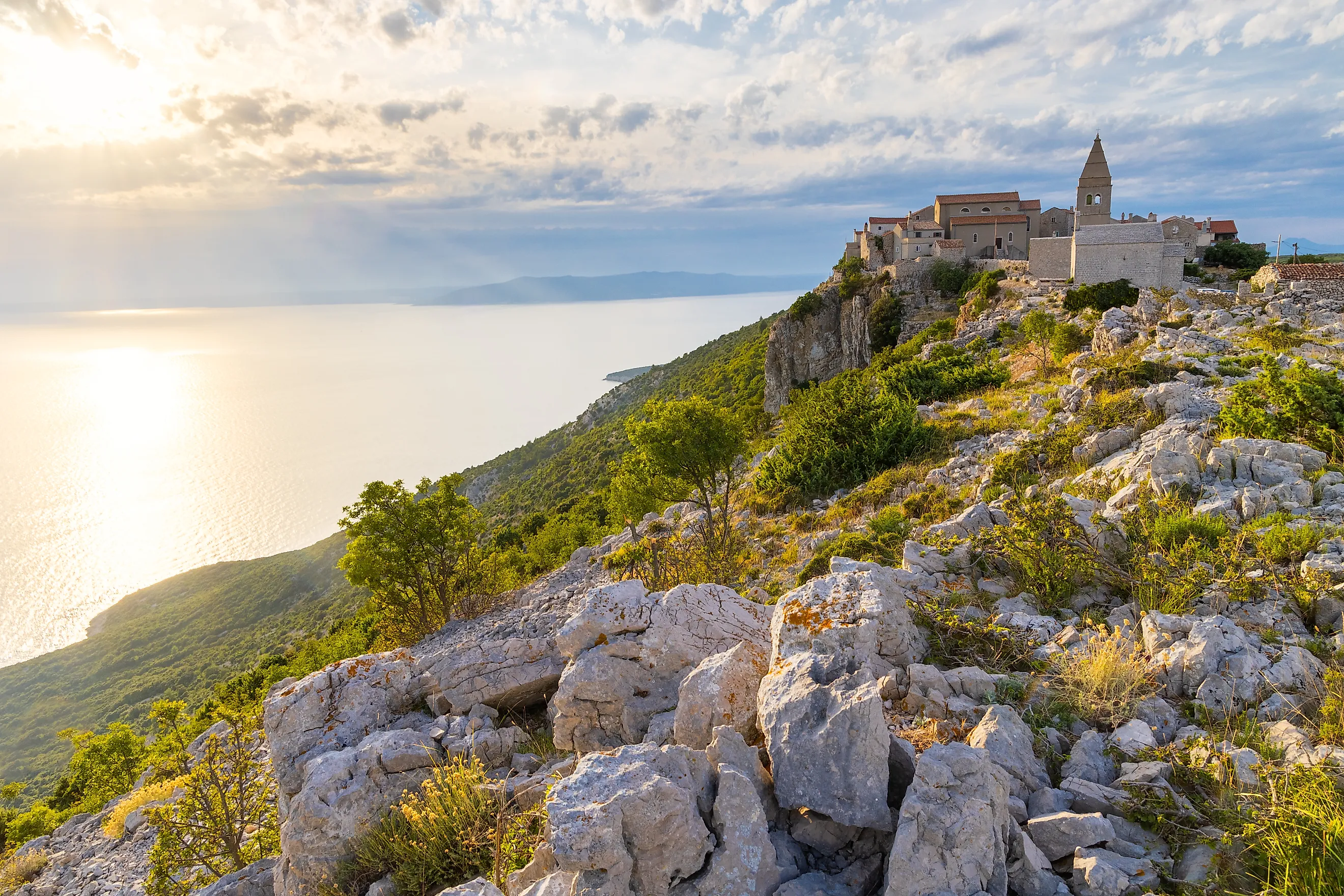
Lubenice stands on a ridge 378 meters above the Adriatic Sea, on the site of a prehistoric fortified settlement that remained inhabited through antiquity and the Middle Ages. In Roman times, it was known as Hibernitia, a name possibly linked to the cold winter winds and chilly weather it experienced due to its location. Remains of the medieval fortifications and two town gates still mark the old center.
About 40 stone buildings stand within the settlement, along with medieval chapels, narrow streets, and houses that preserve architectural elements from different periods. The Museum of Sheep Breeding traces a tradition that still survives on Cres. Sheep spend the entire year outdoors and move between enclosed plots of land.
In summer, the main church and its square host the Lubenice Musical Evenings, with concerts performed by Croatian and international musicians. A steep footpath descends from the village to Sveti Ivan Beach in under an hour.
Farther south on the same island, Osor's rotating bridge opens over a channel widened by the Romans.
Osor, Cres Island

Osor became an important Adriatic port because of its position at the narrowest point between Cres and Lošinj. A channel widened by the Romans let ships pass between the two islands, placing Osor on a major transit route between the northern Adriatic and the Dalmatian coast. The foundations of the town walls contain traces of settlement dating to the 9th century BC.
Osor Swing Bridge still opens twice daily to let boats and yachts pass through the ancient channel. Around the main square, stone buildings from the 15th and 16th centuries stand alongside the Cathedral of the Assumption of Mary, the Bishop's Palace, and a former town loggia that now houses the Archaeological Collection of Osor.
Its exhibits span prehistory through the Middle Ages, including Roman coins and early Christian stone inscriptions. Sculptures by Ivan Meštrović and other Croatian artists stand along Osor's streets, giving the historic center its reputation as an open-air museum.
Pag Town, Pag Island

Pag's history has long revolved around two traditions that predate modern tourism: lace and salt. Construction of the present town began in 1443 according to a Renaissance urban plan developed with the involvement of architect Juraj Dalmatinac.
Pag lace, made with needle and thread, dates back to the late 15th century and was traditionally passed from one generation to the next. The Gallery of Pag Lace displays pieces from different periods, replicas based on old patterns, traditional clothing, and photographs of local lacemakers. Salt production has been central to the local economy for centuries, with the first written record of salt production in Pag dating to 999.
Historic salt warehouses, like Magazini Soli, still testify to its importance. The Church of the Assumption of St. Mary stands on the main square and Kula Skrivanat (Skrivanat Tower) is the only survivor of nine towers that once formed part of the town's defenses.
On the mainland, about an hour away, Nin holds a similar salt tradition, wrapped around one of the oldest settlements in the country.
Nin, Dalmatia

Nin compresses 3,000 years of settlement onto a 500-meter islet surrounded by a shallow lagoon. Two stone bridges connect the old town to the mainland, and Nin became an important political and religious center under Croatia's early medieval rulers. The 9th-century Church of the Holy Cross earned the nickname "the smallest cathedral in the world" from 19th-century British architect Thomas Graham Jackson.
Outside the old town, the Church of St. Nicholas was built on an earthen mound over a prehistoric burial tomb and dates to the late 11th or early 12th century. Salt production continues in the surrounding lagoon, where seawater evaporates under the sun and wind before workers harvest the salt by hand.
Near Kraljičina plaža (Queen's Beach), people still cover themselves with Nin's medicinal mud, leave it to dry in the sun, and rinse it off in the warm seawater. Archaeological finds suggest the area's association with bathing stretches back to Roman times.
Komiža, Vis Island

Komiža's strongest link to its fishing past is the falkuša, a wooden sailing boat local fishermen built for open-sea sardine runs. A small number of boatbuilders still construct and sail it, and an annual regatta retraces the historic route toward the fishing grounds off Palagruža. After World War II, Vis served as a major Yugoslav military base and remained closed to foreign visitors for decades.
The restrictions helped shield the island from mass tourism until the late 20th century. Komiža lies deep in the island's largest bay, with narrow kalete, tall stone houses, fishing boats, and a fish market where the morning's catch arrives early. At the waterfront, the 16th-century Venetian fortress known as Komuna houses the Fishermen’s Museum (Maritime Museum), where traditional fishing equipment is displayed alongside the remains of Cicibela, the last original Komiža falkuša.
Above town, the Church of St. Nicholas, locally called Muster, has long been associated with fishermen, sailors, and travelers. Each year on St. Nicholas's Day, an old wooden boat is burned in front of the church in a traditional ritual honoring the town's patron saint.
Ston, Pelješac Peninsula

Ston exists because of salt. After acquiring the Pelješac Peninsula in 1333, the Republic of Dubrovnik founded the planned towns of Ston and Mali Ston on the narrow isthmus connecting the peninsula to the mainland, protecting saltworks that at times generated about a third of the republic's income.
Construction of the defensive walls began in the mid-14th century, stretching more than 4.3 miles between the two towns. Today, about 3.4 miles remain, with 41 towers and six bastions. Inside the walls, Ston has retained the medieval street grid and spatial layout planned by Dubrovnik's architects in the 14th century.
Below the ramparts, workers still harvest salt by hand using traditional evaporation ponds. The site is widely regarded as one of Europe's oldest continuously operating saltworks. The Solana Ston Museum traces a craft that never disappeared. Nearby, Mali Ston has cultivated oysters in its sheltered bay since Roman times. Climb the ramparts, and the view below is a working landscape shaped by the same salt pans, oyster beds, and streets that defined Ston centuries ago.
Where Old Patterns Still Hold
These towns have changed, but their oldest layouts and traditions still influence how they function. Motovun’s walls continue to control access to its hilltop core, while Grožnjan’s stone houses now serve as studios and galleries. Medieval streets remain in use, historic buildings have new roles, and long-standing practices still connect the present to the past. Time has not stopped, but it moves more slowly here.