7 Most Underrated Towns on Florida's Emerald Coast
Florida's Emerald Coast runs along the panhandle, where fine quartz sand on the seafloor turns the Gulf of Mexico green. The resort destinations get most of the attention. The seven towns ahead each run on something specific and well-defined that the resort strips do not carry. DeFuniak Springs has the country's last continuous Chautauqua program. Fort Walton Beach has an 800-year-old ceremonial mound at the heart of downtown. Cedar Key sits well to the south on the Nature Coast and earns its place here on the same terms.
DeFuniak Springs

DeFuniak Springs, the seat of Walton County, was founded in 1881 along the Pensacola and Atlantic Railroad survey route by railroad executive W.D. Chipley, who chose the site for its almost perfectly round, spring-fed lake. Lake DeFuniak sits at the center of town, ringed by Circle Drive and the historic district. The town was named for Frederick R. DeFuniak, vice-president of the Pensacola and Atlantic Railroad.
What set DeFuniak Springs apart was the Florida Chautauqua Assembly, founded in 1884 as a winter outpost of the New York Chautauqua Institution. From 1885 through 1922, thousands traveled here each winter for lectures, concerts, and religious programs. The Chautauqua Hall of Brotherhood, originally built in 1909, anchored the campus. The current Florida Chautauqua Assembly, revived in 1996, still runs an annual late-January program of lectures and performances. The Walton-DeFuniak Library, founded in 1886 in its original building, is the oldest continuously operating library in Florida. Chautauqua Vineyards on the western edge of town runs muscadine wine tastings. Ponce de Leon Springs State Park, the closest first-magnitude spring at 68 degrees year-round, is about 25 miles east near the town of Ponce de Leon.
Fort Walton Beach

Fort Walton Beach sits in Okaloosa County between Pensacola and Panama City, on the Santa Rosa Sound and Choctawhatchee Bay. The town is the commercial center for Eglin Air Force Base, established in 1935 and now covering more than 700 square miles of land north and west of town, making it the largest air base in the United States by area.
The most distinctive site downtown is the Fort Walton Temple Mound, an 800-year-old Mississippian-period platform mound on Highway 98. The Indian Temple Mound Museum, opened in 1962 as the first municipally owned museum in Florida, runs more than 12,000 years of regional history through artifacts of stone, bone, clay, and shell. The mound itself, 12 feet high and 223 feet wide at the base, was designated a National Historic Landmark in 1964. The Gulfarium Marine Adventure Park on Okaloosa Island, founded in 1955, runs marine mammal shows and an animal hospital. Okaloosa Island Pier extends 1,261 feet into the Gulf for fishing and walking. Henderson Beach State Park, technically in Destin but a short drive east, runs 6,000 feet of preserved white-sand Gulf shoreline.
Niceville

Niceville sits on the northern shore of Choctawhatchee Bay just north of Destin and adjacent to Eglin Air Force Base. The town runs about 16,000 residents and was originally named Boggy in the 1880s for the area's swamps, renamed Niceville in 1910 when residents wanted something less unappealing for the post office. The Mattie Kelly Arts Center at Northwest Florida State College runs touring Broadway productions, regional theater, and concerts in a 1,600-seat hall through its annual mainstage season.
Fred Gannon Rocky Bayou State Park, on the northern shore of Choctawhatchee Bay, runs four hiking trails, freshwater bayou access for kayaking, and a campground in 357 acres of sand pine scrub. Turkey Creek Nature Trail, on the south side of town, runs a half-mile boardwalk through a hardwood swamp where Turkey Creek meets Boggy Bayou, with the rare blue spring run visible from the deck. The Boggy Bayou Mullet Festival, the town's signature event, has run every October since 1979 and is one of the larger seafood-and-music festivals on the Emerald Coast. 3rd Planet Brewing on John Sims Parkway runs an in-house taproom of regional craft beers.
Panama City

Panama City on St. Andrews Bay is the seat of Bay County and runs about 32,500 residents. The town is distinct from Panama City Beach, the resort community across the Hathaway Bridge with its own city government, sugar-sand beaches, and resort high-rises. Panama City proper is the working harbor and historic downtown side of the bay. The Historic St. Andrews neighborhood, on the western edge of the city, was a separate town until 1927 and runs the St. Andrews Marina, the 1908 Bank of St. Andrews building, and the 1886 Historic St. Andrews Church.
St. Andrews State Park, on a peninsula at the eastern end of Panama City Beach, runs 1.5 miles of Gulf and bay shoreline, a 1929 Gulf-side jetty pool ideal for snorkeling, and the Pier 1,260 feet long for fishing. Shell Island, accessible by ferry from the park, runs 7 miles of undeveloped barrier-island beach. Panama City has been gradually rebuilding since Hurricane Michael (Category 5, October 10, 2018) damaged or destroyed nearly half the housing stock in Bay County. The Center for the Arts, the Bay Co. Public Library, and downtown's Harrison Avenue commercial strip have all reopened. Locally, Shipwreck Island Waterpark on Panama City Beach has been a Front Beach Road fixture since 1985.
Destin

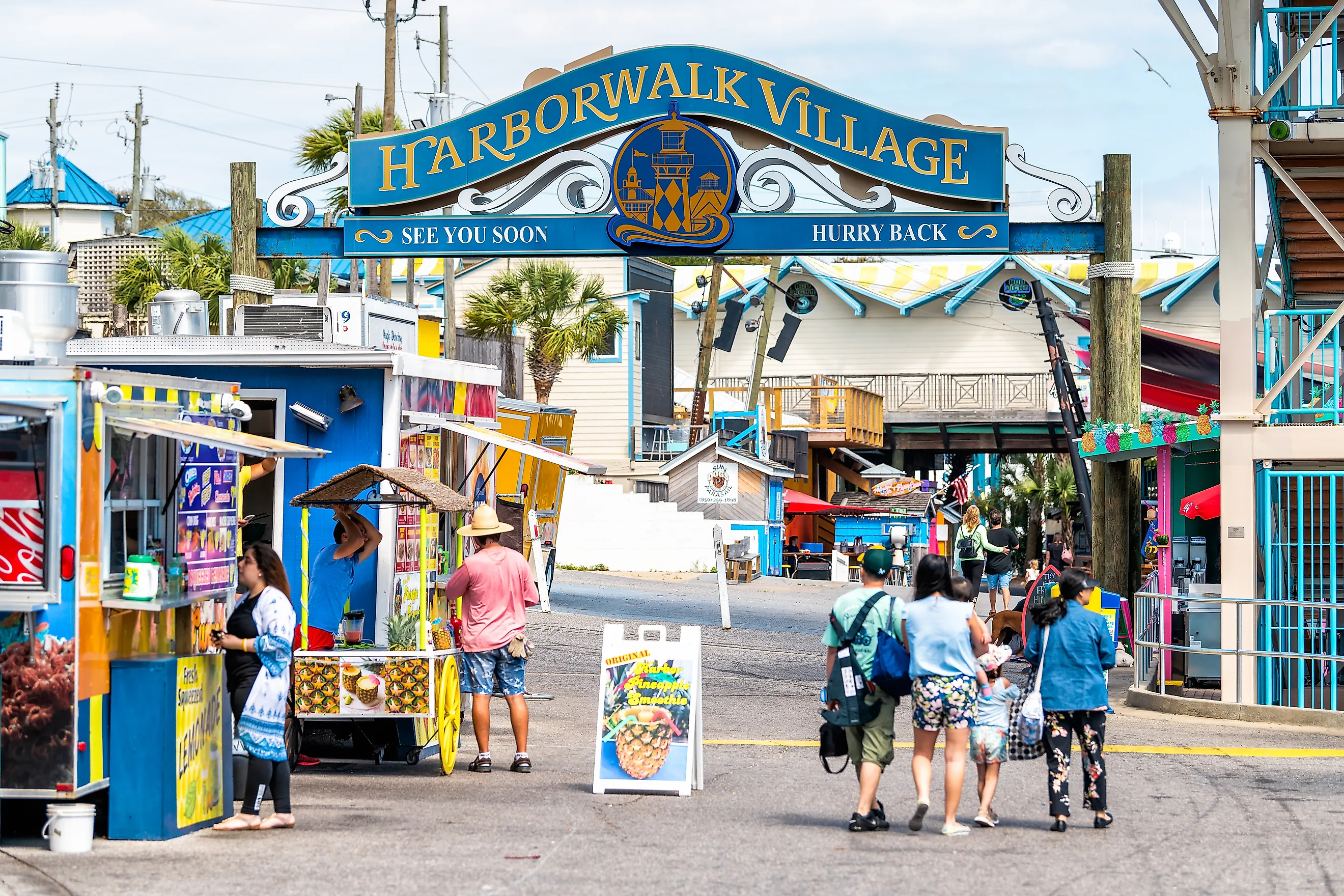
Destin, in the Florida Panhandle east of Fort Walton Beach, has been called the "World's Luckiest Fishing Village" since the 1950s for its location on East Pass at the entrance to Choctawhatchee Bay, where a deep underwater canyon brings game fish unusually close to shore. The annual Destin Fishing Rodeo, running every October since 1948, is the longest-running fishing tournament in Florida. HarborWalk Village runs the working charter and party-boat docks, restaurants, and the Destin History & Fishing Museum.
Henderson Beach State Park, just east of downtown on Highway 98, runs 6,000 feet of preserved Gulf shoreline, 60 campsites, and dune walkovers through sea-oat-anchored coastal scrub. The Destin History & Fishing Museum runs the area's commercial fishing heritage from Leonard Destin's 1845 arrival as a Connecticut sea captain through the post-war charter boat boom. The Emerald Coast Science Center on Memorial Parkway runs hands-on exhibits and a touch tank for visiting families. Big Kahuna's Water & Adventure Park has been a Highway 98 fixture since 1986.
Freeport

Freeport, in Walton County on the LaGrange Bayou at the head of Choctawhatchee Bay, was originally settled as Genoa, then renamed Four Mile Landing for its distance from the bay. The town picked up the current name during the Civil War because there was no charge to dock at the wharf, an unusual policy along the wartime Gulf Coast where most ports collected fees. Freeport runs about 3,000 residents today and serves as the gateway to the South Walton coastal communities (Seaside, Rosemary Beach, Watercolor, Alys Beach) about 15 miles south on Highway 331.
The Freeport Regional Sports Complex on College Boulevard runs ballfields, walking trails, and a community pool. Hammock Bay, just north on Highway 331, is a master-planned community with its own amenity center, miles of walking trails, and Lake Hammock for kayaking and small-craft fishing. Freeport's central position between Destin, Panama City, and the South Walton beaches makes it a popular base for visitors who want quieter accommodations than the resort towns while staying within 20 minutes of the Gulf.
Cedar Key

Cedar Key, on the Gulf Coast in Levy County about three miles offshore at the end of State Road 24, is technically on Florida's Nature Coast rather than the Emerald Coast proper, but the seafood-village feel, the stilt-supported waterfront, and the absence of resort development make it a fair traveler's pairing with the Panhandle towns. Florida's second-oldest town (after St. Augustine), Cedar Key runs fewer than 700 year-round residents and sits at the end of the longest series of barrier-island bridges in the state.
The Cedar Key Historical Society Museum, in an 1871 building, runs exhibits on the town's role as a Civil War-era salt-producing port, the post-war cedar pencil industry (Eagle and Dixon pencil factories drew on the abundant Florida cedars), and the 1896 hurricane that effectively ended the town's commercial prominence. The Lower Suwannee National Wildlife Refuge, ten miles north on State Road 347, preserves 53,000 acres of one of the largest undeveloped river-delta-estuary systems in the United States. The Cedar Keys National Wildlife Refuge, a 762-acre cluster of barrier islands established in 1929, is accessible only by boat and protects one of Florida's largest brown pelican rookeries on Seahorse Key. The town's annual Cedar Key Seafood Festival in October draws around 35,000 visitors. Hurricane Idalia in August 2023 and Hurricane Helene in September 2024 damaged a substantial portion of the town's stilt-house stock, and rebuilding has been steady.
What These Seven Towns Have in Common
The seven towns above all run on something specific that the larger Emerald Coast resort destinations don't carry. DeFuniak Springs has the Chautauqua history. Fort Walton Beach has the Indian Temple Mound. Niceville has the mullet festival and a working community college arts center. Panama City has the historic St. Andrews neighborhood and St. Andrews State Park. Destin has the fishing rodeo and the deep East Pass canyon. Freeport has the Civil War-era no-charge wharf and the gateway access to South Walton. Cedar Key has the 1871 history museum and the 19th-century pencil-mill industrial archaeology, even if it sits a long drive south of the Emerald Coast proper. Each delivers what the resort strips can't: a town that exists on its own terms beyond the beach.