7 Fairy-Tale Small Towns In South Carolina
Fairy tales are supposed to be made up. A few South Carolina towns never got the message. The castle is real and standing on the dunes at Murrells Inlet; the enchanted wood is a swamp older than the country; the relic is a giant peach off the interstate at Gaffney. None of these places is putting on a show. They are ordinary Southern towns that happen to have something impossible at the edge of them, and these seven have the most impossible things of all.
Murrells Inlet

Half a mile of wooden boardwalk runs along a natural saltwater estuary at the heart of Murrells Inlet, on the stretch of coast known as the Hammock Coast. The MarshWalk crosses the town's historic fishing district, with open-air music, waterfront restaurants, and views out over the tidal bay that drains toward the Atlantic Ocean. A short drive south is Huntington Beach State Park, a Grand Strand beach on the southern end of the inlet with hiking trails, campsites, and jetty fishing. Anna Hyatt Huntington and her husband Archer, sculptors and philanthropists, built their winter home Atalaya here in the 1930s, and the Moorish-style castle still stands at the center of the park.
The Huntingtons left a second mark across the highway at Brookgreen Gardens, the sculpture garden and wildlife preserve they founded in 1931 to display American figurative work outdoors. TripAdvisor has ranked it among the best public gardens in the country. The grounds hold formal gardens, low-country history exhibits, native animals in the zoo, and one of the largest collections of American sculpture anywhere.
Edisto Island

Cabins on the salt marsh let visitors sleep within earshot of the surf at Edisto Beach State Park, one of only four oceanfront state parks in South Carolina and among the most beloved. The Spanish Mount Trail runs two miles to one of the earliest documented Native American shell middens in the state, a mound of oyster shells left by people who gathered here thousands of years ago. Nearby, Botany Bay Plantation Heritage Preserve protects roughly 4,600 acres of undeveloped coastal habitat, including about three miles of beachfront where loggerhead sea turtles nest. The ground is fragile, so the preserve asks that visitors tread lightly.
Out on the water, Edisto Island Shrimp Boat Charters runs trawling trips and sunset cruises from the island. A charter might turn up redfish, spot-tail bass, or even shark, and passengers often come back ashore with sand dollars, starfish, and blue crabs collected along the way. It is the kind of unhurried sea outing that ends, more often than not, with the sun going down over the marsh.
Gaffney

Georgia may carry the Peach State motto, but the giant peach belongs to Gaffney. Built in 1981 and standing 135 feet tall, the Gaffney Peachoid is a million-gallon municipal water tower sculpted and painted to look like a ripe peach, right down to a 60-foot leaf and a deep cleft. Locals call the town the Peach Capital of South Carolina, and the tower, billed as the world's largest peach, is its best-known roadside landmark. Fans of the Netflix series House of Cards will recognize it from an early episode.
History reaches deeper here than the fruit. At the Cherokee County History and Arts Museum, exhibits on the Revolution and the county's growth cover the region's past through documents, photographs, maps, uniforms, and furniture. Ten miles west, Cowpens National Battlefield marks the ground where Brigadier General Daniel Morgan routed Banastre Tarleton's British force on January 17, 1781, a turning point in the war's southern campaign. Among Morgan's militia commanders that morning was Andrew Pickens, the Revolutionary officer who lends his name to another town on this list. More than five miles of walking paths and an auto loop follow the battle lines past monuments and interpretive markers.
Sullivan's Island

A 650-foot boardwalk zigzags through the dunes on the Sullivan's Island Nature Trail, its angular turns echoing island landmarks like the triangular lighthouse nearby. The footpath opens onto the harbor, vegetated dunes, and forested wetlands, and it ranks among the best butterfly and bird watching on the island. It is a short, strange, memorable walk, unlike almost any other boardwalk on the coast.
The island's forts hold far heavier history. Fort Moultrie, restored to show its long service between 1809 and the end of World War II, has wayside exhibits along its ramparts, and visitors can fish, walk the grounds, and watch the wildlife. A boat ride away, Fort Sumter marks where the Civil War began in April 1861; the site limits recreation but offers trailside exhibits and preserved fortifications. Both forts sit at the mouth of Charleston Harbor, and both were central to the port city's defense.
Pickens

The county's former jail, a stone building put up in 1903 and closed in 1975, now holds the Pickens County Museum of Art & History. Local art and history exhibits fill the old cellblocks, among them genuine oddities: Andrew Pickens' dueling pistols, a model of Fort Prince George, a radio once owned by Hitler, and a 19th-century doctor's field kit. A few miles north, the Hagood Mill Historic Site keeps one of the oldest working gristmills in the state, still grinding grain, alongside a barn, a family-farm exhibit, a log cabin, and a nature trail across the grounds.
Table Rock State Park spreads across 3,000 acres beneath the granite face of Table Rock Mountain, the source of the park's name. From the park, the 76-mile Foothills Trail heads across the upstate, linking several state parks and running past mountain streams, waterfalls, and Pinnacle Mountain along the way. The Civilian Conservation Corps built many of the park's cabins and structures in the 1930s, and a good number still stand.
York

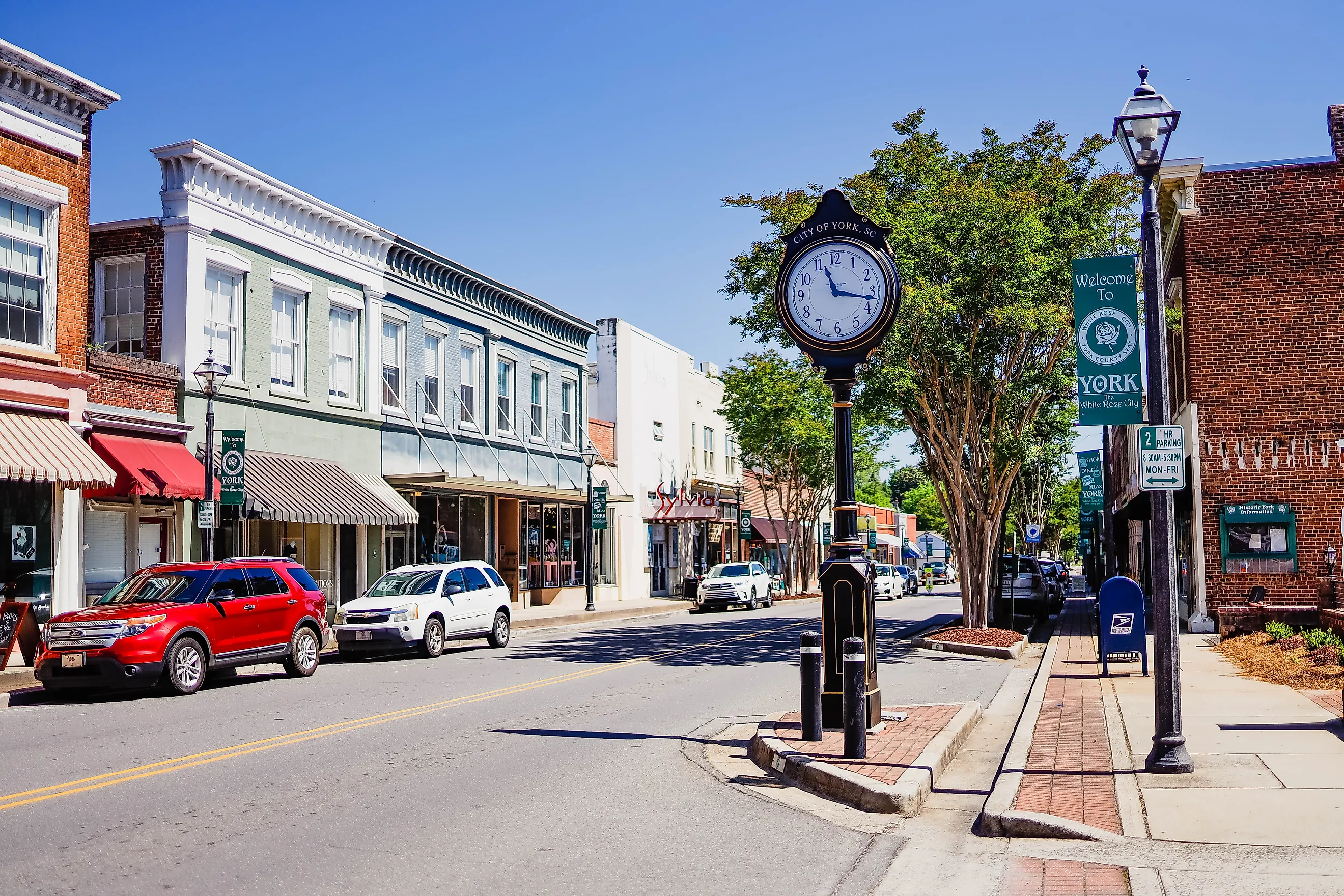
York's nickname comes from a fight that ended more than five centuries ago and an ocean away. Scots-Irish settlers named the town after York, England, and the "White Rose City" tag goes back to the House of York and the English Wars of the Roses. Established in 1785 as the seat of York County, the town sits at the center of one of the largest historic districts in the state, a compact grid where brick storefronts and 19th-century homes line Congress Street and the blocks around it. The Yorkville Historical Society counts some thirty distinct architectural styles within a few walkable blocks. At the center stand the 1914 York County Courthouse and the McCelvey Center, home to the Historical Center of York County and the Southern Revolutionary War Institute, a reminder of the two American Revolution battles fought in the county. The Sylvia Theater, a former storefront turned performance hall, fills out the downtown's early-1900s look.
The town's Revolutionary past turns tangible a short drive south at Historic Brattonsville, an 800-acre living history farm near McConnells with more than thirty colonial and antebellum structures, heritage-breed animals, and eight-plus miles of trails. On the same grounds is the site of the Battle of Huck's Defeat, the July 1780 skirmish where local Patriot militia overran a Loyalist force under the reviled British captain Christian Huck, an early morale boost ahead of the later victories at Kings Mountain and Cowpens. Costumed interpreters demonstrate blacksmithing, weaving, and open-hearth cooking, and the site's programs also tell the story of the enslaved people who worked the plantation.
Abbeville

Abbeville calls itself the "Birthplace and Deathbed of the Confederacy," and the claim holds up at two sites a short walk apart. A secession meeting drew crowds to the town in November 1860, and on May 2, 1865, Confederate President Jefferson Davis held his final Council of War inside the Greek Revival Burt-Stark Mansion, where his cabinet and advisers convinced him the cause was lost. Tours of the house, a National Historic Landmark, take in the period furnishings, the cabinet-meeting parlor, and the kitchen. Just off the same court square is the Abbeville Opera House, built in 1908 and restored to its early-1900s look, where an old chair is left empty on the balcony for the ghost of an actress said to have died during a performance.
The whimsy turns literal at Diamond Hill Mine, where visitors dig for crystals across six acres of tailings. The site is unsalted, meaning no stones are seeded for the experience, so any quartz or purple amethyst that turns up came straight out of the ground the excavators missed. It is a rare chance to walk away from a small South Carolina town with a gemstone you pulled yourself.
Seven Towns, One Improbable State
What ties these seven together is not a single landscape but a shared talent for the unexpected. In Gaffney a peach-shaped water tower is visible for miles, and in Abbeville the Confederacy came to its end in a single parlor. The Blue Ridge Mountains rise behind Pickens and the Atlantic laps at Edisto, and between them sit shrimp charters, ghost stories, an amethyst mine, and a Revolutionary battlefield reenacted every July. Read as a set, the seven point to a state far stranger and more storied than a quick drive along South Carolina's interstates would suggest.