7 Fairy-Tale Small Towns In Connecticut
The castle above the Connecticut River at East Haddam has forty-seven doors, and no two are alike. Woodstock boasts a coral-pink cottage fronted by twenty-one boxwood flower beds still planted to their 1850 pattern, with the oldest surviving indoor bowling alley in the country out in the barn. Litchfield holds a fieldstone grotto in the woods, and the drawbridge at Mystic still lifts on the hour through the summer. These fairy-tale towns across Connecticut are the real deal.
Litchfield

Topsmead State Forest holds an English Tudor-style cottage in the rolling hills east of the village, the former summer estate of Edith Morton Chase, who left it to the people of Connecticut on her death in 1972 with instructions that it be kept in a state of natural beauty. Nature trails, formal gardens, bird habitats, and a butterfly garden surround the house. Free docent-led tours of the cottage run on weekends through the warmer months.
Litchfield's other landmark of note is the Lourdes in Litchfield Shrine, a stone grotto dedicated in 1958 and built by two Montfort Brothers as a replica of the grotto at Lourdes in France. Set in the wooded hills of northwestern Connecticut beside running water, it draws thousands of pilgrims each year between May and October, and a Way of the Cross climbs the hillside behind it to a Calvary scene at the summit. You can also embrace the outdoors at the White Memorial Conservation Center. Forty miles of trails cross the foundation's roughly 4,000 acres of wetland and upland around Bantam Lake, with more activity available through horseback riding, biking, boating, canoeing, and camping.
Stonington

Stonington sits midway between New York and Boston on a mile-long peninsula that projects into Fishers Island Sound and Little Narragansett Bay. Step into the spotlight at The Lighthouse Museum. The 1840 tower is notable among lighthouses of its period for its ornamental cornices around the tower and the heavy granite lintels above its doors and windows. The building was decommissioned in 1889 and opened as a museum in 1927, the first of its kind in the nation. The harbor below it still supports the last commercial fishing fleet in Connecticut.
While on the coast, learn more about Stonington's history at the Captain Nathaniel B. Palmer House Museum. Designed in 1850 for two brothers who were both sea captains, the National Historic Landmark now serves as the headquarters of Historic Stonington, and its cupola gives out over Stonington Harbor. Nathaniel Palmer is credited with one of the first sightings of Antarctica in 1820, at the age of twenty-one. Exhibits inside display a model of his sloop Hero, other model ships, dollhouses, and period textiles. Unwind from the day with a tour and tasting at Stonington Vineyards. Established in 1987 on 58 acres of the Stonington uplands and a founding member of the Connecticut Wine Trail, it stays open year-round, and its wines are shaped by the maritime climate of the ocean a few miles south.
Mystic

Mystic is a village rather than a town, split down the middle by the Mystic River. The two halves are joined by the Mystic River Bascule Bridge, which opened in July 1922 and still lifts on the hour through the warmer months while traffic waits on both banks. Its overhead concrete counterweights make it one of the few surviving Brown balance beam bascules anywhere, and the only one in the state, and the sidewalks fill with people whenever it goes up.
Just upriver, the Mystic Seaport Museum keeps the Charles W. Morgan, an 1841 whaler out of New Bedford and the last wooden whaleship left in the world. She is a National Historic Landmark, and visitors can go below deck. The museum spreads over 19 acres of relocated and restored nineteenth-century buildings, including a preservation shipyard where shipwrights still work timber by traditional methods. North of the village, B.F. Clyde's Cider Mill has pressed apples since 1881 and remains the oldest steam-powered cider mill in the country, opening each autumn for sweet cider, hard cider, apple wines, and doughnuts.
Essex

Essex Station has stood at the north end of Main Street since 1892, and the Valley Railroad Company has run excursions out of it since 1971. A coal-fired steam locomotive pulls vintage coaches north through Deep River and Chester, then hands passengers off at Deep River Landing to the Becky Thatcher, a multi-deck riverboat that works its way up the Connecticut River before the train carries everyone back. The full round trip runs about two and a half hours, and the operation is one of the last working steam railroads left in New England.
At the foot of Main Street, the Connecticut River Museum occupies a former steamboat warehouse on Steamboat Dock. Its exhibits cover the town's part in the Revolutionary War and the British raid of 1814, when a landing party burned much of the local shipping fleet at anchor. The collection includes a full-size working replica of the Turtle, the one-man submarine built in 1775 by David Bushnell of nearby Saybrook. A short walk back up the street, the Griswold Inn has served food and lodging since 1776, which makes it one of the oldest continuously operating inns in the United States. Low ceilings, wide floorboards, open fireplaces, and period furnishings survive inside, along with a marine art collection hung through the public rooms.
East Haddam

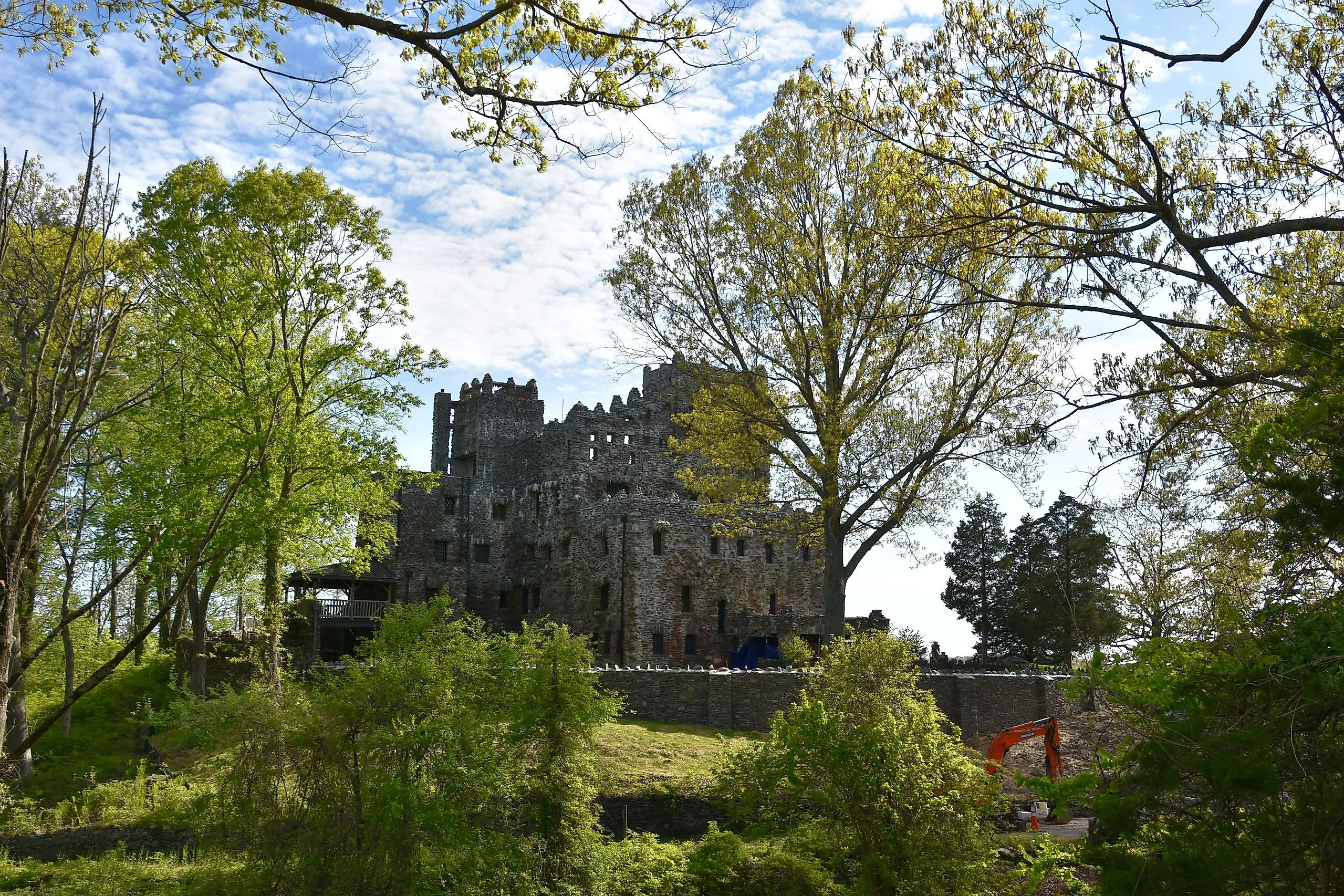
East Haddam has a unique way of mixing history and nature through its parks and attractions. At Gillette Castle State Park, the medieval stone castle sits 200 feet above the Connecticut River on the southernmost hill of the chain known as the Seven Sisters, surrounded by 184 acres of woodland. William Hooker Gillette, the actor, director, and playwright most famous for his portrayal of Sherlock Holmes, designed the 24-room, 14,000-square-foot fortress himself, as well as the contents, which include built-in couches, a movable table on tracks, hand-hewn southern white oak woodwork, carved wood light switches, and forty-seven doors, no two alike.
The Nathan Hale Schoolhouse is over 200 years old. The one-room building served as the First Society School between 1750 and 1799, and Nathan Hale taught here as schoolmaster over the winter of 1773, three years before the British hanged him as a spy. For more history and a little bit of mystery, visit the round potholes that mark Chapman Falls at Devil's Hopyard State Park, which drops more than sixty feet over a series of steps in Scotland schist. The potholes are perfectly cylindrical and range in size between a few inches and several feet across, and they are among the finest examples of the formation in this part of the country. Geologists give the credit to stones carried downstream, trapped in an eddy, and spun until the friction wore a depression in the rock.
Woodstock

Visit Woodstock and take a stroll through historic Roseland Park. The 60-acre park of wooded land and waterfront along Roseland Lake. Roseland Cottage, across from the town common, is a Gothic Revival house known for its coral-pink exterior, and the interior is equally eccentric, with elaborate wall coverings, heavily patterned carpets, and stained glass, much of it unchanged since the Victorian era. Within the sprawling estate, visitors can find an icehouse, aviary, carriage barn, and the oldest surviving indoor bowling alley in the United States, built with the house in 1846. Four presidents came here as guests for the Fourth of July celebrations, and Ulysses S. Grant is said to have bowled his first strike in the barn.
Become a part of local traditions at the Woodstock Fair. Run by the Woodstock Agricultural Society and held every year since 1860, it opens the Friday before Labor Day and closes on Labor Day itself, and it is the largest agricultural fair in Connecticut as well as one of the oldest. Live music, agricultural and livestock shows, competitions, and food and drink from local vendors fill the grounds on Routes 169 and 171 in South Woodstock.
Waterford

Take in the salty air on the state's coastline at Waterford Beach Park. The quarter-mile stretch of beachfront backs onto an intact dune system and a wide tidal marsh, an increasingly rare combination on a shoreline that is mostly in private hands. For more coastal views, Seaside State Park stretches across 30 acres of rolling ground and rocky coast that gives way to a sandy beach on Long Island Sound. Walking, surfcasting, birding, and kayaking are the main draws. The site was formerly the Seaside Sanatorium, a heliotropic hospital built for children with tuberculosis and designed by Cass Gilbert, the architect of the United States Supreme Court building and the Woolworth Building in New York City. The state designated the grounds a park in 2014. Its buildings are listed on the National Register of Historic Places, though they are closed to the public.
The Long Island Sound is one of the most intriguing places in the state, as it provides activities, sights, and history. Harkness Memorial State Park boasts a mix of sand dunes, salt marshes, and coastal grasslands. The park provides opportunities for bird watching and wildlife spotting, including favorites such as piping plover, least terns, and osprey. But it is not the birds that keep visitors coming. Eolia, the summer retreat of Edward and Mary Harkness, is the crown jewel of the park. The 42-room Renaissance Revival mansion is surrounded by 230 seaside acres of open lawn and formal gardens under mature trees, and it is open for tours on weekends and holidays through the summer.
Real Life Fairy Tale Towns
Gillette wrote into his will that his castle must never pass to anyone with no conception of what it was. Edith Chase did much the same at Topsmead. The Griswold Inn has served guests since 1776 and B.F. Clyde's has pressed apples since 1881, both without a break. Connecticut is the third-smallest state in the country, which puts Litchfield and Stonington within a couple of hours of each other and the rest of the state well within reach. When it comes to bringing stories to life, these seven sweet spots deserve a closer look.