7 Best Towns In North Dakota For A Two-Day Recharge
A two-day reset is easy to find in North Dakota's small towns. Each one here pairs something to do outdoors with a bit of history or culture close by. Some sit beside a national park, others on the shore of a big reservoir, a few along a quiet river valley. You can spend the first day outside and the second on foot downtown, then sleep within a few minutes of both. These seven towns are built for exactly that kind of weekend.
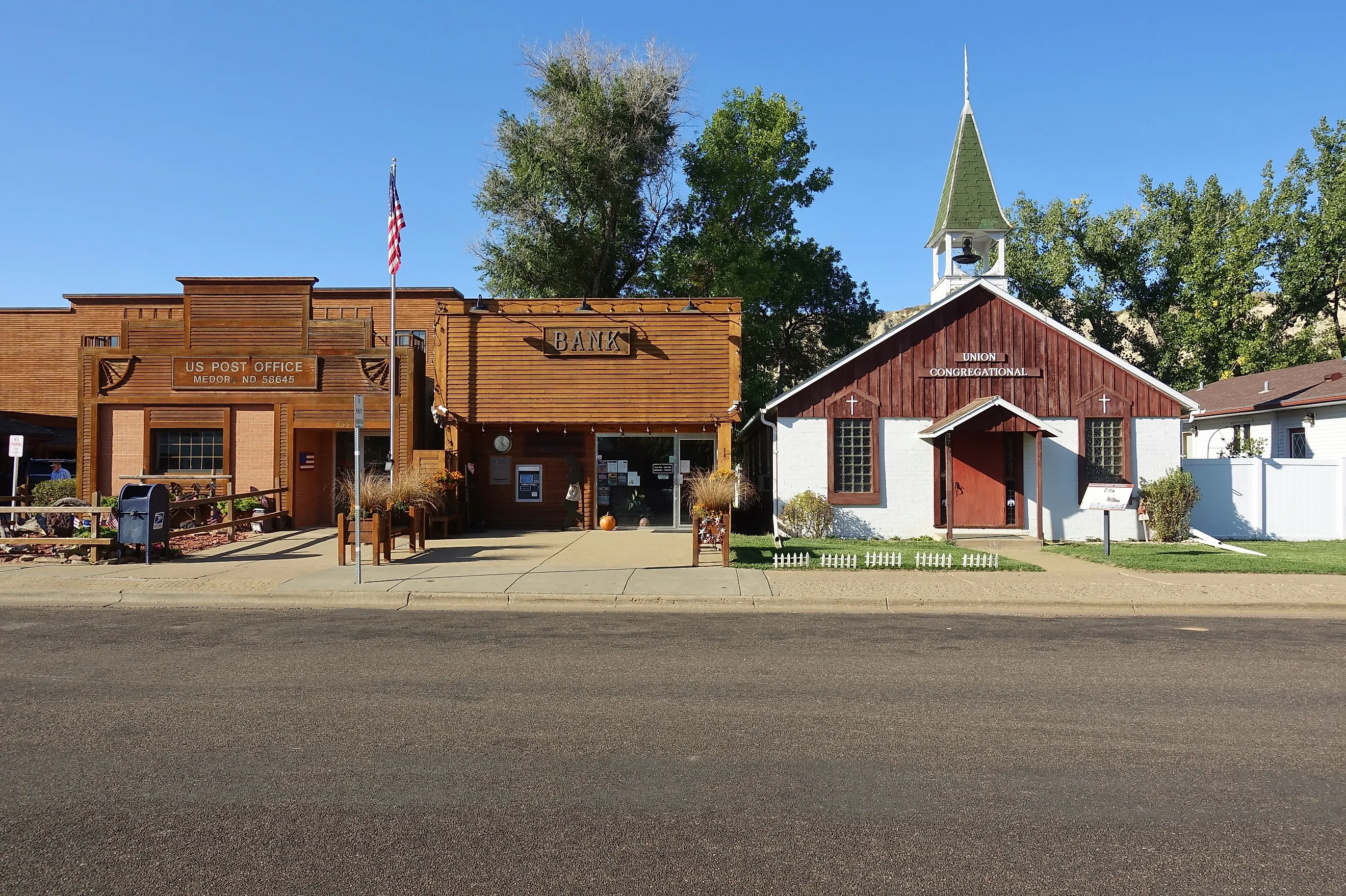
Medora

Medora is the kind of town where bison set the pace of traffic. The South Unit of Theodore Roosevelt National Park starts right at the western edge of town, so close that you can walk to the boundary from your hotel. Its 36-mile scenic loop winds through banded badlands, and the herd crosses on its own schedule, which can stop you cold for ten minutes at a time. Seven miles east on I-94, the Painted Canyon Overlook opens onto a floor that sits roughly 250 feet below the rim walkway, and late afternoon turns the whole thing orange. In town, the Rough Riders Hotel has been open since 1884, named for Theodore Roosevelt's volunteer cavalry, and it keeps one of the largest private collections of books by and about the president anywhere. The Chateau de Mores tells a shorter story: the Marquis de Mores showed up in 1883 with plans for a refrigerated-beef empire, built a 26-room mansion to match, and was gone inside three years when it collapsed. Come evening, the Burning Hills Amphitheatre runs the Pitchfork Steak Fondue before the Medora Musical, where the steaks really do go into hot oil on pitchforks.
Watford City

Watford City is the quieter way into the park. It sits 14 miles from the North Unit of Theodore Roosevelt National Park, the half most visitors skip, which is reason enough to come. The Oxbow Overlook puts you above a canyon corridor with the same stripped badlands color and a fraction of the cars. The Maah Daah Hey Trail links the park's units across 144 miles of terrain, and you can rent a mountain bike in town and ride a stretch without taking on the whole thing. The Little Missouri River runs past the park entrance about 15 miles south, and a kayak gives you those canyon walls from water level, lower and slower and without the interpretive signs. Back in town, the Long X Trading Post Visitor Center covers the cattle-drive era and the oil boom that followed under one roof, and Teddy's Residential Suites has a restaurant and lounge attached for when you have no interest in driving again after dark.
New Town

New Town exists because the old towns are underwater. When Garrison Dam flooded the Missouri River valley in 1953, five Mandan, Hidatsa, and Arikara communities went under, along with farms, cemeteries, and three tribal agency towns. New Town was built on higher ground to replace them, and it marks that history more directly than anywhere else on the lake. Four Bears Bridge crosses Lake Sakakawea on a mile-long span, with storyboards at its west end on how the reservoir displaced most of the MHA Nation. The MHA Interpretive Center nearby goes deeper, with exhibits and a 500-seat outdoor amphitheater that runs programs all summer. Drive up Crow Flies High Butte before dark and the scale finally makes sense, the reservoir filling the valley below. Walleye boats run from the marina by the 4 Bears Casino and Lodge, which sits right on the bank with rooms over the water and a kitchen that stays open late.
Garrison

Garrison leads with a 26-foot fiberglass walleye. Wally stands at the north end of Main Street under a sign reading Walleye Capital of the World, a title Lake Sakakawea's catch rates more or less earn. Twenty miles south, Garrison Dam is the fifth-largest earthen dam in the world, and it runs free guided tours through the summer that take you into the turbine hall while the Missouri moves more than 100 feet below. Not many earthen-dam tours are worth recommending, but this is one. A mile away, the Garrison Dam National Fish Hatchery and Aquarium has a self-guided walk past tanks of the same walleye that fill the lake. Fort Stevenson State Park, five miles south on a protected bay, keeps a Guardhouse Museum covering what stood here before 1953 redrew the map. For the night, the Cabernet Inn is a restored 1917 house on Third Avenue with five rooms and a sitting porch that books up in fishing season, and the Garrison Motel on Fourth Avenue is the practical fallback.
Mandan

Mandan packs five centuries of history into one state park. Fort Abraham Lincoln State Park, established in 1907 as North Dakota's first, holds two very different sites on the same grounds. Down at the base of the Missouri River bluff, On-A-Slant Indian Village has six reconstructed earthlodges where the Mandan lived for roughly two centuries, each one round, earth-covered, and big enough to hold several families and their horses through a plains winter. Half a mile uphill, the Custer House stands furnished the way it was when Custer rode out for the Little Bighorn in June 1876. The walk between them takes about 20 minutes and covers some 500 years. If you would rather park once, the Blackstone Hotel just off I-94 runs its own grill and tavern in the same building. The North Dakota State Railroad Museum keeps Northern Pacific locomotives from the line the fort was built to guard, and Mandan Rodeo Days, held every July since the 1880s, fills the arena with team roping, barrel racing, and an evening rodeo under lights.
Devils Lake

Devils Lake gives you two full days on opposite shores. White Horse Hill National Game Preserve, long known as Sullys Hill, covers more than 1,600 acres of wooded hills on the south shore, with a four-mile auto tour that brings bison and elk close enough for a phone camera. Eight miles west along the same shore, Fort Totten State Historic Site keeps 16 original buildings from the 1867 military post, the brick barracks and hospital and guardhouse laid out so clearly that the place reads like a real fort rather than the one or two survivors you usually get. On the north shore, Grahams Island State Park has a sand beach that stays calm most mornings and a boat ramp for the perch and walleye runs. The Cobblestone Hotel and Suites on Highway 2 has an indoor pool and an on-site fish-cleaning station, which tells you what kind of town this is, and the Woodland Resort is the pick if you want to sleep closer to the water, with its Perch Patrol guide service running off the resort dock.
Valley City

Valley City has 11 historic bridges because the Sheyenne River valley forced every road and rail line to climb over it. The one to stand under is the Hi-Line Bridge, 3,860 feet long and 162 feet above the water, built in 1908 and still carrying BNSF freight today. From Chautauqua Park on the riverbank, the view lines up with the full span, and you hear a train coming before you see it. Medicine Wheel Park sits on a hill above the Sheyenne, where a stone solar calendar marks the solstices and equinoxes against the horizon. Downtown, the Rosebud Visitor Center keeps an 1881 Northern Pacific superintendent's railcar restored to its mahogany paneling, velvet seating, and rear observation deck. The Barnes County Museum next door greets you with a triceratops skull pulled from the North Dakota badlands, which is exactly the right thing to find in a small-town county museum. The GrandStay Hotel and Suites is a short walk away, near enough to both Medicine Wheel Park and the Rosebud Center to do them without moving the car.
Pick Your Two Days
Choosing between these seven comes down to the kind of two days you want. The badlands towns, Medora and Watford City, suit anyone after open terrain and long park drives. New Town and Garrison are fishing towns first, with history and wildlife as the second reason to go. Mandan and Devils Lake carry the heaviest history, with state parks and frontier forts that ask for more than an afternoon. Valley City is the quietest of the bunch and works best as a place to settle in. Summer keeps everything open, though Fort Totten and White Horse Hill stay reachable year-round for a self-guided visit.