7 Best Downtowns In The Prairies
Every fall a building in Mitchell gets covered head to toe in real ears of corn. The murals come down and go back up with a new design each year. South Dakota calls it the World's Only Corn Palace and means it. Faribault built the first Episcopal cathedral in the country and put it on a small Minnesota main street. Pella grinds flour in a 124-foot Dutch windmill and sells the bread three doors down. These seven prairie downtowns earned their reputations the hard way. They are worth the stop.
Faribault, Minnesota

The country's first Episcopal cathedral does not sit in Boston or Philadelphia, but in downtown Faribault, where the Gothic-style tower of the Cathedral of Our Merciful Saviour rises over a small Minnesota main street. Built in the 1860s of local limestone, it is hard to miss. Guided tours walk through the stone interior and its stained glass and lay out the building's history. The town itself sits at the confluence of the Straight and Cannon rivers, in the "prairie parkland" zone where woodland once met native tallgrass prairie, and the Faribault City Trails run from downtown out along both rivers.
For a meal, head to Redemption, a restaurant in an old 1870s warehouse. Eat some midwestern comfort foods like pot roast and cheese curds while sitting among the old stone walls and brick columns. Wear your favorite flannel and get a good dose of the Midwest in early March at the annual Faribault Flannel Formal, which celebrates the lumberjack with games, food, beverages, and live music. Sample local food in September during the Taste of Faribault, where restaurants, caterers, and food vendors share samples. For outdoor adventure, choose from at least 10 lakes near Faribault for fishing, boating, swimming, kayaking, and paddleboarding.
Pella, Iowa

Another town in the tallgrass prairies is Pella, established in 1847 by a Dutch immigrant and settled by 800 more immigrants from the Netherlands. The Vermeer Windmill is a 124-foot-tall grain mill imported from the Netherlands and one of the tallest working windmills in North America. Guests can explore all five floors of the mill and take in views of Pella from the top. The windmill tour includes a viewing of the Miniature Dutch Village, which was started in 1938. The model portrays all four seasons of a Dutch village from the 1840s.
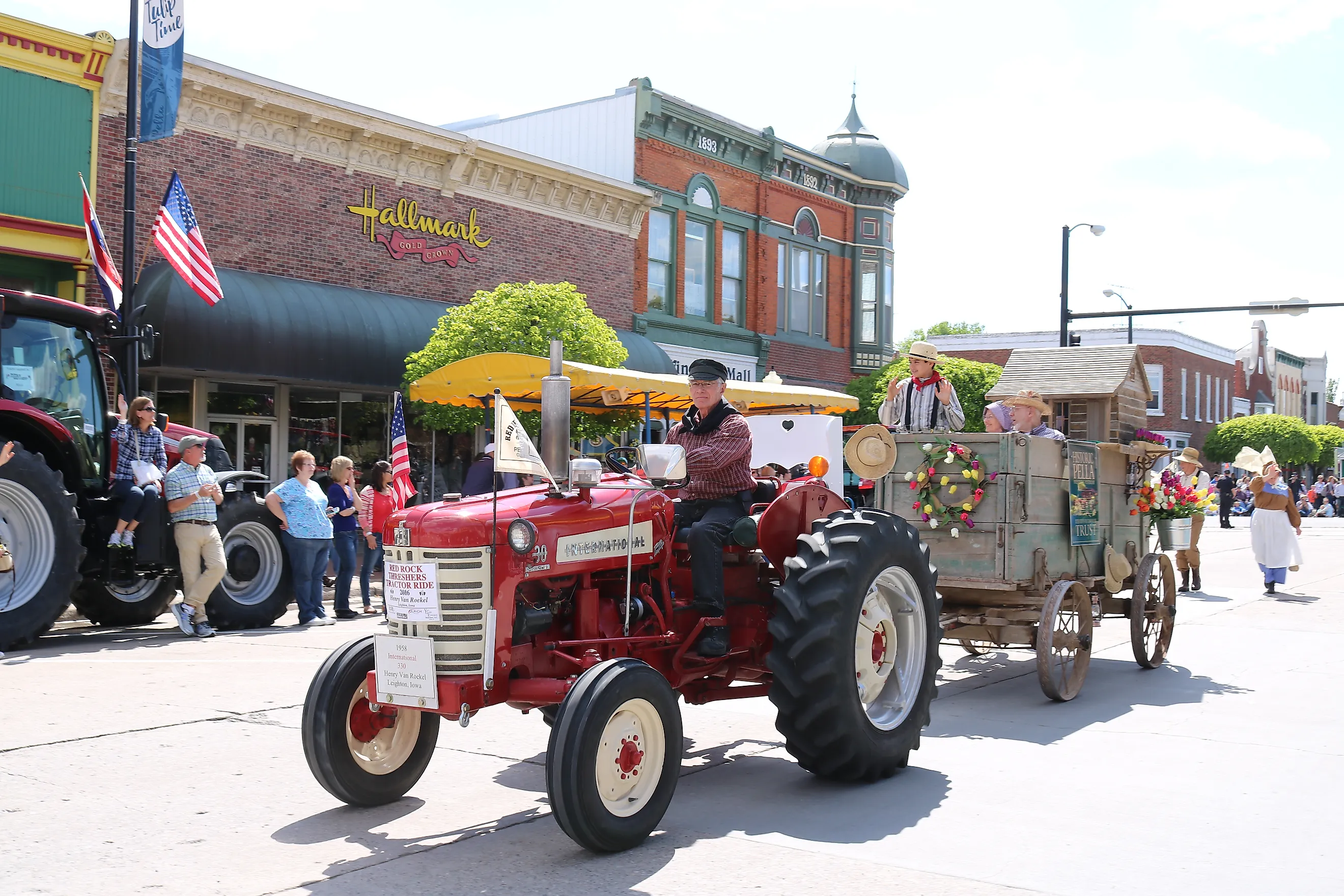
For refreshments, go to Maria's Tea Room, which serves traditional Dutch coffee time that includes treats from meat markets and bakeries in Pella. A reservation at this tearoom includes free access to the Scholte House, where Maria Scholte lived with her husband, Hendrik, in 1847 and 1848. Go through the gardens and see the rooms with the family's 19th-century Dutch furnishings. Spring is the time to catch Pella at its best, during the annual Tulip Time Festival, where visitors can sample Dutch food and see others dressed in traditional Dutch attire. Springtime also brings colorful tulip beds to see all over town, especially in Sunken Gardens Park and Central Park. For Dutch baked goods, stop into Vander Ploeg Bakery or Jaarsma Bakery, which has been at it since 1898.
Mitchell, South Dakota

Mitchell built its downtown around a building that exists nowhere else: The World's Only Corn Palace, a Moorish-domed hall whose exterior murals are rebuilt every year from corn and native grasses. About half a million people a year stop in southeastern South Dakota to see it. The town was established in 1879 and grew fast, with fertile farmland and two intersecting railroads feeding its agriculture and retail trade. The palace anchors the rest of the main street too.
Visitors during late August can also attend the Corn Palace Festival, which has a carnival, food, and entertainment. The Corn Palace is also the beginning and end of Mitchell's walking tour of its commercial historic district. Some stops of the tour are old government and business buildings, houses, and churches, many over 100 years old, and some dating back to the late 19th century. Enjoy a meal at The Depot, which was the town's railroad depot for over 40 years, starting in 1908. The former depot building is within the National Register-listed Mitchell Historic Commercial District. Lake Mitchell, in the north part of town, is an ideal place to experience the region's outdoors. It has access to swimming, hiking, and biking trails, as well as a golf course.
Ponca City, Oklahoma

Just about 27 miles directly south of Arkansas City is Ponca City in northern Oklahoma. The downtown has continued to develop since the early 20th century, and residents have worked to preserve it since the 1980s. One of the several conserved buildings is the Poncan Theatre, which retains much of its original 1927 extravagant decorations. Even without a play or movie on, it is worth stepping inside this 1927 "atmospheric theatre," a style built to feel like an open-air courtyard, to see its displays of old photographs and posters. The town's main street holds several annual events. Crazy Days Downtown Ponca City, in August, is a tax-free shopping festival that fills the streets with vendors. The Goblins on Grand Halloween Carnival is every October, and there is an ice-skating rink and evening entertainment during November and December with Ice on the Plaza.
A couple of miles off the main strip is Marland's Grand Home, a 16,500 square foot Neo-Renaissance-style mansion from 1916 that was once home to former oil tycoon, U.S. Congressman, and Oklahoma governor E.W. Marland. Some featured rooms are the office, dining room, kitchen, and indoor swimming pool. There are also exhibits on the Marland family artifacts, regional Native American cultures, and Wild West culture.
Nebraska City, Nebraska

Right in historic downtown Nebraska City stands the Kregel Windmill Factory Museum, a workshop frozen as it was in the 1940s, with the machinery, tools, and benches that turned out Eli windmills, the kind still standing across the prairies and Great Plains today. The town sits on Nebraska's eastern edge along the Missouri River. A few blocks from the windmill factory is the Civil War Veterans Museum, set in an 1894 building that is one of four surviving Grand Army of the Republic halls in Nebraska. Inside, the war and its aftermath are told through soldiers' supplies, artillery, and medical equipment. Many of Nebraska City's shops occupy old buildings, including The Keeping Room, built in 1870, where you can stop for tea or a slice of pie and browse home décor under a preserved 19th-century interior.
A couple of miles from downtown is the Wildwood Historic Center. This Gothic-style Victorian house, built in 1869, welcomes visitors from April through October. The tour will show how the Ware family lived in the ten rooms, which are still decorated in their 19th-century settings.
Arkansas City, Kansas

Sitting on Kansas's southern border, this town dates back to 1870. It flourished in the late 19th and early 20th centuries, particularly in the oil, flour, and meatpacking industries. The Arkansas City Historic Building Tour walks you through that history. It includes the Gothic-style Trinity Episcopal Church with its stained-glass windows, the former Carnegie Library building, dedicated in 1908, and a row of commercial buildings from the same era. See a play or comedy show at Burford Theatre, restored close to how it looked when it opened. The theatre opened in 1924, and its gold detailing and heavy red curtains still evoke the period.
The autumn season is a particularly good time to be in downtown Arkansas City. The Arkalalah Festival takes place during the final full weekend every October. Downtown fills with parades and a marching band competition during the day, then food vendors and a carnival at night. Right outside of town on 80 acres is Pumpkin Pants Ranch, where visitors can pick a pumpkin or navigate through the corn maze. Chaplin Nature Center along the Arkansas River is full of trails for those who want a hike with regional scenic views or simply to gaze at local wildlife.
Pierre, South Dakota

South Dakota runs its government from one of the smallest state capitals in the country, set on the Missouri River in the center of the state. Pierre's grandest landmark is the State Capitol Building, completed in 1910, with classical architecture, marble columns, sculpture, and stained glass inside. The Capitol grounds hold several memorials, among them a World War II monument and the Flaming Fountain Memorial, a veterans memorial whose fountain was once lit by a natural-gas flame. Nearby, the South Dakota Cultural Heritage Center traces the state's settlers and immigrants, the Oceti Sakowin and the Dakota, Nakota, and Lakota people, and 20th-century life through boom, drought, and depression.
Pierre's riverfront Steamboat Park has fishing piers and an 18-hole disc golf course. The middle of the river is LaFramboise Island Nature Area, a wooded landscape with local wildlife that Lewis and Clark passed through in 1804. For more nature, go outside of downtown to Lake Oahe and Lake Sharpe for fishing, boating, camping, and hiking. Pierre brings annual entertainment with the Oahe Days Music & Arts Festival in the summer, and later in the year with the Parade of Lights and Oahe Winter Festival.
Historic Main Streets Across the Prairie States
These seven downtowns show how prairie communities preserved their local identity through theaters, civic buildings, festivals, museums, bakeries, and riverfront parks. Some lean into agricultural history, while others highlight Dutch heritage, state history, or restored 20th-century architecture. Together, they offer a useful starting point for travelers interested in the historic downtowns of America's prairie states.