6 of the Quirkiest Towns in Arkansas
Eureka Springs laid out its streets to wander the hillsides, so good luck finding a right angle or a traffic light downtown. In Murfreesboro, you can dig a real diamond out of a plowed field and keep it, no questions asked. Calico Rock keeps an entire ghost town inside its own city limits. And Jasper paid for its elk herd in catfish. None of that is invented. These six Arkansas towns run weird in six completely different directions.
Eureka Springs

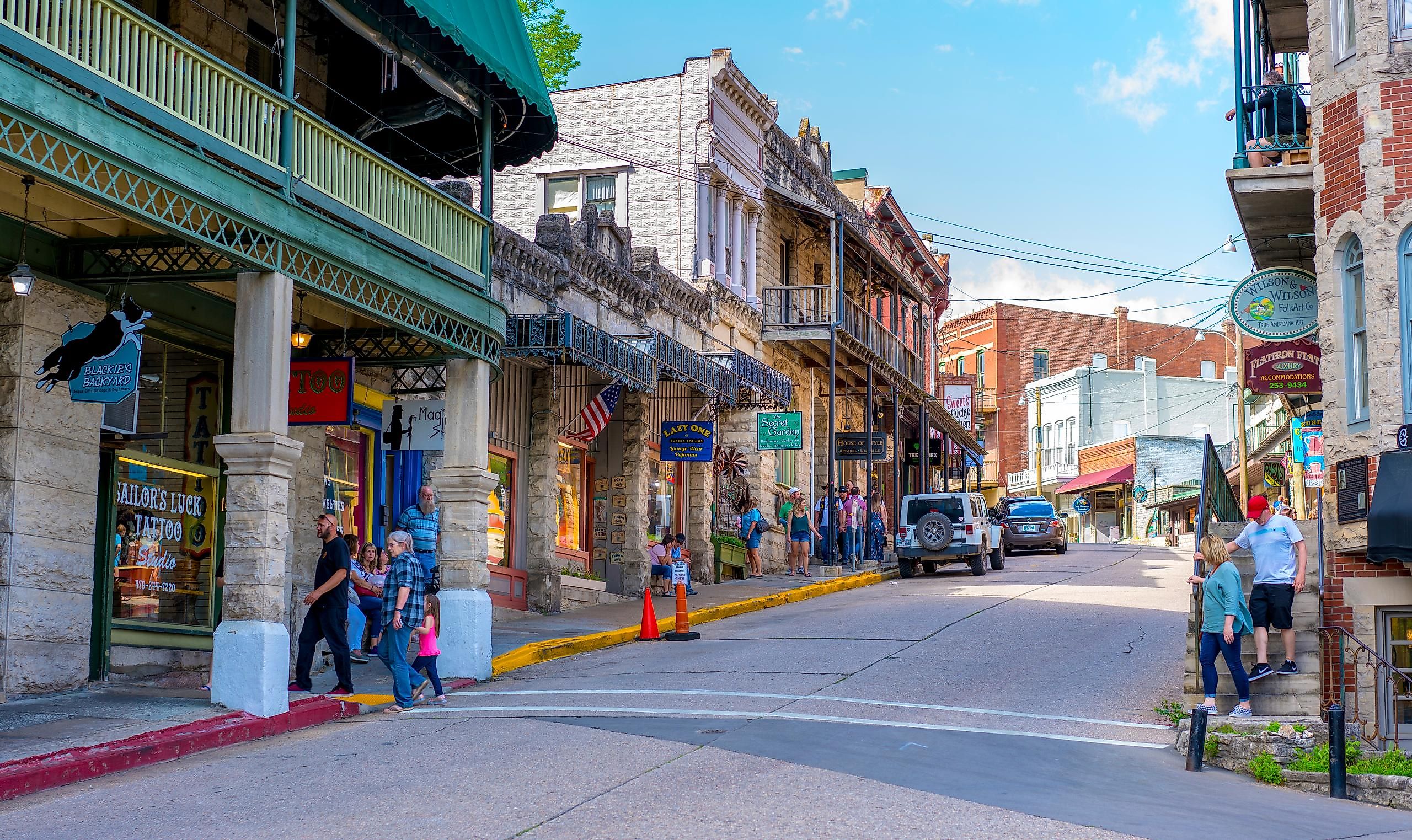
Eureka Springs grew up around more than 60 natural springs, on streets so steep that locals call it the Stairstep Town. Victorian storefronts climb the slopes, and at the top sits the 1886 Crescent Hotel, which bills itself as America's most haunted. It earned the reputation the hard way. In 1937 a con man named Norman Baker bought the place and ran it as a cancer hospital. He had no medical degree. He wore lilac suits, drove a purple car, and sold a cure made mostly of watermelon seeds and spring water. Authorities nabbed him for mail fraud within a couple of years. A 2019 dig out back turned up hundreds of his old bottles, and his autopsy table still sits in the basement. The hotel works every bit of it into the nightly ghost tour.
A few miles west, Thorncrown Chapel plays it quieter. Architect E. Fay Jones finished the glass-and-timber sanctuary in 1980 under a single rule: no piece could be bigger than what two people could carry through the woods. It rises 48 feet behind 425 windows. Closer to town, the Turpentine Creek Wildlife Refuge gives 459 acres to big cats and bears rescued from the exotic pet trade. So a Bengal tiger and a haunted autopsy table end up a few miles apart in the same small town.
Calico Rock

Calico Rock has a ghost town, and it sits inside the town. East Calico, also called Peppersauce, is the oldest part of the place, and it has been left to stand empty: a couple dozen abandoned buildings a few blocks east of the living Main Street. It is one of the only genuine ghost towns sitting within the limits of an active town anywhere in the country. You can walk it with a self-guided map. The old jail still wears a stenciled sign that reads "$5 Fine for Talking to Prisoners."
The living half is doing fine. The town grew up as a White River steamboat landing, named for the striped sandstone bluff over the water that somebody decided looked like calico cloth. Peppersauce Alley, the lane behind Main Street, took its name from the moonshine, called peppersauce, that traders sold in the wagon yard there. The whole downtown is on the National Register, and the Calico Rock Museum lays out the river-port and timber years that left the place with a ghost town to spare.
Jasper

Jasper has about 470 people and a full-blown elk festival. Every June the Buffalo River Elk Festival takes over the Newton County courthouse square, which is a lot of ceremony for an animal Arkansas wiped out back in the 1840s. The elk only came back in 1981, when the state hauled a herd in from Colorado and paid for them, no kidding, in Arkansas channel catfish.
The herd grazes the Boxley Valley meadows to the west, along the Buffalo National River, and crowds line the road every fall to watch the rut. While they were at it, somebody looked at a roadside pullout above the Big Creek valley and named it the Arkansas Grand Canyon. Newton County does not do understatement.
Paris

Yes, Arkansas has a Paris. No, there is no Eiffel Tower. What it has instead is the tallest mountain in the state, right in the backyard. Mount Magazine tops out at 2,753 feet just south of town, and the flat summit doubles as a hang-gliding launch, so plenty of people drive up specifically to jump off it. Downtown plays it straighter. Two small museums dig into the local coal-mining past, one of them set inside the old 1886 county jail with the cells still upstairs.
Then there is the wine. Cowie Wine Cellars, out on Highway 22, bottles a native American grape called Cynthiana that almost nobody else plants. A French-named Arkansas coal town with its own winery feels about right for this list.
Mountain View

Mountain View calls itself the Folk Music Capital of the World, and most warm evenings it backs the claim up. Musicians simply show up at the Stone County courthouse square with fiddles, banjos, and guitars and play until they feel like stopping. Nobody schedules it. Bring an instrument and join in, or bring nothing and listen. About 2,900 people live here in the Ozark foothills of north-central Arkansas.
The tradition has a permanent home at the Ozark Folk Center State Park, where craftspeople still demonstrate blacksmithing, broom making, and dulcimer building. Every April the Arkansas Folk Festival takes over downtown, and in the warm months the picking spills off the square into a spot named, with zero irony, Pickin' Park. The whole town runs on the theory that a song gets better when a stranger sits in.
Murfreesboro

Murfreesboro sits on the only spot on earth where the public can dig for diamonds and keep whatever turns up. The Crater of Diamonds looks like an ordinary plowed field. It is the eroded top of an ancient volcano. You rent a shovel and a bucket, pick a furrow, and start sifting, and anything you find is yours, diamonds included.
A farmer named John Huddleston turned up the first stones here in 1906, and he was not even looking for diamonds. A rush followed. The state took the field over in 1972 and has run it as a park ever since. The biggest find came in 1924: a 40.23-carat stone named Uncle Sam, still the largest diamond ever pulled out of the ground in the United States. People keep finding them, roughly a couple a day, so the odds are not as ridiculous as they sound.
Where the Strange Feels Normal
The Crescent Hotel sells out ghost tours built around a real-life quack, and that is somehow one of the tamer entries here. Calico Rock keeps a whole ghost town inside its own city limits. Mountain View fills its courthouse square with strangers playing music together on an ordinary weeknight. Paris launches hang gliders off the highest point in Arkansas and bottles wine from a grape nobody plants. None of it was planned. That is the appeal. These towns turned strange by accident, then leaned all the way in.