8 Idyllic Small Towns In Virginia To Visit In 2026
In Abingdon, the Barter Theatre has been swapping seats for produce since 1933, and it still fills Main Street as the country's longest-running professional theater. Every town on this list has a draw like that, something specific enough to plan a weekend around. Luray hides a musical organ inside a cave. Chincoteague's wild ponies swim a channel every July. Cape Charles turns its evenings toward a bay-side sunset, and Smithfield guards a ham older than your grandparents. All eight are small, walkable Virginia towns built for an unhurried weekend.
Abingdon

The bartering was not a gimmick. When Robert Porterfield opened the Barter Theatre in 1933, cash was scarce across southwest Virginia, so he let people pay for a seat with produce or a live chicken. Ninety years on, the theater is still on Main Street, and it is the longest-running professional Equity theater in the country. It pulls well over a hundred thousand playgoers a year into a town of about 8,300, more than ten times the local population.
The rest of Abingdon lives up to its marquee. A twenty-block historic district of red brick and long porches earned the town its nickname, the England of the Blue Ridge. The William King Museum of Art shows Appalachian work old and new. The Tavern, built in 1779, still serves dinner inside the oldest building in town. Each summer the Virginia Highlands Festival fills the streets with music and craft booths.
Abingdon also sits at one end of the Virginia Creeper Trail, a thirty-four-mile rail-trail that runs downhill through the Jefferson National Forest toward Whitetop. Rent a bike, catch a shuttle to the top, and coast back into town for dinner. Dozens of independent restaurants and cafes line the walkable center, which is why USA Today 10Best readers have named Abingdon one of the best small-town food scenes in the country. Come for a play and you end up staying for the ride and the meal.
Floyd

On Friday nights the town of Floyd runs on old-time music. The Floyd Country Store clears its floor after supper, a string band sets up, and neighbors flatfoot-dance on the worn boards until late. Anyone can walk in, the music is all acoustic, and the Jamboree has been a weekly habit for decades. It is not a show staged for tourists. It is simply what people here do on a Friday.
Floyd sits at a single stoplight in the Blue Ridge, and that crossroads has drawn a whole community of makers. Potters, luthiers, and painters keep studios along the two main streets, and the Floyd Center for the Arts hangs new work through the year. A couple of coffee shops and a good independent bookstore give you a reason to slow down between galleries.
When you want air, Buffalo Mountain Natural Area Preserve rises just outside town to one of the widest views in the region. The trail to the bald summit is short and steep, and rare plants grow on the rocky top. People come to Floyd for the Friday music and find they have booked a Saturday hike too.
Lexington

Two old colleges give Lexington its bones. Washington and Lee University, founded in 1749, sits a few blocks from the Virginia Military Institute. The two campuses trade red brick, white columns, and shaded quadrangles. The effect is less small Southern city and more a place built for walking and reading. Students and visitors share the same downtown cafes and bookstores.
History here sits close to the surface. Stonewall Jackson taught at VMI and lived in a house you can still tour in town. The campus chapel at Washington and Lee, renamed University Chapel in 2021, holds the tomb of Robert E. Lee. The VMI Museum walks visitors through cadet life going back nearly two centuries.
The area's oldest draw is a few miles south. Natural Bridge is a 215-foot limestone arch that Cedar Creek cut through solid rock over thousands of years. Thomas Jefferson once owned the land and called the span the most sublime of nature's works. Trails run beneath the arch and along the creek, and a nearby cavern reaches deeper into the same limestone.
Luray

Luray keeps its main attraction underground. Luray Caverns was discovered in 1878 and ranks as the largest cave system in the eastern United States, with chambers tall enough to swallow a house. The showpiece is the Great Stalacpipe Organ, recognized by Guinness as the world's largest musical instrument. Press a key and rubber mallets tap tuned stalactites across three and a half acres of cave, filling the rooms with soft, echoing notes.
Above ground, Luray makes an easy base for the Shenandoah Valley. Skyline Drive enters Shenandoah National Park just up the road, with overlooks that reach for miles across the Blue Ridge. The Shenandoah River loops nearby for a slow afternoon of paddling or tubing. Trails for every leg length branch off the ridgelines.
Downtown Luray is a short, walkable Main Street of antique shops and family kitchens. It is the kind of place where you can spend a morning inside a mountain and an afternoon on the water. Then you can finish with pie on Main Street before the drive home.
Warrenton

Warrenton is horse country, and it does not hide it. Drive the lanes around town and you pass white board fences, stone walls, and pastures where foxhunts still ride out in the fall. This is the heart of Virginia's hunt country, and the farms have shaped the land for generations. In town, the pace slows to a walk.
Old Town Warrenton keeps its nineteenth-century storefronts full and busy. Brick sidewalks lead past antique shops and a well-loved bakery to the Fauquier History Museum. The museum sits inside a stone jail from the early 1800s and covers the county's Civil War years, when armies moved through these hills more than once.
The same countryside that feeds the horse farms now grows grapes. Fauquier County wineries pour tastings on hillsides where the view runs to the Blue Ridge. For a longer walk, Sky Meadows State Park climbs from rolling meadow into oak woods, with overlooks across the Piedmont. The horses came first, and everything good about Warrenton still grows out of that open land.
Smithfield

Smithfield built its whole identity on ham. A 1926 Virginia law still holds that a true Smithfield ham has to be salt-cured and aged for months inside the town limits, and nowhere else. The town has worn the title Ham Capital of the World for a century. The Isle of Wight County Museum even keeps a cured ham from 1902 in a glass case, watched over by its own live 'ham cam.'
Ham money built a handsome town. Smithfield was laid out in 1752 on a bluff above the Pagan River, and its historic district still holds more than seventy old houses and storefronts. Boutiques and cafes fill the ground floors now, and the whole center is flat and easy to walk. A few miles out, St. Luke's Church stands as the oldest brick church in the country, its walls raised back in the 1600s.
For air and water, Windsor Castle Park runs right up to downtown. Several miles of trail cross wetland and woods along the Pagan River, with boardwalks and a launch for kayaks. The park takes its name from an 18th-century manor house on the grounds. You can smell the marsh, watch an osprey work the river, and still walk back for a ham biscuit at lunch.
Cape Charles

Most of Virginia's coast faces the sunrise. Cape Charles faces the other way. The town sits on the bay side of the Eastern Shore, so its beach looks due west across the Chesapeake, and residents plan their evenings around the sunset. Cape Charles Town Beach runs the length of Bay Avenue with an entry at the end of every block, and it stays free to walk on.
Behind the beach, Mason Avenue holds a few blocks of galleries, a hardware store, and seafood joints where the oysters came out of the bay that morning. The grid is six blocks by six, easy to cross on foot or by golf cart. A free public pier reaches out over the water, open to anyone with a rod.
Just south of town, Kiptopeke State Park holds one of the strangest sights on the bay. Nine concrete ships, built when steel ran short in World War II, sit half-sunk in a long row offshore. They were parked there in 1948 to break the waves, and they still do the job, now crusted with barnacles and busy with cormorants. It is the kind of odd, true thing that makes Cape Charles stick in your memory.
Chincoteague

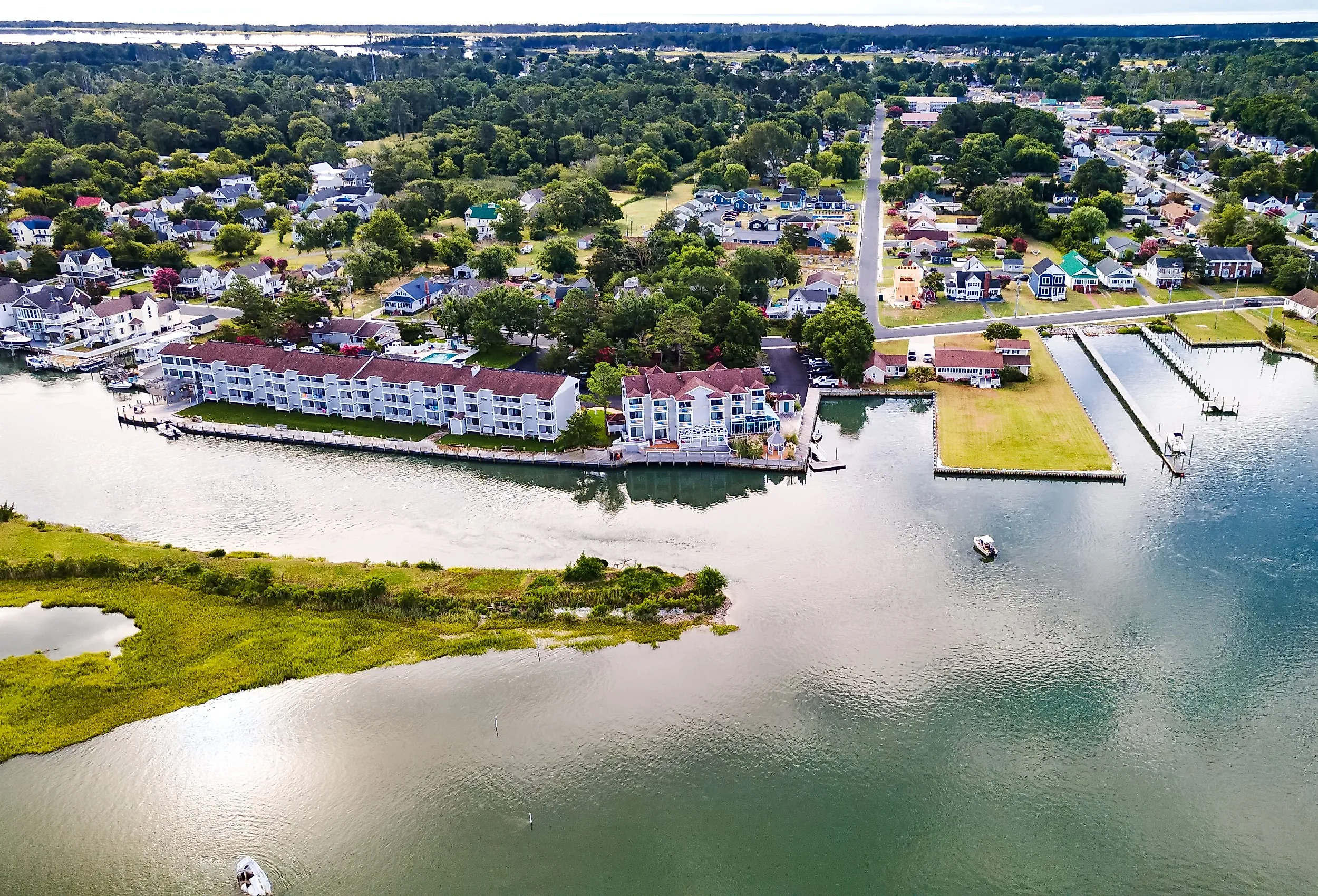
Once a year, wild ponies swim across a channel to Chincoteague, and the whole island turns out to watch. The herds live on neighboring Assateague Island, and every July since 1925 local firefighters have guided them over the water at slack tide. The Pony Swim made this little fishing town famous, helped along by the children's book 'Misty of Chincoteague.' The rest of the year the ponies graze the marshes, free to roam.
Most of that wildness is protected. Chincoteague National Wildlife Refuge covers 14,000 acres of beach, marsh, and pine on Assateague, with fifteen miles of trail and a long stretch of open Atlantic shore. You can paddle the creeks past dolphins and egrets or climb the candy-striped Assateague Lighthouse. The current tower went up in 1867 to replace a shorter one from 1833, and it still guides boats today.
Chincoteague never turned into a resort strip. There are no high-rises here. Weathered docks and painted cottages line the water, and the family restaurants shuck oysters and steam crabs hauled in that morning. The Museum of Chincoteague Island keeps the old lighthouse lens and the story of the watermen. It is the last town on this list, and for a lot of people it is the one they drive back to.
What Ties These Towns Together
Small towns get called idyllic all the time, usually with nothing behind the word. What sets these eight apart is that each one grew up around something specific and real, and none of it was staged for visitors. That is why the theater still barters, the ponies still swim, and the caverns still play music: these are working traditions the towns kept for their own sake, not attractions dreamed up for a brochure. Pick the town whose one thing pulls at you, and let a slow Virginia weekend build around it.