8 Fairy-Tale Small Towns In Ohio
Ohio does not lack for the stuff of fairy tales once you leave the highway. A World War I veteran spent half a century building a stone castle by hand outside Loveland, hauling rock up from the Little Miami and casting his own bricks in milk cartons. A Swiss-styled village in Amish Country keeps the world's largest cuckoo clock ticking over its Main Street. One town raised Thomas Edison and still keeps his birthplace open; another built its whole downtown around the waterfalls it is named for. These eight Ohio towns each hold onto a specific, stubborn kind of character, the sort that reads like a fairy tale precisely because nobody set out to manufacture one.
Loveland

On a wooded bank of the Little Miami River sits a full medieval stone castle that one man built with his hands. Harry Andrews, a World War I veteran who fell for the castles of France while serving overseas, started Loveland Castle in the late 1920s, hauling rock up from the riverbed and, when that ran short, casting his own bricks in milk cartons. He worked on it for roughly fifty years, until his death in 1981. The Knights of the Golden Trail, the scouting group he founded, now run it as a museum, with guided tours, a courtyard garden, and a dungeon, which makes it one of the genuinely odd landmarks in the state.
The rest of Loveland is a former rail town that turned its riverfront into a draw. The Little Miami Scenic Trail and the Loveland Bike Trail run the bank for cyclists and walkers, and the town leans hard into its name, with heart imagery worked into the streets and a Hearts Afire Weekend every February.
Oberlin

Oberlin runs on music and conscience. The Oberlin Conservatory of Music is the oldest continuously operating conservatory in the country, and the sound of it, students carrying instruments, recitals spilling out of practice halls, gives the whole downtown its rhythm alongside Oberlin College. Ben Franklin and MindFair Books has anchored the center for years, and the walkable core rewards an unhurried afternoon.
The town's conscience runs just as deep. Oberlin was a stronghold of the abolitionist movement and a stop on the Underground Railroad, a history the Oberlin Underground Railroad Center keeps front and center and the community takes seriously. For quiet, the Oberlin Arboretum and the grounds of Westwood Cemetery give runners and cyclists green routes close to the middle of town.
Chagrin Falls

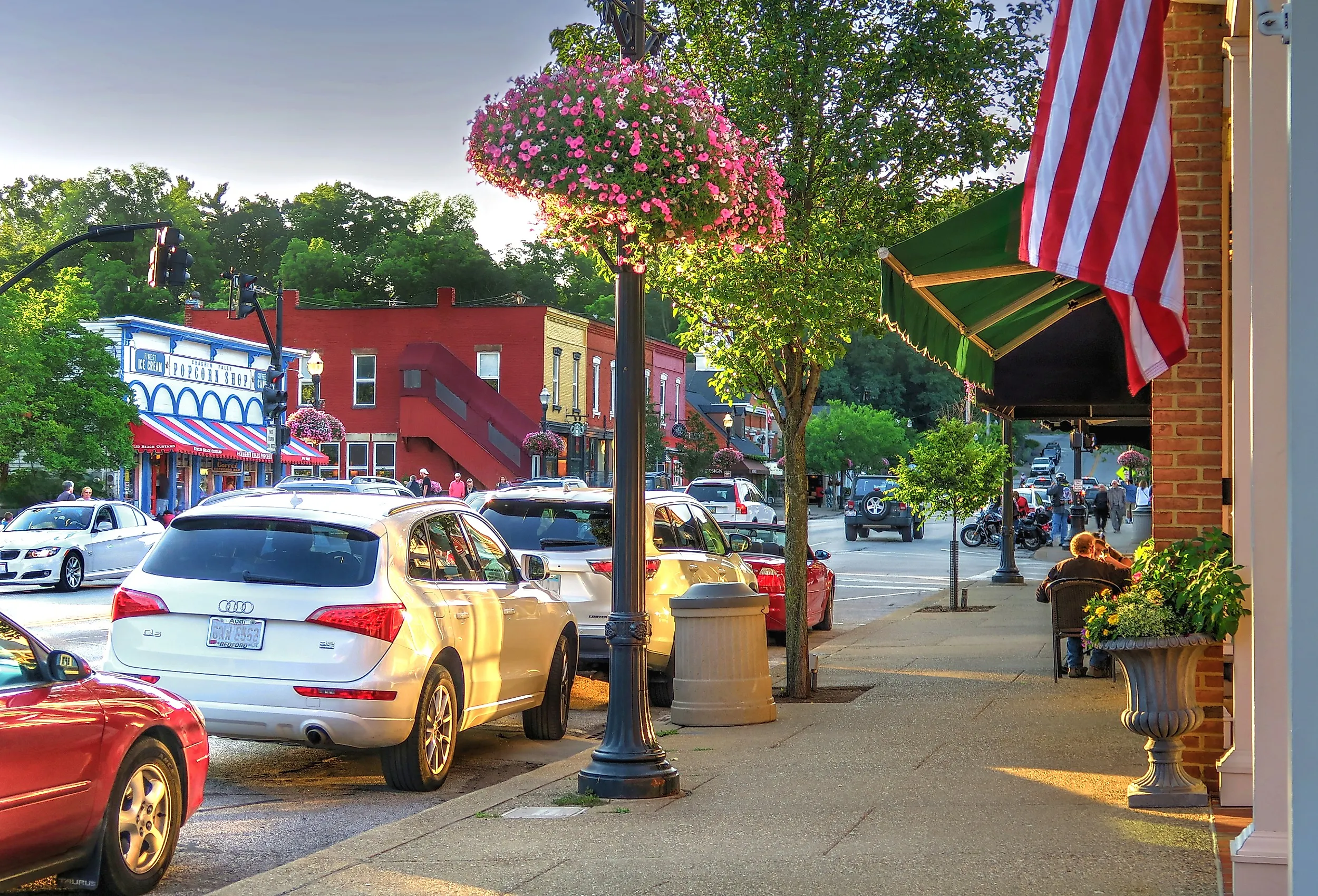
The waterfalls drop right through the middle of downtown, close enough to the shops that you hear them before you see them. Chagrin Falls built itself around that cascade, and the 19th-century storefronts crowd in near the water, among them the 1848 Township Hall and the Triangle Park Commercial Historic District. The Popcorn Shop sits perched at the lip of the falls, an old favorite for watching the water.
Everything clusters within a short walk. Browse the Fireside Book Shop, then take a table at the 17 River Grille overlooking the water, and follow the riverbank paths for cycling, jogging, and walking. Just outside the village, Beartown Lakes Reservation trades the falls for trails, picnic spots, and quiet wildlife-watching.
Milan

Thomas Edison was born in Milan on February 11, 1847, in a small brick house his father built, and the town has never once let anyone forget it. The Edison Birthplace Museum preserves the home and the story of his early years, and the inventor's name turns up across the village, on shops, on streets, on the school mascot. The Milan History Museum fills in the wider town beyond its most famous son.
The rest of Milan is a preserved canal-era village, with 19th-century buildings on the National Register, including the 1848 Turner House, giving the streets an old-world weight. The Invention Restaurant plays the Edison card by name, and the town throws itself into its calendar, with the Milan Melon Festival over Labor Day weekend and Settlers Weekend in October.
Marietta

Marietta was the first permanent settlement in Ohio, founded in 1788 where the Muskingum River empties into the Ohio, and that age shows on every block. The neighborhoods hold a deep stock of historic architecture, cobblestones and brick facades and Victorian homes standing alongside landmarks like the Lafayette Hotel and the Basilica of St. Mary of the Assumption. Few Ohio towns wear their history this plainly.
The rivers still run the calendar. Each September the Ohio River Sternwheeler Festival brings paddlewheel boats back to the waterfront with live entertainment, vendors, and fireworks, and Marietta Main Street First Fridays keep downtown busy through the warmer months. For a town this old, it stays genuinely lived-in rather than embalmed.
Granville

Granville looks like a piece of New England that wandered west, which is close to the truth: settlers from Massachusetts and Connecticut laid it out, and the Greek Revival architecture and the hillside campus of Denison University still carry that stamp. The 1812 Buxton Inn and St. Luke's Episcopal Church anchor a preserved streetscape that photographers work over constantly.
History runs deeper here than the storefronts let on. Just outside the village, the Alligator Effigy Mound is a prehistoric ceremonial earthwork raised by Indigenous peoples roughly a thousand years ago, one of only a handful of effigy mounds in the state. Downtown, Three Tigers Brewing Company and the barbecue at Ray Ray's Hog Pit keep the few blocks busy after the photography is done.
Grand Rapids

Grand Rapids is a quiet canal town on the Maumee where the river sets the pace and the downtown stays small on purpose. Its signature event is the Apple Butter Festival every fall, a long-running gathering built around apple treats and local food that pulls crowds far larger than the village itself. It is the kind of day that fills a single main street and empties it again by dark.
The rest of the year runs low-key: riverside routes for cyclists and joggers, a short row of local businesses to wander, and the Miami and Erie Canal towpath nearby. There is no long checklist of attractions here, and residents will tell you that is exactly the appeal.
Sugarcreek

Over Sugarcreek's Main Street hangs the world's largest cuckoo clock, and the town commits to the bit completely. The clock stands about 23 feet tall and 24 feet wide, and every half-hour a cuckoo pops out while a mechanized band plays Swiss polka and a little couple dances. Recognized by Guinness, it presides over a downtown of Swiss chalet-style buildings in the heart of Amish Country, which styles itself the "Little Switzerland of Ohio" and means it.
Cheese is the other half of the identity. The nearby Broad Run Cheese House and Guggisberg Cheese, home of the original baby Swiss, run tastings across a long list of varieties. Come fall, the Ohio Swiss Festival has filled the streets since 1953 with music, cultural dances, and Swiss and German food. Few Ohio villages carry an identity this defined.
The Character Is the Point
A hand-built castle, a giant cuckoo clock, a downtown wrapped around a waterfall, the birthplace of the man who lit the country: none of it was designed to charm anyone. Each of these towns held onto something specific and a little stubborn, and that is what gives them the fairy-tale quality the polished version of Ohio tends to sand away. The state gets defined by Cleveland, Columbus, and Cincinnati, but its smaller places are where the odder, more particular character lives, close to home and worth knowing well.