6 of the Oldest Incorporated Towns in The United States
North American history is one of the most fascinating subjects in the world. It tells the story of how the United States came to be and of the towns that were eventually incorporated to help build what some believe is the strongest country on the planet.
Some of these towns, including St. Augustine in Florida, were founded by Spanish explorers. Others, like Hampton in New Hampshire, were established by English Puritans. Together, over hundreds of years, Spanish, Dutch, and other European travelers, settlers, and traders set down roots across the continent. The early communities they built were eventually granted formal municipal incorporation.
Hampton, New Hampshire

The English arrived in what would become Hampton in 1638, but long before that, the Pennacooks camped out in the region in the summer. The English Puritans came from Massachusetts and stayed to raise cattle in the salt meadows. They settled in the town, then known as Winnacunnet, on October 14, 1638.
It was officially incorporated by the Massachusetts General Court in 1639. While Hampton grew from a farming and fishing settlement into a seaside resort destination, it is also unfortunately known for being the only town in New Hampshire to put women on trial for suspected witchcraft.
Hampton is still New Hampshire's most popular vacation destination today, especially for families. Hampton Beach is also one of the top three cleanest beaches in the country. After spending time on the beach, visitors can walk the Ocean Boulevard promenade or visit the Tuck Museum of Hampton History that features farming tools dating back hundreds of years along with historic structures.
Kittery, Maine

Kittery is Maine's oldest town and was incorporated in 1647, more than a hundred years before the United States would come to be. English settlers arrived in the area that would become the town in 1623, and it was named after Kittery Court in Kingswear, England.
Those early settlers were seamen, woodworkers, and hunters, but before they even set foot on the land, the area was inhabited by Native Americans who called it Amiciskeag. Kittery's history is filled with conflicts between the settlers and the natives that lasted more than a century.
Kittery is a stunning town today, the southernmost in Maine, and famous for its lobster boats and beaches. The Fort McClary State Historic Site sits on the shores of the Piscataqua River and was built in the early 18th century to defend the harbor. Having seen many conflicts, including the American Revolution and the Civil War, visitors can explore the sites and stay for the living history events.
Fort Foster Park in Kittery Point also features a Civil War-era fort and museum to explore.
Jamestown, Rhode Island

Italian explorer Giovanni da Verrazzano arrived in Narragansett Bay in 1524, long before Dutch Island was inhabited by fur traders in 1622. English colonists arrived in 1638, striking a deal with the native inhabitants to use Conanicut Island. The island officially became Jamestown in 1678, named after James, Duck of York, and boasted 150 residents.
Visitors can explore modern Jamestown by strolling Narragansett Avenue and popping into the famous Bloom Artisan Boutique or Fuller Gallery for the latest in jewelry and artwork. The Jamestown Museum holds more than 45,000 online records on the town's history as well as fascinating photographs, flags, and other artifacts.
Other things to do include paddling at East Ferry Town Beach or biking the path that stretches along the community farm and reservoir.
Annapolis, Maryland

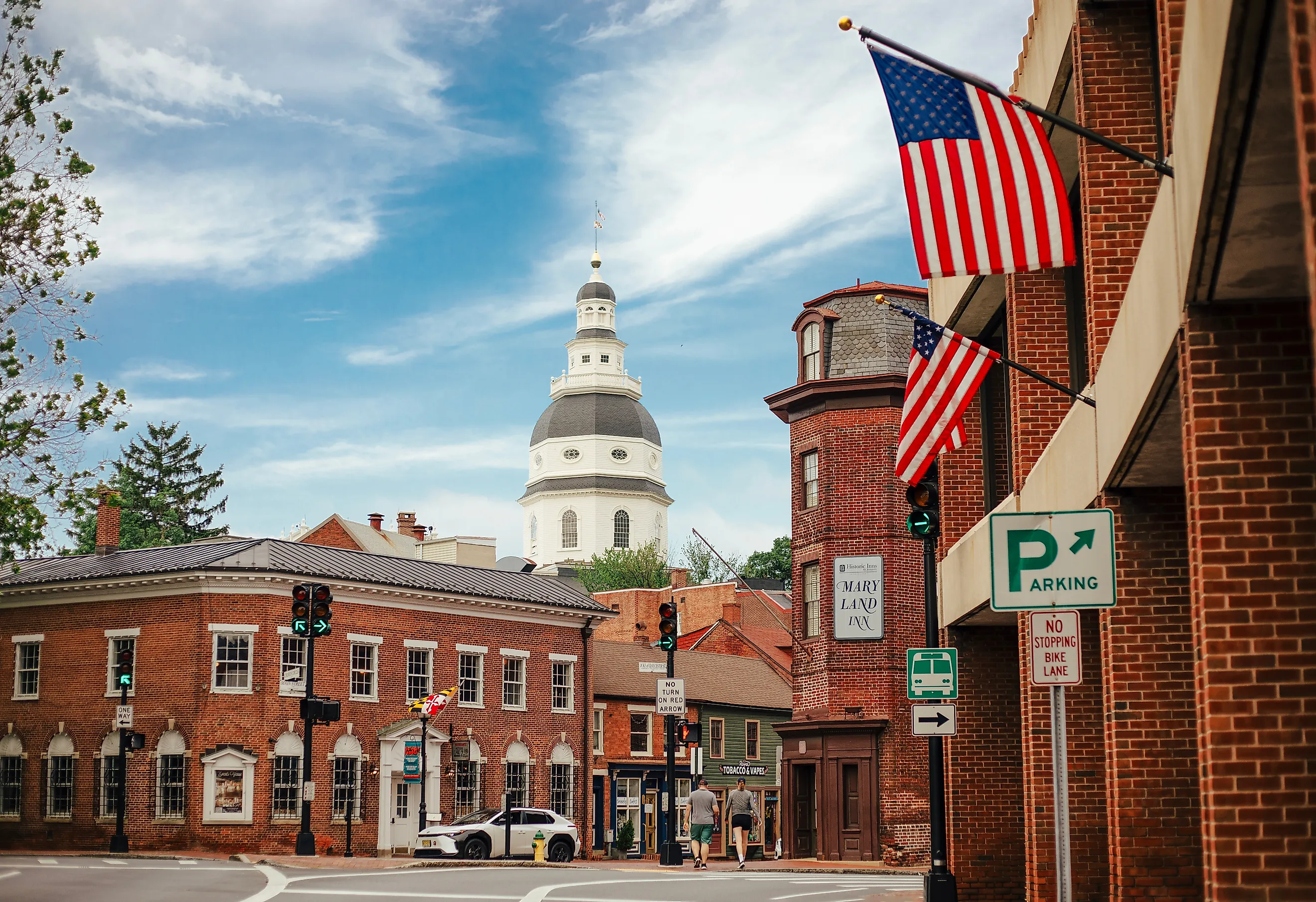
Virginian Puritans settled the area that would become Annapolis as Providence in 1649. As time passed, the town was called Town Land and Anne Arundel Town. The colonial capital was moved to the area in 1694, and the city was renamed Annapolis in honor of Princess Anne.
It is known for avoiding the American Revolution and the Civil War, even though many wounded were treated in local hospitals. The town was officially incorporated in 1708 after receiving its charter from Queen Anne of England.
Annapolis's Maryland State House is one of the best stops on a tour through the town. The building is the site where George Washington resigned his military commission and where the Treaty of Paris was ratified.
Outside, the Lawyers Mall features several historic statues. Those who want to see what the houses looked like here in Colonial times can head to Pinkney Street and Fleet Street, where the house colors range from coral to periwinkle.
The William Paca House & Garden brings another piece of history to life, as it was built by William Paca, one of the signers of the Declaration of Independence. Then, at the U.S. Naval Academy, visitors can watch the cadets march, visit the Naval Chapel, and shop at the on-site gift shop.
Plymouth, North Carolina

North Carolina has its very own Plymouth, established in 1787, making it older than Washington County. It was incorporated in 1807 and named after Plymouth, Massachusetts. It was an integral shipping port that moved products such as tobacco, cotton, and corn while also shipping out masts, lumber, shingles, and tar.
Well known for its role in the Civil War, its history is detailed in three museums along the Roanoke River. The Port O' Plymouth Museum houses several Civil War artifacts, and behind the building, in the river, is a replica of the CSS Albemarle. The Roanoke River Lighthouse and Maritime Museum preserves the town's maritime history and covers an acre of land. The grounds include a replica of the 1867 Roanoke River Lighthouse. At the Bear-Ology Museum, visitors can learn all there is to know about black bears.
Plymouth is also home to the Roanoke River Boardwalk, where wetlands provide a habitat for wildlife and ancient cypress trees grow.
St. Augustine, Florida

It is widely accepted that the first governor of Puerto Rico, Juan Ponce de Leon, was searching for the mythical island of Bimini when he happened upon the area that he would call Florida in 1513, deciding to name it after Pascua Florida, the Spanish Easter season.
Over the next five decades, the Spanish would fail six times to settle Florida. Pedro Menéndez de Avilés founded St. Augustine in 1565, and construction of the Castillo de San Marcos began in 1672. Today, the fortress is still one of America's best examples of Spanish colonial military forts.
St. Augustine was officially incorporated in 1822 and the fort remains the town's number one attraction. Visitors can tour the rooms, the jail, and the chapels, before walking the ramparts to see the cannons.
The Old City Gates at the end of St. George's Street have been standing since 1808 and is home to the oldest wooden school house in the country. Those who want to explore more of the town's history can head to the Lightner Museum, which is filled with historic artworks and antiques.
The Foundations of American Heritage
The founding and incorporation of each American town served as a building block of the United States as a whole. Long before these towns became seaside resorts or credited historic downtown areas, they played a role in wars, operated as ports, and struggled to maintain a stable livelihood.
As you walk through them, you can immerse yourself in the historic atmosphere in the town squares and museums with small markers throughout each one that gives a nod to the settlers who put down roots and create the foundations of the towns as we know them today.