This United States Town Instantly Transports You To The Past
Cannonballs once struck these fort walls and simply lodged in the shell-rock. The Spanish built that fort to protect a town they founded in 1565. St. Augustine has kept the same street grid since before Plymouth existed. Its coquina ramparts still look out over Matanzas Bay from the old town's edge. Walk those Florida streets today and four centuries press in from every balcony. Additionally, a handful of other American towns pull that same trick just as convincingly; we cover a few of them, too.
St. Augustine's Early History

Most historians agree that the first governor of Puerto Rico, Juan Ponce de Leon, reached Florida in 1513 while searching for the mythical island of Bimini and its rumored fountain of youth. He chose the name Florida after the Spanish Easter season, known as Pascua Florida. The Spanish could not settle Florida, however, failing six times over the next five decades. When French Protestants built a colony very close to today's Jacksonville, Spain saw the establishment as a threat to its treasure ships. King Philip II ordered Admiral Don Pedro Menendez de Aviles to expel the French settlers. Menendez brought his own 600 settlers in 1565 and then founded St. Augustine, named after Saint Augustine. Those 600 settlers faced many troubles, including fires and enemy attacks. They also suffered assaults by English soldiers and pirates, prompting Spain to build the Castillo de San Marcos, with construction starting in 1672. The fort helped protect St. Augustine from British attacks in 1702, 1728, and 1740.
A Fort Built From Seashells

Today, the historic Castillo de San Marcos instantly transports visitors to the past when they visit St. Augustine. It is the oldest structure in the town and the oldest masonry fort in the continental U.S. The fort was removed from the list of active fortifications in 1900 and has stood as a national monument since 1924. The Americans called it Fort Marion after Florida became a United States Territory in 1821, and the U.S. Congress restored the Spanish name in 1942 to reflect the fort's heritage. Those who visit the fort today might be amazed to learn that it is built of coquina rock, essentially millions of seashells smashed together. It may not sound like the fort should have been able to withstand deadly attacks, but it did. Cannonballs could not penetrate the rock, nor could the sustained power of armies break it down. Those who want to see the fort for themselves can take self-guided tours around the fort complex. Visits on weekends include cannon firings and weaponry demonstrations.
A Spanish Colonial Street Grid

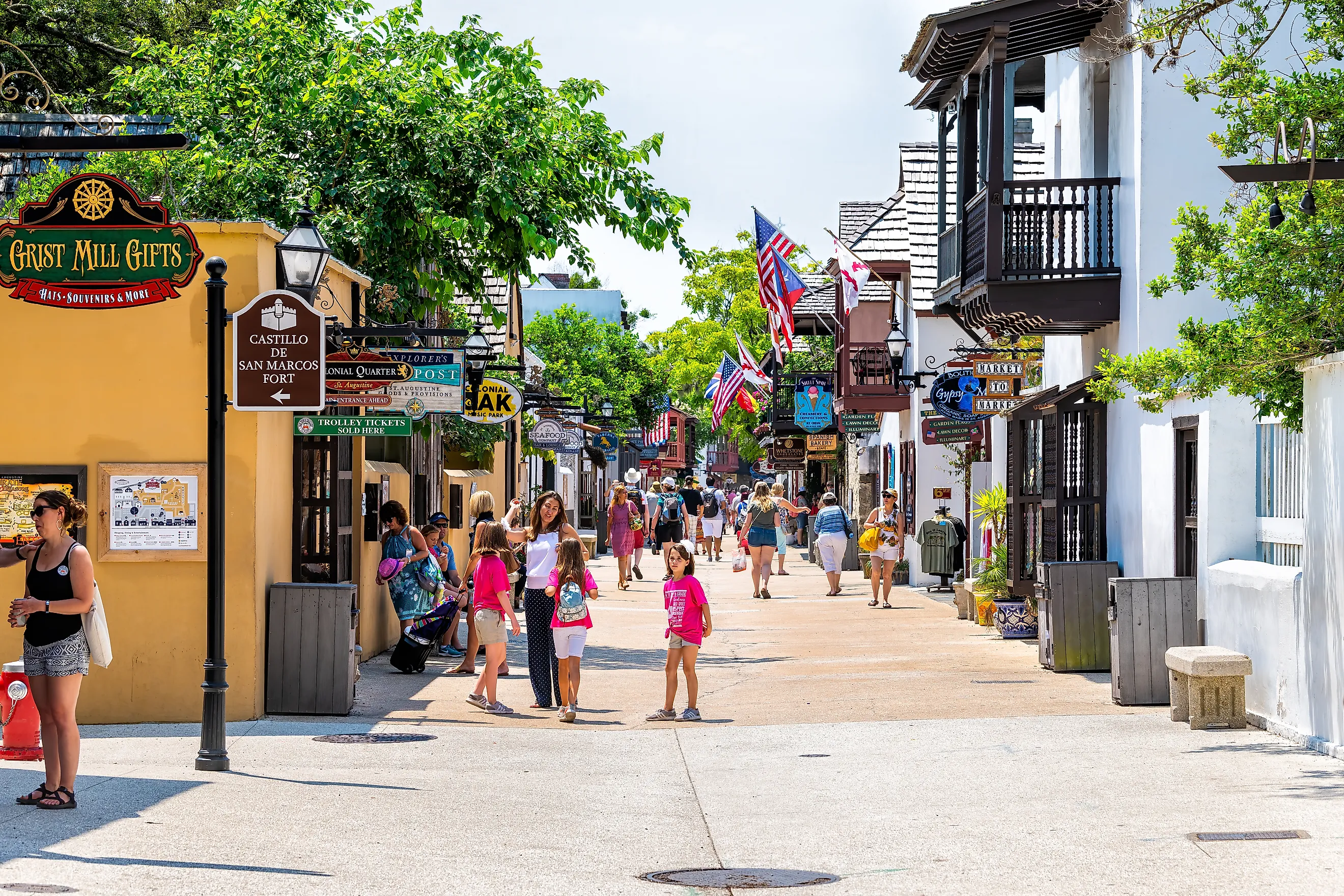
The town's streets also hark back to the days of old when Spanish design was the order of the day and St. Augustine was given a Spanish colonial street grid. St. Augustine is the only urban area in America that still features its original Spanish street layout and architecture. Visitors will see 36 original colonial buildings along these streets, and balconies featuring wrought-iron designs. There are also 40 buildings that have been reconstructed to reflect colonial architecture. In 2026, St. Augustine's historic district, which is the oldest part of the town, is one of its most fascinating attractions. Visitors can walk through the entire district, admiring the Spanish and Moorish pastiche architecture before stopping by the Lightner Museum, formerly the Hotel Alcazar. The building dates back to 1887 and was built in the Spanish Renaissance Revival style. Inside, there are several displays to explore, including Gilded Age furniture. The Colonial Quarter is a must-see, where local actors portray musketeers, shopkeepers, and blacksmiths, allowing visitors to immerse themselves in 18th-century St. Augustine.

From the historical center, visitors can make their way to Ponce de Leon's Fountain of Youth Archaeological Park. This 15-acre park is privately owned and located along Hospital Creek, which forms part of the Intracoastal Waterway. The park was the original site of St. Augustine and today offers tours along the waterfront. Other sites to explore in town include 16th-century Aviles Street, the country's oldest thoroughfare. The Spanish Military Hospital Museum offers an incredible look at what surgery and medical treatments looked like 200 years ago. And at the Hotel Ponce de Leon, now a dormitory for Flagler College, visitors can take guided tours to learn more about the history of this former hotel, built in the 1880s.
A Makeover Courtesy of Henry Flagler

St. Augustine would probably not be the tourist attraction that it is today if not for the efforts of businessman Henry Flagler. Just more than 20 years after the Civil War ended, Flagler realized his dream of turning St. Augustine into a winter getaway for rich Americans. He planned and built railroads and hotels, including the aforementioned Alcazar Hotel and Ponce de Leon Hotel. He also built the Casa Monica Hotel, creating luxurious spaces for those who wanted to winter in an elegant setting. The wealthy Americans who spent time in St. Augustine eventually broadened their travel horizons, frequently to other parts of Florida. But St. Augustine kept its appeal and remains one of the most visited towns in the state.
Civil Rights and the Lincolnville Neighborhood

St. Augustine is known for more history than just its origins and growth. The historic neighborhood of Lincolnville, which is part of St. Augustine, was established in 1866 by a group of people freed from slavery. Finally accepted as American citizens, the new residents of Lincolnville not only built homes and churches, but they also voted in elections for the first time. Many of Lincolnville's leaders went on to fill local political positions during Reconstruction, an era when Josiah T. Walls of nearby Alachua County became the first Black Floridian elected to Congress. Lincolnville thrived, and so did St. Augustine. By 1901, the first public school for Black students opened in St. Augustine.
Throughout the 1920s, Washington Street grew into a busy business center. More than a dozen churches flourished in the area, and the school was rebuilt to accommodate more students. During the 1960s Civil Rights Movement, Lincolnville residents placed themselves at the center of the demonstrations. So significant were the protests that Dr. Martin Luther King visited St. Augustine in 1963 and 1964. Today, the Lincolnville Historic District is on the National Register of Historic Places, and there are several historic attractions to see. This includes the Lincolnville Museum & Cultural Center, which tells Lincolnville's story.
Towns Following St. Augustine's Example

St. Augustine is not the only location in the U.S. that actively preserves its original architecture and history. Williamsburg, Virginia, features a massive Historic Area that doubles as an open-air museum. There are 18th-century taverns to see as well as original colonial structures. New Bern, North Carolina, was settled by Swiss and Palatine German immigrants in 1710. It became the first permanent capital of North Carolina, and today people can tour Tryon Palace, the reconstructed mansion of the British governor. Newport, Rhode Island, was founded in 1639 and, like St. Augustine, features very old colonial structures and Gilded Age properties. Newport has one of the highest concentrations of surviving colonial homes in America. These homes sit just down the street from the summer mansions built by rich families in the late 1800s.
Where the Past Still Stands
If you have ever felt like leaving modern life behind and stepping into a historic setting, St. Augustine is the place to do it. Here, you can see the same walls that soldiers hid behind when the town was attacked. You can touch the shell-rock walls of a fort that stopped cannonballs, and walk the streets that people walked hundreds of years ago. Williamsburg, Newport, and New Bern offer similar experiences. Each one keeps a different chapter of early America standing in place, waiting for anyone curious enough to walk into it.