6 Main Streets Where Connecticut Comes Alive
Connecticut is the third-smallest state in the country, and it has spent four centuries packing things into that space. Proud of their New England heritage, the towns below have gone to real lengths to preserve their main drags rather than pave them over, so what you get is old homes, working commercial buildings, and the occasional cannonball still lodged in a wall where the British left it in 1777. Take a trip to any of these six main streets and you will see why they draw crowds out of New York and Boston most weekends of the year.
Essex

Essex Main Street runs down to the Connecticut River and stops there, which is the whole shape of the town. Colonists from England settled the site around 1648 and built ships here for the next two centuries, though the village was not formally incorporated until 1852.
The Connecticut River Museum sits at the foot of Main Street in an 1878 steamboat warehouse and holds the best story in town. In April 1814 a British raiding party rowed up the river at night and burned some 28 vessels at anchor, the single largest loss of American shipping in the War of 1812, and Essex has never entirely stopped talking about it. The museum also keeps a full-size working replica of the Turtle, the hand-cranked one-man submarine David Bushnell built up the river at Saybrook in 1775 and sent against a British warship in New York Harbor. It was the first submarine used in combat anywhere.
The Essex Steam Train and Riverboat leaves from a station just off Main Street, pairing a vintage train through the river valley with a cruise past Gillette Castle, plus seasonal runs including the North Pole Express. Finish at the Griswold Inn, open since 1776 and among the oldest continuously operating inns in the country. From there it is a short walk to the Ebenezer Hayden II House of 1795, the 1799 Grover L'Hommedieu House, and the 1813 Hayden Chandlery.
Guilford

The green at the centre of Guilford runs to about 12 acres and started life as a drill field and grazing common before anyone thought to plant shade trees on it. English Puritans founded the town in 1639, roughly 17 miles east of New Haven, and the streets around the green now hold one of the largest concentrations of preserved 17th and 18th-century architecture in New England.
The Henry Whitfield State Museum is the headline. Built in 1639 of local granite, it is the oldest house in Connecticut and the oldest stone house in New England, and it has been a museum since 1899, making it the state's oldest of those too. Nearby stand the saltbox Hyland House of 1713, the Thomas Burgis II House of 1735, and the 1912 Guilford Trust Company building. The Guilford Fair, held each September at the fairgrounds off Boston Street, has run since 1859 and is the second-oldest fair in the state.
Litchfield

The Litchfield Historic District is about as intact an 18th-century New England town as survives anywhere. Four roads converge at the town green, and the settlement's high ground made it a useful supply depot for American forces during the Revolution and again in the War of 1812.
The Federal-style houses along South and North Streets explain the rest. Tapping Reeve built his house on South Street in 1773 and then opened the Litchfield Law School beside it in 1784, the first law school in America, which trained two vice presidents and more than a hundred congressmen before it closed. A little further along, the Litchfield History Museum is free to enter and covers the town in locally made furniture and household objects.
Oliver Wolcott's house, also on South Street, went up in 1754; he signed the Declaration of Independence from it. The Oliver Wolcott Library occupies a 1799 building nearby. Turn onto North Street for the 1775 Benjamin Tallmadge House, home to the officer who ran Washington's Culper spy ring, and the old Litchfield County Jail of 1812.
Mystic

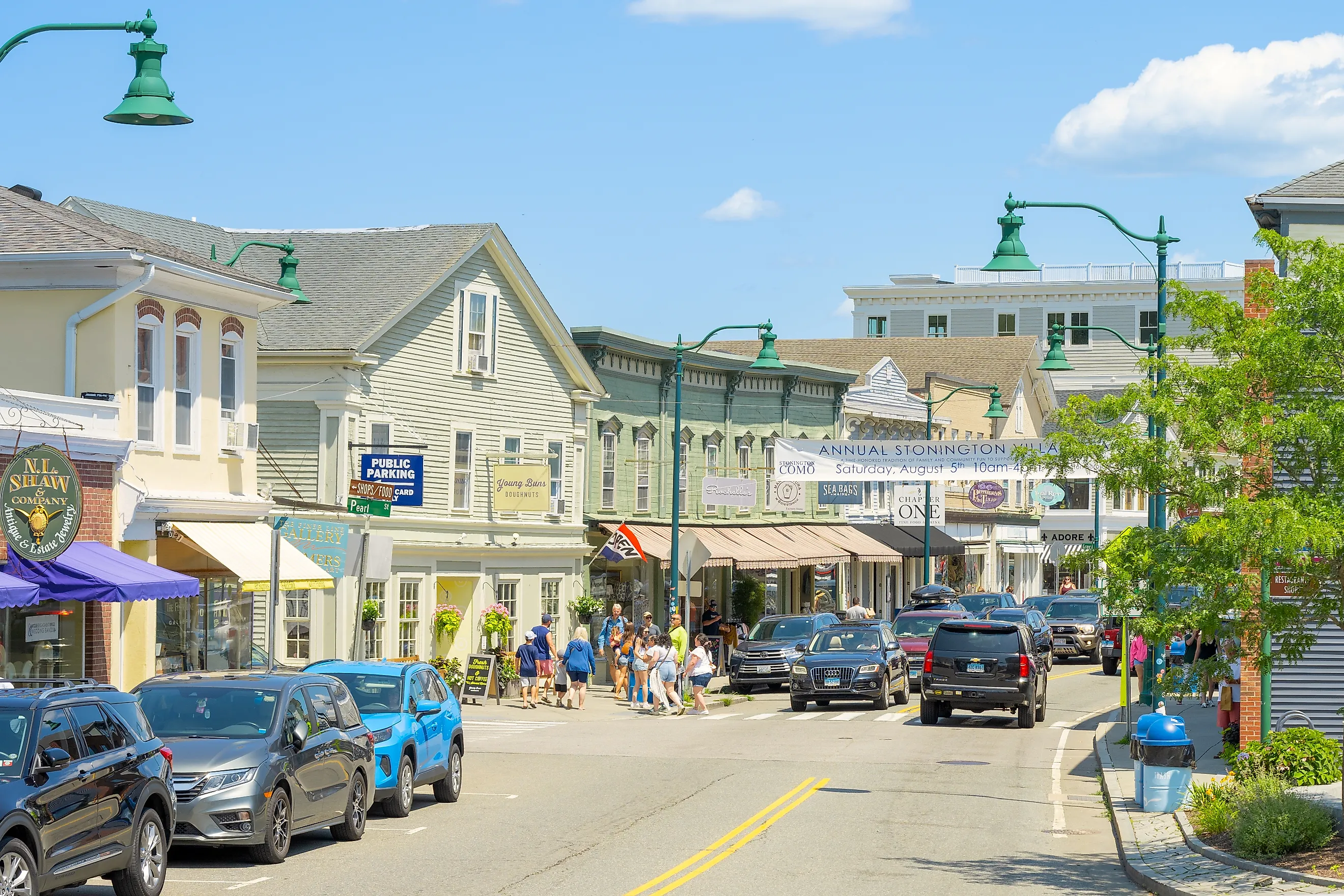
Main Street in Mystic crosses the river on a bascule bridge that goes up on the hour through the summer, stopping traffic and pedestrians alike while a boat passes underneath. Built between 1920 and 1922 with an 85-foot span and two enormous concrete counterweights, it is on the National Register and it is the reason half the photographs of this town look the way they do.
Mystic built ships through the 19th century rather than the 17th, and built them well: the yards here turned out clippers and, during the Civil War, more than fifty vessels for the Union. That money shaped East and West Main Streets, which now run to restaurants, bookshops, and the odd seafood counter. St. Mark's Episcopal Church dates to 1867, and the Whaler's Inn occupies a cluster of buildings by the bridge including the 1865 Hoxie House. Mystic River Park, a block south, puts on free concerts through the summer.
Ridgefield

There is a British cannonball lodged in the corner post of the Keeler Tavern, and it has been there since April 1777. The Battle of Ridgefield was fought through these streets when Benedict Arnold, still fighting for the American side at that point, had his horse shot out from under him a few hundred yards away. The tavern, built in 1713, is now the Keeler Tavern Museum and History Center, and the cannonball is exactly where the gunners left it.
Main Street runs nearly two miles through a town founded in 1708, midway between Hartford and New York City. The Aldrich Contemporary Art Museum sits on it, occupying the 1783 building known as Old Hundred, with a sculpture garden out back that is worth the visit on its own. For an overnight, the West Lane Inn is an 1849 mansion just off Main Street.
Washington

Washington was incorporated in January 1779 and is generally reckoned the first town in the United States named for George Washington, who was at the time still a serving general with the war far from won. The Congregational Church of 1801 stands on the green, and the Gunn Historical Museum occupies an 1813 house with a self-guided walking tour that takes in most of what else is worth seeing.
The Mayflower Inn and Spa spreads across 58 acres just outside the centre, with cottages, hiking trails, and the Garden Room restaurant. A stay there is also what gave Amy Sherman-Palladino the idea for Stars Hollow, which is why Gilmore Girls pilgrims keep turning up in a town of 3,500. Down the hill in Washington Depot, the G.W. Tavern works out of a restored 1850s building, the Hickory Stick Bookshop has been selling books since 1948, and the Washington Art Association and Gallery handles the exhibitions.
The Final Word
What these six share is that the main street is still the point rather than a bypassed relic. Essex and Mystic run on the water, and both make their money from it now the same way they did under sail. Guilford and Litchfield are the architecture towns, with the oldest stone house in New England at one and the first law school in America at the other. Ridgefield and Washington sit closest to New York and know it, which is why the art museum and the spa hotel are as good as they are. Any of them makes a full day, and none is more than about an hour and a half from the next.