2026's 11 Most Scenic Croatia Towns
Croatia's scenery does not begin and end with beaches. Medieval towns crown vineyard covered hills in Istria, waterfalls tumble between old watermills in the country's karst interior, and stone ports sit beneath limestone mountains along the Adriatic. Farther offshore, island towns climb from sheltered harbors toward viewpoints overlooking channels and chains of smaller islands. The 11 small towns on this list each offer a distinctly different way to experience the Croatian landscape. Whether at Motovun's hilltop walls or Korčula's fortified peninsula, the strongest views come from exploring the places where historic townscapes and the surrounding terrain meet.
Motovun

Motovun rises above the Mirna Valley like a stone lookout, with medieval walls encircling the hilltop and vineyards, forests, and farmland spreading across central Istria below. Begin inside the historic center, where narrow stone streets climb toward the main square and the Church of St. Stephen. From there, a walk along the town walls reveals why the elevated setting matters. The view extends across the Mirna Valley toward wooded hills and neighboring Istrian settlements, with the landscape changing noticeably according to the season.
The countryside below provides a different perspective on the same hill town. The former Parenzana railway once connected Trieste with towns across the Istrian interior, and its route has become a cycling and walking trail that passes through vineyards, forests, tunnels, and old railway infrastructure near Motovun. Back on the hill, sunset brings softer light across the valley, when the surrounding ridges recede into layers behind the town's stone ramparts.
Rovinj

Rovinj's old town occupies a compact peninsula where tightly packed houses rise from the waterfront toward the Church of St. Euphemia. Fishing boats and small islands fill the views from the harbor, but the town's most complete panorama comes from above. The church's approximately 200-foot bell tower dominates Rovinj's skyline, and visitors who climb it can look across terracotta roofs toward the Adriatic and the islands scattered offshore.
Descending through the Old Town reveals a more intimate landscape. Stone lanes squeeze between colorful façades before emerging unexpectedly at small terraces overlooking the water. At the base of the peninsula, the harbor provides the classic view back toward St. Euphemia rising above the clustered houses. South of the center, Golden Cape Forest Park changes the scenery completely. Walking and cycling paths cross a roughly 130-acre landscape of pines, cedars, rocky coves, and sheltered beaches, allowing visitors to exchange Rovinj's dense urban waterfront for a wooded Adriatic shoreline without traveling far from town.
Mali Lošinj

Color provides the first impression of Mali Lošinj. Pastel houses line a long natural harbor where fishing boats, excursion vessels, and sailboats sit beneath green hills, creating a waterfront that curves deep into the town rather than running along one straight shoreline. Following the harbor promenade reveals the scene from changing angles as church towers and rows of houses appear across the water.
For the broadest view, climb to the Providenca viewpoint on Umpiljak Hill. Walking paths weave through dry stone walls and native island vegetation before reaching panoramas over Mali Lošinj, neighboring islands, and the open Adriatic. Southwest of town, Čikat Forest Park provides another side of Lošinj's landscape. Aleppo pines planted and protected during the 19th century now shade trails around Čikat Bay, where rocky points separate small beaches and coves. The coastal promenade connecting these bays allows walkers to remain close to the water while moving between pine forest, villas, and views across the Kvarner Gulf.
Vrbnik

Vrbnik occupies one of the most dramatic positions on the island of Krk, with its old stone center crowded onto a limestone outcrop high above the Adriatic. Walking through the Old Town means passing beneath stone archways and through lanes that sometimes narrow to little more than a passage between houses before suddenly opening toward the sea. From the eastern edge of town, the view reaches across the Velebit Channel toward the mountains on the mainland, emphasizing just how sharply Vrbnik rises from the coast.
To appreciate the setting from below, descend toward Nuluk Beach, where the old town appears overhead atop its rocky promontory. Outside the center, the stone houses give way to the vineyards used to produce Žlahtina, the white wine closely associated with Vrbnik. Walking or cycling through these fields provides a quieter perspective, with rows of vines, dry stone walls, and distant hills replacing the tightly packed streets above the sea.
Slunj

Water shapes nearly every memorable view around Slunj. At Rastoke, the Slunjčica River divides into channels and cascades before joining the Korana, creating a landscape where historic wooden houses and watermills stand directly among waterfalls. Paths through the settlement pass cascades such as Buk, Hrvoje, and Vilina kosa, allowing visitors to see the water from bridges, riverbanks, and overlooks rather than from a single viewpoint.
The scenery continues beyond Rastoke along the Korana River, whose clear water runs beneath wooded slopes and limestone cliffs. Walking routes follow sections of the river and connect the town with quieter stretches of forest and natural swimming areas. Slunj itself sits above the rivers, so paths between the center and Rastoke repeatedly reveal the settlement from different elevations. Unlike Croatia's coastal towns, Slunj's strongest scenery comes from the constant interaction of karst rock, vegetation, moving water, and buildings constructed around the rivers rather than apart from them.
Primošten

Primošten's historic center occupies a small peninsula projecting into the Adriatic, creating a compact skyline of stone houses surrounded by water on nearly every side. Climb through the Old Town toward the Church of St. George, which stands at the peninsula's highest point. The churchyard looks across red roofs toward the mainland on one side and open sea on the other, while paths around the edge of the old center keep the water almost constantly in view.
Across the bay, Mala Raduča Beach offers the reverse perspective, with the entire peninsula rising beyond clear water. The landscape becomes markedly different outside town at the Bucavac vineyards. Generations of growers cleared the rocky ground and divided tiny vineyard plots with dense networks of dry stone walls, creating a geometric pattern beside the Adriatic. Seen from above, the vines and pale stone form one of Primošten's most distinctive landscapes and provide a striking contrast with the compact peninsula nearby.
Trogir

Trogir compresses centuries of architecture onto a small island separated from the mainland and Čiovo by narrow channels. Entering the UNESCO listed center reveals stone lanes, courtyards, and small squares before reaching the Cathedral of St. Lawrence. Its bell tower rises above the surrounding roofs and provides an elevated view across the old town toward the sea and neighboring islands.
Along Trogir's southern edge, the Riva replaces narrow medieval streets with palms, boats, and an open waterfront. Following the promenade west leads to Kamerlengo Fortress, whose towers and walls occupy the corner of the historic island. From its upper levels, the view encompasses Trogir's rooftops, marina, waterfront, and the channel separating the town from Čiovo. The contrast is what makes Trogir particularly scenic. Within a short walk, visitors move from enclosed stone passages to cathedral views and then to an Adriatic promenade where medieval fortifications stand immediately beside the water.
Omiš

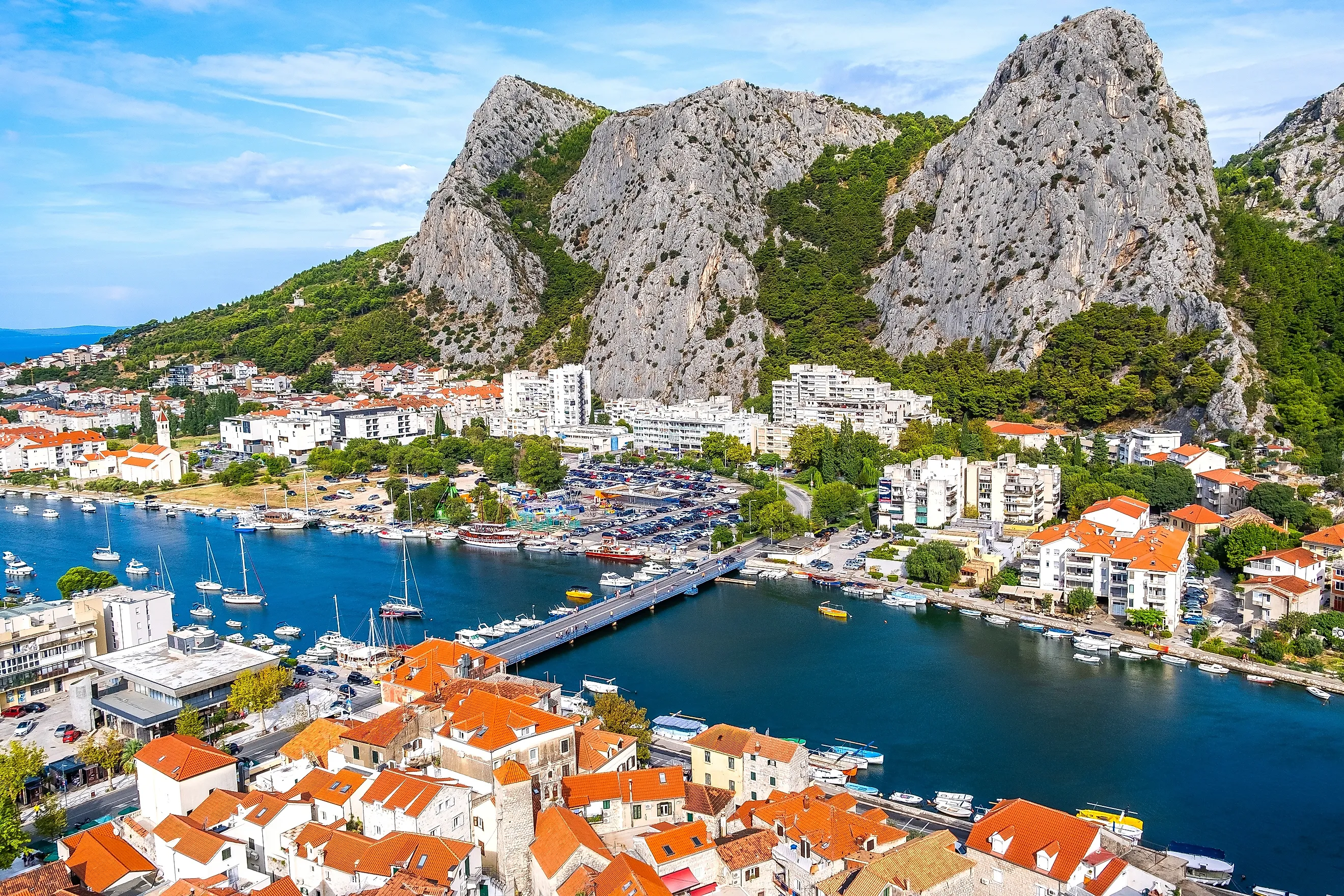
Omiš occupies a setting unlike almost any other town on the Croatian coast. The Cetina River emerges from a limestone canyon immediately behind the old center before flowing into the Adriatic, leaving the town wedged between water and steep mountains. The easiest elevated view comes from Mirabela Fortress, a 13th-century stronghold reached by climbing through the old town. From its walls, visitors can look across Omiš's stone roofs toward the river mouth, sea, and island of Brač.
Higher still, Fortica Fortress stands on the slopes above town and rewards the steeper climb with a panorama encompassing the Cetina canyon, coastline, and surrounding mountains. The landscape can also be experienced from water level. Boat excursions enter the protected Cetina Canyon, following the river beneath sheer rock faces and forested slopes. Rafting and kayaking provide more active alternatives, but even a quiet river trip demonstrates what makes Omiš distinctive. Mountain, river, medieval town, and Adriatic coast meet within an unusually compact landscape.
Makarska

Makarska occupies a narrow strip of coast between the Adriatic and the towering Biokovo massif, whose pale limestone slopes rise almost immediately behind the town. The St. Peter Peninsula provides an easy introduction to that contrast. Shaded paths circle the wooded headland beside the harbor, opening toward the islands of Brač and Hvar in one direction and back toward Makarska and Biokovo in the other.
Across the harbor, the forested Osejava Peninsula offers longer walking routes and elevated views along the rocky coastline. The most dramatic perspective, however, comes from Biokovo Nature Park above town. Its mountain road climbs through changing vegetation toward high overlooks, including the Biokovo Skywalk at Ravna Vlaška. The horseshoe shaped glass platform projects beyond the mountainside at roughly 4,000 feet above sea level, placing the Makarska Riviera far below. Back at sea level, the waterfront promenade supplies the complementary view, fishing boats and palms in the foreground with Biokovo forming a massive stone backdrop behind the town.
Hvar

Hvar spreads around a natural harbor on the island's southwestern coast, with pale stone buildings climbing from the waterfront toward green hills. The best introduction to the setting comes from Fortica, the fortress above the old town. The climb passes through narrow streets and gardens before reaching ramparts with an unobstructed panorama across Hvar's roofs, harbor, and the scattered Pakleni Islands offshore.
Back below, the long Pjaca, or St. Stephen's Square, opens toward the harbor beside the cathedral and historic Arsenal. From the waterfront, visitors can follow the coast past small coves while repeatedly looking back toward Fortica above the town. The Pakleni Islands that dominate the fortress panorama can then be experienced from the water. Boats make the short crossing to an archipelago of wooded islands, rocky inlets, and sheltered bays directly opposite Hvar. Seeing the town first from its fortress and later from offshore turns the harbor itself into part of the experience rather than simply a backdrop.
Korčula

Korčula's old town projects into the Pelješac Channel on a narrow fortified peninsula, with stone walls and towers surrounded by water on three sides. Enter through the Land Gate and climb toward St. Mark's Cathedral, whose bell tower rises above a network of narrow streets arranged in the town's distinctive fishbone pattern. From the tower, the view reaches across terracotta roofs toward the channel, Pelješac Peninsula, and surrounding islands.
Walking around the Old Town waterfront reveals the peninsula from another angle, with restaurant terraces and stone façades facing directly toward the sea. Just outside the historic center, the staircase to St. Anthony's Hill offers a quieter viewpoint. A long avenue of cypress trees leads to 101 stone steps climbing toward the hilltop chapel, from which the landscape opens across Korčula and the channel. The combination of fortified architecture, geometric streets, mountains across the water, and an island studded horizon makes Korčula a fitting final stop on Croatia's scenic progression.
Croatia's Small Towns, Hilltops And Adriatic Shores
Croatia's most scenic small towns reveal considerably more than the coastline for which the country is famous. Motovun overlooks vineyards and the Mirna Valley, while Slunj replaces the Adriatic with waterfalls, rivers, and historic watermills. On the coast and islands, Rovinj, Vrbnik, Primošten, Trogir, Hvar, and Korčula show how dramatically old stone settlements change according to their setting. Farther south, Omiš and Makarska place medieval streets and waterfronts beneath some of Croatia's most imposing limestone mountains. Across all 11 towns, the most memorable scenery emerges where the built and natural landscapes meet, with stone walls above vineyards, houses beside waterfalls, fortresses over harbors, and mountain ridges rising directly behind the sea.