2026's 11 Best Small Towns To Visit In Italy
Italy's best small towns play to their strengths, showcasing their rich histories and natural wonders. In Malcesine, the Scaliger Castle stands directly over the waters of Lake Garda. Ortisei's workshops display the carved figures for which Val Gardena remains known. High above Positano, the hamlet of Nocelle opens onto the Path of the Gods. In Cefalù, a trail climbs La Rocca past ancient fortifications to views over the town's rooftops. These 11 small towns are Italy's top destinations for 2026.
Molveno

Few Italian towns bring lake and mountain scenery together as neatly as Molveno. The village occupies the northeastern shore of Lake Molveno, with the jagged Brenta Dolomites rising immediately beyond the water. Paths follow the lakeshore past beaches and open viewpoints, making the water an easy starting point before heading into higher terrain.
That transition begins right in town. The Pradel cable car climbs to about 1,350 meters, reaching a natural terrace within Adamello Brenta Natural Park and trailheads overlooking the lake. Below, the small Church of San Vigilio offers a quieter stop with medieval frescoes and Romanesque-Gothic architecture. A day can therefore progress naturally from the lakeshore into the mountains before ending among the compact streets of the village.
Ortisei

The Dolomites dominate the horizon around Ortisei, but Val Gardena's culture gives the town an identity independent of the peaks. Its pedestrian center reflects the valley's Ladin heritage, particularly its centuries-old woodcarving tradition. Museum Gherdëina explores the area's archaeology, geology, art, and local culture, providing context for both the community and the landscape surrounding it.
From town, lifts open two very different mountain environments. Seceda offers trails through high meadows beneath the sharply angled Odle peaks, while another lift system provides access toward Alpe di Siusi and its broad Alpine plateau. Returning to Ortisei means stepping back among cafés, shops, and workshops displaying the carved figures for which Val Gardena remains known. The mountains may bring travelers here, but the Ladin town beneath them gives them reason to stay.
Bormio

Naturally warm mineral water has drawn people to Bormio for a long time before skiing and cycling made the upper Valtellina an outdoor destination. That thermal tradition still provides the ideal counterpoint to the mountains surrounding the town, where active days can end in warm pools rather than simply back at a hotel.
Bormio 2000 provides lift access into the slopes above town, while excursions toward the Stelvio Pass reveal a harsher high-Alpine landscape during the appropriate season. Bormio itself deserves time as well. Piazza Cavour and the surrounding historic center contain churches, stone buildings, and narrow streets that long predate the modern resort. After exploring them, local thermal facilities draw on naturally heated mountain water, continuing a practice that has shaped Bormio's identity for centuries.
Malcesine

A stone castle rising above Lake Garda gives Malcesine its unmistakable silhouette. The Scaliger Castle stands directly over the water, with its tower providing broad views across the lake toward the mountains of Lombardy. Below, cobbled lanes descend through the old center toward the harbor, passing cafés, restaurants, and small shops along the way. The town's most dramatic excursion heads in the opposite direction. The Monte Baldo cable car climbs from Malcesine to roughly 1,760 meters, where trails and viewpoints replace the Mediterranean-like vegetation found beside Garda with an Alpine environment. Returning to lake level leaves time for a waterfront walk or the old port.
Orta San Giulio

Piazza Motta opens directly onto Lake Orta, with tiny Isola San Giulio sitting offshore almost as though it were another piece of the town. Cafés occupy the arcaded buildings around the square, while boats make the short crossing to the island and its Basilica di San Giulio. The landscape becomes quieter above town. A path climbs through woodland to Sacro Monte di Orta, part of a UNESCO World Heritage property whose chapels depict episodes from the life of St. Francis of Assisi. Openings between the trees look back toward the lake and island below. Orta's appeal comes from its small scale that still manages to include a piazza, boat landing, island, and wooded sanctuary.
Sperlonga

Whitewashed houses and narrow stairways give Sperlonga the appearance of a medieval hill town until those passages suddenly open toward the Tyrrhenian Sea. The old center occupies a rocky rise above long sandy beaches, making it easy to alternate time among the lanes with an afternoon beside the water. Another chapter of the town's history awaits along the coast. The archaeological complex associated with Emperor Tiberius preserves the remains of an imperial seaside villa, while the adjacent National Archaeological Museum displays monumental sculptures recovered from the site, including scenes inspired by Odysseus's adventures. The villa's famous natural grotto is temporarily closed for extraordinary maintenance, but the archaeological area and museum remain the principal historical attractions.
Positano

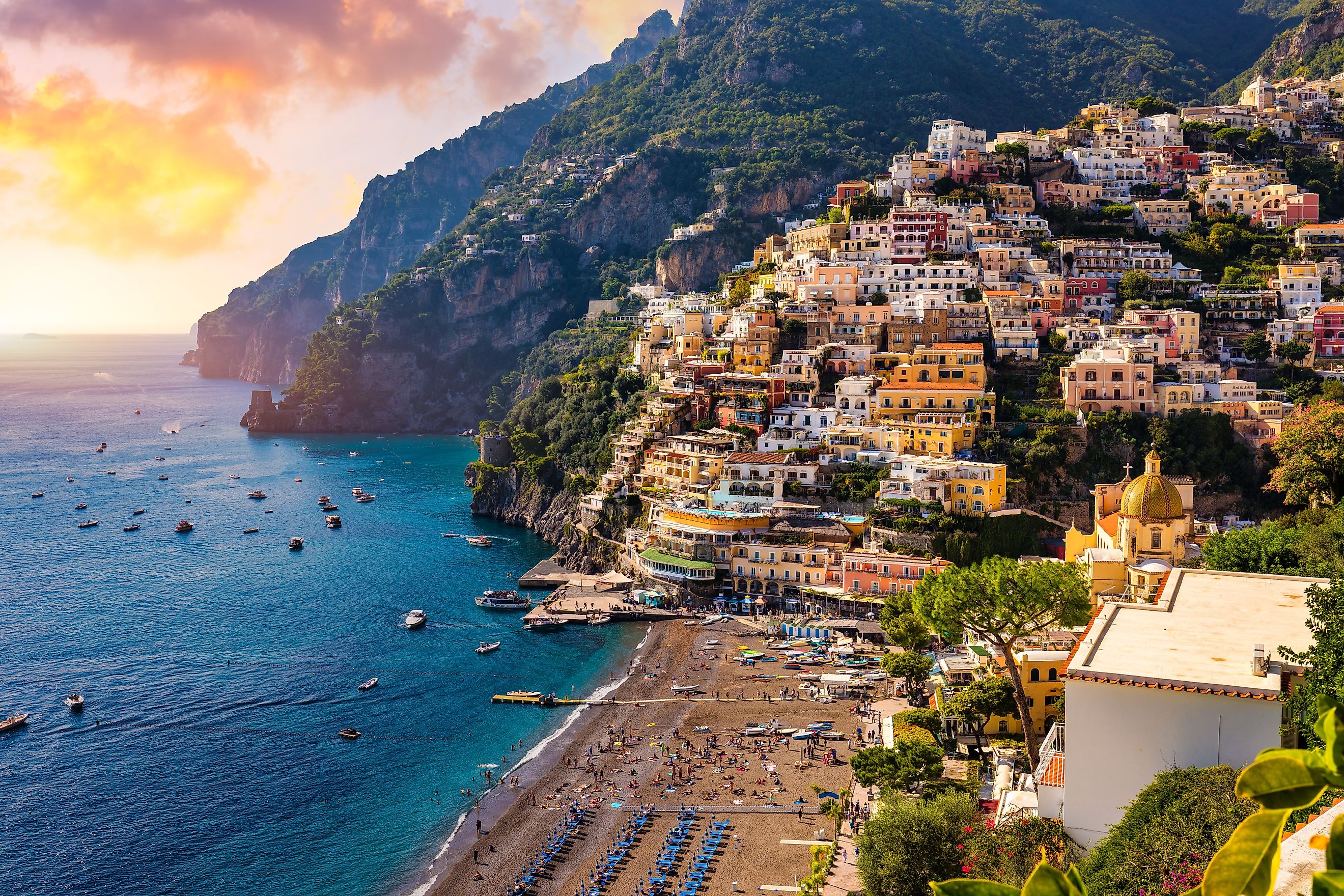
The best way to understand Positano is to change elevation. Marina Grande sits at the bottom of the town beneath tiers of houses climbing the Monti Lattari, while nearby Fornillo Beach offers a somewhat quieter stretch of shoreline. From the water, boat trips reveal just how abruptly the mountains rise behind the buildings. Higher up, Positano becomes a different destination. Nocelle, one of its elevated hamlets, provides access to the Path of the Gods, where the crowded waterfront gives way to mountain vegetation, cliffs, and long views across the Amalfi Coast. Between the two elevations, central Positano supplies restaurants, boutiques, and terraces tucked into steep lanes.
Maratea

A 22-meter statue of Christ the Redeemer looks across the Gulf of Policastro from Monte San Biagio, hundreds of meters above Maratea's Tyrrhenian shoreline. The summit immediately establishes what makes this corner of Basilicata unusual: mountains and sea meet with little space between them. Near the statue, the Basilica of San Biagio preserves Maratea's longstanding devotion to its patron saint. Lower down, the historic center trades summit panoramas for narrow lanes and small piazzas before the landscape drops again toward the coast. Beaches, rocky coves, and sea caves provide the final change of setting, with boat outings revealing stretches difficult to appreciate from land.
Polignano a Mare

Lama Monachile reveals the geography of Polignano a Mare at a glance. A narrow ravine reaches the Adriatic between high limestone walls, leaving a small pebble beach beneath the bridge and the buildings of the historic center. From above, old lanes repeatedly terminate at terraces overlooking open water. The same limestone continues beneath the surface. Boat trips follow the coast into sea caves carved into the cliffs, offering a view of Polignano that cannot be seen from its overlooks. Back on land, the Pino Pascali Foundation shifts its focus from geology to contemporary art through work associated with the influential locally born artist, as well as other modern exhibitions.
Cefalù

The Norman Cathedral has dominated Cefalù since Roger II commissioned it in 1131. Its twin towers rise above the old town, while Byzantine mosaics inside help explain its inclusion within the UNESCO-listed Arab-Norman heritage of Palermo, Cefalù, and Monreale. From the cathedral piazza, medieval streets lead toward Porta Pescara and the old waterfront. Yet Cefalù's most commanding landmark is natural. La Rocca rises nearly 270 meters above the town, and its trail passes ancient fortifications and the remains known as the Temple of Diana before reaching viewpoints over the roofs and Tyrrhenian coastline. After the descent, Cefalù's long beach offers a considerably easier way to spend the afternoon.
Castelsardo

Castelsardo was built to command its surroundings. The medieval town rises across a rocky headland above the Gulf of Asinara, its tightly packed houses and lanes climbing toward the fortress established by the Doria family. Walking uphill remains the best way to experience the old center, with glimpses of the Sardinian coast appearing between stone buildings. At the summit, Doria Castle houses the Museum of Mediterranean Weaving, connecting the fortress with the basketry and woven crafts long practiced in this part of Sardinia. Craft traditions remain visible beyond the museum, while the Cathedral of Sant'Antonio Abate occupies another dramatic perch above the sea.
Italy's Small Towns, Shaped By Their Landscapes
Italy's best small towns give you more than a backdrop, since the land around each one shaped how it grew. Thermal springs built Bormio's reputation, Castelsardo's headland decided where its fortress and lanes would rise, and the Monti Lattari stacked Positano's houses in tiers above Marina Grande. For anyone planning a trip to Italy in 2026, these 11 towns put lakes, mountains, and coastline within a short walk, lift ride, or boat trip of the old town.