The Steepest Paved Road In America
Canton Avenue in Pittsburgh rises at 37% for about 21 feet. That means it climbs roughly four feet for every eleven you travel forward, which is steep enough that the sidewalk alongside it is a staircase and the city posted "Do Not Enter" signs at both ends.
It is the standard answer to the question in the title, it appears on every list, and it is almost certainly not the steepest piece of road surface in the United States. The reasons why are more interesting than the number.
Twenty-One Feet Of Belgian Block

Canton Avenue sits in Beechview, a couple of miles south of downtown Pittsburgh. The whole street runs 630 feet. The hill portion is about 213 feet of that, and the famous 37% section is a mere 21 feet inside it.
So the steepest road in America, by the usual reckoning, is shorter than a bus. That is not a knock on it. Grade is measured as a ratio rather than a distance, and 37% is brutal regardless of how long it lasts.

For comparison, interstate highways in mountainous country rarely exceed 6%. Modern Los Angeles street code caps local roads at 15%. Canton Avenue is more than double the legal maximum for a street built today, which is only possible because it predates the rule.
It Is Cobblestone, And That Is Deliberate

Canton Avenue is not asphalt. It is Belgian block, the squared granite setts people loosely call cobblestones, and the choice was practical rather than decorative.
At this angle a smooth surface is a problem. Asphalt gets slick in rain and glazes over in ice, and a vehicle that loses traction on a 37% slope is not going to recover it. Stone block gives tyres something to bite into, and the joints between the blocks channel water off rather than letting it sheet down the surface.
That matters in a city that gets real winters. Pittsburgh's Department of Public Works runs a dedicated snow and ice control programme, and streets like this are exactly why.
Where The 37% Actually Came From

The number has a specific and surprisingly old provenance. A Pittsburgh Press article from 11 January 1987 cited figures compiled by the Surveys Division and the Snow and Ice Control Program of the city's Department of Public Works, and that measurement is the source of essentially every claim made since.
It has never been independently re-surveyed to modern standards. When people check it with consumer tools they get different answers, and Google Earth reads the slope closer to 30%, which would still be extraordinary but would cost Canton Avenue the title.
This is the part most coverage skips. A figure repeated for nearly four decades rests on one municipal survey from the Reagan administration, and nobody has gone back with a laser level to settle it.
San Francisco Has A Claim

The most serious challenge came from a data analyst named Stephen Von Worley, who ran elevation data across San Francisco's street grid rather than relying on reputation.
He found Romolo Place, between Vallejo and Fresno, at 37.5%, which would edge out Canton Avenue outright. Prentiss Street between Chapman and Powhattan came in at 37%, a dead tie. An unofficial survey has also put a 30-foot stretch of Bradford Street at 40%, resurfaced in 2010.

Lombard Street, the one everybody photographs, is not in this conversation at all. Its switchbacks exist precisely because the original 27% grade was too steep to drive straight down, so the curves were added to reduce it. The famous street is famous for being made less steep.
The Real Answer Is Probably In Hawaii

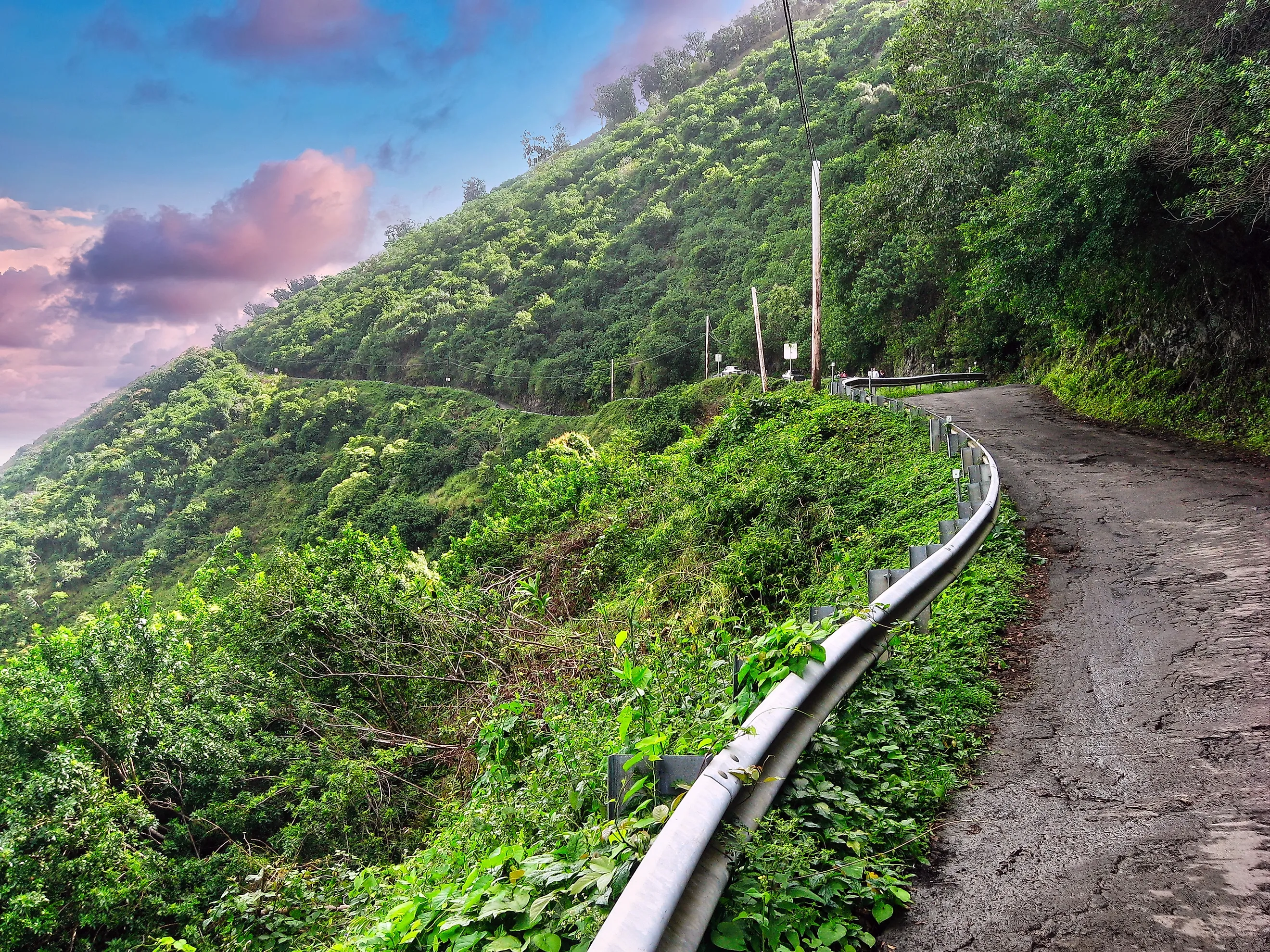
Waipio Valley Road drops off the Hamakua coast into Waipio Valley on the Big Island, and it makes Canton Avenue look like a ramp. On the Big Island of Hawaii it averages about 25% over roughly three quarters of a mile, with sections reported between 40% and 45%.
The difference is sustained effort. Canton Avenue is 21 feet of pain. Waipio is a continuous descent of around 800 feet in under a mile, which is why it has long been described as the steepest road of its length anywhere in the country.

Lance Armstrong's assessment of it is the one that gets quoted: you know a road is steep when the people walking down it are walking backwards.
The reason it rarely wins the title is classification. Most rankings count public streets, and Waipio is a rural access road with a four-wheel-drive requirement, so it gets filed separately or left out.
And You Cannot Drive It Anyway

Waipio Valley Road closed to non-resident traffic in February 2022 over rockfall risk and deteriorating road conditions, and access has remained restricted to county residents and permitted operators since.

What remains open is the lookout at the top, reached by Highway 240, where you can stand at the lip and see the road falling away beneath you. Given the gradient, that is arguably the better view anyway.
Los Angeles Keeps Showing Up

San Francisco gets the reputation, but Los Angeles quietly holds several of the steepest streets in the country, built into hillsides before anyone wrote rules about it.
Eldred Street in Highland Park runs 33% and holds roughly 33.3% for about 400 feet above Avenue 48, climbing 219 feet in total. That makes it the longest sustained extreme climb in the city, and it is steep enough that the postal service has historically declined to deliver up it.
Baxter Street and Fargo Street both hit 32%, and 28th Street in San Pedro reaches 33.3%. Baxter in particular has a habit of stranding fire trucks and delivery vehicles that crest the hill and find they cannot see the road ahead.
Nobody Can Settle This
The honest summary is that "steepest" depends on four decisions nobody has agreed on. How long does the steep section need to be? Does a 21-foot pitch count against a half-mile descent? Does a rural access road count as a road? And whose measurement are you using, a 1987 municipal survey, satellite elevation data, or somebody with a clinometer?
Change any one of those and the winner changes with it. Canton Avenue wins on the traditional reading: a public street, officially recorded, open to traffic. Waipio wins on sustained severity. Romolo Place wins if you trust the elevation modelling.
Canton Avenue is still worth seeing, and the thing photographs never convey is how ordinary it looks until you are standing at the bottom of it. A short cobbled street between two rows of houses in a quiet Pennsylvania neighbourhood, with a staircase where the pavement should be, going almost straight up.