14 Great Places To Live In Pennsylvania
Phoenixville burns a 20-foot wooden phoenix every December to mark clawing its way back from a dead steel economy. That kind of specific, hard-won identity runs through all fourteen places here. Each one hangs off one of Pennsylvania's two big metro job markets, Philadelphia or Pittsburgh, or the university and tourism economies strung along the state's mountain spine, while holding onto a downtown worth walking. Some are college towns. Some are commuter suburbs with real Main Streets. A few run almost entirely on one thing: chocolate, mushrooms, or Saturday football. These are fourteen spots across Pennsylvania that actually work as places to live in 2026.
West Chester

West Chester is the Chester County seat and the unofficial capital of the Brandywine Valley, less than an hour west of Philadelphia and run, in large part, by college students. West Chester University is the largest school in the Pennsylvania State System of Higher Education, and its roughly 17,000 students keep the downtown loud well past dark. That downtown packs more than 100 independent businesses onto Gay, Market, and High Streets, with the Uptown Knauer Performing Arts Center and the Chester County Art Association handling the culture. For green space, Natural Lands' Stroud Preserve spreads 571 acres of trail, pasture, and woodland along the East Branch of the Brandywine. The catch is the price: recent listings have run roughly $625,000 to $735,000, steep nationally but ordinary for this corner of the state.
Phoenixville

Phoenixville earned its comeback name. When Phoenix Iron and Steel Works shut down in 1987, it took the local economy with it, and the borough rebuilt from scratch around small businesses and breweries. The most on-the-nose proof is the Firebird Festival every December, when a 20-foot wooden phoenix goes up in flames as a literal rebirth ceremony in front of thousands. The Colonial Theatre on Bridge Street, restored to its 1903 look, is the actual movie house where audiences fled the ooze in the 1958 cult film The Blob, and it still runs films and live shows year-round. Saturday mornings bring a producer-only farmers' market to Bridge and Main. Recent home prices have landed around $475,000 to $490,000.
Kennett Square

Kennett Square grows the food on your plate more literally than almost anywhere in America. This Chester County borough of about 6,000 is the self-declared "Mushroom Capital of the World," and the title holds up: farms in the surrounding countryside produce roughly half of the nation's mushrooms, and the town rings in the New Year by dropping a 700-pound mushroom. Just outside the borough sits Longwood Gardens, the former estate of industrialist Pierre S. du Pont and one of the premier botanical gardens anywhere, with more than 1,000 acres of fountains, conservatories, and meadows. The walkable State Street core fills up every September for the Mushroom Festival, which pulls in tens of thousands. Set in the Brandywine Valley within easy reach of both Wilmington and Philadelphia, recent home prices have tracked around $450,000 to $500,000.
Ardmore

Ardmore is the downtown of the Main Line, the old commuter-rail spine threading Philadelphia's wealthiest western suburbs. Suburban Square opened here in 1928 as one of the country's earliest planned suburban shopping centers, and the first to anchor itself with a full department store; it still runs more than 50 shops, restaurants, and the Ardmore Farmers Market. The Ardmore Music Hall, set in a former 1920s movie theater, books national touring acts most nights of the week. Golf history is around the corner, too: Merion Golf Club, founded in 1896, has hosted the U.S. Open five times. Best of all for commuters, SEPTA and Amtrak's Keystone trains put Center City 25 minutes away, and recent home prices have run a relatively sane $450,000 to $510,000.
Easton

Easton owns a genuine founding-era footnote: on July 8, 1776, it was one of just three places, along with Philadelphia and Trenton, where the Declaration of Independence got its first public reading. The town reenacts that courthouse-step moment at Centre Square every July on Heritage Day. It sits where the Delaware and Lehigh Rivers meet, as the Northampton County seat, with Lafayette College, founded in 1826 and named for the Marquis de Lafayette, holding College Hill above downtown with about 2,700 students. Families come for the Crayola Experience; everyone else fills the 1926 Art Deco State Theatre for touring Broadway and orchestra dates. At around $260,000, homes here undercut most of southeastern Pennsylvania.
Emmaus

Emmaus, five miles south of Allentown, is one of the older Moravian settlements in eastern Pennsylvania, founded in 1759. It wears its iron-mining, railroad, and silk-mill past openly, anchored by the Shelter House, a 1734 log cabin that ranks among the oldest log structures in the Lehigh Valley. The Wildlands Conservancy keeps hiking and birding trails at the adjacent South Mountain Preserve, and Yergey Brewing on Chestnut Street pours for the small-batch crowd. Recent home prices have settled around $400,000 to $420,000.
York

York spent nine months running the country. While the British held Philadelphia in 1777 and 1778, the Continental Congress met in York and adopted the Articles of Confederation here, the young nation's first framework of government, along with the first National Day of Thanksgiving. That history still anchors a compact, affordable city in the south-central part of the state. Central Market, in operation since the 1880s, keeps the downtown fed, and the Appell Center for the Performing Arts handles the marquee shows. The local economy has a heavier industrial base than most of this list, with Harley-Davidson assembling motorcycles at a major plant just outside town and a cluster of snack-food makers nearby. Best of all for buyers, recent home prices have run around $175,000 to $250,000, among the most affordable on this list.
Indiana

Indiana is the rare western Pennsylvania pick that does not orbit a steel mill. About an hour northeast of Pittsburgh, the town runs on Indiana University of Pennsylvania, a public university of roughly 9,000 students whose campus and payroll steady the local economy. It is also the hometown of actor Jimmy Stewart, celebrated downtown at the Jimmy Stewart Museum, and the seat of a county that has long billed itself the Christmas Tree Capital of the World. The compact downtown carries the usual college-town mix of galleries, cafes, and bars, while the surrounding county opens onto the ridges and state forests of the Allegheny foothills. Recent home prices have tracked around $140,000 to $190,000, the cheapest entry point on this list.
Jenkintown

Jenkintown proves you do not need much land to build a real town. The borough covers just 0.6 square miles eleven miles north of Philadelphia, and that tightness is the point: the Old York Road core is dense and entirely walkable. Independent spots like This Little Gallery, the Bagel Spot, and the longstanding Drake Tavern line the street, with Hallowell Park supplying a small, well-used patch of green. Two SEPTA lines, the Lansdale/Doylestown and the Warminster, stop at Jenkintown station and drop riders in Center City in about 30 minutes. Recent home prices have tracked around $360,000 to $380,000.
Hershey

Hershey is a town built, literally, on chocolate. Milton S. Hershey laid it out in 1903 as a planned company town around his factory, and it has leaned into the "Sweetest Place on Earth" ever since. Hershey's Chocolate World runs factory-style rides and make-your-own-bar classes, while Hersheypark, open since 1906, has grown into one of the Mid-Atlantic's biggest seasonal parks with more than 70 rides and 15 roller coasters. Hershey Gardens adds 23 acres of roses and a butterfly house, and the Penn State Milton S. Hershey Medical Center, funded into existence by the Hershey Trust in 1963, is now one of central Pennsylvania's largest hospitals. Recent home prices have run around $400,000 to $450,000.
Jim Thorpe

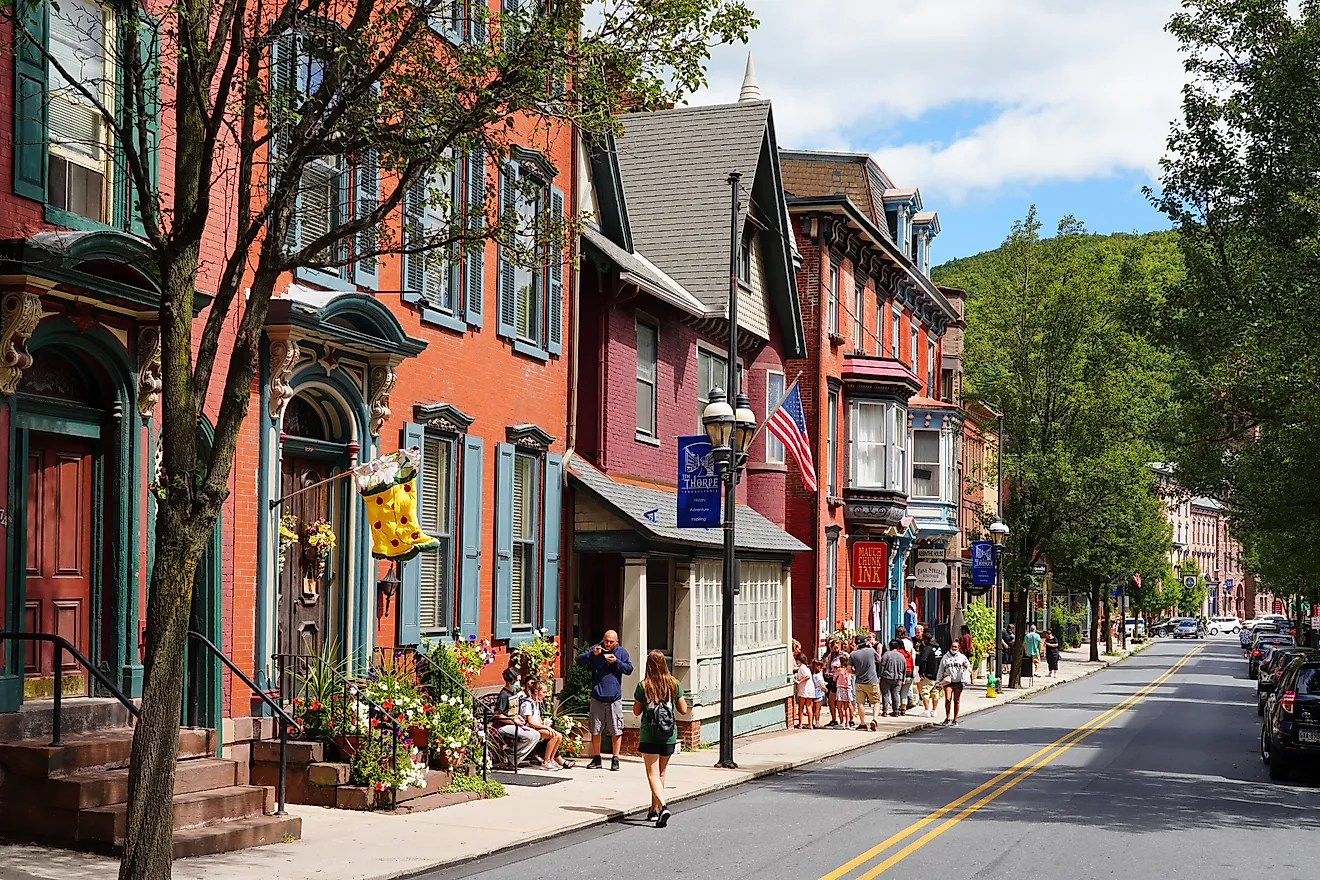
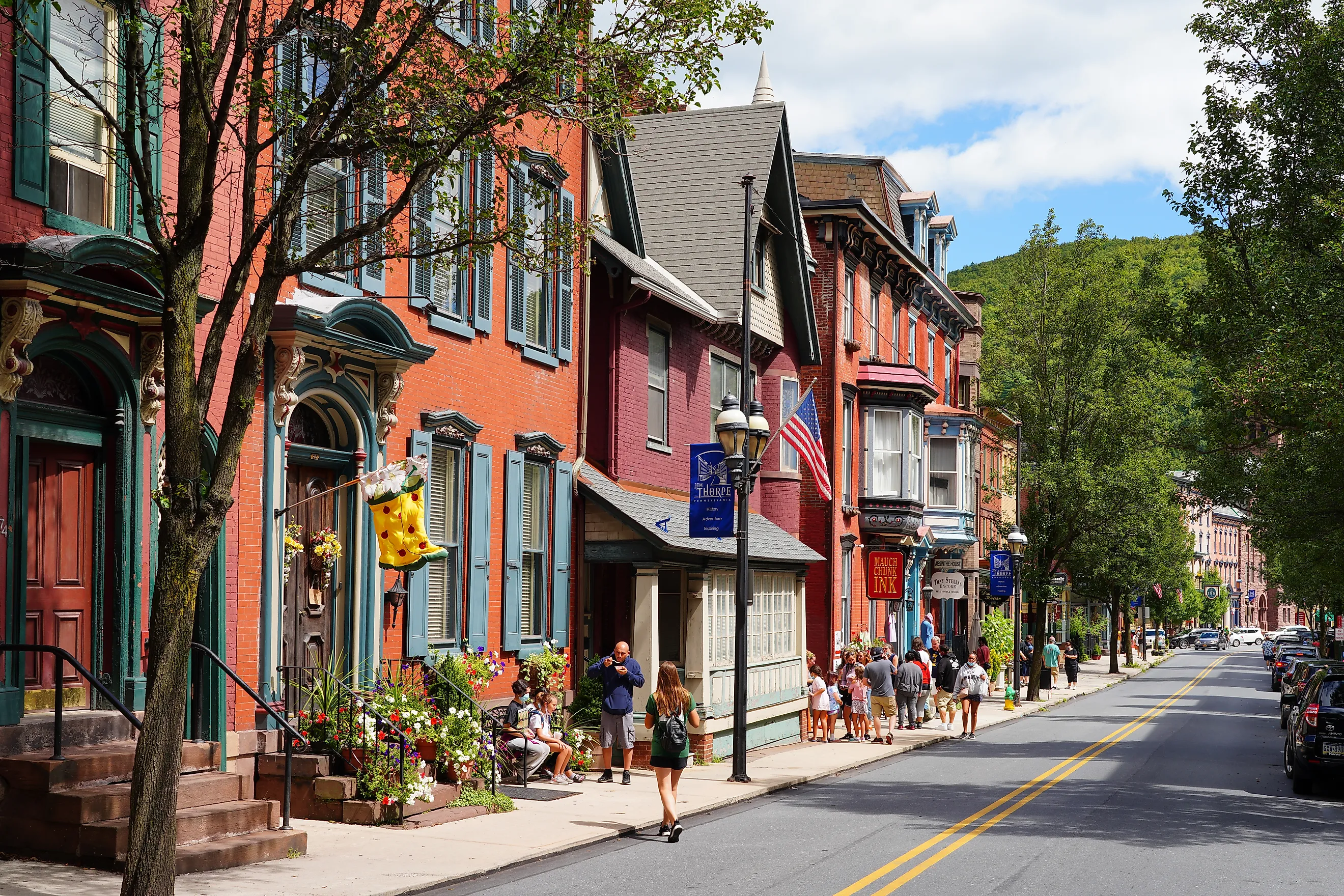
Jim Thorpe may have the strangest origin story on this list. The Carbon County town was two struggling coal boroughs, Mauch Chunk and East Mauch Chunk, until a 1954 deal brought in the remains and the name of Native American Olympic gold medalist Jim Thorpe, who never set foot here. His sons later sued to move the remains to Sac and Fox tribal land in Oklahoma, and a 2013 ruling sided with them, but a federal appeals court reversed it in 2014, so Thorpe still rests in the mausoleum here. The payoff for residents is one of the best-preserved Victorian downtowns in the state, with anthracite-boom architecture restored along Race and Broadway. The Lehigh Gorge Scenic Railway runs excursion trains into the gorge, the 1881 Mauch Chunk Opera House books live music, and the Mauch Chunk Museum tells the story of the gravity-powered Switchback Railroad, an early ancestor of the roller coaster. Recent home prices have tracked around $310,000.
New Hope

New Hope has been an arts colony longer than most American towns have had art scenes. It sits on the Delaware in Bucks County across the bridge from Lambertville, New Jersey, with a creative streak that runs back generations. The Bucks County Playhouse, founded in 1939 inside a converted 1790 grist mill, still runs a full professional season. The Parry Mansion Museum, built in 1784 by Quaker industrialist Benjamin Parry, preserves five generations of period rooms, and Bowman's Hill Wildflower Preserve protects 134 acres of native plants and trails. The vintage New Hope and Ivyland Railroad steams out of Bridge Street for excursions. All that desirability has a number attached: recent home prices have run $900,000 to $975,000, among the highest in the state outside the Main Line.
State College

State College makes its case on stability as much as spectacle. Penn State is the economy, and a university that size keeps the local unemployment rate consistently below the state's and the downtown busy year-round, recession or not. Roughly 47,000 students fill College and Beaver Avenues with restaurants, bars, and independent shops, and the Penn State Berkey Creamery, the largest university creamery in the country, scoops ice cream made on campus. Culture has caught up to the crowds: the Palmer Museum of Art reopened in a new building in 2024 beside the 395-acre Arboretum at Penn State, while Mount Nittany and the Rothrock State Forest put real hiking minutes from town and Mount Nittany Medical Center covers regional healthcare. The famous part still delivers, too, with Beaver Stadium, the second-largest college football stadium in the country, holding more than 106,000 fans on home Saturdays. Recent home prices have tracked around $400,000 to $420,000.
Conshohocken

Conshohocken pulled off the office-tower version of Phoenixville's reinvention. The Montgomery County borough of under 10,000 sits on the Schuylkill River about 13 miles northwest of Philadelphia, and since 2000 it has become one of the strongest commercial markets in the suburbs, with Class A office towers rising on the riverfront where 19th-century steel mills once stood. The Schuylkill River Trail cuts straight through on its paved run between Philadelphia and Pottstown, good for a riverside commute by bike, and Aubrey Collins and Colwell parks fill in the neighborhood green space. Direct rail and highway access seal the deal for Center City workers. Recent home prices have tracked around $525,000 to $540,000.
What These Fourteen Places Have in Common
The thread is not a single type of place but a single trade-off done well: a real job market within reach, and a downtown with a reason to walk it. West Chester, Ardmore, Phoenixville, Kennett Square, Jenkintown, and Conshohocken lean on Philadelphia; Indiana holds the western side near Pittsburgh; Easton and Emmaus run the Lehigh Valley; York and Hershey anchor the south-central belt; State College sits at the university-driven center; and Jim Thorpe and New Hope sell distinct tourism economies on the eastern end. Pick the metro, pick the price, and one of them fits.