13 Prettiest Downtown Strips In California
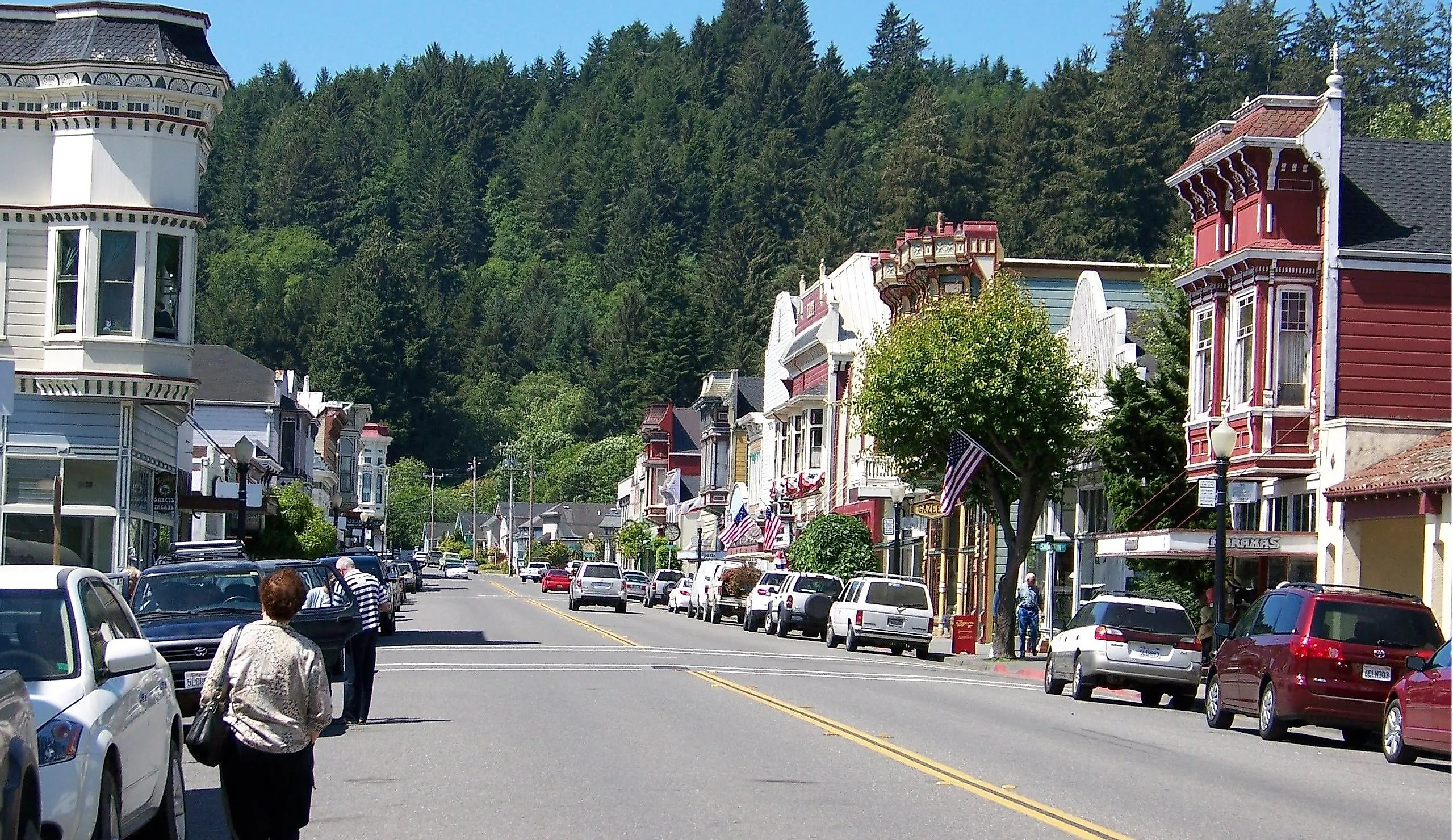
California's Gold Rush and railroad expansion built main streets that outlasted the industries that built them. Ferndale's five-block Victorian corridor in Humboldt County is so intact that the entire town sits on the National Register of Historic Places. Nevada City's wooden balconies and gas-lit storefronts have held their shape on wooded hillsides since the gold ran out. Each of these downtown strips was chosen for intact storefronts, walkable blocks, and scenery that frames the street-level view.
Ferndale

Ferndale sits in a wide pastoral valley in Humboldt County, surrounded by green meadows and the blue ribbon of the Eel River. Main Street is one of the most architecturally intact Victorian corridors in the American West, and the Main Street Historic District in Ferndale is listed on the National Register of Historic Places. The ornate storefronts, with their carved cornices and painted facades, were built during the 1880s and 1890s from dairy wealth. The town was founded in 1852 and has survived floods, earthquakes, and economic decline without sacrificing its bones.

Walking the five-block main strip and then wandering the residential streets past Eastlake cottages, Gothic Revival farmhouses, and Queen Anne homes draped in gingerbread trim takes most of an afternoon. The five-block strip is best walked slowly, down one side and back up the other. The Ferndale Enterprise publishes a walking tour map in its souvenir edition, pointing out landmarks such as the Victorian Village and the Ivanhoe Hotel. Stop into the general store, the saddlery, and the artisan chocolate shop. Two blocks from Main Street, the 1868 cemetery climbs a redwood-capped hill behind The Old Steeple, a Victorian church turned music venue. The hilltop offers panoramic views of Ferndale and the Eel River Valley below. The old pioneer markers and mausoleums draw dedicated cemetery tourists from across the country.
Calistoga

Calistoga, at the northern tip of Napa Valley, has a personality that sets it apart from the vineyard corridor to its south. Lincoln Avenue combines historic brick buildings with tasting rooms, boutiques, and restaurants in a walkable strip that feels both elevated and genuinely unpretentious. The town sits atop geothermal activity, producing natural hot springs and mineral pools. These have drawn wellness-seekers since the 1860s, when Samuel Brannan founded the town as a resort destination in 1862. The result is a downtown where you might browse a gallery, taste wine from a boutique Napa producer, and then sink into a volcanic ash mud bath, all within walking distance. A block off Lincoln Avenue, the Sharpsteen Museum fills in Calistoga's early resort history with old photographs, mineral-springs memorabilia, and detailed dioramas of the town Sam Brannan tried to build as the Saratoga of California.

One of the town's signature features is the Old Faithful Geyser, one of only three faithful geysers in the world. This natural wonder shoots water over 60 feet into the air every 30 to 40 minutes. The surrounding grounds include a geology museum, bocce courts, and an animal farm. The Calistoga section of the Napa Valley wine trail, completed in 2024, connects the town to St. Helena by a dedicated bike path, passing through vineyards, orchards, and some of the valley's most scenic terrain.
Carmel-by-the-Sea

Carmel-by-the-Sea makes no apologies for how beautiful it is. The main approach down Ocean Avenue, a tree-lined boulevard that runs from Highway 1 all the way to the white sand beach, offers one of the great California street-level views with Tudor cottages, stone-clad galleries, cypress trees, and a blue Pacific horizon at the end of it. Carmel has been an arts colony since the early 1900s, when writers and painters discovered the light here, and its gallery concentration remains extensive, with more than 50 within one square mile of downtown.

The town is known for its architectural eccentricity. Cottages styled after English country houses sit next to Craftsman bungalows and Mediterranean villas. Walking Ocean Avenue and exploring the side streets between 5th and 9th Avenues uncovers hidden fountains, secret passageways, and courtyard galleries. The Carmel Art Association, founded in 1927, is one of the oldest continuously operating artist associations on the West Coast.
Nevada City

Nevada City is among California's best-preserved Gold Rush towns, a compact, hilly settlement 60 miles northeast of Sacramento where 19th-century buildings tumble down wooded hillsides into a downtown listed on the National Register of Historic Places. Broad Street and Commercial Street are the heart of it, lined with Victorian storefronts, wooden balconies, and gas-style lampposts that glow at dusk. The 1865 Nevada Theatre at the top of Broad Street is California's oldest operating theater building west of the Mississippi River, having hosted Mark Twain and Mötley Crüe over the years. The town is part Gold Rush history museum, part arts colony, part progressive enclave. In autumn, the surrounding pine-covered foothills turn amber and crimson, making Nevada City one of the better places in the state to experience fall color.
Apart from exploring the historic downtown strip, the Deer Creek Tribute Trail winds through the Sierra foothills with the 150-foot Nisenan Tribute Bridge as its centerpiece. A second crossing, the Chinese Tribute Bridge, honors the miners who shaped Nevada City.
Mendocino

Mendocino sits on a dramatic ocean bluff where the land drops sharply to the sea and the Pacific stretches westward without interruption. Its downtown is surrounded on three sides by Mendocino Headlands State Park, so nearly every street ends with an ocean view. Main Street and Lansing Street are lined with independent bookshops, art galleries, chocolatiers, and farm-to-table restaurants. The Presbyterian Church on Main Street, built in 1868, is the oldest of its denomination still in use in California. The Temple of Kwan Tai, which may date back as far as 1854, though its documented history reaches only to 1883, is one of the oldest Chinese temples in the state.

The Mendocino Art Center features works from resident artists. It offers classes in ceramics, painting, printmaking, and other disciplines, while the broader downtown gallery scene reflects a thriving coastal arts community. Kelley House Museum preserves the history of the Mendocino Coast through historical photos, artifacts, and rotating exhibits. Historic walking tours depart from here, providing context for the architecture and the people who built this unlikely outpost on the Pacific bluffs.
Healdsburg

Healdsburg Plaza is the kind of town square that urban planners dream about. The plaza features a 19th-century park ringed by tasting rooms, Michelin-starred restaurants, art galleries, and locally owned boutiques, shaded by trees and animated by a bandshell still used for summer concerts. The town sits at the confluence of three of Sonoma's most celebrated wine regions: Alexander Valley, Dry Creek Valley, and Russian River Valley. The plaza has been the center of town life since the 1850s. Around it, the architecture is a well-preserved mix of Victorian commercial buildings and the bones of a working farm town, refined over time without losing its authenticity. The Healdsburg Museum, housed in a Carnegie library built in 1910, stands at one corner of the historic district. One block from the plaza, the Healdsburg Center for the Arts hosts the annual Healdsburg Arts Festival, rotating exhibitions, and classes.
Within a few blocks of the plaza, tasting rooms such as LIOCO Wine Co., Marine Layer Wines, Siduri Wine Bar & Tasting Lounge, and Hartford Family Winery let visitors sample downtown Healdsburg's wine scene without getting back in the car.
Truckee

Truckee's downtown looks like what Hollywood imagines of a Western mountain town. The 19th-century brick storefronts, wide sidewalks dusted with pine needles, the smell of woodsmoke in the air, and a working rail line running parallel to the main street make Truckee genuinely interesting. Truckee was a lawless railroad town in the 1860s, a logging hub in the 1890s, and the site of more documented snowfall than almost anywhere else in America.
The Brickelltown Historic District reflects all of that layered past. In 2017, California designated Truckee a Cultural District in recognition of its galleries, studios, and creative community. The town is equally beloved as a winter destination, with more than 16 feet of snow per year. The Old Jail, built in 1875, is one of the few surviving stone jails from the Wild West era in the western United States. Next door, the Railroad Museum offers interactive exhibits on the Central Pacific line and the epic winter snow-clearing operations over Donner Pass.
Solvang

Solvang was founded in 1911 by Danish-American educators who wanted to preserve the language and culture of their homeland in the Santa Ynez Valley. What they built is unlike anything else in California. Solvang carries thatched roofs, half-timbered facades, working windmills, and replica Danish landmarks set against the golden hills of Santa Barbara wine country. Copenhagen Drive is the main commercial artery, lined with bakeries selling aebleskiver and Danish butter cookies, wine-tasting rooms pouring Santa Ynez Valley varietals, boutiques, and the occasional whiff of something extraordinary from one of five bakeries within five blocks.

The architecture is not a stage set but an ongoing community commitment, with residents maintaining and adding to the Danish aesthetic for over a century. The Round Tower, modeled after Copenhagen's Rundetaarn, and the windmills on Alisal Road have become symbols of the town. The Elverhøj Museum of History and Art, housed in a building styled after an 18th-century Danish farmhouse, tells the full story of the town's founding and evolution.
Ojai

Ojai lies in a mountain valley in Ventura County, cradled by the Topatopa Mountains and positioned at the edge of the Los Padres National Forest. Its name is derived from the Chumash word ʼawha'y, meaning moon, and the geography delivers on that promise with hills on every side, clear air scented with citrus and sage, and a light at sunset that turns the mountains a legendary shade of rose pink. Locals call it the "Pink Moment," and it is not exaggerated.

Ojai Avenue runs for about a mile through the downtown, lined with Spanish Colonial Revival architecture, independent boutiques, galleries, organic cafés, and Bart's Books, widely cited as the largest independently owned outdoor bookstore in the United States. Ojai has been a magnet for artists, writers, and spiritual seekers since the early 20th century. The Ojai Valley Museum occupies a National Register building, and the arts calendar is relentless. The Ojai Music Festival, held each June, is one of the most distinguished chamber music festivals in California.
San Juan Capistrano

San Juan Capistrano's downtown is built around one of the most historically charged streetscapes in California. The Los Rios Historic District is the oldest continuously occupied neighborhood in California, with three adobe structures dating to 1794 still standing, including the Rios Adobe, which is still occupied. The Montanez Adobe, the Silvas Adobe, and the Rios Adobe are all intact. This historic district sits beside a working Amtrak station, which means you can arrive by Pacific Surfliner from San Diego or Santa Barbara and walk directly into the 18th century.
Mission San Juan Capistrano was founded on November 1, 1776 by Father Junípero Serra, following a first attempt by Father Fermín Lasuén in 1775 that was abandoned. The mission draws over 300,000 visitors annually to its ruins, restored chapel, and museum. The town is also recognized for its cliff swallows, which return each spring from Argentina, nesting in the mission's masonry. Locals have marked the swallows' return with festivals and parades for generations.
Pacific Grove

Pacific Grove sits at the southern tip of Monterey Bay, separated from Carmel by the Pebble Beach Del Monte Forest. One of its nicknames, Butterfly Town, understates how attractive the place is. Lighthouse Avenue is lined with Victorian homes and cottage-style storefronts, bakeries, independent restaurants, and a wine-bar scene shaped by proximity to the Santa Lucia Highlands and Arroyo Seco wine regions. The town does not have Carmel's celebrity, which is entirely to its advantage, as the streets are less crowded, the dining is less expensive, and the coastline holds equal scenic weight.
Ocean View Boulevard winds along the coastline with tide pools, sea otters, and shorebirds visible from the walking path. Lovers Point Park, at the north end of the scenic drive, is one of the most photographed spots on the Monterey Peninsula, especially in spring when ice plants bloom magenta along the rocks.
Julian

Julian sits at 4,226 feet in the Cuyamaca Mountains of East San Diego County, an hour inland from the coast and a world removed from it. Gold was discovered here in the winter of 1869, and the mining boom that followed produced a Main Street of Victorian wood-frame buildings that have not changed much since. The facades lean in pleasingly toward the street, the sidewalks are wooden in places, and the whole composition reads as an early-California frontier town. What has changed is what fills those storefronts, with boutiques selling locally made goods, a cidery, wine-tasting rooms, and pie shops that bring visitors back year after year.
The Julian apple is the town's other defining legacy. When the gold ran out, the remaining residents discovered that the mountain soil and cool climate produced extraordinary fruit. Today, the annual Fall Apple Harvest from mid-September through mid-November draws enormous crowds for apple picking, cider, and pie.
St. Helena

St. Helena occupies the middle of Napa Valley with a Main Street that is the gold standard for what a wine-country downtown should look like, featuring Victorian stone buildings, limestone facades, arched windows, mature sycamore trees shading the sidewalk, and an unbroken parade of excellent restaurants, tasting rooms, galleries, and specialty shops. The surrounding vineyards press close to the edge of town, so the view from almost any side street combines steepled historic architecture with rows of grapevines disappearing into the hillside.
The town's heritage runs deep. The 1846 Bale Grist Mill State Historic Park, featuring a working 36-foot waterwheel, sits just north of downtown. Farmstead at Long Meadow Ranch, housed in a restored historic property, anchors the farm-to-table dining scene. Nearby Beringer Vineyards, established in 1876, is the oldest continually producing winery in Napa Valley.
What California's Downtown Strips Reveal
These 13 downtown strips share almost nothing in geography or history. A dairy town near the Lost Coast, a Danish village in the Santa Ynez Valley, a gold-mining hamlet in the Cuyamaca Mountains. What they share is the quality of their streets, the visual character, and the walkability. Each has something the others do not, which is the point.