12 Small Towns in The Southern United States Were Ranked Among US Favorites
In October of 1774, a woman named Penelope Barker drafted a resolution refusing British tea and British cloth, and she got fifty-one women in the small colonial port of Edenton, North Carolina, to sign their actual names to it. Not under their husbands' names. Their own. The resolution predated Lexington and Concord by a year. The British papers in London made cartoons of the women, calling them ridiculous. The American papers, busy with other matters, mostly looked away. The signatures held. Edenton today carries that history more quietly than the bigger Southern towns carry theirs, which is part of the point of the twelve towns below. Each is anchored in some piece of past the larger region has chosen to either remember or forget.
Beaufort, South Carolina

Beaufort, pronounced BYOO-furt, was founded in 1711 and is the second-oldest town in South Carolina after Charleston. It sits on Port Royal Island with about 13,500 residents and one of the most intact antebellum streetscapes in the South. Bay Street holds the 1804 John Mark Verdier House and the Robert Smalls House. Smalls being an enslaved man who in 1862 commandeered a Confederate transport, sailed it past Confederate batteries to the Union blockade, and went on to serve five terms in Congress. That house. That story.
The Pat Conroy Literary Center, in a Bay Street townhouse, operates as a museum and writing center dedicated to Conroy, who wrote The Great Santini and The Prince of Tides while living in Beaufort and based both books on the people walking around him. The Penn Center on St. Helena Island, eight miles east, preserves the 1862 Penn School for emancipated slaves. one of the first formal schools for freedmen in the country, where Martin Luther King Jr. retreated for planning sessions in the 1960s. Beaufort hosted production for Forrest Gump (1994), The Big Chill (1983), The Great Santini (1979), and The Prince of Tides (1991). The bench where Forrest sat is no longer at Bay and Carteret but Hollywood replicas have stood in for it. Hunting Island State Park, 17 miles east, runs five miles of undeveloped Atlantic beach and the 1859 Hunting Island Lighthouse you can still climb. Climb it. The view down the empty strand is unlike anywhere else on the East Coast.
Beaufort, North Carolina

Beaufort, North Carolina. pronounced BOH-furt, never confuse the two. was settled in 1709 and incorporated in 1722. The third-oldest town in North Carolina. Sits on Taylor's Creek across from Carrot Island, with about 4,400 residents and a working harbor that gave the town its nickname, Fish Towne.
The North Carolina Maritime Museum on Front Street holds the largest single collection of artifacts from Blackbeard's flagship, the Queen Anne's Revenge, identified in 1996 about a mile from Beaufort Inlet near Fort Macon. Excavation continues. More than 400,000 artifacts have come up to date, including cannons, anchors, navigational instruments, and personal items belonging to the crew. Yes there are pirate skeletons. No they don't have eye patches. The Old Burying Ground, established in 1709, holds a sailor reportedly buried standing up (he asked for it that way) and the grave of a young girl said to have been preserved and shipped home from England in a barrel of rum because her mother had promised to bring her back alive. The headstone reads: "Little girl in rum cask." That is the actual inscription. The wild horses of Shackleford Banks and Carrot Island, descended from Spanish mustangs that swam ashore from shipwrecks, are visible from the Front Street boardwalk. Fort Macon State Park, four miles east on Bogue Banks, preserves a Third-System masonry fort completed in 1834.
Eureka Springs, Arkansas

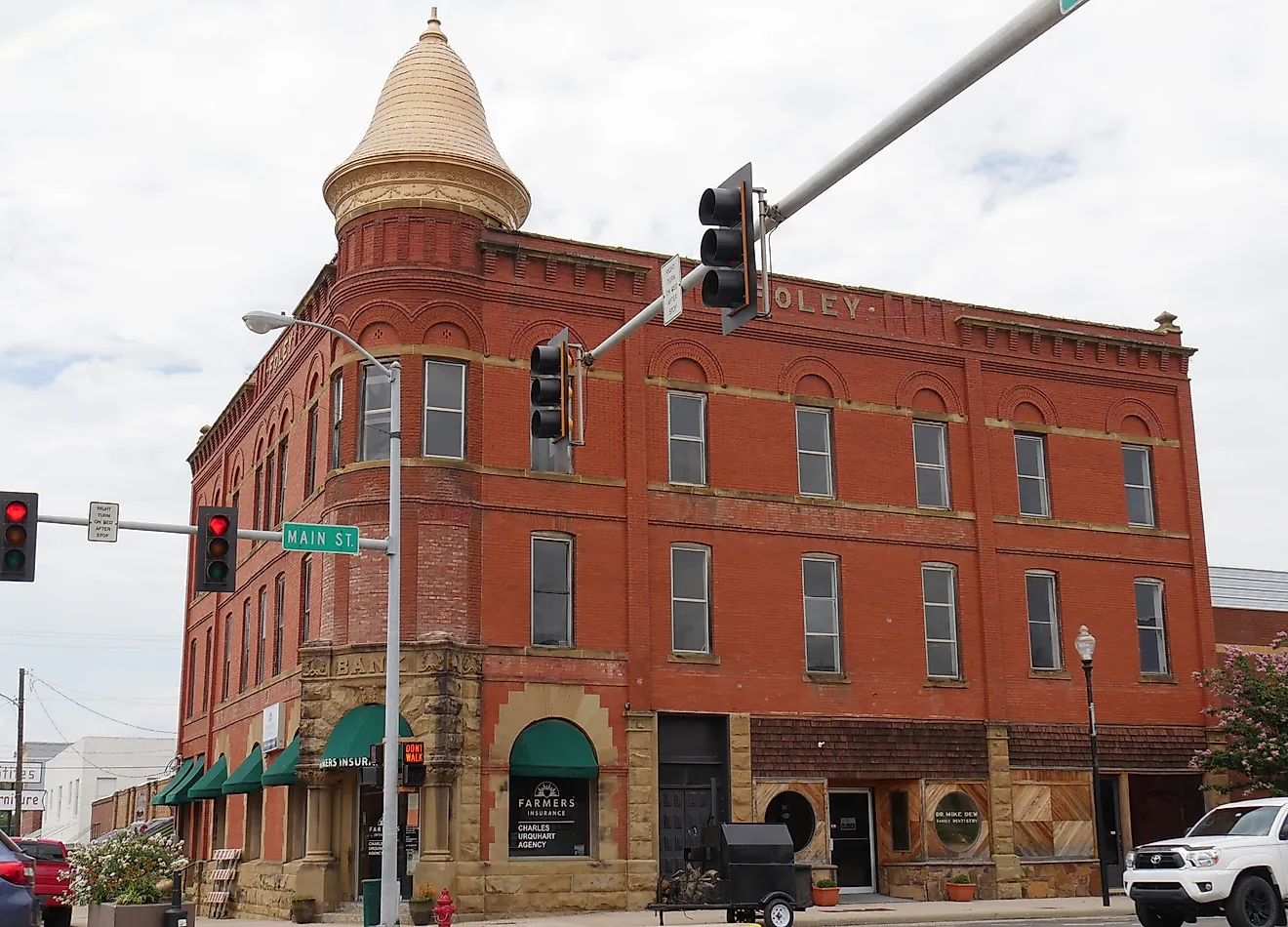
Eureka Springs sits in the Ozark Mountains of northwestern Arkansas with a year-round population of about 2,000. The entire downtown commercial district is on the National Register of Historic Places. and no two streets meet at a right angle. The buildings cling to hillsides like they were dropped from a helicopter. The town was founded in 1879 around 63 natural springs once promoted for their alleged medicinal properties, a Victorian wellness boom that built the whole downtown in roughly two decades. The springs themselves no longer cure anything. The town survives because the Victorian boom was so over-the-top it left behind a piece of architecture nobody could afford to tear down.
The 1886 Crescent Hotel, the town's defining landmark, sits on a high ridge above the downtown. It has been a women's college, a cancer hospital under the discredited Norman Baker in the 1930s (he claimed to cure cancer with a cocktail of watermelon seeds and clover; he killed a lot of people; this is where the ghost stories come from), and now operates as a working hotel with regular ghost tour programming. Thorncrown Chapel, a 1980 E. Fay Jones design with 425 windows and 6,000 square feet of glass set in a forest just outside town, was named the AIA's Best American Building of the 1980s and one of the best buildings of the 20th century, full stop. Walk into it. The light through 425 windows hits like nothing else. The Great Passion Play, operating since 1968 on Magnetic Mountain, runs an outdoor amphitheater production from May through October. Lake Leatherwood City Park, four miles west, preserves 1,600 acres of Ozark wilderness around an 85-acre lake.
Fairhope, Alabama

Fairhope sits on a bluff above the eastern shore of Mobile Bay, 30 minutes from Mobile. The town was founded in 1894 by the Fairhope Single Tax Corporation, a colony based on the economic theories of Henry George. Progressive Era reformer who argued that land value, not labor, should be taxed. The town still operates within a unique 99-year leasehold land system on the original colony tract. Henry George's land-value tax in actual practice for over 130 years. The kind of utopian project that almost always collapses by year 30. This one didn't. About 23,000 residents now call it home.
The downtown follows a four-block grid along Section Street and Fairhope Avenue, with flower-lined sidewalks (the city employs a full-time horticulture team), and the Fairhope Pier extends 1,448 feet into Mobile Bay. Walk to the end of it at sunset. Pelicans dive. Crabbers pull buckets. The local atmosphere does its work. Page and Palette, an independent bookstore in continuous operation in Fairhope since 1968, anchors the literary side of the town. Panini Pete's, in an alley off Section Street, has built a regional reputation since opening in 2005 and was featured on Throwdown! with Bobby Flay. go for the panini, stay for the beignets. The Marietta Johnson School of Organic Education, the progressive school founded in 1907 to apply John Dewey's educational theories, still operates today on the original principles. The Fairhope "jubilee" phenomenon. in which fish, crabs, and shrimp swarm the shallows due to low-oxygen conditions in the bay. happens several times each summer along the shoreline, usually at night. Locals run out with buckets. The fish basically give themselves up. A genuinely strange piece of natural history that mostly happens here and almost nowhere else.
Hendersonville, North Carolina

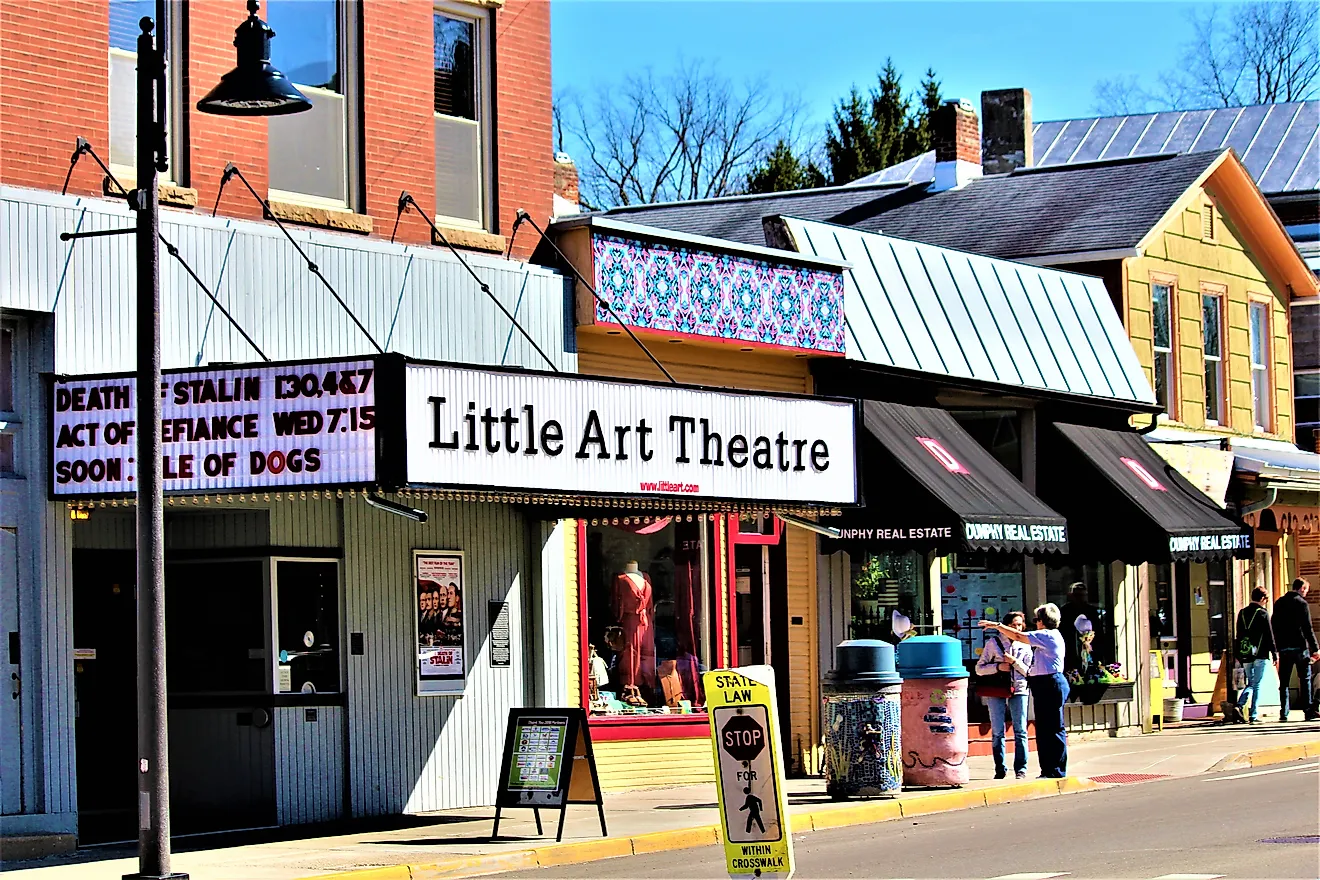
Hendersonville sits in the Blue Ridge Mountains of western North Carolina, 25 miles south of Asheville. About 15,700 residents. Henderson County seat. Main Street's serpentine layout, with curves added in the 1920s as traffic-calming long before "traffic calming" was a phrase, holds a six-block historic district of brick storefronts.
The Western North Carolina Air Museum, in an original 1920s hangar at the Hendersonville Airport, preserves over 20 vintage aircraft including a 1929 Curtiss-Wright Travel Air. Volunteers will start the engines for you on Sunday afternoons. Henderson County is the seventh-largest apple-producing county in the United States, with about 200 commercial apple farms in the surrounding hills. The annual North Carolina Apple Festival, held over Labor Day weekend, draws around 200,000 visitors. DuPont State Recreational Forest, 15 miles southwest, runs five major waterfalls including Hooker Falls, Triple Falls, and High Falls. filming locations for The Last of the Mohicans (1992) and The Hunger Games (2012). Watch the films again. You will spot the rocks. The Henderson County Heritage Museum, in the 1905 county courthouse, runs exhibits on local history including the curiously detailed story of how the curves got into Main Street.
Islamorada, Florida

Islamorada is a village of six islands in the upper Florida Keys, 80 miles south of Miami along U.S. Route 1. The Spanish name "isla morada" likely refers either to the purple-tinted sunsets or to the violet sea snails that wash ashore. debate is ongoing among local etymologists who take this question more seriously than you might expect. The village runs about 6,000 residents and was incorporated in 1997.
Islamorada calls itself the "Sport Fishing Capital of the World" based on the concentration of charter boats (over 700) and a species mix that runs to sailfish, tarpon, bonefish, and permit. The History of Diving Museum, opened in 2006, runs the world's largest collection of diving helmets and apparatus. over 500 helmets from 35 countries, including hardhat copper rigs that look like deep-sea Victorian space suits. The Theater of the Sea, a marine park established in 1946, runs dolphin and sea lion programs in former quarry pits hand-dug for the Florida East Coast Railway in the early 1900s. Lignumvitae Key Botanical State Park, accessible only by boat, preserves a virgin West Indian tropical forest with 200-year-old gumbo limbo and lignum vitae trees still standing where they grew. Stand under those trees. Imagine the Keys before air conditioning. Indian Key Historic State Park preserves the ruins of the 1830s wreckers' settlement destroyed in the Seminole attack of August 1840. one of the more dramatic single events in early Florida history, almost completely unknown outside Florida.
La Jolla, California

La Jolla is an affluent coastal neighborhood of San Diego, 12 miles north of downtown. The community sits on a peninsula of Pacific bluffs and runs about 47,000 residents within the San Diego city limits. La Jolla appears on this list as a contrast to the Atlantic and Gulf coast towns, not for any actual Southern affiliation.
La Jolla Cove, a 12-acre protected ecological reserve, runs guided snorkeling and kayak tours through the kelp beds offshore. The Children's Pool, originally built in 1931 as a safe swimming area for children, has been claimed by harbor seals and California sea lions since the 1990s and now functions as a marine mammal rookery. The lifeguards eventually stopped pretending to discourage them. The Birch Aquarium at Scripps, operated by the Scripps Institution of Oceanography at UC San Diego, runs exhibits on Pacific marine life and the institute's century-plus of oceanographic research. Windansea Beach, immortalized in Tom Wolfe's 1965 essay The Pump House Gang, remains an active surf break. and the surfers who break here still take the spot seriously. The Museum of Contemporary Art San Diego on Prospect Street runs rotating exhibits in a 1916 Irving Gill-designed building that itself belongs in the museum.
Madison, Georgia

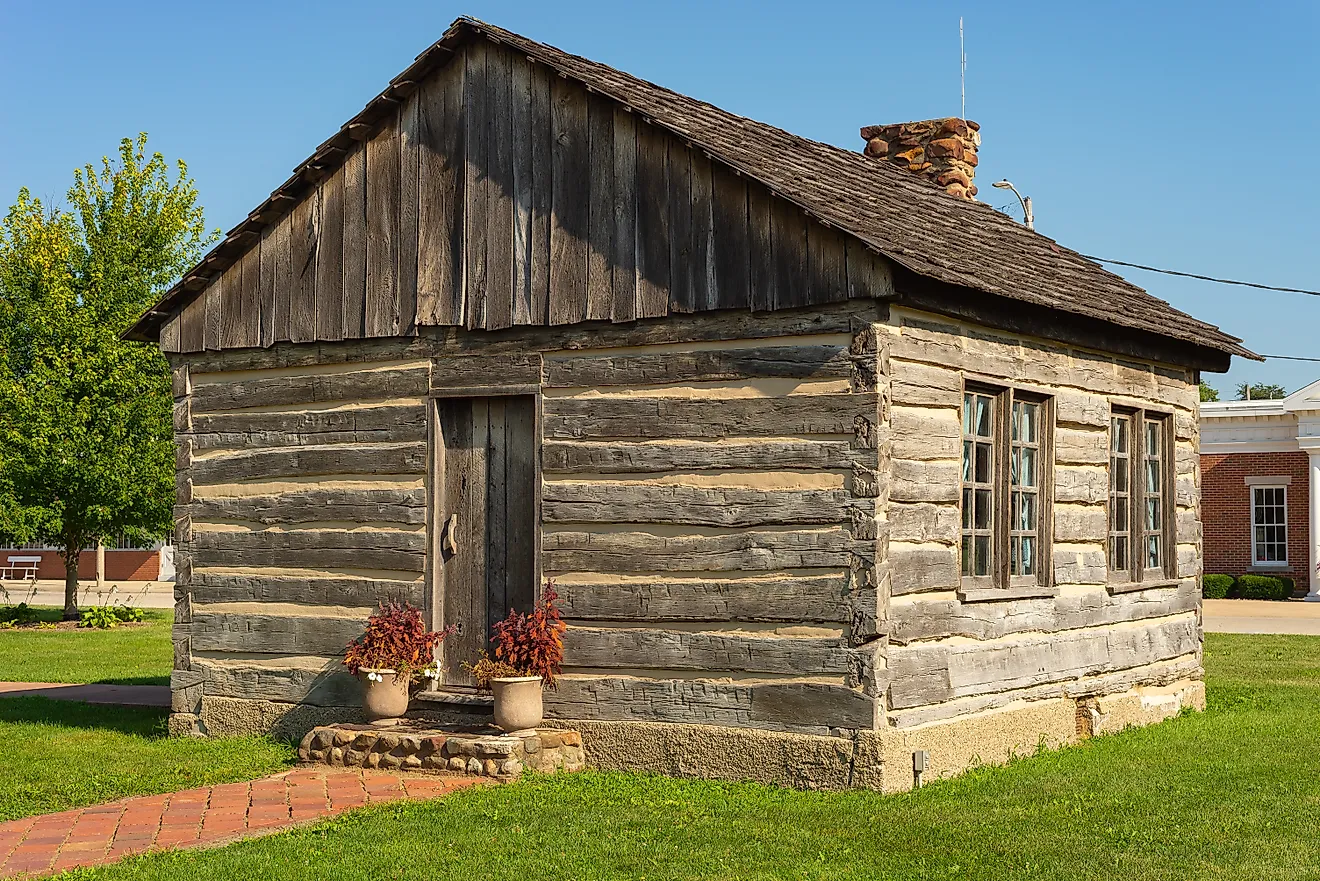
Madison sits about 60 miles east of Atlanta on I-20. The town's antebellum architecture survived the Civil War because General Sherman's March to the Sea passed around the town rather than through it. and the reason is debated by historians but the leading explanation involves former U.S. Senator Joshua Hill, who was anti-secession and personally appealed to Sherman to spare the place. Whether Hill's intervention was decisive, the town stands. The historic district covers about 100 blocks and is one of the largest National Register historic districts in Georgia.
The Madison-Morgan Cultural Center, in an 1895 Romanesque Revival former school building, runs as a regional arts center with an art museum, a history museum, and a 396-seat theater. The 1809 Heritage Hall, a Greek Revival residence on Bonar Street, operates as a museum house. the kind of antebellum interior you do not normally get to walk through. Hard Labor Creek State Park, 10 miles north, preserves 5,800 acres with two lakes, an 18-hole golf course, and equestrian trails. Madison runs an annual Holiday Tour of Homes in early December that opens private antebellum residences to visitors. Tickets sell out by Thanksgiving most years. The host families take it seriously and so do the visitors.
Natchitoches, Louisiana

Natchitoches (pronounced NAK-uh-tish, and yes you will get it wrong the first three times) was founded by the French in 1714. four years before New Orleans. making it the oldest permanent European settlement in the Louisiana Purchase territory. The town sits on Cane River Lake, an oxbow lake formed when the Red River shifted course in the 1830s and left the original riverbed behind. The historic district along Front Street, with wrought-iron balconies that look like New Orleans' French Quarter without the crowds, was the principal filming location for Steel Magnolias (1989). Every conversation about Natchitoches gets to Steel Magnolias eventually. Embrace it.
Northwestern State University, founded in 1884, runs an enrollment of about 8,000 students and gives the town a year-round student population that keeps the cafes open on weeknights. The Cane River Creole National Historical Park preserves the Oakland and Magnolia Plantations along the Cane River, including the largest surviving collection of pre-Civil War slave quarters in the United States. a difficult, necessary stop, and the only way to make the Steel Magnolias romance honest with what was here before the cameras came. The annual Natchitoches Christmas Festival of Lights, running since 1927, draws around 150,000 visitors for the lighting display along Cane River Lake. Lasyone's Meat Pie Restaurant, founded in 1967, serves the Natchitoches meat pie that has been designated the Official State Meat Pie of Louisiana. Yes that is a real designation. Order one. Order two.
Sanibel, Florida

Sanibel is a barrier island and city in Lee County off the coast of Fort Myers, 16.2 square miles of land that run east to west rather than north to south. This unusual orientation causes Gulf currents to deposit shells on the beaches in quantities and varieties that don't happen elsewhere on the Gulf or Atlantic coasts. The locally named "Sanibel stoop" describes the universal posture of shell collectors at low tide. you will see grandmothers bent at the waist for an hour at a time without complaining.
Hurricane Ian made landfall on Sanibel as a Category 4 storm on September 28, 2022, washing out the only causeway and isolating the island for weeks. The $328 million causeway reconstruction completed in May 2025, nearly two years ahead of schedule. People came back. The shops reopened. The shells, somehow, kept washing up. The J.N. "Ding" Darling National Wildlife Refuge, named for the Pulitzer Prize-winning political cartoonist who lobbied for its protection in the 1940s, covers about 5,200 acres of mangrove and wetland with a four-mile Wildlife Drive open to vehicles. Time it for low tide. The wading birds come out. The Bailey-Matthews National Shell Museum runs the only museum in the United States devoted entirely to shells and mollusks. Sanibel city ordinance prohibits buildings taller than 35 feet and bans franchise restaurants except for a small grandfathered list, which keeps the island visibly distinct from the rest of the southwest Florida coast.
St. Michaels, Maryland

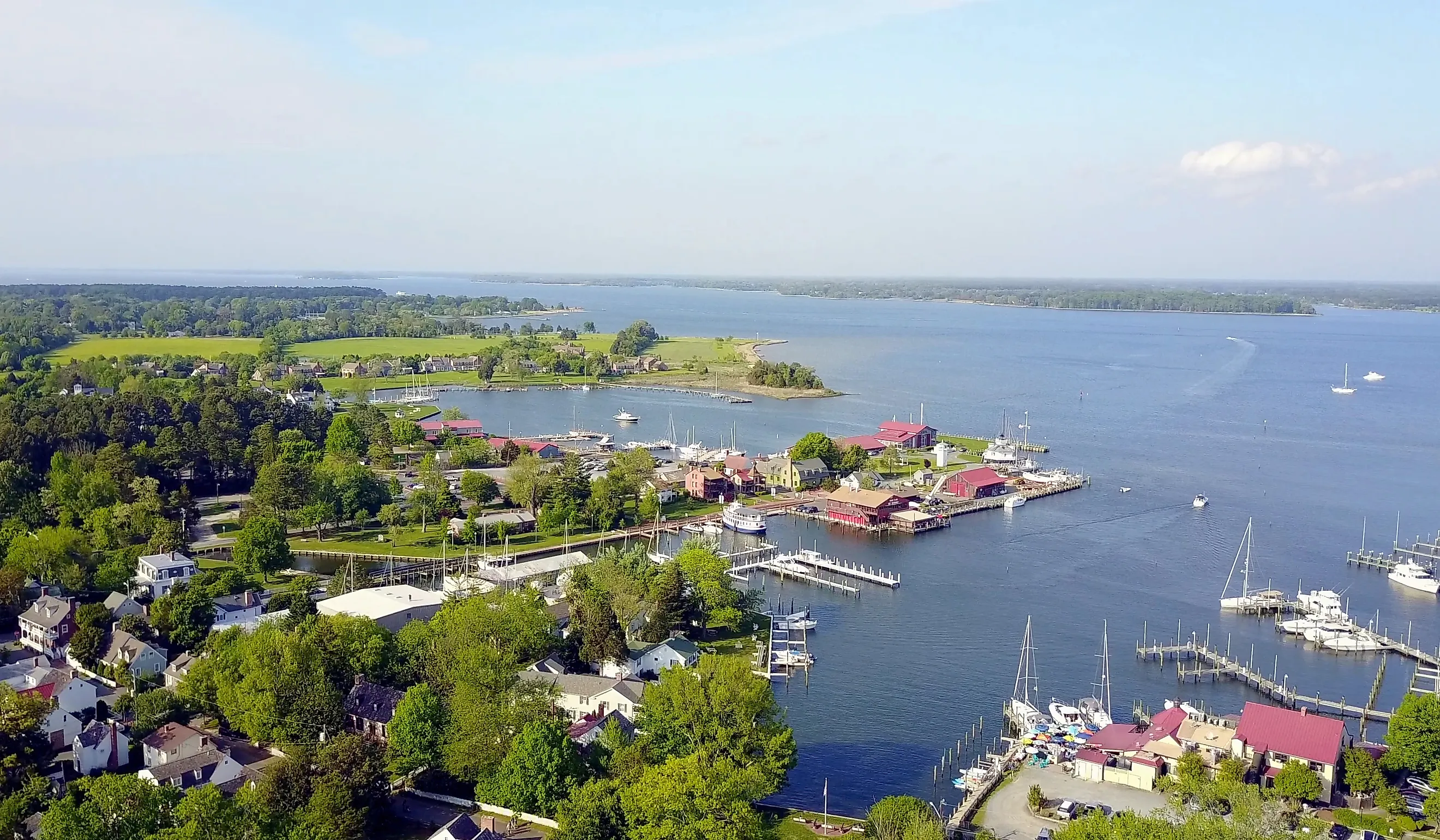
St. Michaels sits on the Miles River on Maryland's Eastern Shore, 90 minutes east of Washington, D.C. The town was settled in the 1670s and runs about 1,000 residents. Locally St. Michaels is called "the town that fooled the British" after residents reportedly hung lanterns in trees during the 1813 British naval bombardment to make ships overshoot the town. Historians dispute the legend. The town tells it anyway, and the story has the right kind of cleverness to be true regardless of whether it actually is.
The Chesapeake Bay Maritime Museum on Navy Point Marina runs 12 waterfront acres with the 1879 Hooper Strait Lighthouse (a screwpile cottage-style lighthouse relocated from its original location and reassembled on the museum grounds. climb the stairs, look out the keeper's window), the Edna E. Lockwood (the last surviving log-bottomed bugeye, built 1889 and on the National Historic Landmark register), and the largest collection of Chesapeake Bay watercraft in existence. The Crab Claw Restaurant, opened in 1965 on the museum grounds, serves steamed blue crabs from a Bay-front pier. Cracking crabs at the Crab Claw at sunset is essentially the entire pitch for the town. Mallets included. The Inn at Perry Cabin, originally built in 1816 and named for Commodore Oliver Hazard Perry, operates as a Belmond resort and was featured in Wedding Crashers (2005). The annual OysterFest each November draws crowds to the maritime museum for shucking competitions and Eastern Shore oyster preparations.
Williamsburg, Virginia

Williamsburg served as the capital of the Virginia Colony from 1699 to 1780, which means Patrick Henry, Thomas Jefferson, George Washington, and George Mason all worked the same rooms here. debating the political ideas that produced the Declaration of Independence and the Bill of Rights. The actual room where Patrick Henry delivered "Caesar had his Brutus" still stands. Colonial Williamsburg, the 301-acre living history museum funded by John D. Rockefeller Jr. beginning in 1926, preserves 88 original 18th-century buildings and hundreds of reconstructed ones.
The Governor's Palace, the Capitol building, the Courthouse, the Magazine, and dozens of trade shops (blacksmith, wigmaker, silversmith, printer, milliner, cooper) run with costumed interpreters demonstrating period crafts using period tools. Watch the blacksmith. Watch the printer set type by hand. Watch the silversmith make a tankard from a flat sheet, hammered around a stake for an hour. These are not actors playing a part. They are working tradespeople trained in 18th-century methods. The College of William and Mary, founded in 1693, is the second-oldest college in the United States after Harvard and runs the Wren Building, the oldest college building still in use anywhere in North America. The Muscarelle Museum of Art on the William and Mary campus runs a 5,000-piece collection. The DeWitt Wallace Decorative Arts Museum and the Abby Aldrich Rockefeller Folk Art Museum share a building near the Colonial Williamsburg visitor center and run substantial collections of American decorative and folk arts.
What These Towns Have in Common
Each of the twelve rests on a specific identifying anchor that makes the town recognizable from outside the region. Williamsburg has Colonial Williamsburg. Sanibel has the shells and the unusual east-west island orientation. Natchitoches has the 1714 French founding and Steel Magnolias. Beaufort SC has Robert Smalls, Pat Conroy, and the antebellum streetscape; Beaufort NC has Queen Anne's Revenge and the girl in the rum cask. Eureka Springs has the 1880s Victorian downtown and the Crescent Hotel ghost stories. Madison has Sherman's bypass. St. Michaels has the maritime museum and the lantern legend. Hendersonville has the apples and the deliberately curved Main Street. Islamorada has the sport fishing and the diving helmet museum. Fairhope has the 1894 single-tax colony and the jubilees. La Jolla, the outlier on a list otherwise centered on Atlantic and Gulf shorelines, has the cove and the Scripps research legacy. The anchors are different. The walkable unhurried downtown is the through line.