9 Towns on the Pacific Coast With the Best Downtown Areas
The iron cannon that gave Cannon Beach, Oregon, its name washed ashore in 1846 from the wreck of the U.S. Navy schooner USS Shark, lost in the Columbia River bar. The cannon is still on the coast. It sits behind glass in the town's history center, the way an object in a small museum sits when everyone knows the story. Most of these nine Pacific downtowns work the same way. Each town keeps one piece of original economic anchor: a fur-trading post, a lighthouse, a 235-foot basalt sea stack, a logging dock, a railway terminus that never actually got built. Each town has organized itself around that one piece since the 19th century.
Florence, Oregon

Florence sits at the mouth of the Siuslaw River on the central Oregon coast. Historic Old Town runs three blocks along the riverfront, with the commercial district dating to 1893 and most of its restoration completed in the 1980s after decades of post-timber decline. The 1936 Siuslaw River Bridge. a Conde McCullough Art Deco design with bascule lift sections. frames every downtown view south. Look at the bridge. Then look at it again. McCullough designed thirteen of these along the Oregon coast in the 1930s, and they are the unsung sculpture gardens of US highway engineering.
The Waterfront Depot, in the relocated 1913 Mapleton train depot, has been a destination dinner spot for crab cakes and Pacific Northwest seafood since 1998. Bridgewater Fish House and Zebra Bar serves halibut and Dungeness from a former 1907 hardware store. The Siuslaw Pioneer Museum, in the 1905 schoolhouse on Maple Street, runs pioneer-era artifacts and exhibits on the Coos and Siuslaw tribes. Twelve miles north on Highway 101, Sea Lion Caves runs an elevator down into an active Steller sea lion rookery in the largest sea cave in the United States. You hear them before you see them. The sound carries up through the rock, and the smell carries up too. which is the part the brochures leave out.
Cambria, California

Cambria sits on California's central coast between San Simeon and Morro Bay, 35 miles north of San Luis Obispo. Founded in 1866 as Slabtown, a logging center for Monterey pine shipped out through a now-vanished pier at San Simeon. the original wood went to build half of late-19th-century San Francisco, which is why so little of Monterey pine survives in California today. The downtown splits into West Village and East Village, with West Village along Main Street and East Village a half-mile inland. Vault Gallery, Artifacts Gallery, and Mission Gallery anchor the local art scene.
The Cambria Historical Museum operates inside the 1874 Guthrie-Bianchini House, one of the oldest surviving residences in town. Moonstone Beach on the western edge of town is named for the small white moonstones still found along its tide line. pick one up at low tide, hold it up to the light, and watch it glow blue-white. The paved boardwalk over the bluffs runs the length of the beach. Sunset is the time. Just north, the Piedras Blancas elephant seal rookery hosts up to 17,000 northern elephant seals at peak season in January and February, with a free viewing area run by Friends of the Elephant Seal. Adult males. Up to 5,000 pounds. They will not care that you exist, and the bulls will fight each other on the sand thirty feet from where you're standing, and you should not get any closer. Hearst Castle, eight miles north in San Simeon, remains the area's biggest single visitor draw and now operates as a California state historic park.
Gig Harbor, Washington

Gig Harbor sits across the Tacoma Narrows from Tacoma, with the downtown wrapped around a small horseshoe-shaped harbor that gave the town its name. Settled by Croatian and Scandinavian fishermen in the 1860s and 1870s, the kind of working immigration story that doesn't get told because nobody got famous. The town built its commercial economy on commercial salmon fishing, which still operates from this harbor today.
The Harborview Drive promenade runs the full length of the downtown waterfront. The Harbor History Museum on Harborview Drive runs the restored 1947 Shenandoah purse seiner. actual 100-foot fishing boat, displayed under cover, climb-aboard-the-deck welcome. and exhibits on the town's Croatian and Native heritage. Skansie Brothers Park, named for four immigrant Croatian fishermen who built their family fishing fleet from this spot, runs the public dock and the original Skansie family net shed. The Maritime Pier and floating moorage keep the downtown harbor working rather than ornamental. boats coming and going, not docked for display. Kopachuck State Park, 15 minutes west, runs a Puget Sound beach with views across to Cutts Island and the Olympics on clear days. The Olympic Range on a clear day is the view that gives the Pacific Northwest its reputation.
Long Beach, Washington

Long Beach sits on the Long Beach Peninsula, a 28-mile sand spit between Willapa Bay and the Pacific. The town runs about 1,400 residents and serves as the commercial hub for the peninsula. The beach gets promoted as "the World's Longest Beach," which several other places dispute. What is verifiable: the 28-mile stretch is the longest drivable beach in the United States and is legally classified as a state highway. You can literally drive on it. People do. There are speed limits. There are mile markers. There is a road that is a beach.
The town's commissioned "World's Largest Frying Pan," a 14-foot-long fiberglass replica of the 1941 original, hangs at the corner of Pacific Avenue and 5th Street. No longer the world's largest. Still the oldest such claim and the only one to have actually cooked food. having fried a 200-pound clam fritter at the 1941 Razor Clam Festival. Marsh's Free Museum across the street runs Jake the Alligator Man, a small but persistent collection of oddities that has drawn visitors since 1921. Jake is a real mummified gator head sewn to the body of a small monkey. Make of that what you will. The Cranberry Museum and the surrounding working cranberry bogs reflect the area's status as one of the major cranberry-growing regions in the Pacific Northwest. The Discovery Trail runs 8.4 miles of paved path along the dune line connecting Ilwaco and Long Beach.
Bandon, Oregon

Bandon sits at the mouth of the Coquille River on the southern Oregon coast and rebuilt itself after a 1936 wildfire wiped out almost the entire town in a single afternoon. Imagine that for a second. Old Town Bandon now occupies the restored waterfront area, with the 1894 commercial buildings replaced by 1936-era construction and modern infill. The boardwalk along the Coquille runs past commercial fishing boats that still work the river.
The Coquille River Lighthouse, on the north spit of the river entrance, dates to 1896 and now operates as part of Bullards Beach State Park. Face Rock Scenic Viewpoint on the south end of town overlooks the offshore sea stack named for a Coquille legend about a young woman turned to stone by an evil spirit. Stand on the bluff at low tide. The face is unmistakable. The stack stares straight north out to sea and once you see her, you cannot un-see her. Bandon Dunes Golf Resort, four miles north, has built a global reputation since 2001 for links-style coastal golf and now ranks among the top golf destinations in the United States. The Bandon Historical Society Museum runs exhibits on the cranberry industry, the 1936 fire, and the Coquille Indian tribe. small museum, big stories.
Astoria, Oregon

Astoria, founded in 1811 by John Jacob Astor's Pacific Fur Company, is the oldest American settlement west of the Rockies. Older than St. Louis on the western side, and the downtown still sits on a steep slope above the Columbia River that demands different gears in different vehicles. Commercial Street is the spine, with the 1925 Liberty Theatre as the anchor performance venue. The Riverwalk runs five miles along the Columbia waterfront. A vintage 1913 trolley operates seasonally along it, and yes you can flag it down like a bus.
The Columbia River Maritime Museum on the waterfront runs exhibits on the Columbia Bar (the most dangerous river bar in the world, with over 2,000 ships wrecked since records began. they call it the Graveyard of the Pacific and they are not exaggerating), the lightship Columbia (anchored alongside as part of the museum), and the river's commercial fishing and cannery history. The Astoria Column atop Coxcomb Hill is a 125-foot reinforced concrete tower built in 1926, with a spiral sgraffito frieze depicting Pacific Northwest history. Climb the 164 interior steps. Buy a balsa-wood glider at the gift shop and throw it from the observation deck. Everyone does. Children, adults, dignified people who claim they wouldn't. They all throw the glider. The 1886 Flavel House, a Queen Anne Victorian built by Columbia River Bar pilot Captain George Flavel, anchors the upper end of the downtown historic district. Fort Stevens State Park 10 miles west preserves a Civil War-era coastal defense fort and the wreck of the Peter Iredale rusting on the beach since 1906. a four-masted barque that ran aground in fog and never came off.
Claremont, California

Claremont sits 35 miles east of Los Angeles at the southern foot of the San Gabriel Mountains. Founded in 1887 as a railroad stop. Became home to the Claremont Colleges consortium that started with Pomona College the same year, then added six more colleges over the next century into what is now one of the country's strongest small-college consortiums. The downtown, locally called Claremont Village, runs eight tree-lined blocks adjacent to the Pomona College campus.
The Claremont Lewis Museum of Art, in the restored 1930s Santa Fe depot, runs rotating exhibits on California artists. The Folk Music Center, a working musical instrument shop and museum founded in 1958 by the grandparents of musician Ben Harper, sells and repairs folk instruments from around the world. Ben Harper grew up here. Photos on the walls. His grandmother Dorothy Chase still appears in the shop. The Claremont Packing House, a 1922 citrus packing facility converted to a mixed-use complex, holds independent restaurants, the Last Name Brewing tasting room, and a public market. Rancho Santa Ana Botanic Garden, 86 acres on the north end of town, runs the largest collection of California native plants in the world: over 2,000 species, including coastal redwoods you didn't think grew in Southern California. Mount Baldy, the highest peak of the San Gabriels at 10,069 feet, sits 20 miles north and supplies the visual backdrop from anywhere in the Village.
Port Townsend, Washington

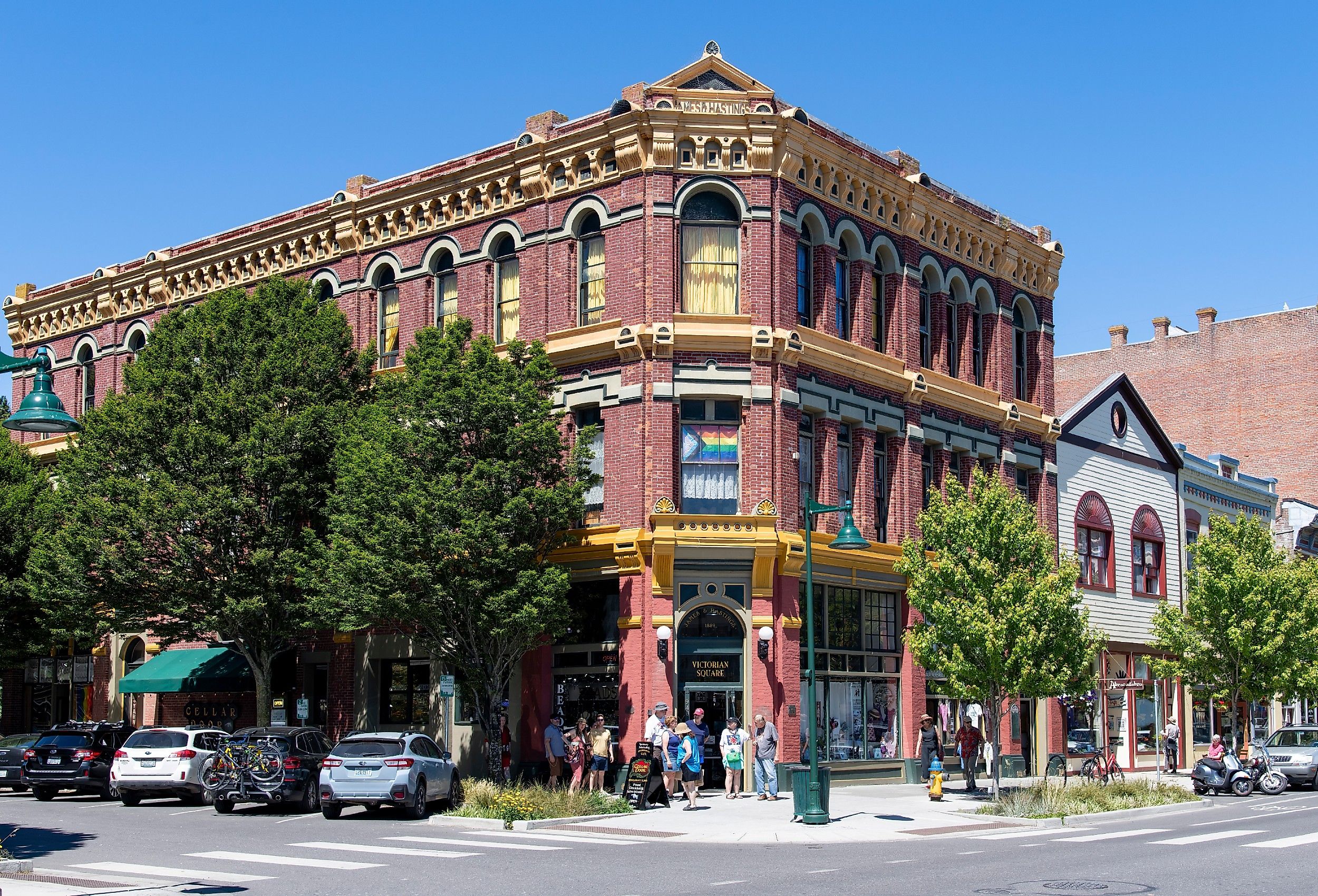
Port Townsend sits on the northeast tip of the Olympic Peninsula and is one of only three Victorian seaports on the National Register of Historic Places. The others are Cape May, New Jersey, and San Francisco. The commercial district was built mostly between 1880 and 1893 in anticipation of becoming the western terminus of the Northern Pacific Railroad. The terminus never came. The panic of 1893 froze the boom overnight, the railroad picked Tacoma, and the half-finished Victorian downtown sat preserved by lack of money for the rest of the 20th century. Bad luck became preservation. The downtown survives intact because nobody could afford to modernize it.
The 1891 Hastings Building, a Romanesque Revival commercial block, anchors the Water Street view. The 143-foot 1892 Jefferson County Courthouse clock tower remains the tallest courthouse tower in Washington state. The Rothschild House, an 1868 frame residence on a bluff above the downtown, runs as a state park and preserves the pre-Victorian frame-construction style. Fort Worden State Park, two miles north on Point Wilson, preserves the 1900s coast artillery installations and runs the Point Wilson Lighthouse, a Coast Artillery Museum, and the venue where most of An Officer and a Gentleman (1982) was filmed. Stand on the parade ground at Worden. You will recognize it. Richard Gere ran across it. The Wooden Boat Festival each September brings hundreds of vessels to Point Hudson Marina. the largest wooden boat festival in North America, and a town packed shoulder to shoulder with people who can talk about caulking for 90 minutes.
Cannon Beach, Oregon

Cannon Beach sits on the northern Oregon coast 80 miles west of Portland. The downtown runs along Hemlock Street with cedar-shingle buildings, art galleries, and restaurants concentrated in roughly six walkable blocks. The town was named for an iron cannon that washed ashore from the wrecked U.S. Navy schooner USS Shark in 1846. The cannon is on display in the town's history center. Not a metaphorical cannon. An actual one, recovered from the beach, on display behind glass.
The defining landmark is Haystack Rock, a 235-foot basalt sea stack rising directly from the beach about 90 feet off the downtown. The base is a designated Marine Garden and part of the Oregon Islands National Wildlife Refuge, with tide pools containing ochre sea stars, sea anemones, and hermit crabs, and a tufted puffin nesting colony active April through July. Walk out at low tide. The pools are alive. The Cannon Beach History Center and Museum runs exhibits on the Shark wreck and the town's history as an early Oregon Coast resort. The Cannon Beach Sandcastle Contest, running since 1964, is the oldest continuous sandcastle competition on the West Coast. and the sculptures are not what you remember from the beach as a child. They are architecture. Ecola State Park immediately north runs the trail to the abandoned Tillamook Rock Lighthouse viewpoint. Tillamook Rock Lighthouse stands a mile offshore, decommissioned since 1957, now a private columbarium where ashes are stored. The keepers who worked it called it Terrible Tilly. Look at it on a winter day. You will understand why.
What These Nine Downtowns Share
Each rests on a specific original economic anchor that either survived or got preserved. Florence and Bandon work because river-mouth fishing economies left walkable port districts behind. Astoria and Port Townsend kept their commercial cores intact because boom-era ambition fell through before it could be paved over. Cambria and Cannon Beach work because the surrounding state parks set hard limits on growth. Gig Harbor and Long Beach keep their working identities because the harbor and the beach are still working. Claremont anchors itself to its college consortium and a citrus-packing past. None of the nine is interchangeable with any of the others.