12 of the Quietest Georgia Towns
Georgia has a deep bench of quiet towns. The North Georgia mountains deliver orchards, cool-weather overlooks, and rail-trail rivers. The central Piedmont holds preserved 19th-century courthouse squares where the Civil War still shapes the streetscape. The state's single coastal stretch offers tabby ruins and marsh views. And Lake Oconee, Lake Burton, and Lake Chatuge each anchor towns built around year-round water life. The ten towns below span all of these: not one is a louder version of the one before it.
Blue Ridge

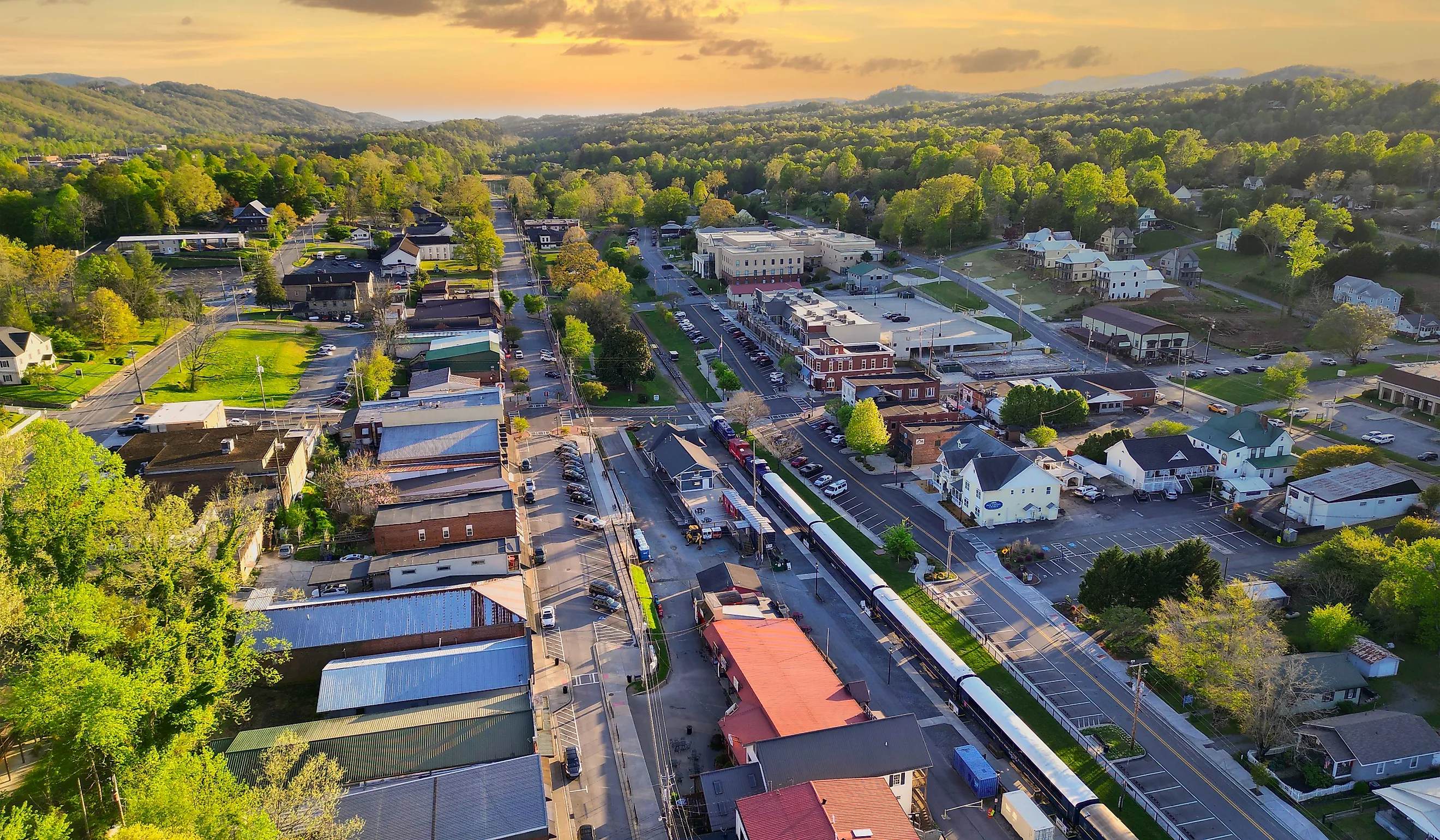
Blue Ridge sits in Fannin County where the Toccoa River, orchard country, and Lake Blue Ridge all close ranks on a compact downtown. The 1905 depot is still the anchor: the Blue Ridge Scenic Railway runs excursions from here along the Toccoa into McCaysville on the Tennessee line. Mercier Orchards is the regional heavy hitter for apple picking, baked goods, and hard ciders (fifth-generation family operation since 1943). Lake Blue Ridge opens a short drive away, with boat launches, wooded coves, and ridge views that most Georgia mountain towns can't match. The Downtown Historic Heritage Walk adds markers and walking-tour depth to an otherwise easy stroll.
Clayton

Tucked into Rabun County in Georgia's far northeast corner, Clayton punches above its weight for mountain-town dining and trail access. Black Rock Mountain State Park is the main draw: at 3,640 feet elevation, it's the highest-elevation state park in Georgia, with overlooks that span four states on clear days. Along Main Street, Clayton Café serves classic Southern breakfast, Wander North Georgia stocks outdoor gear with local expertise, and Fortify Kitchen and Bar leans farm-to-table for dinner. Lake Burton sits 20 minutes southwest with marinas, coves, and some of the most photographed lakefront in the state.
Hiawassee

Hiawassee sits in Towns County near the North Carolina line, with Lake Chatuge spreading out below the Blue Ridge crest. Bell Mountain delivers one of the state's best overlooks, reached by a steep paved road that climbs above the water and the surrounding valleys (the summit's graffiti-covered rocks are a longtime local tradition, love it or hate it). Hamilton Gardens at Lake Chatuge covers a lakeside hillside with one of the Southeast's largest native rhododendron collections and paths designed for easy walking. The Georgia Mountain Fairgrounds runs concerts, craft events, and seasonal gatherings on the edge of the lake year-round, including a busy summer fair week and a major fall festival.
Tallulah Falls

Near the South Carolina line in northeast Georgia, Tallulah Falls sits directly above the roughly 1,000-foot-deep gorge carved by the Tallulah River. Tallulah Gorge State Park anchors the town with rim trails, metal staircases, and a suspension bridge 80 feet above the river that's not for the squeamish. For a wider view without the descent, Tallulah Point Overlook frames the full canyon and surrounding ridges from the northern rim. Tallulah Adventures handles guided kayak trips and paddleboard rentals on Tallulah Lake, with scheduled water releases (typically weekends in spring and fall) that turn the gorge into a world-class whitewater run for experienced paddlers.
Madison

Madison sits about 60 miles east of Atlanta in Morgan County, and its broad streets and preserved antebellum architecture earned it a claim sometimes made by locals that Sherman spared the town during his 1864 March to the Sea (historians note the story is mostly local legend; the actual reason was political, not sentimental). Heritage Hall is the centerpiece: an 1811 Greek Revival house museum furnished with period pieces and open for tours. Hard Labor Creek State Park just outside town brings wooded trails, two lakes, and an 18-hole golf course. The Madison-Morgan Cultural Center occupies an 1895 Romanesque Revival former school, now one of the South's most active small-town arts spaces, with rotating exhibitions and a 400-seat performance hall. Ricardo's Kouzzina handles dinner around Town Park.
Darien

On Georgia's coast in McIntosh County, Darien is one of the state's oldest planned towns (founded 1736 by Scottish Highlanders as part of the Oglethorpe colony) and still runs a working shrimp fleet out of its waterfront. Fort King George State Historic Site preserves a reconstructed 18th-century timber fort, originally built in 1721 as the first English outpost in what is now Georgia. Darien Waterfront Park faces the Darien River and gives a direct read on the boat traffic, marsh views, and passing commercial shrimp boats. The Darien Walking Tour links tabby ruins (a distinctive oyster-shell concrete used throughout the Georgia coast), early-19th-century church buildings, and older commercial architecture. Skipper's Fish Camp is the local institution for fresh Georgia shrimp, grouper, and crab cakes, with dockside views.
Pine Mountain

Pine Mountain sits in Harris County in west-central Georgia, just outside two of the state's biggest outdoor draws. Callaway Gardens spreads across 2,500 acres of lakeside grounds, garden displays, and the Cecil B. Day Butterfly Center (Georgia's largest enclosed butterfly conservatory, with over 1,000 butterflies in free flight). F.D. Roosevelt State Park nearby is Georgia's largest state park at 9,049 acres, with stone shelters built by the Civilian Conservation Corps in the 1930s and 40 miles of Pine Mountain Trail. On Main Street, Moore's Whistling Pig Café and the Chipley Historical Center tie the commercial strip to both food and Pine Mountain's early railroad history. Wild Animal Safari runs a drive-through park stocked with over 500 zebras, camels, giraffes, and other animals.
Greensboro

Greensboro sits in east-central Georgia's Greene County, where a courthouse square and Lake Oconee together set the rhythm. The Old Gaol (built 1807) is one of the oldest jails still standing in Georgia, with two-foot-thick granite walls, barred cells, and a trap door once used for executions (grim, but historically significant). Lake Oconee itself opens the landscape with marinas, fishing access, and miles of shoreline, while Reynolds Lake Oconee brings golf courses, resort property, and lake restaurants outside the square. Back downtown, Broad Street and Main Street hold together the preserved commercial blocks that predate the lake era.
Ellijay

In Gilmer County in the North Georgia mountains, Ellijay sits at the confluence of the Ellijay and Cartecay rivers and markets itself (with justification) as Georgia's apple capital. The Cartecay River brings tubing, paddling, and a scenic downtown setting. B.J. Reece Orchards is the standout during fall apple season with pick-your-own acres, a farm market, cider doughnuts, and on-site bakery. The Gilmer County Apple Festival in October is the region's signature fall event. Tabor House and Civil War Museum uses one of Ellijay's oldest residences to cover Cherokee removal history, early settler life, and the Civil War. Gilmer County has the highest apple production in Georgia, supplying much of the state.
Washington

Washington sits in east Georgia's Wilkes County and claims a strong case for being the first town in the United States named for George Washington (incorporated 1780, while Washington was still a general). The Mary Willis Library, opened 1889, is Georgia's oldest free public library, occupying a High Victorian building with Tiffany stained-glass windows that remain one of the most striking interiors in the state. The Robert Toombs House State Historic Site preserves the 19th-century residence of Robert Toombs, a U.S. senator, Confederate Secretary of State, and unreconstructed post-war figure who never took the oath of allegiance after the Civil War. Kettle Creek Battlefield south of town marks the 1779 Revolutionary War battle where Patriot militia defeated Loyalist forces in one of the war's most significant Southern engagements. Near the square, 1896 Wine Room brings a contemporary stop to the historic facades.
Ten Quiet Georgia Towns, Ten Different Reasons to Go
Mountains in Blue Ridge, Clayton, Hiawassee, Tallulah Falls, and Ellijay. Antebellum and Revolutionary-era history in Madison and Washington. Lake life in Greensboro and the Callaway-Gardens area around Pine Mountain. Salt marsh and working waterfront in Darien. The ten towns here cover Georgia's full geographic range, and each one is built around something specific: an 1,000-foot gorge, a fifth-generation orchard, a 2,500-acre public garden, a 1721 coastal fort. None of them is a watered-down version of somewhere else.