10 Prettiest Downtown Strips In Wyoming
Wyoming's prettiest downtown strips center on historic main streets and Western storefronts tied to the Rocky Mountains and high plains. Many districts developed along early rail lines and frontier routes connected to cattle drives and Yellowstone travel corridors. In Jackson, wooden boardwalks and elk antler arches define a town square beneath the Teton Range. Sheridan features a broad main street with the Bighorn Mountains rising nearby and brick buildings reflecting its ranching history. In Cody, a structured downtown connects museums and historic sites tied to the region's frontier past. These downtowns stand out for how their layouts and surroundings form unforgettable town centers.
Pinedale

Pinedale's Pine Street is a compact Western strip of log-accented storefronts, outfitters, and historic buildings set against wide views of the Wind River Range to the east. The street holds independently owned shops, outfitters, and galleries that have served the local ranching and outdoor community for decades. The Sublette County Courthouse, a modern brick complex built in the 1980s, gives the downtown a dignified civic presence. The Sublette County Library on South Tyler Avenue occupies a well-kept building just off the commercial strip, its public reading rooms open six days a week.
Just off Pine Street, Pinedale's downtown holds its most historically rich and naturally beautiful attractions. The Museum of the Mountain Man on East Hennick Street dedicates 15,000 square feet to the Rocky Mountain fur trade. Its galleries hold Jim Bridger's 1853 engraved rifle and a rare Shoshone sheephorn bow. A vivid diorama recreates Hugh Glass's 1823 grizzly bear encounter in striking detail. The museum is open for self-guided tours covering mountain men, Native American heritage, and the Oregon Trail. A short drive away on the west side of town, Boyd Skinner Park provides a quiet green space where moose and deer wander the same creekside paths as joggers and families.
Jackson

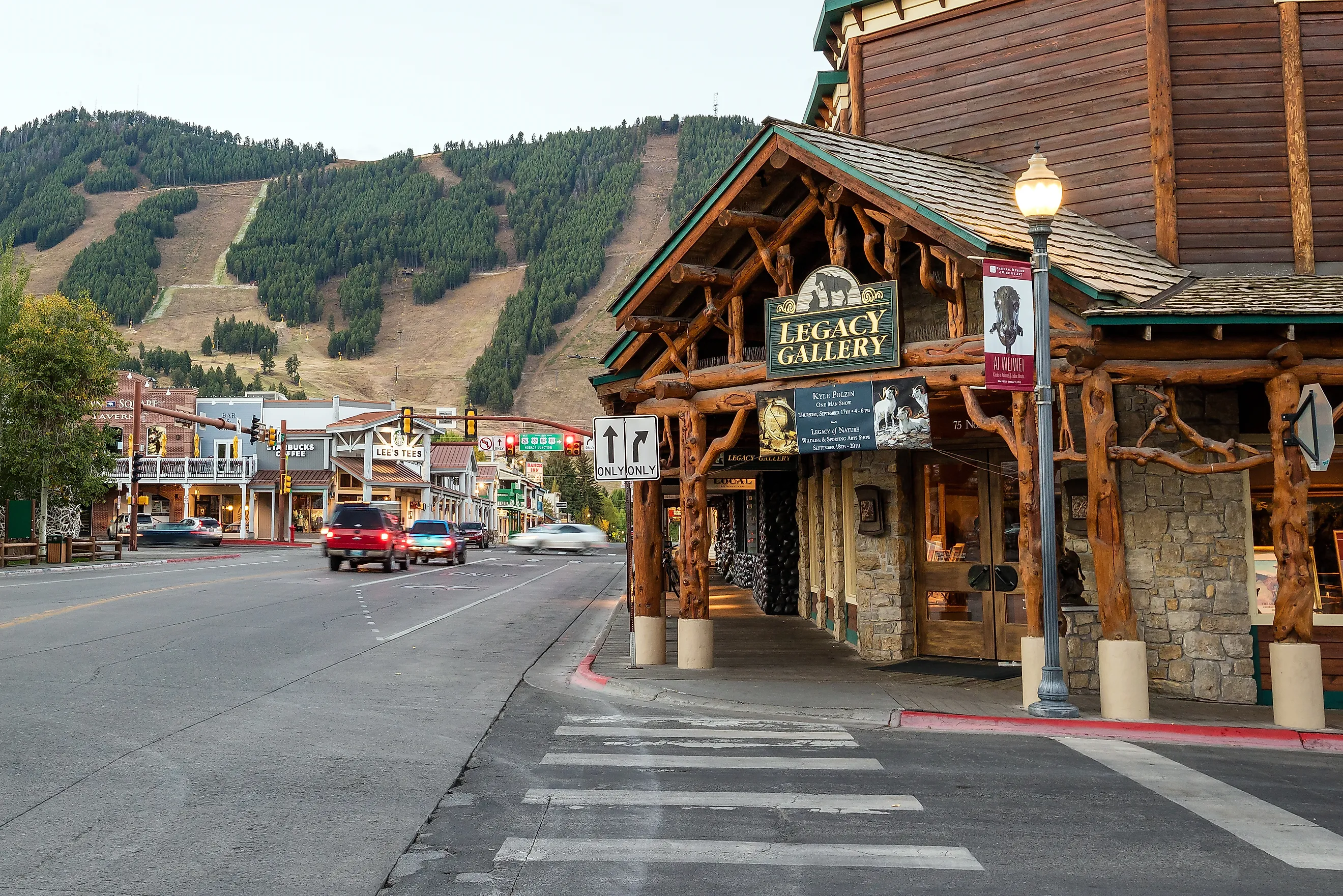
Jackson's downtown spreads outward from the intersection of Broadway and Cache Street in a grid of wooden boardwalks, Western storefronts, and frontier-era buildings. At its center, George Washington Memorial Park, known locally as Town Square, holds four arches built entirely from naturally shed elk antlers. Each arch contains around 2,000 antlers collected from the nearby National Elk Refuge. Their bleached ivory curves frame views of the busy downtown streets against the backdrop of the Teton Range. From Memorial Day through Labor Day, the square hosts the Jackson Hole Shootout, a free mock gunfight in period costume running every summer since 1957.
Two downtown bars give Jackson's streets a lived-in Western character built on silver dollars, saddle stools, and decades of cowboy history. The Million Dollar Cowboy Bar on Town Square, open since 1937, features a hand-carved bar top with silver dollars embedded in it and saddle-topped barstools lining its worn wooden floor. The Wort Hotel on North Glenwood Street, built in 1941, holds the Silver Dollar Bar with its elegant S-shaped counter inlaid with 2,032 uncirculated 1921 silver dollars. Its walls display a carefully curated collection of original Western art.
Cody

Cody's Sheridan Avenue is a walkable Old West stretch of brick storefronts, Victorian landmarks, and Western museums that carry the full spirit of Wyoming's frontier era. The Irma Hotel presides over the avenue with its ornate Victorian facade. The hotel was built by William "Buffalo Bill" Cody, the legendary buffalo hunter, scout, and showman who founded the town in 1896, left his mark throughout downtown. Inside, a cherrywood back bar gifted by Queen Victoria still serves drinks beneath original pressed tin ceilings. Just across the street, the Historic Cody Theatre hosts live Western performances and community events on weekend evenings.
Beyond its storefronts, Cody's downtown holds an extraordinary collection of museums and green public spaces. The Buffalo Bill Center of the West on Sheridan Avenue puts five museums under one roof. The Buffalo Bill Museum, the Plains Indian Museum, and the Whitney Western Art Museum tell the story of the American West through artifacts, art, and photography. The Draper Natural History Museum and the Cody Firearms Museum, holding over 10,000 artifacts, complete the campus. A ten-minute walk east back toward the heart of downtown, Cody City Park provides a green and shaded retreat where Thursday evening summer concerts draw crowds onto the open lawn.
Buffalo

Buffalo's Main Street Historic District is a broad, unhurried section of frontier-era brick buildings set against the dramatic backdrop of the Bighorn Mountains. The Occidental Hotel, founded in 1880 and beautifully restored, carries a storied past in every detail. Its saloon retains a 100-year-old black bar and bullet holes still visible in the tin ceiling. The Johnson County Courthouse, constructed in 1884, presides over Main Street from its hilltop position with quiet, enduring authority.
Buffalo's downtown holds a rich museum, a celebrated trail, and colorful street art woven through its blocks. The Jim Gatchell Memorial Museum, housed in a 1909 Carnegie Library building on Fort Street, holds around 40,000 artifacts gifted to pharmacist Theodore James Gatchell by cowboys, lawmen, and Native American friends. The Clear Creek Trail System begins in the heart of downtown and follows the banks of Clear Creek toward the foothills of the Bighorn Mountains, with easy walking, fishing spots, and picnic areas along the way.
Lander

Lander's Main Street is a walkable stretch of locally owned storefronts, galleries, and 19th-century brick buildings rooted in the town's ranching and climbing heritage. The Noble Hotel, built in 1918 to welcome Eastern travelers headed to Yellowstone, still stands as a towering landmark in the very heart of downtown. Old brick walls along the street hold vivid murals painted by local artists, including scenes of the Wind River Range and the prominent "Power, Life, and Healing" mural that depicts Native American heritage.
The Lander Downtown Historic District, on the National Register of Historic Places, preserves 16 contributing commercial buildings across the grid. The area sits against the Wind River Range and gives direct access to a river, a park, and dramatic canyon scenery. The Popo Agie Creek runs along the western edge of the downtown district, its clear mountain water moving fast through a cottonwood-lined channel. City Park, one block from the main commercial strip, adds a green and tree-shaded gathering space to the district. The Sinks Canyon State Park trailhead is about 10 minutes southwest of downtown, where the Middle Fork of the Popo Agie River disappears underground and surfaces again downstream.
Dubois

Dubois's Ramshorn Street is a log-cabin-lined main street of weathered wood storefronts and old Western saloons set against the raw beauty of red-rock badlands, the Absaroka Mountains to the north, and the Wind River Mountains to the south. The Dubois Museum, located on a historic campus just off the west end of Ramshorn Street, preserves fossils, Native American artifacts, and exhibits that trace the Upper Wind River Valley from ancient geology through the timber era. The National Bighorn Sheep Center displays vivid dioramas and interactive exhibits on Rocky Mountain bighorn sheep. The center serves as a launching point for guided winter wildlife tours to see the real herds on nearby Whiskey Mountain.
Beyond its storefronts, Dubois's downtown holds a storied old tavern and a living river that give the district its most memorable character. The Rustic Pine Tavern, established in 1919 on East Ramshorn Street, holds a handmade bar of local wood, antique guns, and a vintage cigar cabinet. The Wind River runs along the edge of downtown, its cold green water cutting through a sedge-lined area. People can fly fish the river right from the downtown or walk the shaded riverbank as the red badlands glow behind the treeline.
Sheridan

Sheridan's Main Street is a broad and beautifully preserved corridor of late 19th and early 20th-century brick buildings set against the distant blue wall of the Bighorn Mountains. The Sheridan Main Street Historic District, added to the National Register of Historic Places in 1982, holds over 60 contributing historical structures from the town's early decades. The WYO Theater at 42 North Main Street, built in 1923 as a vaudeville house and carefully restored, hosts Broadway acts, live music, and film screenings under its glowing marquee. King's Saddlery has been a Main Street fixture since founder Don King opened the shop in 1972. Its free museum in the back holds ropes, Native American artifacts, antique firearms, and historic wagons spanning 150 years.
Beyond its architecture, Sheridan's downtown holds a rich collection of art, historic bars, and cultural venues that give the street its distinctive character. The Mint Bar on Main Street, pouring drinks since 1907, features black-and-white rodeo photographs, historic cowboy memorabilia, and a famous neon cowboy sign that lights up the street after dark. Around 30 public art pieces are mounted across the downtown, including bronze sculptures and large-scale murals. The Whitney Center for the Arts at Sheridan College, located a short drive south of downtown on the main campus, mounts rotating visual arts exhibitions and hosts performances throughout the year.
Thermopolis

Thermopolis's Broadway Street is an unusually wide and stately historic corridor of early 20th-century commercial buildings. It was purposely laid out 150 feet wide in the town's earliest days to accommodate large mule freight teams. The Downtown Thermopolis Historic District, listed on the National Register of Historic Places in 1984, holds buildings constructed between 1898 and 1923 in Commercial and Victorian styles. Their warm brick facades and ornate cornices give the street a handsome, unhurried character. The Hot Springs County Museum at 700 Broadway Street holds pioneer artifacts, Native American beadwork, and a replica of an early Thermopolis general store and jail cell.
Thermopolis's downtown sits at the edge of a dramatically beautiful natural setting where mineral springs and a broad river valley shape the landscape. Hot Springs State Park, located just across the Bighorn River from the downtown district, features terraced travertine formations in brilliant orange and white. The mineral waters cascade in steaming layers toward the river below. The State Bath House within the park offers free 20-minute soaks in healing mineral waters under a state treaty in force since 1896. The Wyoming Dinosaur Center south of downtown off Carter Ranch Road holds life-size dinosaur mounts where people can watch paleontologists work on real fossils.
Douglas

Douglas's Center Street and 2nd Street form a beautifully preserved downtown area with warm brick facades, ornate cornices, and century-old commercial buildings. The Jenne Building on Center Street features cream-colored ceramic crowning set against orange and black-speckled brick walls. Its decorative parapet and monogrammed entrance shield make it one of the most visually striking facades on the street. The Douglas Main Post Office, completed in 1916, presents a copper-clad hipped roof and broad granite steps in a Neo-Classical style. The College Inn Bar, built in 1906 with a carved mahogany backbar and marble floors, has operated from the same location longer than any other business in Douglas.
Douglas's downtown holds two carefully preserved railroad depots and a museum packed with frontier history. The FE&MV Railroad Passenger Depot, the oldest building in Douglas, now houses the Douglas Railroad Interpretive Center. Historic train cars and a steam locomotive are on display outside its restored walls. A self-guided walking tour map, available at the Douglas Railroad Interpretive Center, connects over 20 historic buildings across the downtown.
Lusk

Lusk's Main Street is a quiet stretch of early 20th-century buildings holding a Carnegie library, a celebrated museum, and a leafy downtown park. The Niobrara County Library, housed in one of Wyoming's surviving Carnegie library buildings, gives Main Street a dignified architectural presence. The Stagecoach Museum at 322 South Main Street preserves an authentic stagecoach from the historic, long-defunct Cheyenne-Black Hills Stage and Express Line. Across its main hall and separate annex buildings, the museum displays wagons, buggies, Native American artifacts, and a reconstructed pioneer general store. Caboose Park, right on Main Street, holds a restored historic train caboose in a leafy green setting.
Beyond its buildings, Lusk's downtown draws people into a colorful outdoor art trail and wide open skies. Over 100 painted wood and metal quilt squares from the Wyoming Quilt Trail decorate buildings and fences along and around Main Street. Walking the trail gives the district the feel of a vivid open-air gallery.
Hidden Beauty in Wyoming's Downtown Strips
Wyoming's prettiest downtown strips earn their place through a combination of preserved architecture, natural backdrops, and a Western character that runs deep. Jackson's elk antler arches and Cody's Victorian storefronts carry the spirit of the frontier era into every corner. Thermopolis offers steaming travertine terraces steps from a historic main street. Lusk's Carnegie library and quilt trail give its modest strip a quiet, lasting beauty. Each downtown area shows Wyoming at its most genuine, where history, landscape, and community share the same block.