12 Of The Most Adorable Small Towns In Tennessee
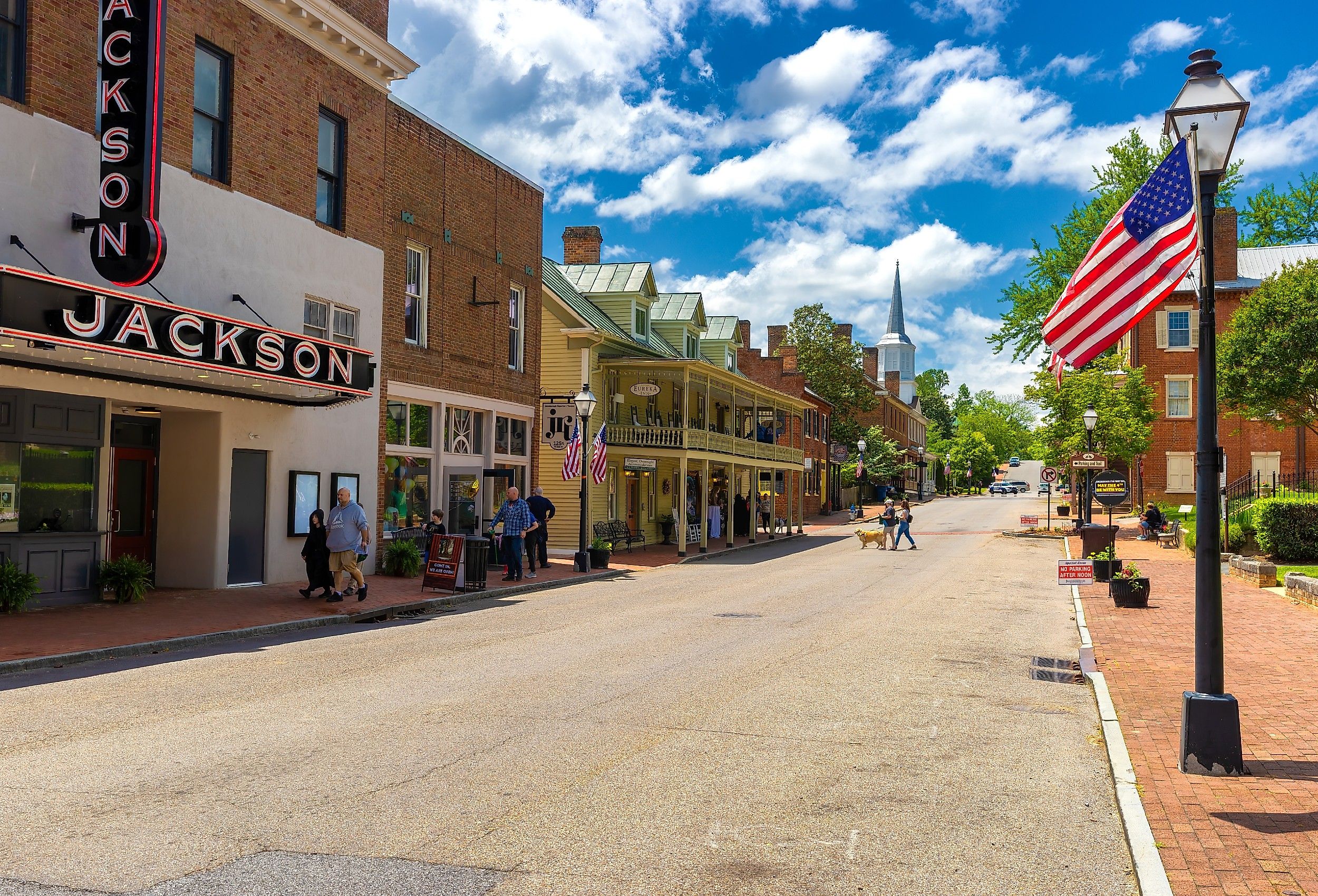
Jonesborough was laid out in 1779, 17 years before Tennessee became a state, and its Main Street still carries the storefronts to prove it. Towns like it survive across the state, where the courthouses are still the heart of the downtown and the surrounding landscape sets the pace. In Townsend, the Little River leads straight into the Smokies. Tellico Plains sends drivers up the Cherohala Skyway toward Bald River Falls. Smithville opens onto Center Hill Lake. Dandridge frames Douglas Lake with the Smokies beyond. Lynchburg puts a world-famous distillery beside a courthouse square. Bell Buckle lines its railroad tracks with Victorian storefronts. Granville fills a restored general store with Saturday-night bluegrass. Across these adorable towns, the scenery is only half the reason to stop.
Townsend

The Little River has shaped Townsend for generations, and it still defines a visit today. On warm afternoons, colorful tubes drift downstream while fly anglers cast into cooler stretches of water shaded by hardwood trees. Unlike neighboring Gatlinburg, Townsend remains a calmer entrance to Great Smoky Mountains National Park, making it a popular choice for travelers who want to spend more time outdoors than in traffic.
A few minutes southwest of the highway strip, Tuckaleechee Caverns descends into limestone chambers that formed over roughly 20 to 30 million years. The tour passes Silver Falls, a 210-foot two-tier cascade billed as the tallest underground waterfall in the eastern United States, before reaching the "Big Room," one of the largest publicly accessible cavern chambers in that same region. The caverns operate seasonally, generally from March through November. Above ground, the Great Smoky Mountains Heritage Center explains how Cherokee communities, early settlers, and mountain families shaped this corner of Tennessee through preserved cabins, artifacts, and rotating exhibits.
Many travelers continue a few miles into the national park to drive the eleven-mile Cades Cove Loop Road. Historic churches, log homes, and open meadows line the route, and early morning often brings sightings of black bears, wild turkeys, and white-tailed deer before the day's heavier traffic arrives.
Jonesborough

History does not sit behind glass in Jonesborough. It spills onto the sidewalks, fills restored storefronts, and comes alive through stories told from theater stages and front porches. Established in 1779, it is the oldest town in Tennessee, predating statehood by seventeen years, and it holds one of the best-preserved historic districts in the state.
The International Storytelling Center has turned an age-old tradition into Jonesborough's signature attraction. Professional storytellers perform throughout the year, while every October the National Storytelling Festival draws performers and audiences from across the country. Even outside festival season, storytelling remains woven into everyday life through smaller performances and community events.
A short walk leads to the Chester Inn State Historic Site and Museum, where exhibits trace the town's role during Tennessee's earliest years. Nearby, the Jonesborough Repertory Theatre occupies a former factory and stages classic musicals alongside original productions. Between performances, visitors often browse Main Street's independent bookstores, antique shops, galleries, and cafés, all housed in buildings dating back to the 19th century.
Tellico Plains

Road signs point toward the Cherohala Skyway long before the mountains fully reveal themselves. By the time drivers leave Tellico Plains behind, the road begins climbing through the Cherokee National Forest toward elevations exceeding 5,000 feet before crossing into North Carolina.
The Skyway is the reason most people come, but many turn onto River Road first to see Bald River Falls. Water tumbles nearly 90 feet over a broad rock face beside the road, putting one of Tennessee's largest roadside waterfalls within a few minutes of the parking area.
Back in town, the Tellico River attracts trout anglers from across the Southeast. Outfitters rent equipment, while nearby swimming holes become gathering places during the summer. Travelers interested in local history often stop at the Charles Hall Museum, whose collection runs to Civil War artifacts, antique telephones, Appalachian tools, and vintage firearms. Afterward, Tellicafe on Bank Street, a fixture here for more than three decades, remains a favorite place to refuel before heading deeper into the mountains.
Bell Buckle

Bell Buckle owes much of its identity to the railroad that arrived during the 19th century. Today, trains still pass through downtown, where Victorian storefronts house antique dealers, bakeries, art galleries, and locally owned shops. Bell Buckle Café has earned its reputation for meat-and-three lunches, scratch-made desserts, and biscuits that regularly attract diners from well beyond Bedford County.
Each June, the RC Cola-MoonPie Festival transforms downtown into one of Tennessee's most unusual celebrations. Thousands gather for live music, games, races, a parade, and the lighthearted tradition of tossing MoonPies into the crowd. Visitors who arrive outside festival season can walk the Bell Buckle Historic District and pass the campus of The Webb School, founded in 1870 and described as the South's oldest continuously operating boarding school.
Paris

No visitor arrives in Paris expecting France, yet the town embraces the comparison with good humor. A 70-foot steel Eiffel Tower stands inside Eiffel Tower Park, successor to the wooden version that engineering students from Christian Brothers University in Memphis built and dedicated here in 1993. Walking paths, sports courts, playgrounds, and a seasonal splash pad make the park a gathering place for local families as well as road trippers searching for an unexpected photograph.
Downtown offers a different experience. Around the Henry County Courthouse, locally owned restaurants, boutiques, and cafés continue to anchor the commercial district much as they have for decades. It is an easy place to spend an afternoon without rushing from one attraction to the next, and each spring the square fills for the World's Biggest Fish Fry, the town's largest annual event.
About 15 miles northeast, Paris Landing State Park overlooks Kentucky Lake, the largest man-made lake in the eastern United States, at a point where the water spreads roughly three miles across. Boaters launch from the marina while anglers pursue crappie, bass, and catfish throughout the year. Bald eagles frequently appear during the winter months, and nearby sections of the Tennessee National Wildlife Refuge attract thousands of migratory waterfowl along the Mississippi Flyway.
Lynchburg

Few places in Tennessee enjoy worldwide name recognition while keeping a downtown this compact. Lynchburg shares a consolidated government with Moore County, which puts roughly 6,900 residents inside the city limits across 130 square miles, and the town center still runs on a single traffic light. Millions of people recognize the name because of one business that has operated here since the 19th century.
Jack Daniel Distillery remains the town's centerpiece, but the guided tour spends as much time telling the story of Jasper Newton "Jack" Daniel as it does explaining whiskey production. Guests walk past Cave Spring Hollow, learn how sugar maple charcoal gives Tennessee whiskey its signature character, and see warehouses where barrels mature over time. Moore County itself is dry, an irony the guides tend to enjoy, though tastings are permitted on distillery grounds.
The courthouse square deserves attention after the distillery visit. Antique stores, specialty shops, candy makers, and locally owned businesses fill the surrounding buildings, creating a downtown that still functions as the community's center. A short walk leads to the Moore County Old Jail Museum, where restored cells illustrate what incarceration looked like in rural Tennessee more than a century ago. Miss Mary Bobo's Restaurant has served meals on Main Street since 1908. Lunch runs Monday through Saturday in two seatings.
Rogersville

Rogersville has welcomed travelers since the 18th century, and much of its downtown still reflects that long history. The site was settled in 1775 by the grandparents of Davy Crockett, and the town itself was chartered in 1789, taking its name from Joseph Rogers, who laid out the streets around a public square. Walking along Main Street feels less like touring a preserved museum and more like stepping into a town that has continued to evolve while keeping many of its earliest landmarks intact.
One of the best places to appreciate that history is the Hale Springs Inn. Built in 1824, the inn has hosted American Presidents Andrew Jackson, James K. Polk, and Andrew Johnson, and it continues to welcome overnight guests today. Just a few blocks away, Crockett Spring Park marks the natural spring that first drew settlers to the area, and the Hawkins County Courthouse on the square is the second-oldest courthouse in Tennessee.
The Tennessee Newspaper and Printing Museum preserves historic presses, type, and other equipment tied to the Knoxville Gazette. That paper was first printed in Rogersville in 1791, making it Tennessee's first newspaper. Between those landmarks, visitors pass churches, brick storefronts, and homes that have stood for generations, all within a downtown listed on the National Register of Historic Places.
Sewanee

Life in Sewanee revolves around the Cumberland Plateau. Thick forests surround the community, sandstone bluffs rise above deep coves, and miles of trails connect overlooks that change dramatically with the seasons.
The University of the South gives Sewanee much of its identity. Built from local sandstone, its Gothic campus feels at home among the surrounding woods rather than separated from them. All Saints' Chapel remains one of the university's architectural highlights, while nearby University Avenue has cafés and restaurants that welcome students and visitors alike.
Outdoor recreation quickly becomes the focus. Sections of the 20-mile Perimeter Trail reach Green's View, where the plateau drops away toward broad valley vistas. During spring, Shakerag Hollow fills with trilliums and other native wildflowers that carpet the forest floor. A short drive from campus leads to Sewanee Natural Bridge State Natural Area, where a sandstone arch, carved naturally over thousands of years, spans nearly 50 feet. The trail to the arch is brief, making it an easy addition to a day spent on the plateau.
Granville

Granville nearly disappeared after the creation of Cordell Hull Lake changed traffic patterns across the region. Instead of fading away, residents restored historic buildings and turned the river community into one of Tennessee's most active heritage destinations.
The T.B. Sutton General Store remains the center of activity. Visitors pick up admission tickets there before browsing antiques, enjoying a country lunch, or attending one of the Saturday evening bluegrass performances that regularly fill the dining room. Across town, Pioneer Village recreates rural Tennessee through restored cabins, a blacksmith shop, barns, and agricultural exhibits that explain everyday life before modern conveniences. Television fans often make time for the Mayberry-I Love Lucy Museum, where rare artifacts, memorabilia, Floyd's Barber Shop, and a recreation of the Ricardos' living room celebrate the two sitcoms.
Greeneville

Greeneville's connection to American President Andrew Johnson shapes much of the town's identity, but it is only one chapter in a community whose history stretches back to the American Revolution. Founded in 1783, the town briefly served as the capital of the State of Franklin, an unrecognized state that occupied this region before Tennessee existed.
The Andrew Johnson National Historic Site preserves the tailor shop where Johnson built his livelihood before entering politics, along with two homes associated with his family. A short drive uphill reaches Andrew Johnson National Cemetery, where the former president rests beneath a monument overlooking the town.
Downtown contains several worthwhile stops beyond the historic site. The Greeneville Greene County History Museum traces centuries of local history through artifacts, photographs, and themed exhibits. Automobile enthusiasts often spend an hour at the City Garage Car Museum, where restored vehicles illustrate more than a century of automotive design. Performances at the Niswonger Performing Arts Center bring nationally known musicians, Broadway tours, comedians, and orchestras to Greeneville throughout the year.
Smithville

Center Hill Lake has made Smithville one of Middle Tennessee's favorite outdoor destinations. The reservoir's winding shoreline creates quiet coves for kayaking while open water attracts anglers pursuing bass, crappie, and walleye.
About 20 miles north of Smithville, Edgar Evins State Park occupies roughly 6,300 acres along Center Hill Lake. Hiking trails wind across steep ridges above the shoreline, and an observation tower above the visitor center looks across forested hills and blue water stretching toward the horizon. The park's cabins sit back in the woods, giving overnight guests easy access to sunrise views over the lake.
Music replaces the sound of boat motors when the Smithville Fiddlers' Jamboree fills downtown on the Friday and Saturday nearest the Fourth of July. First held in 1972 and now designated the official Jamboree and Crafts Festival of Tennessee, it runs more than 35 competition categories in old-time and traditional Appalachian music and dance around the courthouse square. Handmade instruments, quilts, pottery, and woodworking demonstrations keep the sidewalks busy between performances.
Dandridge

Founded in 1783 and incorporated in 1799, Dandridge bills itself as Tennessee's second-oldest town, a title Rogersville also claims on the strength of its earlier settlement date. Dandridge holds one distinction outright: it is the only town in the country named for Martha Dandridge Washington. That connection helped save it. When Douglas Dam was built during World War II to power the Manhattan Project's work at Oak Ridge, the rising reservoir threatened to submerge a downtown that sat below the new high-water mark, and residents petitioned Washington until engineers agreed to build a protective dike between the town and the lake.
The Jefferson County Courthouse, completed in 1845, remains the centerpiece of Main Street and now houses the county museum. Nearby churches, brick commercial buildings, and restored homes illustrate more than two centuries of local history. Historical markers throughout downtown explain how the Tennessee Valley Authority transformed the surrounding landscape while the community itself stayed put.
Just beyond town, Douglas Lake attracts boaters, anglers, paddlers, and birdwatchers throughout the warmer months. On clear days, the Great Smoky Mountains rise beyond the water, creating one of East Tennessee's most recognizable views. Before leaving the area, many travelers stop at the Bush's Visitor Center in nearby Chestnut Hill, where exhibits trace the history of the family-owned company that helped make baked beans a household staple across America.
Tennessee's Small Towns Are Still Working Towns
Many travelers pass through these communities on the way to larger destinations, yet each rewards anyone willing to spend more than a few hours there. Townsend opens the door to Great Smoky Mountains National Park, while Tellico Plains introduces one of the South's finest mountain drives. Jonesborough has built an international reputation around storytelling, and Lynchburg continues to welcome visitors to one of America's most famous distilleries.
Other towns reveal Tennessee through different experiences. Granville preserves traditions along the Cumberland River, Smithville celebrates Appalachian music every summer, and Dandridge combines 18th-century history with sweeping views across Douglas Lake. Taken together, these communities show that some of Tennessee's most memorable places are found where history, local traditions, and the landscape still shape everyday life.