10 Famous Fountains of the United States
Americans do not do fountains by halves. Where an Italian piazza might settle for a modest marble basin, the United States has produced a 510-foot pool honoring a man his own contemporaries called a scoundrel, a Las Vegas water show that once shared a stage with a "Sharknado" promotion, and a Chicago landmark shaped, with a straight face, like a wedding cake. A fountain, technically, is just architecture that pours water into a basin. In practice it is one of the great excuses for civic showing-off, a way for a city or a wealthy donor to say something grand without having to put it into words. Here are ten of the most famous in the country, counting up to the most storied of them all, with the tangled histories that make each one worth a second look.
10. Scott Memorial Fountain (1925)

The grandest fountain in Michigan honors one of Detroit's least admirable citizens. James Scott was a wealthy socialite whom a later historian flatly described as a vindictive misanthrope, a man who reportedly gambled, feuded, and delighted in lawsuits. When he died in 1910, he left the city $200,000 on one condition: build a fountain in his honor, complete with a life-sized statue of himself. Detroit spent years arguing over whether to accept money from such a man, then took it anyway. Architect Cass Gilbert and sculptor Herbert Adams delivered a white-marble showpiece in 1925 that cost roughly $500,000 all told, its lower bowl spanning 510 feet across and its central jet climbing 125 feet. Water spouts from carved lions, dolphins, turtles, and the head of Neptune. Scott's statue, per the design, sits off to one side, gazing at the monument he bought himself.
9. Buckingham Fountain (1927)

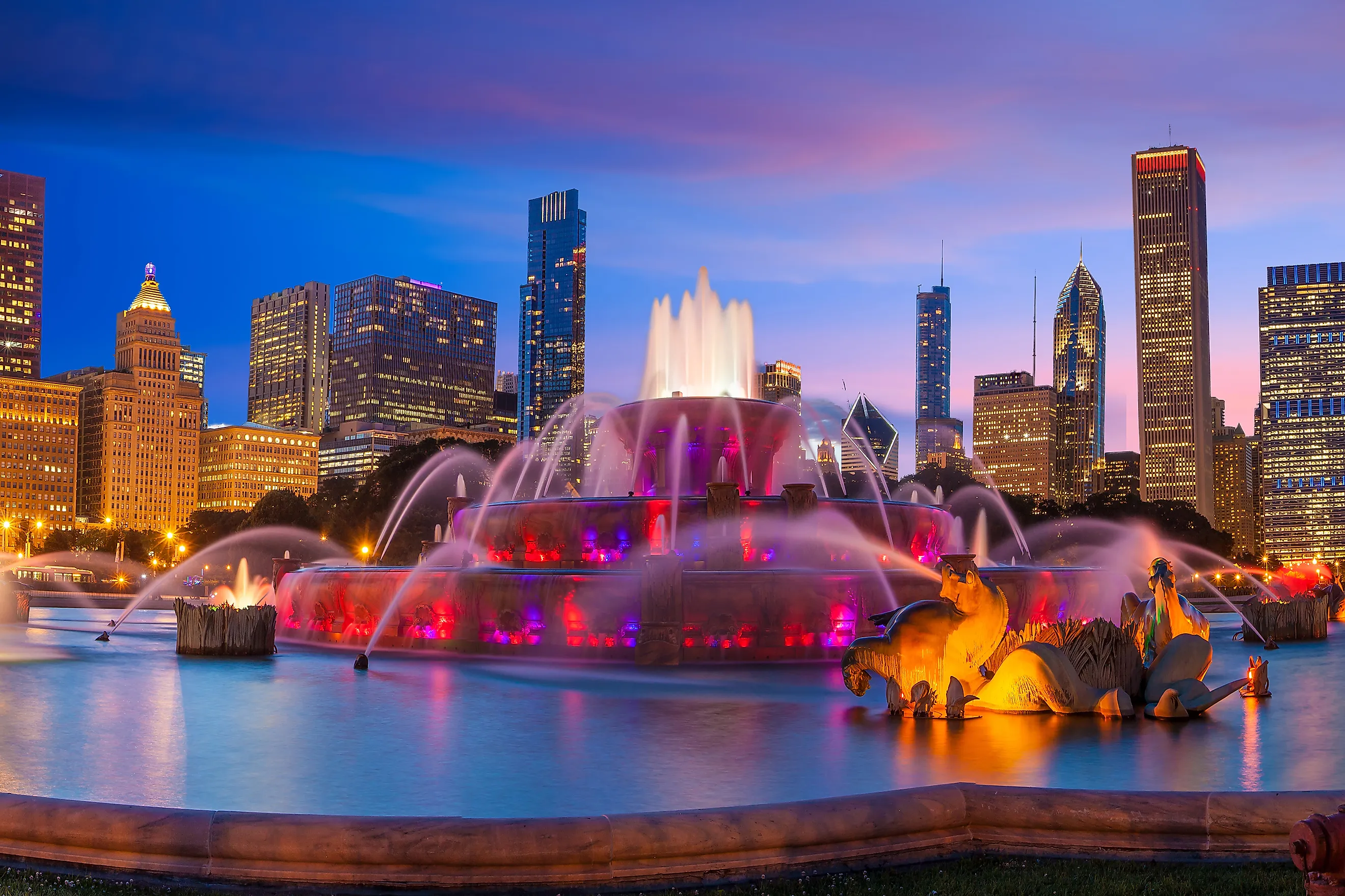
One of the largest fountains in the world sits in Chicago's Grant Park, and it was designed to look like dessert. Buckingham Fountain follows a rococo wedding-cake plan in Georgia pink marble, holding about 1.5 million gallons of water and running from roughly April to October. It is a scale model of an idea: the fountain represents Lake Michigan, and its four sets of bronze sea horses stand for the four states that touch the lake, Illinois, Indiana, Michigan, and Wisconsin. Kate Buckingham gave it to the city in memory of her brother Clarence, which is why its formal name is the Clarence Buckingham Memorial Fountain. Edward Bennett designed it; the French sculptor Marcel Loyau modeled the sea horses. The build ran about $750,000, a genuine fortune in 1927.
8. Bethesda Fountain (1873)

The heart of Central Park's Bethesda Terrace holds a genuine landmark in American art history. The commission for its statuary went to Emma Stebbins, who in the process became the first woman to receive a public art commission in New York City. Designed in the late 1860s and dedicated in 1873, her bronze "Angel of the Waters" crowns the fountain, an eight-foot winged figure blessing the water below. The imagery comes straight from the Gospel of John, where an angel stirs the healing pool of Bethesda, and the reference was pointed: the fountain celebrates the Croton Aqueduct, which in 1842 finally brought New York City clean drinking water after decades of deadly disease. Four cherubs beneath the angel represent temperance, purity, health, and peace. It is one of the largest and most filmed fountains in the city, and, fittingly for a monument to clean water, one of the most beloved.
7. Fountains of Bellagio (1998)

No fountain on this list works harder for its applause than the one outside the Bellagio in Las Vegas. Conceived by casino magnate Steve Wynn, built by the design firm WET, and opened with the resort in 1998, the show sends water as high as 460 feet, taller than a 40-story building, choreographed to music and light across an 8.5-acre artificial lake. The number that stops people is the price: roughly $40 million, making it one of the most expensive fountains ever built. The playlist swings from "Viva Las Vegas" to opera, the water is recycled rather than drawn fresh, and the whole spectacle is free to anyone on the sidewalk. It has since appeared in more films than most working actors, from "Ocean's Eleven" to, yes, a "Sharknado" sequel. Only in Vegas would a fountain build a résumé.
6. National World War II Memorial (2004)

The tone shifts completely at the National World War II Memorial, where the fountain is not spectacle but solemnity. Opened in 2004 on the National Mall between the Washington Monument and the Lincoln Memorial, it honors the roughly 16 million Americans who served in the war. A central fountain plays within an oval pool, ringed by 56 granite pillars for the states and territories. The quiet heart of the site is the Freedom Wall, set with 4,048 gold stars. Each star stands for 100 American military deaths, more than 400,000 in all, beneath the inscription "Here we mark the price of freedom." The sound of the water is deliberate, engineered to hush the surrounding city and give visitors a pocket of stillness in the middle of the Mall.
5. Franklin Delano Roosevelt Memorial (1997)

Most memorials give you a statue and a plaque. The Franklin Delano Roosevelt Memorial gives you weather. Dedicated in 1997 to the 32nd president, who steered the country through the Great Depression and most of World War II, it unfolds as four open-air "rooms," one for each of his terms, linked by pools and waterfalls that grow more turbulent as his presidency wears on. The water is the point: quiet pools for the early years give way to crashing, chaotic cascades evoking economic collapse and global war. It is one of the few memorials in the country that uses moving water as narrative, and the effect lands without a word of explanation.
4. Rackham Memorial Fountain (1939)

Back in Michigan, the Rackham Memorial Fountain is better known by its nickname: the Bear Fountain. A large bowl rests between two standing bears, joined by cast seals, frogs, and turtles, with granite putti stationed around the rim. Mary Rackham funded it to honor her late husband Horace and his ties to Detroit's Zoological Commission, which explains its home at the center of the Detroit Zoo in Royal Oak. Completed in 1939 in bronze and granite, it was the work of sculptor Corrado Parducci and Frederick Schnaple. It is proof that not every grand American fountain has to memorialize a president or a tycoon; sometimes two bronze bears will do.
3. Unisphere (1964)

The Unisphere stretches the definition of "fountain," and gloriously so. It is a 12-story stainless-steel globe rising from a circular reflecting pool, ringed by water jets whose spray was designed to hide the columns holding it up, so the Earth appears to float. Built for the 1964-1965 New York World's Fair on the theme of global interdependence, it stands in Flushing Meadows-Corona Park in Queens and was championed by Robert Moses, the fair's organizer. Three great rings orbit the globe, commonly said to mark early milestones of the space age, the first human in orbit, the first American to orbit the Earth, and the first communications satellite. Whether you call it a fountain or a sculpture, it remains one of the most recognizable objects in New York.
2. Piazza d'Italia (1978)

The Piazza d'Italia is the boldest entry here and, for a long stretch, the saddest. Designed by architect Charles Moore and completed in 1978 in downtown New Orleans, it is a riot of colored columns, neon, and a fountain shaped like the map of Italy, built to celebrate the city's Italian community. It became a textbook icon of Postmodern architecture almost immediately. It also fell into disrepair almost as fast, decaying so badly that critics nicknamed it the first Postmodern ruin, before a restoration finally brought it back. Few American fountains have swung so hard between celebrated and abandoned, which is exactly what makes it unforgettable.
1. Pulitzer Fountain (1916)

Topping the list is a fountain paid for by the man whose name now graces journalism's highest honor. Joseph Pulitzer, the publishing titan of the sensational New York World, died in 1911 and left the city $50,000 for a fountain, with one instruction: make it like the ones in the Place de la Concorde in Paris. Architect Thomas Hastings answered with a 22-foot cascade of tiered stone basins in Manhattan's Grand Army Plaza, crowned by Karl Bitter's bronze Pomona, the Roman goddess of abundance, cradling a basket of fruit. Bitter, poignantly, was struck by a car and killed just after finishing the clay model, and colleagues completed the statue from his design. Water spills from beneath Pomona's feet down through the basins, and more than a century on, she still presides over one of the busiest corners in New York.
Why We Keep Building Them
Line these ten up and a pattern surfaces: the American fountain is rarely just about water. It is a rich man's apology or vanity (Scott, Pulitzer), a sister's grief (Buckingham), a monument to clean water or to the war dead, a casino's marketing budget, even a floating steel planet. Two Roman goddesses of abundance turn up within the same list, which tells you something about the mood these things are built in. They no longer quench anyone's thirst, but they still do the older job a fountain has always done, stopping a crowd in its tracks and giving a city something to gather around.