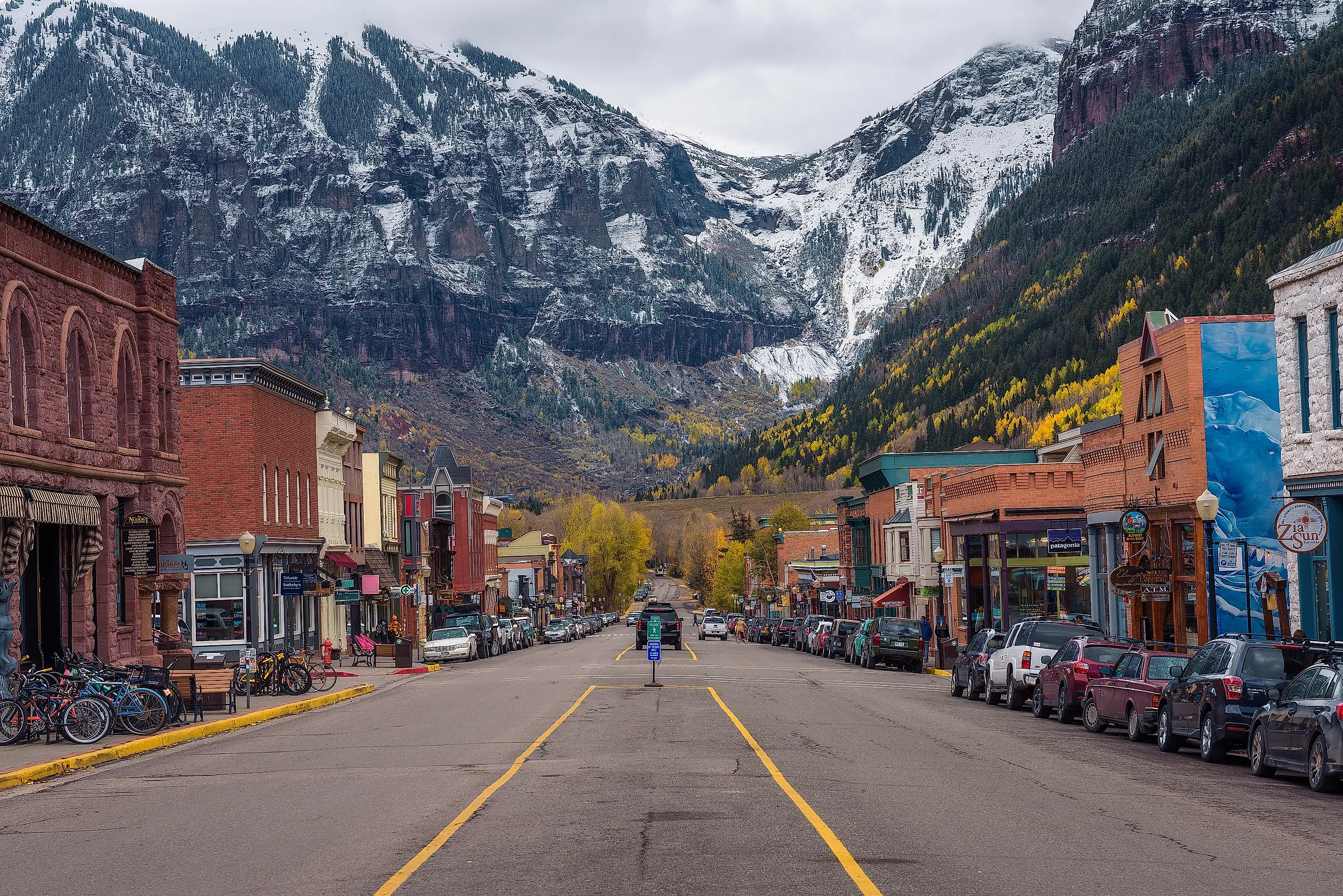
11 Picture-Perfect Main Streets In Colorado
On Telluride's Colorado Avenue, preserved Victorian storefronts run straight toward a wall of peaks. An hour or so away through the same San Juan Mountains, steam trains still pull out of downtown Durango. And in Silverton, a block off the main drag, the old red-light district now sells fudge and coffee. These are working main streets, not museum pieces, and every town on this list keeps the focus on the old downtown core, where a single street can hold a mining-era hotel, a small museum, and a trailhead within a few blocks. Here are eleven Colorado main streets worth walking end to end.
Telluride

Colorado Avenue may be the most photographed main street in the state, and the setting does most of the work naturally. Preserved Victorian storefronts are banked by a wall of steep peaks. The whole corridor sits inside the Telluride Historic District, a National Historic Landmark, so the buildings that once served the mining boom now hold cafes, shops, and galleries. The New Sheridan Hotel is the crown jewel, with its rooftop bar looking out over the surrounding summits.
A short walk from the avenue, the free Telluride Gondola climbs to Mountain Village, an easy way to see the box canyon from above without a car. At the eastern end of Colorado Avenue, Town Park adds open green space, walking paths, and the grounds that host the town's summer festival season, including its long-running bluegrass festival.
Crested Butte

Brightly painted Victorian buildings line Elk Avenue, and they hold enough shops and restaurants to keep the street busy in every season. The Crested Butte Mountain Heritage Museum sits right on the avenue and lays out the town's mining and ranching history, which gives some context to the old structures next door. Crested Butte calls itself the wildflower capital of Colorado, and by July, the surrounding slopes make the case.
One block over, Third Street brings more dining and small businesses to the downtown strip. A short drive out, the Trailhead Children's Museum offers hands-on exhibits for families. Elk Avenue also works as a launch point for the trail network that draws hikers and mountain bikers once the snow clears, with wildflower routes leading straight out of town.
Durango

Steam trains still pull out of downtown Durango, where the Durango & Silverton Narrow Gauge Railroad depot sits right on Main Avenue and sends coal-fired locomotives north through the San Juan Mountains, as it has since the 1880s. Main Avenue runs parallel to the Animas River and sets that railroad history against a long stretch of preserved commercial architecture.
The Strater Hotel is the standout building on the street, its red-brick exterior and period-furnished lobby dating to 1887. A short walk away, the Powerhouse Science Center fills a former power plant with hands-on exhibits on energy and technology. Between the two, the Animas River Trail follows the water through town, giving downtown a paved route for walking and cycling right off the avenue. A short drive out, the La Plata County Fairgrounds hosts seasonal events and community gatherings throughout the year.
Georgetown

Georgetown grew up around the 1860s silver rush, and Sixth Street still carries the brick buildings and preserved facades from that era. The Hotel de Paris Museum is a former hotel built by a French immigrant, Louis Dupuy, and kept as one of the most elaborate accommodations of its day. Art galleries along Sixth Street, including the Georgetown Gallery, bring a working contemporary scene into the historic setting.
Just outside downtown, Georgetown Lake offers walking, fishing, and seasonal recreation close enough to pair with an afternoon in town. And the Georgetown Loop Railroad, one of the area's most direct links to its mining past, runs excursions on restored narrow-gauge track that climbs the grade between Georgetown and Silver Plume.
Ouray

Cliffs box in Ouray on nearly every side, and Main Street threads the narrow valley floor between them, which is how the town earned its nickname as the Switzerland of America. The Wright Opera House has stood on the street since 1888 and still hosts performances and community events. Around it, shops and restaurants fill historic storefronts that have kept their original look.
North of the main street, the Ouray Hot Springs Pool holds water between 96 and 106 degrees Fahrenheit year-round, an outdoor soak that stays comfortable even in deep winter. Box Canyon Falls Park is a short distance off, where a trail leads into a narrow gorge to a thundering waterfall, and Cascade Falls Park adds a second easy walk to a viewpoint. All of it sits within a few minutes of the downtown core.
Breckenridge

Breckenridge began as an 1859 gold camp and has grown into a year-round resort town without losing its historic street grid. The Main Street corridor is a designated National Historic District, its Victorian-era storefronts now filled with locally owned shops, restaurants, and outfitters. Blue River Plaza sits at the center as a gathering space that regularly hosts events, with the river running right alongside.
Uphill from Main Street, Carter Park trades the downtown bustle for open green space and a wider view over the valley. The Barney Ford House Museum tells the story of a formerly enslaved man who escaped to freedom, became a successful entrepreneur, and helped shape the town's early growth. Together, they make it easy to move between history and the open air without leaving the center of town.
Manitou Springs

Vintage arcade games still take real coins on Manitou Avenue, where the Manitou Springs Penny Arcade keeps rows of machines running much as they did decades ago. The street mixes historic buildings with roadside attractions, giving it a looser, more playful feel than most mountain towns. The naturally carbonated Manitou Mineral Springs surface at a series of public fountains along the way, each with its own distinct mineral taste.
A few blocks off the avenue, the Miramont Castle Museum occupies a rambling 1895 mansion of some 40 rooms and walks visitors through Victorian architecture and regional history. Arcade Plaza and Fountain Creek give the downtown a shaded outdoor pause between stops, and the compact layout makes it simple to move between indoor attractions and open air.
Silverton

At more than 9,300 feet, Silverton sits deep in the San Juans, and Greene Street forms the backbone of a downtown where wooden storefronts still read as a mining camp. The northern end of the street shifts to Blair Street, once the town's notorious red-light district and now a stretch of shops and eateries. The Old Hundred Gold Mine, just outside town, runs underground tours into a real hard-rock mine for anyone who wants the history firsthand.
The San Juan County Historical Society Museum, housed in the old county jail, digs into daily life during the mining era. Just north of downtown, the Kendall Mountain Recreation Area opens onto trails and wide-open terrain. Greene Street ties the two together, so a day can be split easily between the town and the country around it.
Salida

Salida runs one of Colorado's oldest state-certified creative districts, designated in 2012, and the arts identity shows up all along F Street in galleries hung with work by regional painters, sculptors, and photographers. The downtown's historic commercial buildings give that creative scene a handsome backdrop rather than overwhelming it.
The SteamPlant Event Center, a restored 1887 steam power plant, serves as the cultural hub, hosting concerts, theater, and community events. A short distance away, Riverside Park opens onto the Arkansas River, and the Arkansas Headwaters Recreation Area follows the water for rafting and fishing, some of the busiest whitewater in the state. The short hop between the river and downtown makes it easy to combine a morning on the water with an afternoon among the galleries.
Pagosa Springs

The San Juan River runs right through the middle of Pagosa Springs, and Pagosa Street follows it through the center of town. The San Juan River Walk traces the water and links several downtown stops, while Town Park adds open space for events, picnics, and time outside. Just off the street, The Springs Resort & Spa draws visitors to a terraced set of geothermal pools fed by the town's Mother Spring, which holds a Guinness World Record as the deepest measured geothermal hot spring; a plumb line ran out at 1,002 feet before reaching the bottom. The Pagosa Springs History Museum, run by the San Juan Historical Society in the town's old 1938 waterworks building, fills in how the area grew up around that water. Everything sits close enough together that a visit can shift between the river, the parks, and the pools without much travel.
Trinidad

Coal and cattle money built Trinidad's brick downtown, and the results still line Main Street as one of the more architecturally intact commercial districts in southern Colorado, much of it paved in the town's distinctive red brick. The A.R. Mitchell Museum of Western Art holds a focused collection of regional painting and Western illustration, while the Trinidad History Museum walks through the area's frontier and Hispano heritage across several restored buildings. A short distance off, Cimino Park gives downtown a green outlet with walking paths and an open lawn. The surrounding historic district deepens the visit, its buildings marking different waves of the town's growth. Main Street connects it all into a walkable route linking museums, parks, and historic blocks.
Streets That Still Do the Work
What sets these downtowns apart is not just preserved architecture but how directly each street connects to the rest of its town. Colorado Avenue in Telluride, Elk Avenue in Crested Butte, and Main Avenue in Durango all run within a few blocks of museums, parks, rivers, and rail history, so the walk itself becomes the itinerary. Even the attractions that sit past the main blocks stay close enough to reach on foot or with a short drive. In each case, the old main street still earns its keep, working as both the town's front porch and the simplest way into everything around it.