11 Main Streets Where Croatia Comes Alive
Croatia's most memorable streets do more than connect one landmark with another. Roman planners, medieval merchants, maritime captains, craftsmen, and changing empires have shaped streets that remain gathering places centuries later. Along them, café terraces spill into historic squares, shops sell regional foods and wines, and festivals return music and crowds to spaces once occupied by markets and guilds. These 11 towns show how Croatia's history continues to intersect with everyday life.
Samobor

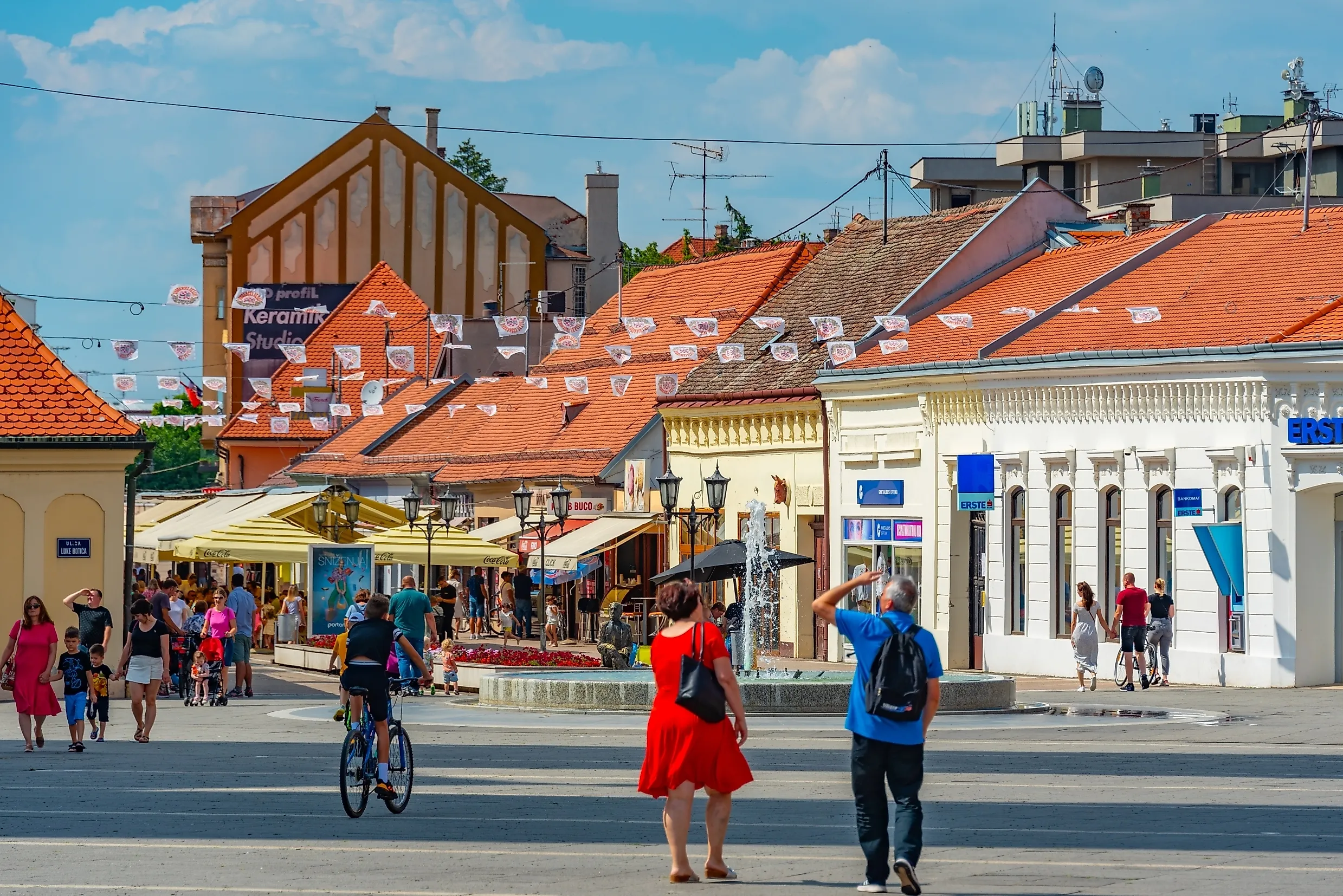
For centuries, King Tomislav Square has functioned as Samobor's meeting place and commercial heart. The square assumed much of its present appearance around the turn of the 19th century, after fires and flooding prompted changes to the center. Its surrounding buildings now form an architectural timeline, incorporating late Baroque, Classicist, and more recent styles. Former hotels, coffeehouses, and civic institutions also recall the generations of merchants and travelers who passed through this market town west of Zagreb.
The tradition of gathering here has not disappeared. Settle at one of the cafés around the square and order a Samobor kremšnita, the custard cream cake closely associated with the town. Afterward, follow the nearby Gradna Creek, whose waters run through central Samobor beneath small bridges and past historic buildings. The square itself rewards a slower inspection as well, with colorful façades surrounding the central fountain and streets radiating toward the rest of the compact historic center.
Poreč

Few shopping streets can trace their route back roughly 2,000 years, but Decumanus Street follows the east-west axis laid out when Poreč was a Roman settlement. Together with the intersecting Cardo Maximus, Decumanus formed the framework around which the ancient town developed. Successive generations continued building along the route, leaving Roman remains alongside Gothic, Renaissance, and Baroque architecture.
Today, pedestrians rather than Roman traffic fill the polished stone street, passing shops, café tables, and restaurants inside centuries-old buildings. Stop at the Pentagonal Tower, a 15th-century defensive structure marking one end of the historic route, before continuing past ornate palaces along Decumanus. At the western end, Marafor Square occupies the area of the ancient Roman forum, where remnants of temples survive among later buildings. The result is not merely an archaeological attraction. Poreč's ancient street plan continues to organize commerce and social life in the modern town.
Makarska

Known locally as Kalalarga, Makarska's historic main street has served as a route for commerce, traffic, celebrations, and everyday social life for centuries. Its name derives from the Italian calle larga, or "wide street," although visitors accustomed to modern boulevards may find the narrow stone passage an amusing contrast to its name. Traditional Dalmatian buildings still press closely against the route as it winds through the old center.
Small shops, cafés, and restaurants make Kalalarga worth exploring slowly rather than treating it simply as a shortcut to Makarska's waterfront. Follow it toward Kačić Square, the historic center's principal gathering place, where a monument to poet Andrija Kačić Miošić stands beneath the immense backdrop of the Biokovo mountains. The Baroque St. Mark's Church anchors the upper side of the square. From there, continue downhill toward Makarska's palm-lined waterfront, where restaurant terraces and boats extend the bustle of the old commercial center to the Adriatic shore.
Karlovac

Radićeva Street runs through the historic core of Karlovac, a city founded in 1579 as a Renaissance fortress against Ottoman expansion. The street developed as an important route through the geometric Karlovac Star, once linking entrances known as the Rijeka Gate and Turkish Gate. Houses, workshops, and businesses subsequently made Radićeva one of the center's principal commercial streets, connecting everyday urban life with a military plan drawn more than four centuries ago.
Walk Radićeva to appreciate its historic façades and local businesses, then explore the surrounding Star, where the former fortress geometry survives in streets, green spaces, and remnants of defensive structures. Nearby Ban Josip Jelačić Square has long served as another focal point within the old center. Karlovac's setting among four rivers provides the natural counterpoint. Continue toward the Korana River, where promenades and green spaces demonstrate why Karlovac feels unusually leafy for a former fortress town.
Mali Lošinj

The history of Riva Lošinjskih Kapetana, or "Waterfront of the Lošinj Captains," reflects the sea that stretches directly beside it. Mali Lošinj prospered through shipbuilding and seafaring during the 18th and 19th centuries, when local captains and shipowners helped transform the settlement into an important Adriatic maritime center. Tourism subsequently joined shipping as an economic force. The town's first hotel, Vindobona, opened on today's Riva in 1887.
The harborfront remains Mali Lošinj's social center, with cafés and restaurants facing fishing boats and pleasure craft across the water. One of its most important cultural attractions, the Museum of Apoxyomenos, occupies a restored building on the Riva and revolves around an ancient Greek bronze statue recovered from the Adriatic near Lošinj. The harbor itself provides the final attraction. Walk beside the water, browse local shops, or watch boats arrive beneath the pastel façades surrounding the bay. Maritime festivals and events periodically return traditional boats, music, and local products to the waterfront.
Požega

The name Cehovska Street preserves the history of the craftsmen and merchants who once defined this part of Požega. Ceh means "guild," and organized guilds became important to the city's commercial life from the late 17th century onward. The street now forms part of Požega's pedestrian center, but its continued concentration of shops makes its historical name particularly appropriate.
Rather than rushing through, use Cehovska to sample Slavonian specialties. Shops along the pedestrian zone sell regional products such as kulen, wine, fruit brandies, and chocolate, connecting today's businesses with the street's older commercial function. Continue toward Holy Trinity Square, Požega's spacious Baroque central square, distinguished by its unusual triangular shape and the 18th-century Holy Trinity monument. The surrounding historic façades and café terraces make the square another gathering place rather than simply an architectural attraction. Together, Cehovska and the square provide an unusually tangible link between Požega's guild past and contemporary street life.
Virovitica

Going for a walk through central Virovitica became such an established social ritual that the town's promenade developed its own place in local memory. By the mid-20th century, residents followed a customary route through the center to meet friends, exchange news, observe fashions, and see who else was out. That tradition turned walking through town into a social activity rather than simply a way of getting somewhere.
Visitors can still experience central Virovitica on foot, stopping at cafés and businesses along the pedestrian area before continuing into the surrounding historic core. The standout landmark is Pejačević Castle, a 19th-century residence whose restored interiors now house the Virovitica City Museum. Around it spreads Pejačević Castle Park, creating a large green space directly beside the center. The combination allows a walk through Virovitica to move easily from café tables and everyday commercial life into local history and landscaped grounds without leaving the heart of town.
Labin

Labin's hilltop Old Town developed behind medieval fortifications during centuries of Venetian rule, with Titov Trg and the streets branching from it forming the civic heart of the historic settlement. Noble residences and public buildings gradually filled the center, while later development reflected the prosperity and changing fortunes of a town that eventually became one of Istria's most important mining communities. Today, the old streets remain pedestrian friendly, allowing cafés, galleries, and small shops to occupy spaces shaped by several periods of Labin's history.
Begin around Titov Trg, then browse the art studios and galleries scattered through the surrounding lanes. The Labin Town Museum adds an unexpected experience. Beneath displays about local history, a reconstructed coal mine recreates the tunnels and working conditions associated with the industry that transformed modern Labin. From there, continue through the Old Town to the Fortica viewpoint, where the hilltop position opens views across the surrounding countryside toward Rabac and the Adriatic. During summer, performances and guided walks bring additional activity into these centuries-old streets.
Đakovo

Ulica Ivana Pavla II functions as Đakovo's principal promenade, running beside the historic civic and religious center around Strossmayer Square. The surrounding district changed substantially during the 19th century as older fortifications disappeared and Đakovo developed around episcopal, civic, and commercial institutions. Its present pedestrian spaces continue that role by bringing cafés, shops, residents, and visitors into the center beneath one of Slavonia's most recognizable landmarks.
Stop at a café along the promenade before crossing into Strossmayer Square, whose open pedestrian space provides the grand approach to the twin-towered Đakovo Cathedral. Bishop Josip Juraj Strossmayer oversaw construction of the monumental brick church during the 19th century, creating the landmark that still dominates the town's skyline. Nearby Strossmayer Park offers a greener extension of the central promenade. Its paths and mature trees provide everyday gathering space, while festivals and cultural programs periodically turn the park and neighboring streets into some of Đakovo's busiest public spaces.
Križevci

The unusually named Ulica Ivana Zakmardija Dijankovečkog follows an old route that historically connected Križevci's northern and southern gates. As the town developed, civic and religious buildings gathered along this central axis, reinforcing its importance beyond simple transportation. The street still leads through the historic center toward the squares where much of Križevci's public life takes place.
Among its architectural anchors are St. Anne's Church and the former Pauline monastery, whose Baroque complex stands opposite the County Palace. Continue toward Antun Nemčić Square, one of the traditional gathering places in central Križevci, where an interactive carousel commemorates local inventor Marcel Kiepach. Turning the carousel helps illuminate lights embedded in the square, adding an unexpectedly playful element to the historic center. Nearby Josip Juraj Strossmayer Square provides another place to pause among cafés and civic buildings. Markets, festivals, and public events regularly use these interconnected central spaces, continuing the social function of a route that once carried travelers between the town gates.
Sinj

Sinj's historic main square and adjoining central streets began assuming their present urban form during the first half of the 18th century. The center developed around a principal street and square from which smaller streets extended, while Baroque residences and commercial buildings reflected Sinj's growing importance in the Dalmatian hinterland. The result remains a compact center where cafés, religious traditions, and one of Croatia's most distinctive cultural events intersect.
The central cafés provide an easy place to watch everyday activity before visiting the Sanctuary of the Miraculous Madonna of Sinj, a major pilgrimage site whose history is closely connected with the town's resistance to an Ottoman attack in 1715. That same victory forms part of the tradition behind the Sinjska Alka, the equestrian competition held in Sinj each August and inscribed by UNESCO on the Representative List of the Intangible Cultural Heritage of Humanity. The nearby Museum of Sinjska Alka explains the competition through historic uniforms, equipment, documents, and multimedia exhibits, allowing visitors to understand why the Alka remains so central to Sinj's identity even when the annual riders are not racing through town.
Streets That Still Bring Croatia Together
Croatia's small-town main streets reveal how historic spaces can continue to serve contemporary communities. Roman Decumanus still carries pedestrians through Poreč, Makarska's Kalalarga retains its commercial and social role, and Mali Lošinj's maritime history survives along a harborfront now filled with cafés and cultural attractions. Continental streets tell equally distinctive stories, including Požega's guild heritage, Karlovac's Renaissance fortress plan, and the promenades and squares of Virovitica, Đakovo, and Križevci. Whether residents gather for coffee, shopping, festivals, or an evening walk, these streets remain places where centuries of Croatian history meet everyday life.